Salary Advance to Employees: A Diwali Advance, Recovered From Payroll
In short
Give a Diwali salary advance once: set a monthly cut under the 50% deduction limit and let payroll recover it from each payslip, with no notebook.
- Write the advance down the day you give it: amount, instalment, the month recovery starts, and how it was paid.
- Pick an instalment the person can live on. The law caps all deductions together at half the wages for the period.
- Recover it from payroll, not by asking for cash back. A deduction on the payslip is visible to both sides.
Every October the same conversation happens in salons, restaurants and shops across India. A stylist, a cook or a counter hand asks the owner for money before Diwali. Bonuses are weeks away, the family needs clothes and sweets and a ticket home, and the owner says yes, because saying no to a good worker in festival season costs more than the advance does.
The advance is the easy part. The hard part starts in November, when somebody has to remember to take it back. A salary advance to employees is usually recorded in a notebook, a WhatsApp message or the owner's memory, and by February nobody is sure whether Sunita has repaid Rs 9,000 or Rs 6,000. Diwali falls on 8 November this year. This is how to give the festival advance so that it recovers itself, and how staff can now ask for it from their phone.
Why the festival advance goes wrong
Nobody forgets to give the advance. People forget the recovery, and they forget it in three predictable ways.
The first is the instalment that was agreed out loud. "Take it back over four months" is clear in October and vague in January, when the accountant is preparing salaries and does not know the agreement exists.
The second is the month nobody deducted. The owner was travelling, the salary went out as usual, and the instalment simply did not happen. Now the schedule is off by a month and nobody wrote down which month.
The third is the person who leaves. A worker with Rs 6,000 still owed resigns in January, and the full and final settlement is calculated without it, because the advance lived in a notebook that the person doing the settlement never saw.
Each of these is a record problem, not a trust problem. The fix is the same for all three: one written record per advance, with its balance, read by whoever runs payroll.
Salary advance deduction rules: what the law allows
An advance is not a loan from a bank. It is money you pay early against wages you will owe anyway, and the law treats recovering it as a deduction from wages.
Under the Code on Wages, 2019, Section 18 lists the deductions an employer may make, and recovery of advances or loans is one of them. The same section sets the limit that matters most for a festival advance: the total of all deductions in a wage period cannot exceed 50% of the wages for that period. The Ministry of Labour and Employment's compliance handbook for employers under the four labour codes states it in one line: deductions shall not exceed 50% of wages during the wage period. The PRS Legislative Research summary of the Code is a readable overview of where that section sits.
In practice that 50% line is shared. The advance instalment sits alongside provident fund, ESI, professional tax and any other deduction you make that month. So the question is not "can I take Rs 9,000 back from an Rs 18,000 salary", it is "what is left under the 50% line after everything else I already deduct".
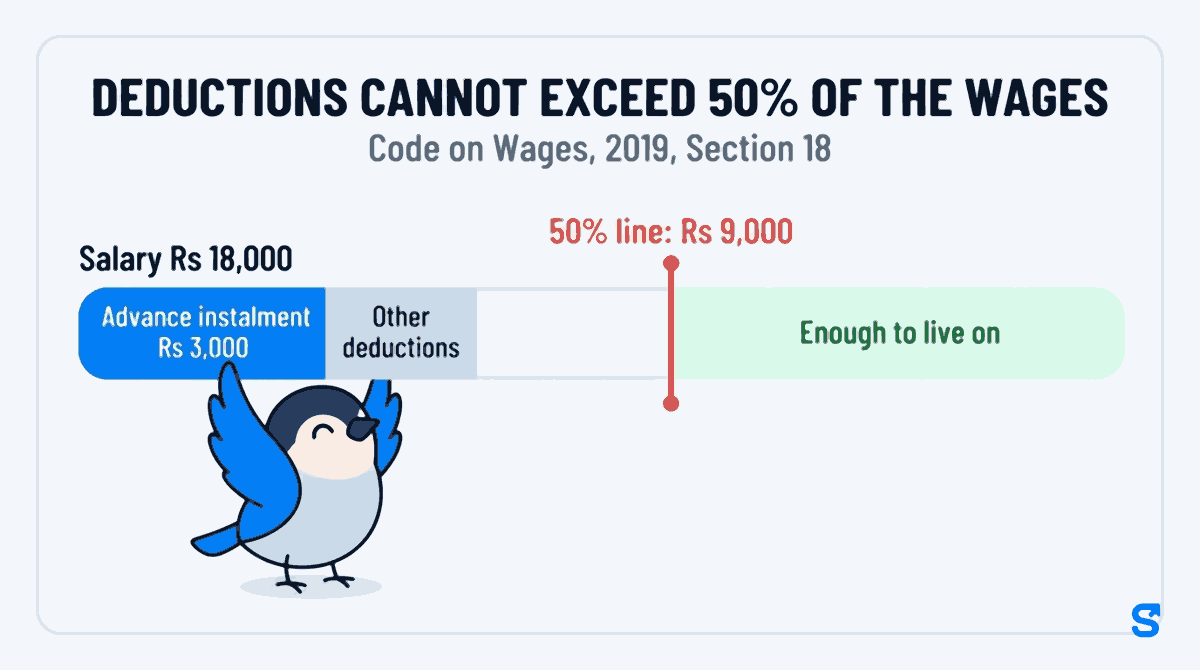
A useful rule of thumb for a festival advance: keep the instalment to a sixth of the monthly salary or less. On Rs 18,000 that is Rs 3,000, which leaves plenty of room under the 50% line for the deductions you already make, and leaves the person enough to live on.
How to set the instalment
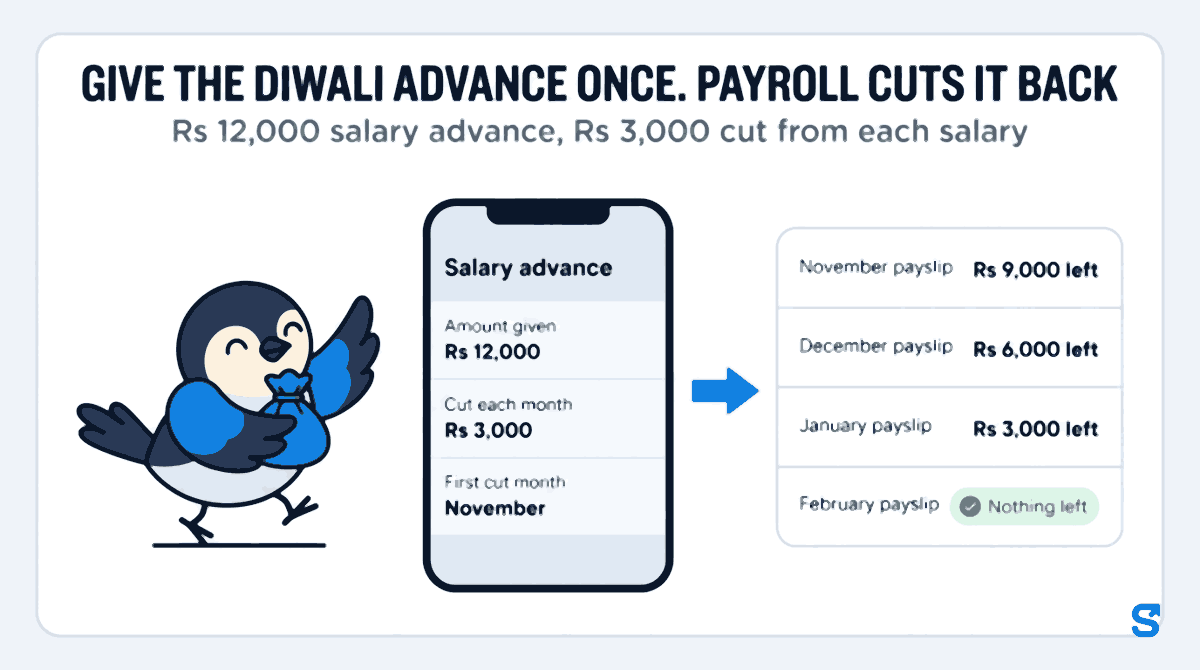
Take one real case. Sunita is a stylist on Rs 18,000 a month. She asks for Rs 12,000 in the second week of October.
Rs 12,000, paid by UPI on the day she asked. The payment method matters later, when somebody asks whether the money was ever handed over at all.
Rs 3,000 a month for four months. Rs 3,000 is a sixth of her salary, well inside the legal limit.
November's salary, not October's. Taking the first instalment from the salary she is paid just after Diwali defeats the point of giving the advance at all.
Four deductions, November to February, Rs 3,000 each, and the balance after each one. A short message is enough. It is the thing she will check her payslip against.
Salary advance recovery in the payslip
Recovering an advance by asking for cash back each month is the worst option. It depends on somebody remembering, it happens at the counter in front of other staff, and it leaves no trace on the payslip. Recovering it from payroll puts the instalment on the payslip as its own line, so both of you can see it.
Sunita's balance then reads the same way on both sides:
- October: advance given, Rs 12,000 owed.
- November payslip: Rs 3,000 recovered, Rs 9,000 left.
- December payslip: Rs 3,000 recovered, Rs 6,000 left.
- January payslip: Rs 3,000 recovered, Rs 3,000 left.
- February payslip: Rs 3,000 recovered, nothing left.
If she takes unpaid leave in December and her salary that month is smaller than usual, the instalment should not push her pay below zero. The sensible rule is to take what the month allows and let the schedule run one month longer.
How Shiftelio records a salary advance
In Shiftelio a festival advance lives in Money > Staff money. Open the person, tap Give money, and choose Salary advance, which the app describes as their own money, cut from salary. The other choice, Work cash, is money handed over for jobs, which the person accounts for with bills and which is never cut from salary. Keeping the two apart is what stops a Diwali advance and the cash for a site's cement from ending up as one confused number.
Then fill in what the steps above already decided: the Amount, the Date, How it was paid (cash, UPI, bank transfer, cheque or other) and Cut in how many months. The sheet shows the cut each month as you type: Rs 12,000 over four months reads Rs 3,000 cut each month.
The cut starts with the salary for the month you gave the advance. To start in November instead, as step 3 suggests, tap Change cut on the person's salary advance card and set the First cut month to November. From then on every payroll run takes the cut by itself. Nobody has to remember November.
Three details do the work that the notebook could not:
- The payroll never cuts more than the month's net pay. If a month's salary is smaller than the cut, it takes what is there and the advance simply runs longer.
- The balance only falls when the salary is actually paid. While a pay run is prepared but not paid, the cut is waiting in that payroll. Mark the run paid and what the person owes drops.
- The employee sees the same number you do. Their payslip carries a Salary advance cut line, kept separate from any work cash they did not account for, and the Salary advance card on their My money screen shows what they still owe.
When the employee asks first
Staff no longer have to ask at the counter. From My money an employee taps Ask for money, chooses Salary advance (cut from your salary) rather than Work cash, types the amount and a reason, and sends it. The owner, and any manager allowed to give salary advances, gets an alert and finds the ask under Money > Waiting.
Opening it shows what the person already owes before you decide. You can Say no, with a reason the employee sees, or give it: choose how it was paid and tap Give. An asked advance is set to come off that month's salary in one go, so for a Diwali advance open the person's card afterwards and use Change cut to spread it over four months starting in November. Nobody can give themselves the advance they asked for: someone else has to decide it.
When something changes later
- Change cut moves the monthly cut or the first cut month. A payroll that is already prepared keeps the old cut.
- Pay part records part of the advance paid back in cash outside the payroll.
- History shows the day it was given and every cut and repayment in date order, which is what you need in front of you for the full and final settlement when somebody leaves with money still owed.
- Past salary advances keeps the finished and cancelled ones, with how and when each one ended.
What Shiftelio does not do is check the legal 50% limit for you. It caps the cut at the month's net pay, not at half the wages. Choosing a cut that keeps every deduction together under the 50% line is still your decision, and the rule of thumb above is the easy way to make it.
Which app recovers a salary advance from payroll
Staff money sits with attendance, payroll and the rest of the app on the features page, and the salary side is covered on the payroll software page. If your advance is really a bonus, read how festive season incentive targets are set instead.
Can I recover a salary advance from an employee's salary without their consent?
Recovery of advances is a deduction the Code on Wages, 2019 permits under Section 18, within the 50% limit on total deductions. Agreeing the schedule in writing when you give the advance is still the right thing to do, because it is what both sides check the payslip against.
What is the difference between a festival advance and a loan?
A festival advance is money paid early against wages and recovered in a few instalments, usually with no interest. A loan is larger, runs longer and may carry interest. Shiftelio records a festival advance as a salary advance in Staff money, cut from salary, and keeps it apart from work cash, which is money given for jobs and accounted for with bills.
The employee left before repaying the advance. What now?
The outstanding balance is a deduction from the final settlement, subject to the same 50% limit on the final wage period. Anything beyond that is a debt to raise with the person, not something to take from wages. This is why the balance has to be written down: a settlement cannot deduct what nobody recorded.
Should I charge interest on a Diwali advance?
Almost nobody does for a short festival advance, and it adds a calculation the worker will not follow. Leave the interest rate at zero for an advance. Keep interest, if you charge any, for a larger loan with a longer tenure.
The short version
Give the festival advance once, and write down four things the same day: the amount, the instalment, the month recovery starts and how you paid it. Keep the instalment small enough that every deduction together stays under half the wages. Then let payroll take it back, on a line the employee can see, until the balance reads zero.
Keep reading
Free to use, no signup: Payroll calculators.