Salon Packages and Therapist Commission, Sitting by Sitting
In short
A bride pays half for a six-sitting pre-bridal package. What do you owe the therapist after four sittings? How salons and spas should count it.
- Pay package commission per sitting, on that sitting's share of the price, in the month the sitting happens.
- A client who has paid half has funded half the sittings. Hold the commission on the rest until the balance is confirmed, then pay it on the original dates.
- Let reception record a payment and a different person confirm it.
Late September is when the pre-bridal packages get sold. A bride with a December date walks in, picks a six-sitting glow package, pays half at the counter and books her first facial for the following week. WeddingWire's own planning guide tells brides that the ideal time to start is two months before the wedding, which puts the selling season squarely in the next few weeks. And the season behind it is not small: CAIT estimated about 48 lakh weddings in November and December 2024 alone.
So here is the question that lands on your desk at the end of October. The bride has had four of her six sittings. She has paid half. The therapist who did them wants her commission on this month's salary. How much do you owe her?
If the answer lives in a register book at reception, most salons get it wrong in one of two directions, and both cost money.
Why a package breaks the usual commission sum
A walk-in service is easy. The client pays for one facial, the therapist does one facial, and her cut of that bill goes on her salary. The money and the work arrive on the same day.
A package splits them apart. The money arrives once, or in two or three parts. The work arrives over eight weeks, one sitting at a time, sometimes done by two different people if a therapist leaves or goes on leave in the middle. So at the end of any month, three things are true at once, and your register has to know all three:
- How many sittings of this package are used, and how many are left.
- Which of those sittings the client has actually paid for.
- Who did each sitting, and at what commission rate.
Miss the first and the client argues about her last sitting. Miss the second and you pay commission out of money you never collected. Miss the third and two therapists both think the same sitting was theirs.
Price the sitting, not the package
The fair way to pay commission on a package is to pay it per sitting, as each sitting happens, on that sitting's share of the price. The arithmetic is two lines.
Value of one sitting = package price ÷ number of sittings
Commission for that sitting = value of one sitting × the therapist's commission rate
Take the bride's package. It is ₹18,000 for six sittings, so each sitting is worth ₹3,000. The therapist's rate is 10 percent, so each sitting she does earns her ₹300. Had the bride paid in full, four sittings in October would be ₹1,200 on the therapist's October salary. Not the whole ₹1,800 up front, which pays her for work she has not done yet, and not nothing until the package ends, which makes her wait eight weeks for money she earned in the first.
This is the sum Shiftelio does for you. When you open a package on the New PT Package screen you enter the price, the number of sessions, the start and end dates, the person it is assigned to and their Commission Rate (%). Before you save, a Commission Preview shows what each session will pay. Then every time a session is recorded against the package, its commission is worked out and set aside for that person's next payroll run. The session count goes down by one, so reception can see at a glance that the bride has two sittings left.
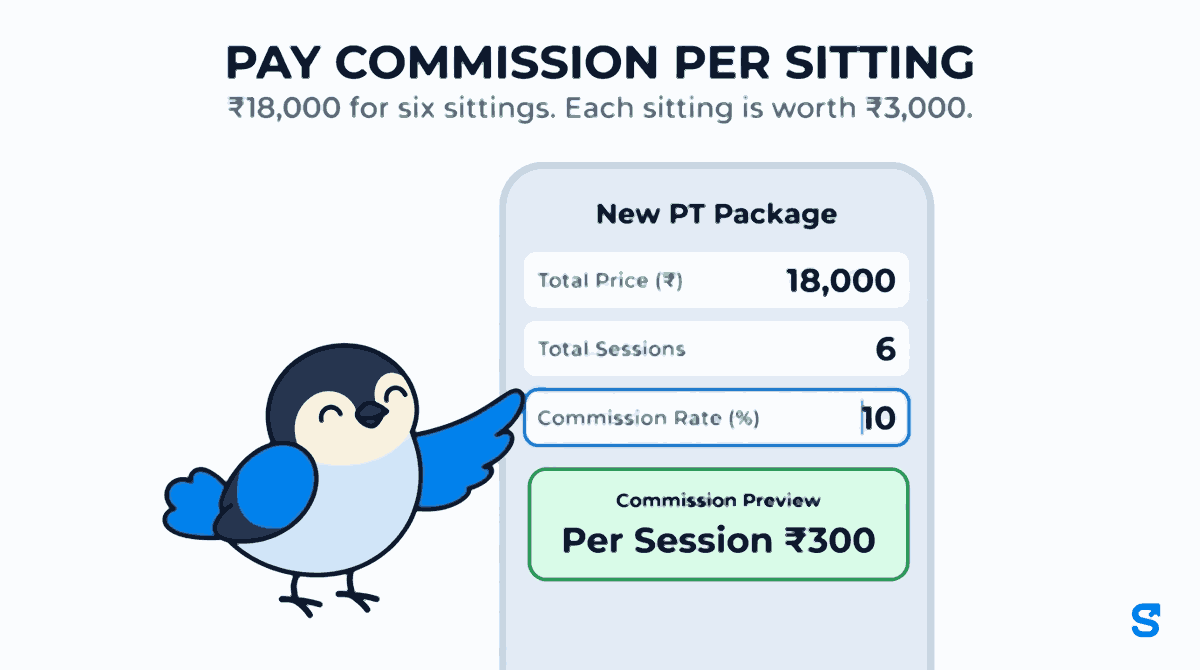
A word on the name, because you will see it on the screen. The feature was built for gyms, where a block of sessions is a personal-training package, so the screen says PT Sessions and the person field says Assigned Trainer. In a salon, the trainer is your therapist or stylist and the package is whatever you sell in sittings: a pre-bridal course, a hair spa course, a series of skin treatments. The arithmetic does not care what the sitting is.
Half paid means half the sittings are funded
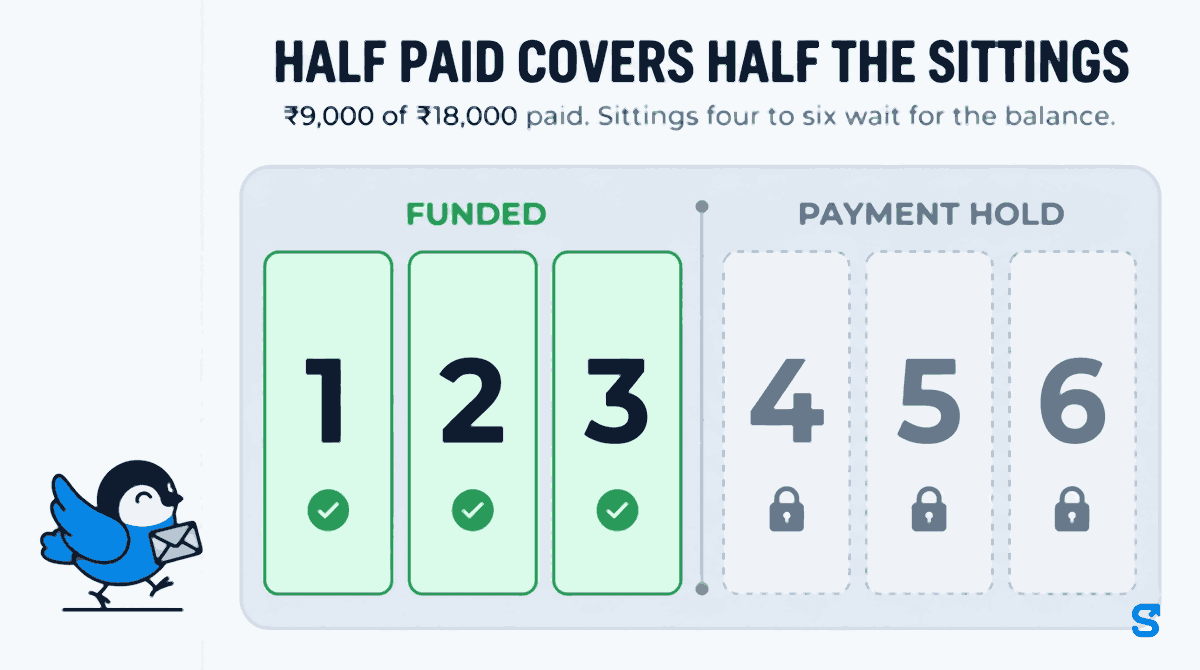
Now the part the register book gets wrong. The bride has paid ₹9,000 of ₹18,000. At ₹3,000 a sitting, her money covers exactly three sittings.
Sittings one to three are funded. Their commission goes on the therapist's salary in the month they happen.
Sittings four to six still happen. Nobody is going to turn a bride away from her fourth facial three weeks before the wedding. But the commission on them waits. In Shiftelio this is called Payment Hold: when you record the package with a partial payment, the screen tells you in plain words that sessions beyond number three will be placed on Payment Hold until payment is collected. Each held session is still recorded with its date and its therapist, and the owner and the therapist are both told it is on hold.
When the bride pays the balance and the payment is confirmed, the held sittings become payable. They are not lost and they are not moved to a later date. They join the therapist's next payroll run with their original dates on them. So the answer to the October question is ₹900 on her October salary for sittings one to three, and ₹300 for sitting four waiting for the balance. If the bride only ever pays ₹12,000, sitting four becomes payable and sittings five and six stay on hold, because that is what the money covers.
Without a hold
Sittings four, five and six are paid to the therapist as they happen. The bride postpones the wedding and never pays the balance. You have paid ₹900 of commission on ₹9,000 you never received, and there is nothing to recover it from.
With a hold
The same three sittings are recorded and waiting. If the balance arrives, the therapist is paid the same ₹900 in the next run. If it never arrives, you owe nothing on money you never had, and the record shows exactly why.
This is also the fairest version for the therapist, which matters more than it sounds. The rule is written down and it is the same for everyone. She can open her own app and see which of her sittings are paid, which are on hold, and why. The argument at salary time becomes a conversation about whether the client has paid, which is a question for the front desk, not about whether the owner is being stingy.
Who records the sitting
A sitting counts when it is recorded, so it matters who can record one and when.
The therapist records her own. From her phone, straight after the client leaves. She needs no extra permission to record a sitting on a package assigned to her.
Reception can record for her. If a therapist forgets, whoever you trust at the front desk can mark the sitting on her behalf. That needs the Record sessions tick on their role, so not everybody who can see the screen can add sittings to it.
Late entries are flagged. A sitting recorded for an earlier date is marked as backdated, and the owner gets a separate alert for it. A therapist who enters a sitting three days late is not doing anything wrong, but a pattern of late entries at the end of the month is worth a look.
Two settings close the easy mistakes. In the PT settings you can block sessions recorded for a future date, and allow only one session per package per day. The second one matters in a salon: two facials on the same day for the same bride is almost always a double tap on a phone, not a real sitting.
Two hands on the money
Most salon losses on packages are not fraud. They are a balance written down as received when it was only promised, and a commission paid against it.
Shiftelio separates the two jobs. Reception can record a payment the moment the bride hands over cash or a UPI screenshot. That payment sits as pending. Somebody with the Confirm payments tick, usually the owner or the manager who does the cash-up, confirms that the money actually arrived. Only then do the held sittings unlock. The person who takes the money and the person who signs it off are different people, which is the whole point.
When a bride is running out of paid sittings, the app warns the trainer and the owner once two or fewer paid sittings are left, so the balance gets asked for before the sitting, not after it.
When a therapist leaves in the middle of a package
Wedding season is also when staff move. A therapist who did the first three sittings leaves for a bigger salon in November, and somebody else has to finish the bride's package.
Use Transfer trainer. The package moves to the new person, with their own commission rate if it is different. The three sittings already done stay with the therapist who did them, and her commission on them is paid to her. Every sitting after the move pays the new person. The transfer is kept on the package's record with who moved it, when, and how many sittings were done at that point, so there is no argument about sitting three when the full and final settlement is worked out.
When a package runs past its end date
Every package has an end date. Once it passes, the package is marked expired and stops showing as active. Brides do postpone weddings, though. If you extend the end date, the package comes back to active on its own.
A sitting recorded against an expired package is treated as backdated, and the owner is told. You decide whether to honour it, which is a business decision and the right one to keep in human hands.
If you sell the same courses again and again, save them as package templates, each with a name, a short description and how long the course runs, in days, weeks or months. Pick the template when you open a new package and the end date is worked out from the start date for you.
What this does not do
It is better you read this here than find it out after the season has started.
- It is not a booking system. There is no appointment calendar for clients. Your appointment book stays wherever it is now.
- It is not your billing counter. It records what a client paid against a package. It does not raise the client's invoice or GST bill.
- It pays commission on packages, not on every walk-in service. If your therapists earn a cut of each walk-in haircut or of retail products sold, that is not what this feature counts. For a monthly target on walk-in sales, use Incentives instead, as in our guide to festive season staff targets for salons and retail.
- The screens say PT and trainer. They were built for gyms first. Everything works the same for a salon, but the words on the screen are the gym's.
Which app ties a salon package to the therapist's payslip?
PT packages and commission are switched on for your business on request rather than being on by default. There is no separate charge and no higher tier for them, the same as for gyms; if the PT screens are not showing in your account, ask us. How the rest of Shiftelio works for a salon, from selfie check-in per branch to split shifts, is on the salons and spas page. The package and commission feature is described in full on the page for gyms and fitness studios, and our guide to gym staff attendance and trainer commission walks through it from the gym side.
Questions salon owners ask
Should a therapist be paid commission on a package when it is sold, or when each sitting is done?
When each sitting is done. Paying on the sale pays for work that has not happened yet, and if the client stops coming or the therapist leaves, you have paid for sittings nobody did. Paying per sitting ties every rupee of commission to a sitting with a date on it.
What happens to the commission if the client never pays the balance?
The sittings she has not paid for stay on Payment Hold. They are recorded, with their dates and the therapist's name, but no commission is paid on them. If the balance arrives later and is confirmed, they are paid in the next payroll run.
Can two therapists share one package?
One person is assigned to a package at a time. If the work moves to somebody else, transfer the package: sittings done before the move stay with the first therapist, and every sitting after it pays the second.
Can reception record sittings, or only the therapist?
Both. The therapist can always record sittings on her own packages. Anybody else needs the Record sessions permission on their role, which the owner gives or withholds.
Does this replace our salon software?
No. Keep your booking and billing software. Shiftelio sits on the staff side: attendance, shifts, payroll, and the commission those packages earn.
Keep reading
Free to use, no signup: HR letter formats.