Shift Differential Pay: How to Set a Night Rate So Every Paycheck Gets It Right
In short
Shift differential pay is extra pay per hour for night, weekend or late shifts. Federal law does not require it, so you set the rate and payroll must apply it.
- Shift differential is optional under federal law. The Department of Labor says extra pay for night work is a matter of agreement between employer and employee.
- Once you pay it, it changes overtime. Under the FLSA, overtime is based on the regular rate for the week, which is total pay divided by total hours worked.
- Attach the rate to the shift, not the person. Give the overnight shift its own pay per hour, and every hour worked on it is paid at that rate.
Shift differential pay is an extra amount per hour that you pay for a less popular shift, such as overnight, a late close or a weekend. Under the federal Fair Labor Standards Act it is not required, so the rate is yours to choose, and the hard part is making sure every overnight hour actually gets paid at it.
That second part is where most small businesses slip. The owner promises "an extra $1.50 an hour for overnights", the promise lives in a text message, and three months later somebody's paycheck shows the day rate for a night they worked. This guide covers what a differential is, what federal rules touch it, how the overtime math changes, and how to set it up so the rate is attached to the shift itself rather than to somebody's memory.
What shift differential pay is
A shift differential is the gap between the base rate and the higher rate you pay for a specific shift. If a cashier earns $16.00 an hour on days and $17.50 an hour on overnights, the differential is $1.50 an hour.
Businesses usually pay one for three kinds of shift:
- Overnight or graveyard shifts, for example 11 pm to 7 am in a 24-hour store, a care home or an office cleaning crew.
- Late closes, where a restaurant team stays past midnight to clean down.
- Weekend shifts, when nobody volunteers for Sunday morning.
There are two common ways to set the amount. A flat differential adds a fixed amount, such as $1.50 an hour. A percentage differential adds a share of the base rate, such as 10 percent, which on a $16.00 base works out at $1.60 an hour. To calculate either one, work it out once per person and write down the result as an hourly rate: the paycheck is paid in dollars per hour, not in percentages.
Is shift differential required by law?
This section is about federal rules only. States can have their own rules, so check your state labor department's site for your state.
- No federal requirement. The Department of Labor's night work and shift work page says extra pay for working night shifts is a matter of agreement between the employer and the employee, and that the FLSA does not require extra pay for night work. Checked on 11 October 2026.
- It feeds the overtime rate. The Department of Labor's Fact Sheet #56A on the regular rate of pay says overtime is based on the regular rate, worked out as total compensation in the workweek (except for statutory exclusions) divided by total hours worked in the workweek. A differential is part of the pay for those hours, so it is part of that total. Checked on 11 October 2026.
This is general information, not legal advice: check with the agency or an employment lawyer for your case.
How a differential changes the overtime math
This is the question people search for most after the definition: "shift differential overtime". When somebody works only day shifts, their regular rate is simply their hourly rate. When they mix day and night shifts in one week, the federal formula above gives a blended rate that sits between the two. (For the 40-hour basics on a single rate, see how to calculate overtime pay for hourly employees.)
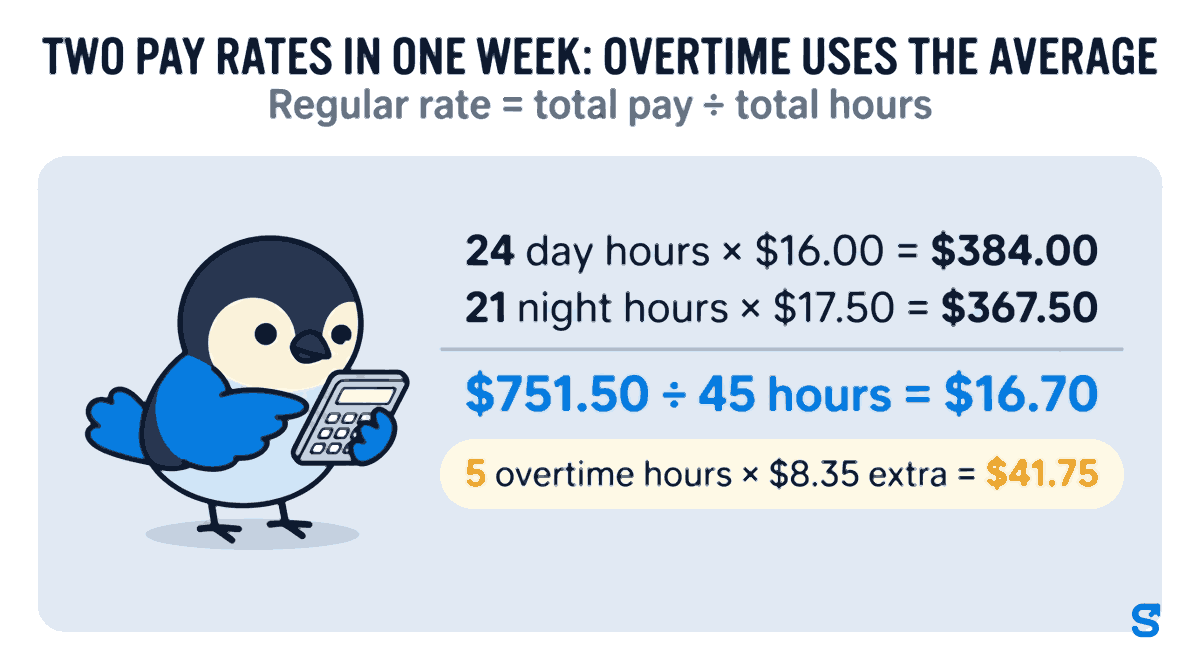
Take a week where one employee works 24 hours on days at $16.00 and 21 hours on overnights at $17.50, 45 hours in all:
- $751.50: straight pay for the week (24 × $16.00 plus 21 × $17.50)
- $16.70: regular rate ($751.50 ÷ 45 hours)
- $41.75: overtime premium (5 overtime hours × $8.35 extra)
Because the straight pay already covers every hour once, the overtime hours need only the extra half: half of $16.70 is $8.35, and 5 hours of it is $41.75. The week's total comes to $793.25.
Two shortcuts are wrong here. Paying the overtime premium on the $16.00 day rate alone gives $40.00 and underpays. Paying it on the $17.50 night rate gives $43.75 and overpays. The blended figure is the one the fact sheet describes, which is why the week's totals need to be right before overtime is worked out.
Write the policy before you set the rate
A differential that is not written down becomes an argument the first time two people compare paychecks. Keep the policy to one page:
- Which shifts qualify, by time: for example "any shift that starts at 10 pm or later".
- The amount: a flat amount per hour, or a percentage turned into a dollar figure per person.
- Whether weekend shifts qualify, and whether a weekend overnight gets both.
- The date it starts, and the date of any change.
- Who can change it: the owner only, or a manager as well.
The last line matters more than it looks. When a shift lead can quietly change a rate, the differential stops being a policy and becomes a favour.
Set the night rate on the shift, not on the person
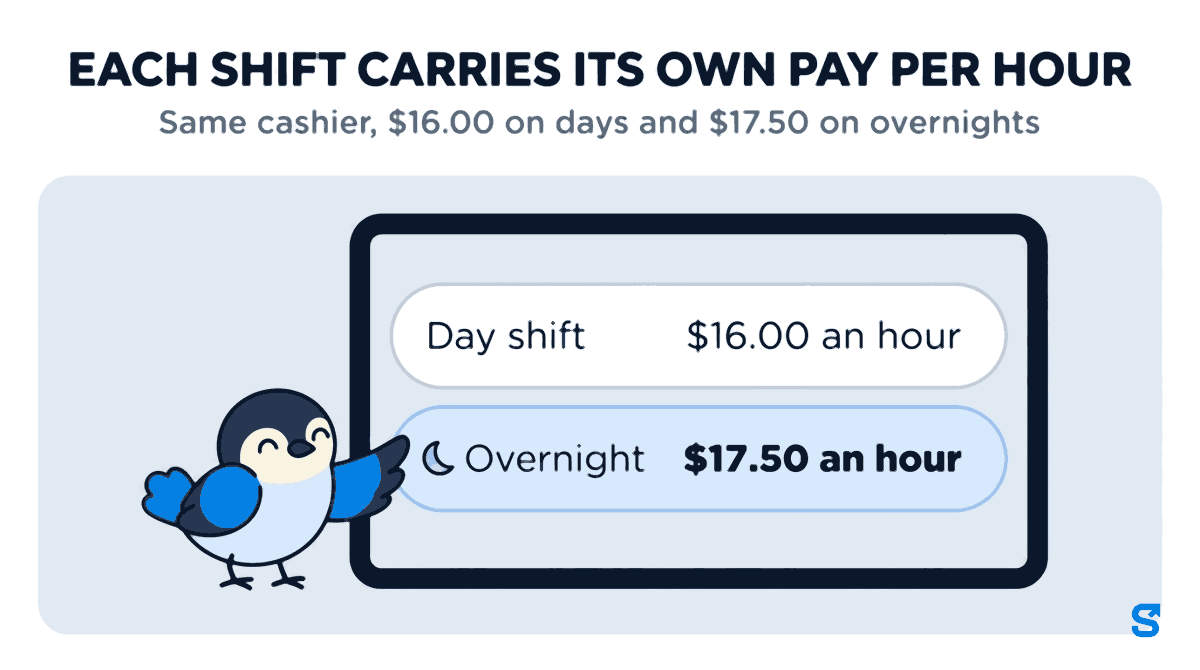
The reliable way to pay a differential is to stop treating it as a note and make it part of the shift. In Shiftelio, each shift a person works carries its own pay: the times, the working days and the Pay per hour. So an employee can have a day shift at $16.00 and, alongside it, an overnight shift at $17.50. They keep the day shift they have and get the overnight shift alongside it.
On the Shifts page, find the employee who works both days and nights.
Name it so anybody reading the schedule understands it, such as Overnight, and set its times, for example 11 pm to 7 am. A shift that crosses midnight is fine.
Type the night rate, $17.50 in our example. The day shift keeps its $16.00.
When the employee clocks in for the overnight, that clock-in is matched to the overnight shift and paid at its rate. Payroll adds up both kinds of hours for the pay period without anybody remembering which nights were which.
When you raise a differential later, the new rate starts from the date you choose. A pay period that has already been paid is never touched, so last month's paychecks stay exactly as they were. The full picture of how shifts and rates work together is on the shift roster page.
What the app does and does not do with a differential
Frequently asked questions
Is shift differential pay required by federal law?
No. The Department of Labor says the FLSA does not require extra pay for night work; it is a matter of agreement between employer and employee. State rules can differ, so check your state labor department.
How do I calculate shift differential pay?
Add the differential to the base rate to get the shift's hourly rate. A flat $1.50 on a $16.00 base gives $17.50; a 10 percent differential on the same base gives $17.60.
Does shift differential count toward overtime?
Under the federal FLSA, overtime is based on the regular rate, which is the week's total pay divided by total hours worked. Pay for differential hours is part of that total, so it raises the regular rate.
What is a typical night shift differential?
There is no federal standard amount. Businesses commonly pay either a flat amount per hour or a percentage of the base rate, and the figure depends on how hard the shift is to fill.
Can one employee have two different hourly rates?
Yes. An employee can work a day shift at one rate and an overnight shift at another. In Shiftelio each shift carries its own Pay per hour, and each clock-in is paid at the rate of the shift it belongs to.