Double Duty and Split Shifts: How to Pay One Person for Two Shifts a Day
In short
One person, a lunch shift and a dinner shift at different rates. How to pay a split shift or double duty right, and what a missed second shift should cost.
- A person on two shifts a day should have two shifts, each with its own rate, not one long shift with a guessed daily figure.
- Pay is counted per shift: a missed dinner shift costs one dinner shift, not a whole day.
- The register needs a mark for "came to one of two shifts". In Shiftelio's Excel download that mark is 1of2.
Imran is a kitchen helper at a restaurant in Pune. He works the lunch shift, 11 am to 3 pm, and comes back for the dinner shift, 6 pm to 10 pm. The owner pays him ₹350 for a lunch shift and ₹450 for a dinner shift, because dinner is longer on the feet and busier. That is a perfectly normal arrangement in Indian restaurants, gyms and security agencies, where the owner calls it a split shift or double duty.
It is also where the salary register usually breaks. One row per person, one P per day, and a single "days present" number cannot say that Imran came for lunch on 9 September and skipped dinner. So at the end of the month somebody either pays him for a dinner he did not work, or docks a whole day for a shift he did. This article walks through what a correct split shift salary looks like, where a spreadsheet loses it, and how Shiftelio's shift rosters keep the two shifts apart all the way to the payslip.
What counts as a split shift or double duty
The words get used loosely, so it helps to pin them down. A split shift is one person working two separate shifts in one day with a gap in between: lunch and dinner service, a gym trainer's 6 am batch and 6 pm batch, a housekeeping crew that cleans an office before it opens and after it closes. Double duty is the phrase most owners use for the same thing, and in security agencies it often means a guard who stays on for a second shift because the next guard did not turn up.
What matters for pay is not the name. It is whether the two shifts are paid the same way. Three set-ups are common:
| One shift, one daily rate | Two shifts, same rate | Two shifts, two rates | |
|---|---|---|---|
| How it is set up | One long shift for the whole day | Two shifts, each paid ₹400 | Lunch paid ₹350, dinner paid ₹450 |
| Missed dinner on one day | Whole day lost, or whole day paid | One shift's pay lost | ₹450 lost, lunch still paid |
| What the register shows | P or A, nothing in between | Which shift was missed | Which shift was missed, and what each earned |
| Right for | People who really work one continuous shift | Equal shifts | Shifts that are worth different amounts |
The left column is where most split shift salary mistakes start. If Imran is entered as one shift from 11 am to 10 pm, every attendance system will see him "leave early" or "arrive late" around the gap, and a day where he skipped dinner looks the same as a day where he went home sick at 3 pm.
Why one row per person cannot pay two shifts
A hand-kept salary register has one row per person and one cell per day. That cell holds one letter. For a split shift it has to answer two questions, "did he come for lunch?" and "did he come for dinner?", and a single letter can only answer one of them.
Owners work around it in three ways, and each one costs money somewhere:
- Mark P if he came at all. The month's total is now too high by every missed second shift. For Imran, three missed dinners is ₹1,350 paid for work nobody did.
- Mark A if he missed either shift. The total is now too low, and the staff member who came for lunch has every reason to stop coming for lunch.
- Mark ½. It looks fair, but it is only right when both shifts pay the same. Half of Imran's day is ₹400, while the dinner he missed was worth ₹450 and the lunch he worked was worth ₹350.
The same problem appears in a "shift wise attendance register" kept in Excel. It is possible to keep two rows per person, but the formulas that turn those rows into pay have to be written and checked by hand every month, and a rate change halfway through the month breaks them.
The month, worked shift by shift
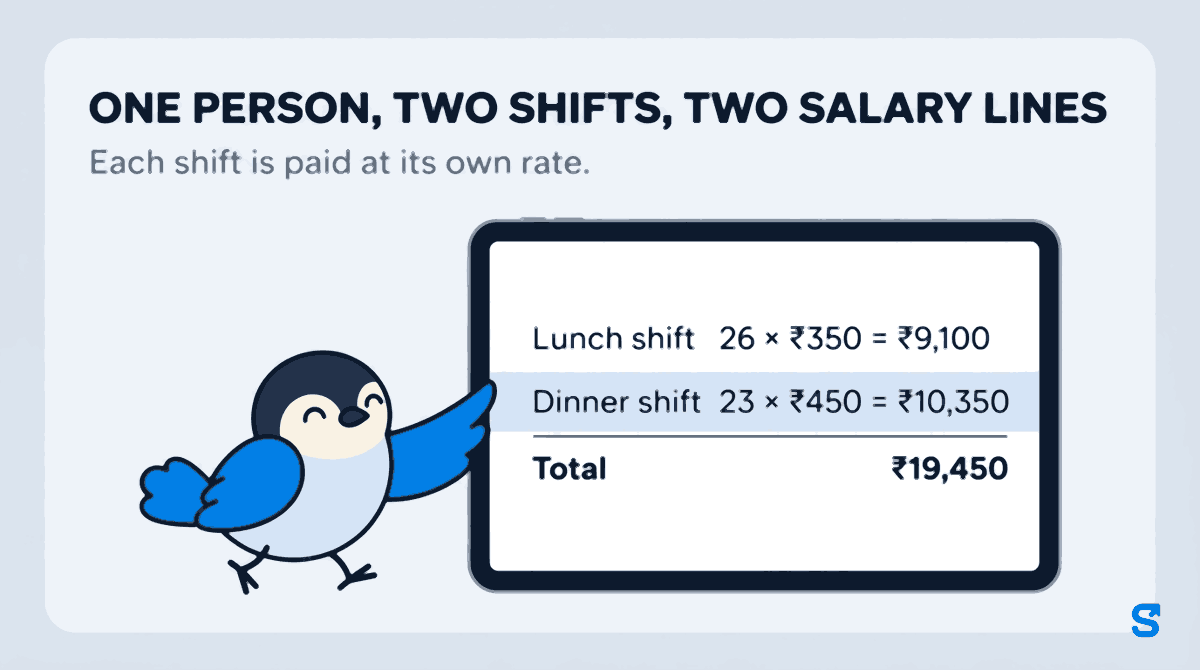
Here is Imran's September done properly. He has 4 weekly offs, so each of his shifts is scheduled on 26 days. He came for every lunch shift and missed the dinner shift on 9, 17 and 24 September.
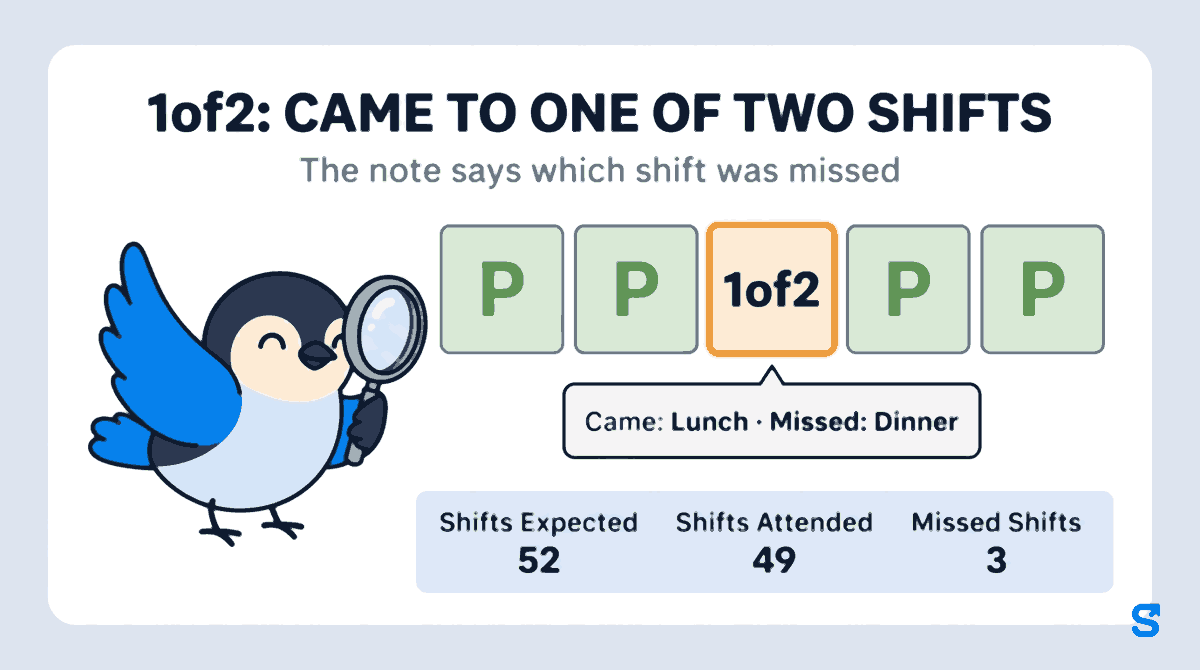
- 52 shifts expected in the month
- 49 shifts attended
- 3 missed shifts, all dinner
- ₹19,450 salary for the month
One person, two shifts, two salary lines: Lunch shift 26 × ₹350 = ₹9,100, and Dinner shift 23 × ₹450 = ₹10,350.
| Shift | Shifts attended | Rate per shift | Pay |
|---|---|---|---|
| Lunch shift | 26 | ₹350 | ₹9,100 |
| Dinner shift | 23 | ₹450 | ₹10,350 |
| Total | 49 | ₹19,450 |
Nothing about this is hard arithmetic. What is hard is getting the 26 and the 23 right without anybody counting them from a register, and keeping them right when a shift time or a rate changes during the month.
How Shiftelio pays a split shift
In Shiftelio, a person can have more than one shift, and each shift carries its own pay. On the Shifts screen you give Imran a lunch shift and a dinner shift, and you set each one's pay: a fixed amount per shift, an hourly rate, or a weekly or monthly salary. Imran's lunch shift reads ₹350/shift and his dinner shift reads ₹450/shift.
From there the attendance he marks on his phone decides the pay:
Two shifts mean two check-ins and two check-outs a day. Each check-in is matched to the shift it falls in, so the lunch check-in counts for the lunch shift and the dinner check-in for the dinner shift.
The payroll run has one card per shift for each person. A dinner shift he did not come to simply earns nothing, while the lunch shift on the same day is paid in full. There is no half day to argue about.
On the Payroll screen, Download Excel gives the usual Salary Statement, and when anybody has two shifts on one date it adds a Shift Statement with one salary line per shift and a Shift Register with one attendance row per shift. The Salary Statement gains three columns: Shifts Expected, Shifts Attended and Missed Shifts.
The shift lines always add up to the Salary Statement. Pay that belongs to no single shift, such as a trainer's PT commission, goes on a line of its own, so the totals still match to the paisa. The full workbook, sheet by sheet, is in our guide to the attendance and salary sheet in Excel.
1of2: the register mark for a missed second shift
In the ordinary Attendance Register, a day where Imran came to one of his two shifts does not read P. It reads 1of2. Tap it and the note names both shifts, for example "Came: Lunch · Missed: Dinner". So the owner reading the register on 30 September can see the three dinners Imran skipped without opening anything else, and the Salary Statement's Missed Shifts column says 3.
A file where nobody has two shifts on one date shows none of this: no extra sheets, no extra columns. A business that runs one shift a day sees nothing change.
The three things that go wrong later in the month
A split shift salary is easy in a month where nothing changes. These are the months that are not.
The rate changes on the 15th. Say the owner raises the dinner rate from ₹450 to ₹500 from 15 September. In Shiftelio that is a new pay setting on the same dinner shift, not a new shift, so the payroll still shows one dinner card for Imran. The card lists each pay setting by date, and the days before the 15th are paid at ₹450 and the days after at ₹500.
He works a day with no shift on it. If Imran covers a Sunday he was not scheduled for, payroll does not guess what that day is worth. It sits on a card called Days with no shift, marked as not priced, with a button to link it to one of his shifts. Choose the dinner shift and that day is paid at the dinner rate. Months that were already paid are left alone.
Two monthly salaries for one person. Some owners pay a split shift as two monthly salaries, ₹11,000 for each shift. That works: a weekly off is paid as one day of the combined ₹22,000, exactly as it should be. But if the same shift has been entered twice by mistake, a weekly off would be paid twice, so the Shifts screen shows a warning naming the people whose two monthly salaries look like one shift entered twice.
Payroll does not decide which of two shifts a person "should" have worked. It pays the shifts they were scheduled for and checked in to. If the roster is wrong, fix the roster, and the pay follows.
A second shift is not overtime, and the law still counts the hours
Paying the dinner shift at its own rate is not the same as paying overtime, and the two should not be mixed up. Overtime is work beyond the hours the law allows in a day or week. The Occupational Safety, Health and Working Conditions Code, 2020 sets the normal working day at eight hours in Section 25 for the establishments it covers, and the Code on Wages, 2019 says in Section 14 that overtime is paid at no less than twice the normal rate of wages.
Imran's two shifts add up to eight hours, so there is no overtime in his month. A security guard doing double duty is different: two 8-hour shifts back to back is a 16-hour day, and the hours past the legal limit are overtime whatever the second shift is called. State Shops and Establishments Acts also limit the spread-over, the time from the first start to the last finish, and a split shift with a long gap can run into that limit even when the hours worked are fine. Check your state's Act before you design the gap.
In Shiftelio, paid extra hours are switched on or off for each shift separately, so a guard's second shift can carry its own rule. What the app does not do is tell you whether your shift pattern is legal in your state. That is still a question for your labour consultant.
When a split shift needs nothing more than a notebook
If you have two or three people on split shifts and both shifts pay the same, a notebook with two columns per day, L and D, does the job. The trouble starts when the shifts pay different amounts, when more than a handful of people work them, or when the person who keeps the notebook is not the person who pays the salary. That is when the counting has to come from the check-ins and not from memory.
Which app pays staff on two shifts a day at different rates?
Frequently asked questions
How is salary calculated for a split shift?
Count the shifts attended for each shift separately and multiply by that shift's rate. Imran worked 26 lunch shifts at ₹350 and 23 dinner shifts at ₹450, which is ₹9,100 plus ₹10,350, or ₹19,450 for the month.
What does double duty mean in salary terms?
Double duty means one person working two shifts in a day. In salary terms it should be paid as two shifts, each at its own rate. If the two shifts together go past the legal working day, the extra hours are overtime and are paid at no less than twice the normal rate.
What happens if an employee misses one of their two shifts?
Only that shift goes unpaid. In Shiftelio the other shift on the same day is paid in full, the Attendance Register shows 1of2 for that day with a note naming the missed shift, and the Salary Statement counts it under Missed Shifts.
Can one employee have two different pay rates?
Yes. Each shift has its own pay, so the same person can be paid ₹350 a shift for lunch and ₹450 a shift for dinner, or one shift monthly and the other hourly.
Is a split shift legal in India?
Split shifts are allowed, but the total hours and the spread-over are limited by the labour codes and your state's Shops and Establishments Act. Check the spread-over limit in your state before you set a long gap between the two shifts.
Keep reading
Free to use, no signup: Payroll calculators.