Tool Handover Between Field Technicians: When the Leak Detector Moves Van to Van
In short
Field technicians pass tools between vans and never visit the store. A handover the other person must accept is how a tool issue register keeps up.
- In a field team, most tool movements happen between two technicians at a job site, not at the store counter, so a counter-based register is wrong by Wednesday.
- A handover between two technicians should be an offer that the receiver accepts. Until they accept, the tool stays signed out to the giver.
- That acceptance is also what turns "the tool was in his van" into a tool expressly entrusted to a named person, which is the test the Code on Wages sets before any deduction for loss.
The leak detector that was in three vans in one week
A Pune air-conditioning service company runs 18 technicians out of one small store. The store owns one electronic refrigerant leak detector, which costs more than most of the tools in the building put together.
On Monday the storekeeper signs it out to Ravi. On Tuesday Ravi finishes a gas top-up job in Hinjewadi and a colleague, Imran, has a leak to trace in Wakad the next morning, so Ravi drops the detector at Imran's site on his way home. On Thursday a third technician borrows it from Imran for an hour. On Saturday it comes back to the store with a cracked sensor tip, and the register still says Ravi.
Nobody lied. Every one of those handovers was sensible. The register simply never saw three of the four movements, because none of them happened at the counter. When the owner asks who cracked the sensor, the only honest answer is that nobody knows, and every technician in the story has a perfectly good reason to believe it was somebody else.
That is the whole problem with a tool issue register in a field team. It is not that people refuse to fill it in. It is that the register lives in one place and the tools do not.
Why a counter-based register misses field teams
A shop, a restaurant or a gym has a counter, and nearly every movement of a tool passes it. The person issuing and the person receiving are both standing there, so a paper register or a spreadsheet at the counter is right most of the time. We covered how that kind of register works, and what it has to record, in the company asset register guide.
A field team breaks three of the assumptions that register depends on:
- Tools move between technicians, not between a technician and the store. A vacuum pump, a manifold gauge set, a ladder, a crimping tool and a meter all go where the next job is.
- The two people are rarely in the same place as the book. The handover happens in a car park at 7 in the evening. The register is 20 kilometres away.
- The giver has every reason to say they handed it over, and the receiver has every reason to say they never got it. With no neutral person watching, whoever writes it down first decides the story.
So the fix is not a better book at the counter. It is a record that is made at the moment of the handover, on the phones of the two people doing it, and that neither of them can write alone.
A handover between two technicians is an offer, not a fact
The rule that makes this work is simple to say: the tool does not move until the person receiving it says it arrived.
When Ravi hands the leak detector on, he opens the list of company items signed out to him, taps Hand to a colleague, picks Imran, and can add a short note such as "Left it in the site office". He taps Send it over. The detector does not leave his list. The app tells him exactly that: it stays on his list until Imran confirms.
Imran gets a notification that somebody is handing him something. His list shows the offer, with two buttons: I have it and I do not have it. If he taps I have it, the detector moves to his name and Ravi is told it is off his list. If he taps I do not have it, Ravi is told it is still signed out to him, which is the truth.
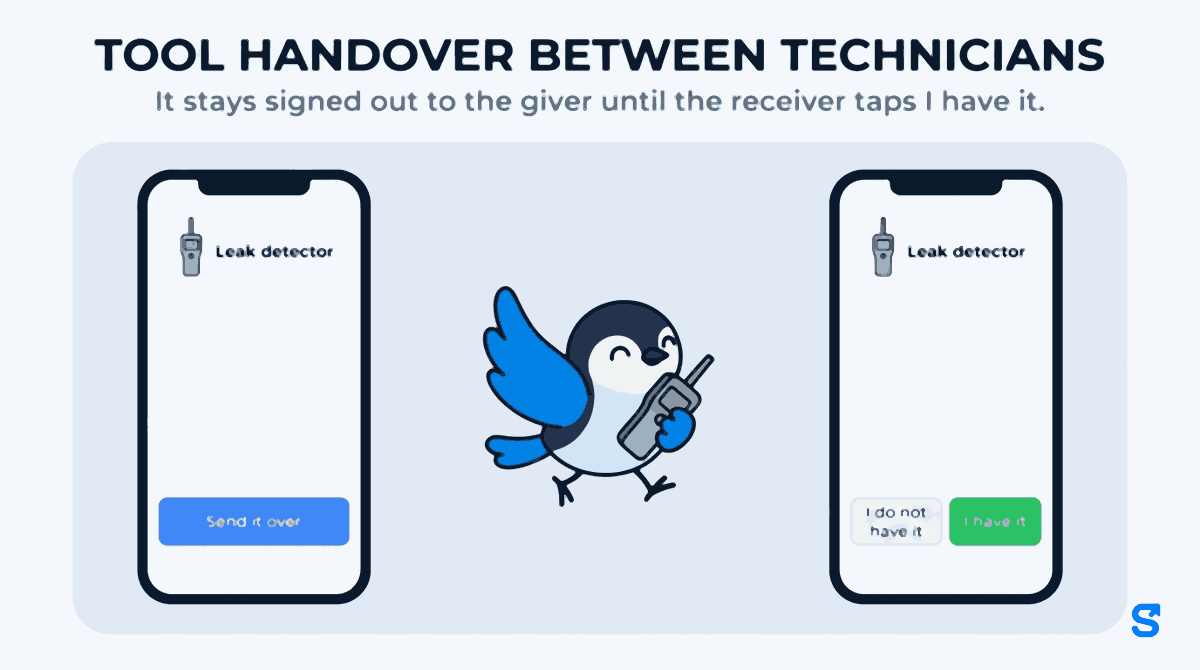
Why the giver stays responsible until the receiver accepts
It can feel harsh on Ravi. He dropped the detector off in good faith. But consider the alternative: a register where anybody can tap a button and make a tool somebody else's problem. The first time a tool goes missing, the log would point confidently at whoever received it last, including somebody who never saw it.
Keeping the tool on the giver's list until the receiver accepts means the register only ever says something both people agreed to. It also gives the giver a reason to chase the acceptance the same evening, while everybody still remembers where the detector was left.
Why an unanswered offer expires after 48 hours
An offer nobody answers is not a handover. If Imran never responds, the offer expires after 48 hours and the detector is still with Ravi, which is what the register has said all along. Imran sees "That handover expired. Ask them to send it again." if he tries to answer late. The point is to stop a permanent "did Imran take it or not" from sitting in anybody's inbox for a month.
What a technician cannot do
A technician cannot mark a tool returned to the store. A return is a handover to somebody, and a register where the holder decides when they stopped holding it is a note, not a record. The storekeeper records the return, which is also the moment somebody actually looks at the tool.
A technician also cannot hand on something that is not signed out to them. The list of colleagues they can pick from is only the active staff of their own business, and the only items they can offer are the ones on their own list.
Damage reported from the site, with a photo
The cracked sensor tip in the Pune story was discovered on Saturday. It almost certainly happened on Thursday. Two days is enough for the detector to change hands again and for the truth to become an argument.
In a field team, damage has to be reported from wherever the tool is, the moment it is noticed. The technician holding it taps Report damage on that item, writes what is wrong with it, and attaches a photo. The office is told immediately. The report screen says it plainly: it tells the office, and it does not hand the item back. So the tool stays signed out to the person holding it until the store takes it in.
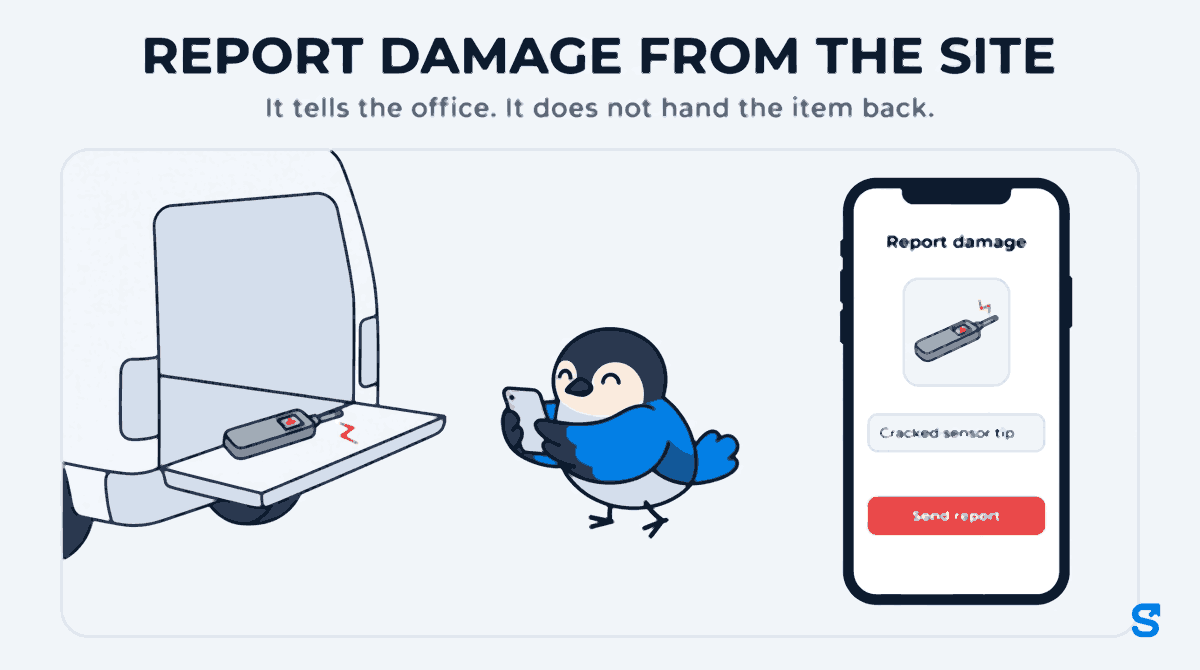
The practical effect is that a damage report becomes routine rather than a confession. A technician who reports a loose chuck on Thursday afternoon, with a photo, has done exactly what was asked. A tool that turns up damaged at the store with no report, after three handovers that were all accepted, points to the last person who accepted it, and that person had every chance to say something.
Return dates for tools that are meant to come back
Some tools live with a technician: their own screwdriver set, their uniform, their helmet. Others are meant to come back: the vacuum pump borrowed for one installation, the long ladder, the detector. When the store issues a tool that is meant to come back, it can set the date it is due back.
The technician sees Due back with the date on that item. Once the date passes, the list says "1 item is past its return date" at the top, and only then. A permanent "0 overdue" line would train everybody to ignore the space where a real warning appears.
What the law lets you recover, and why the acceptance step matters
The four Labour Codes came into force on 21 November 2025. Under the Code on Wages, 2019, Section 18(2)(c) permits a deduction for damage to or loss of goods expressly entrusted to the employee for custody, where the loss is directly attributable to their neglect or default. Section 21 limits the deduction to the actual loss and requires the employee to be given an opportunity to show cause first, and Section 18(3) caps all deductions in a wage period at half of the wages. The Ministry keeps the text of all four codes on its Labour Codes page.
Read "expressly entrusted" against the Pune story. The detector was expressly entrusted to Ravi on Monday. It was never expressly entrusted to Imran or to the third technician: it was left at a site and borrowed. If the only record is the store's book, the only person the law could ever point at is the one who, on the facts, had the least to do with the damage.
An accepted handover changes that. It is a dated record, naming the person, that they themselves confirmed. That does not make a deduction right, and it does not replace hearing the technician out. It means that if the conversation ever happens, it is about facts that both people signed, rather than who remembers what. This is general information and not legal advice; take advice on your own facts and on the rules your state has notified.
A tool handover routine for a field team
- Sign every costly or shared tool out to a named technician at the store, never to "the Wakad team" or "the night crew".
- Set a due-back date on anything that is meant to come back, and leave it blank on things that live with the technician.
- Make one rule for handovers in the field: the giver sends the handover from their phone before they leave the tool, and the receiver accepts it the same day.
- Ask the giver to chase any handover still waiting at the end of the day. It is still on their list, so they have the reason to.
- Report damage from the site with a photo, the moment it is noticed, even if the tool still works.
- Take tools back only at the store, where somebody actually looks at them.
- Before a technician's last day, look at what is still signed out to them, and get it back before the final settlement.
Running tool handovers in Shiftelio
Shiftelio's Company items keeps a log book of company property: who has the laptop, the drill, the uniform, and since when. For a field team, the part that matters is on the technician's own phone, in the same app they check in with, under My Items: every company thing currently signed out to them, the due-back date, Report damage and Hand to a colleague. Most asset trackers let any user reassign an item, or keep all reassignment in the office. Company items does neither: a handover between two workers only takes effect when the receiver confirms it, and it lapses after 48 hours if they never do. Field teams are covered in more detail on the field teams page, and every feature is on the features page.
Common questions
Can a technician hand a tool to a colleague without going through the store?
Yes. The technician sends the handover from their phone and names the colleague. Nothing moves until the colleague confirms they have it, and until then the tool stays signed out to the person who sent it.
What happens if the colleague never accepts the handover?
The offer expires after 48 hours and the tool stays signed out to the person who sent it. The sender is told if the colleague answers I do not have it, so nobody walks away believing a handover happened when it did not.
Can a technician mark a tool as returned?
No. Only the store records a return, because a return is a handover to somebody and it is the moment somebody actually looks at the tool. A technician can report damage and hand a tool to a colleague, but not sign it back in themselves.
Can I deduct the cost of a damaged tool from a technician's salary?
Only under conditions. Section 18(2)(c) of the Code on Wages, 2019 allows a deduction for loss or damage to goods expressly entrusted to the employee, where it is directly attributable to their neglect or default. Section 21 requires the employee to be heard first and limits the deduction to the actual loss, and Section 18(3) caps total deductions at half the wages of the period. Take advice on your own facts.
Does this need a barcode or QR scanner?
No. A technician picks the item from the list of things signed out to them. Labels can be printed for items in the store, but a handover in the field needs nothing more than the two technicians' phones.
Keep reading
Free to use, no signup: HR letter formats.