UAN Generation in 2026: Your New Joiner Creates It With Their Face, Not You
In short
EPFO moved UAN allotment to Aadhaar face authentication on UMANG. You can no longer generate it for an Indian joiner, but you still owe the ECR. What to do on day one.
On 7 September 2026 the Ministry of Labour and Employment posted a reminder that members can now allot, activate and authenticate their Universal Account Number through the UMANG app. It was written for employees, it read like a convenience announcement, and almost every write-up that followed framed it that way: get your UAN yourself, no employer needed.
For an employer it is not a convenience announcement. It is the moment you find out that a statutory duty you still carry now depends on something only your employee can do, on a phone you do not control, with a face you cannot borrow.
This article is what that means at the joining desk: what actually changed, who can still generate a UAN for somebody else, the one step that fails silently every time, and what it costs when a new joiner reaches the fifteenth of the month without a number.
What actually changed, and when
The change is older than the September headline. EPFO issued a circular on 30 July 2025 providing that from 1 August 2025, allotment and activation of a UAN would be done through Aadhaar-based Face Authentication Technology in the UMANG app. Face authentication had been available since April 2025 and was optional. From August it was the route.
Three services sit behind one tab in the app. UAN allotment, for a worker who has never had one. UAN activation, for a worker who has a number but never switched it on, which is an enormous population. And face authentication update, which refreshes the biometric record itself. All three end in a live face scan checked against UIDAI records through the Aadhaar Face RD application.
What the September 2026 post added was not a new rule. It was volume. A restatement from the Ministry, at the exact moment two other EPFO deadlines are running, is how a rule that had been quietly true for thirteen months arrives on the desk of a company that never noticed it.
Who can still generate a UAN for somebody else
This is where most HR teams have the shape of the rule backwards. Asked which category is the difficult one, they say international workers. International workers are the only category the employer can still handle the old way.
The circular keeps the existing employer-generated process alive for exceptional cases such as international workers and citizens of Nepal and Bhutan. Everyone else, which is to say, essentially every Indian new joiner you will hire this year, is outside your reach. You may collect their Aadhaar. You may verify their name. You cannot press the button that turns those into a UAN.
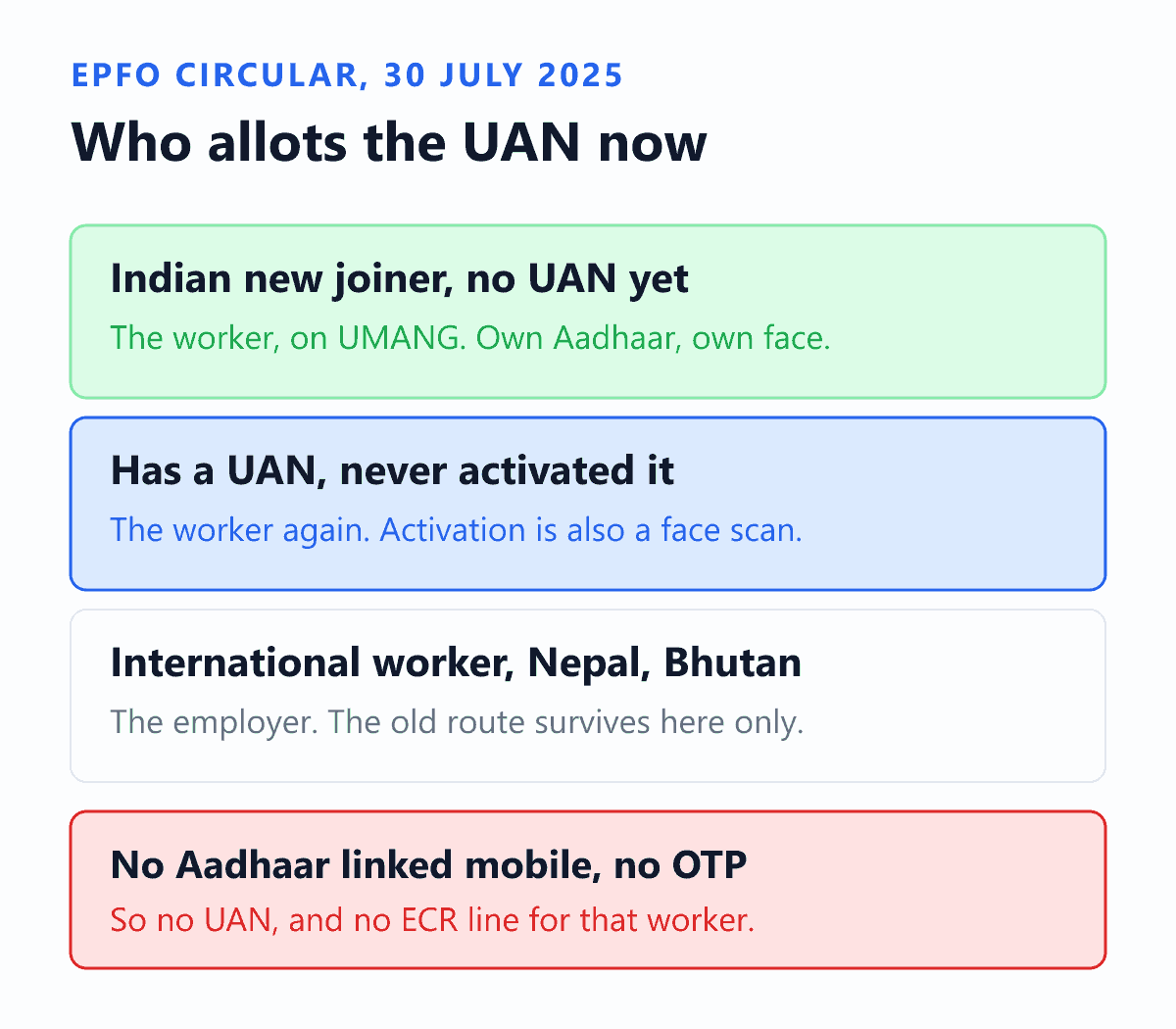
A distinction worth keeping straight. The circular narrows how a UAN is allotted. It does not touch the employer’s own portal for filing returns, adding a member to an establishment or remitting contributions. Your Electronic Challan cum Return work is unchanged. What changed is that one of its inputs is now produced somewhere you cannot see.
The four steps, and the one that fails silently
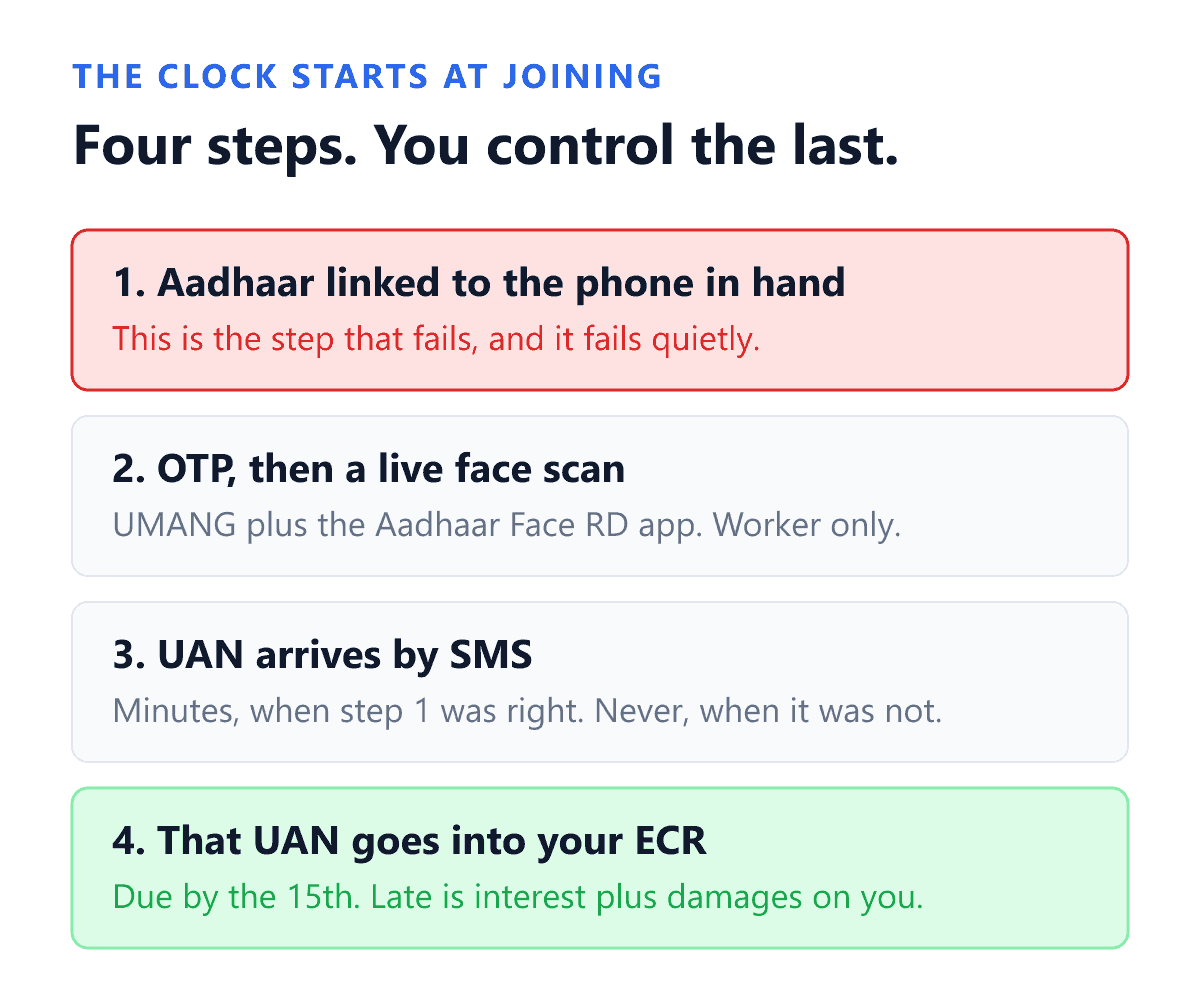
The sequence, as the Ministry describes it, is short. The worker opens UMANG and chooses UAN Allotment and Activation. They enter their Aadhaar number and mobile number and give consent. An OTP arrives. The system checks whether a UAN is already associated with that Aadhaar. If none is, the worker completes a live face scan through the Aadhaar Face RD app, and a new UAN is generated and sent to their registered mobile number.
Four steps. When it works it takes about five minutes and costs nothing. When it does not work, it almost always breaks in the same place, and it is not the place anybody expects.
Why the Aadhaar-linked mobile number is the whole game
The OTP does not go to the phone in the worker’s hand. It goes to the number recorded against their Aadhaar at UIDAI. For a migrant worker who has changed SIM twice since the number was seeded, for a woman whose Aadhaar carries her father’s number, for anyone who registered on a family member’s handset in 2016: that number is not theirs any more.
Nothing about this produces an error you can see. The worker taps, waits, and nothing arrives. They assume the app is slow. They try again after lunch. Nobody tells payroll, because from the worker’s point of view a UAN is paperwork and paperwork is always slow. The first time the business finds out is three weeks later, when a name is missing from a return that was already filed.
So ask the question on day one, and ask it precisely. Not “do you have Aadhaar”. Not “what is your mobile number”. The question is: is the number registered on your Aadhaar the same number you are holding right now? A worker who does not know can find out in a minute on the UIDAI portal, and if the answer is no, the fix is an Aadhaar mobile update at an enrolment centre, which takes days rather than minutes. That is a day-one question precisely because the remedy is slow.
The enrolment campaign sentence that cannot be followed literally
EPFO’s notice for the Employees’ Enrolment Campaign 2026, which runs from 29 June to 31 October 2026, instructs participating employers to review their records for employees left out of coverage, to generate a Face Authentication-based UAN through the UMANG App for each declared employee, and then to remit through the ECR.
Read the middle instruction against the circular and it cannot be performed as written. Face authentication binds to the member’s Aadhaar and the member’s live face. An employer cannot generate one on anybody’s behalf. What the instruction means, once you translate it into things a person can actually do, is: you must get it done.
That translation has a cost, and it is a cost measured in bodies and phones rather than in rupees. A firm regularising twenty-eight past employees under the campaign needs twenty-eight people physically present, each holding a phone with an Aadhaar-linked SIM, each completing a scan. Several of them left years ago. Several will fail on the mobile number and need an enrolment centre visit first.
Which makes the campaign deadline a scheduling problem, not a filing problem. The window closes on 31 October 2026. If you are relying on the campaign to clean up past non-enrolment, the UAN scans are the long pole and they have to start now, not in the last fortnight. Our guide to the Employees’ Enrolment Campaign 2026 covers who qualifies and what the relaxations actually waive.
What it costs when the UAN is late
Here is the asymmetry that makes this worth a process rather than a hope. The worker controls whether the UAN exists. The employer carries every consequence of it not existing.
Enrolment is owed from the date the employee becomes eligible, which for a covered establishment is the date of joining. The monthly ECR is the instrument that discharges it, and the ECR needs a UAN per member. No UAN means no line, no line means no contribution, and a contribution that is not remitted on time carries interest under the Code’s successor to section 7Q along with damages, on the employer, for a delay caused by an OTP that went to a dead SIM.
The EPF Scheme, 2026 tightened the reporting layer around this as well: a consolidated return carrying every member’s UAN, Aadhaar, PAN and wages, monthly electronic returns on a fifteen-day clock from month end, and a late fee of Rs 500 per day for a delayed return. We work through that machinery in the piece on the Rs 1,800 cap and what the EPF Scheme, 2026 actually changed.
The point is not the size of any one penalty.It is that the cheapest possible remedy, five minutes with a phone on the first morning, sits on one side of the line, and interest, damages and a late-fee clock sit on the other, and the only thing that decides which side you land on is whether somebody asked the right question at induction.
The onboarding checklist that survives this
What follows is deliberately dull. The rule does not need cleverness; it needs the same four things to happen in the same order every time somebody joins.
- Ask the mobile question at induction, before anything else. Is the number on your Aadhaar the number in your hand? Record the answer as a yes or a no, not as a phone number.
- Ask whether a UAN already exists. Most workers with any formal history have one and do not know it. UMANG checks for duplicates itself, so a worker who thinks they are new may simply need activation rather than allotment: a shorter path, and one that avoids the mess of a second UAN.
- Do the scan on the premises, on day one, with somebody sitting next to them. Both apps installed, decent light, five minutes. This is the single highest-value fifteen minutes in your onboarding, and it is the one most often left to the employee to do at home.
- Write the UAN into the employee record the same day, against the date of joining: not into a WhatsApp message, not into the payroll operator’s notebook.
And one exception to keep visible: if the joiner is an international worker or a citizen of Nepal or Bhutan, steps one to three do not apply and you generate the UAN yourself, the way you always did.
A worked example
A Coimbatore engineering workshop with fifty-one employees hires four people on 1 October 2026.
| Joiner | Position on day one | What the employer does |
|---|---|---|
| Fitter, first formal job, Aadhaar mobile current | No UAN. | Sit with him. UMANG allotment, face scan, UAN by SMS in minutes. Record it. |
| Store keeper, worked in Tiruppur until 2023 | UAN exists, never activated. | Activation, not allotment. Same app, shorter path. Do not create a second number. |
| Helper, changed SIM twice since 2018 | OTP never arrives. | Aadhaar mobile update at an enrolment centre first. Flag the file; do not let October close on it. |
| Design engineer, on assignment from Germany | International worker. | The exception. Employer generates the UAN as before. |
Three of the four are finished before lunch. The fourth is the only one that can hurt, and it hurts only if nobody notices it until the ECR for October is already filed.
This is a records problem before it is a software problem
Notice what the inspector’s question actually is. Not “does this employee have a UAN”. It is: on the day this person joined, did you have their UAN, and if not, when did you get it? That is a question about a date, and a date can only be answered by a record that was written on it.
A business whose staff list is a spreadsheet that gets overwritten each month cannot answer it. Neither can one whose joining dates live in a WhatsApp group and the memory of a supervisor. The gap between “we always do this” and “here is the file showing we did it on 1 October” is the entire distance between compliance and an argument.
What a system buys you here is small and specific: every employee carries a joining date and their statutory identifiers in one place, so the UAN either sits against the joining date or is visibly missing from it. In Shiftelio the employee record is created at onboarding with the joining date, documents and identifiers attached, which means a person hired without a UAN shows up as an incomplete record in October rather than as a surprise in a return. That is not a clever feature. It is a filing cabinet that does not lose things, which is exactly what this rule needs.
For the wider set of monthly obligations this sits inside, our PF and ESI compliance checklist for small business owners runs the due dates in the order they fall.
Frequently asked questions
Can I still generate a UAN from the employer portal?
For an ordinary Indian new joiner, treat the answer as no: since 1 August 2025 allotment and activation are to be done through UMANG with Aadhaar face authentication. The employer-generated process was expressly kept alive for exceptional cases such as international workers and citizens of Nepal and Bhutan.
What if the employee has no smartphone?
The scan needs a camera and two apps, so in practice somebody’s smartphone is required. The workable answer is that the process runs on a company handset at the joining desk, with the worker’s own Aadhaar and the worker’s own face. The OTP still has to reach their Aadhaar-linked number, so a borrowed handset does not solve a stale-number problem.
The face scan keeps failing. What now?
Confirm the Aadhaar Face RD app is installed and updated, try in even daylight rather than under a tube light, and remove glasses and headgear. If the OTP stage is where it stops rather than the scan, the problem is the registered mobile number, not the face, and no amount of retrying will change it.
Does this change my ECR due date?
No. The monthly remittance and return clock is unchanged. What changed is the lead time you need before it, because one of the inputs now depends on somebody else completing a biometric step.
An employee already has two UANs. What do I do?
Do not create a third by running allotment again. UMANG’s duplicate check exists precisely to prevent that. Two live numbers are resolved by a member transfer request so the service history consolidates under one, and that is EPFO’s process rather than yours to fix in payroll.
Sources
The EPFO circular of 30 July 2025 making Aadhaar-based Face Authentication Technology the route for UAN allotment and activation from 1 August 2025, and the carve-out continuing employer generation for exceptional cases including international workers and citizens of Nepal and Bhutan, is reported consistently in KPMG’s flash news on the circular and in contemporaneous reporting. The service list and step sequence are as described by the Ministry of Labour and Employment in September 2026 and reported by Business Today on 7 September 2026. EPFO’s own member services and the scheme framework are at epfindia.gov.in; Aadhaar mobile number updates are handled by UIDAI.
The Employees’ Enrolment Campaign 2026 window of 29 June to 31 October 2026, and the instruction that employers generate a Face Authentication-based UAN through the UMANG app for each declared employee before remitting through the ECR, are from EPFO’s campaign notice. Where a summary described the employer route as “discontinued”, the narrower language of the circular was preferred.
This is general information about Indian provident fund practice as it stands in September 2026, not legal advice. EPFO’s procedures and the UMANG interface change without much notice. Check the current circular for your establishment, or take advice, before relying on any step described here.
Keep reading
See how Shiftelio does this in practice with the joiner record that carries a date of joining.
Work your own numbers with the free PF and ESI calculator. No signup, no email.