PF Was Not Capped at Rs 1,800 in 2026: What the EPF Scheme Actually Changed
In short
The Rs 15,000 ceiling dates from 2014 and above it was always voluntary. What changed on 29 June 2026, what cutting saves, and why the ceiling is about to move.
Since the first week of July 2026 the same question has been arriving in payroll inboxes across India, usually with a screenshot attached. The screenshot says provident fund is now capped at Rs 1,800 a month and that anything above it is voluntary. The question underneath it is always the same: can we stop paying PF on the full basic and drop everyone to Rs 1,800?
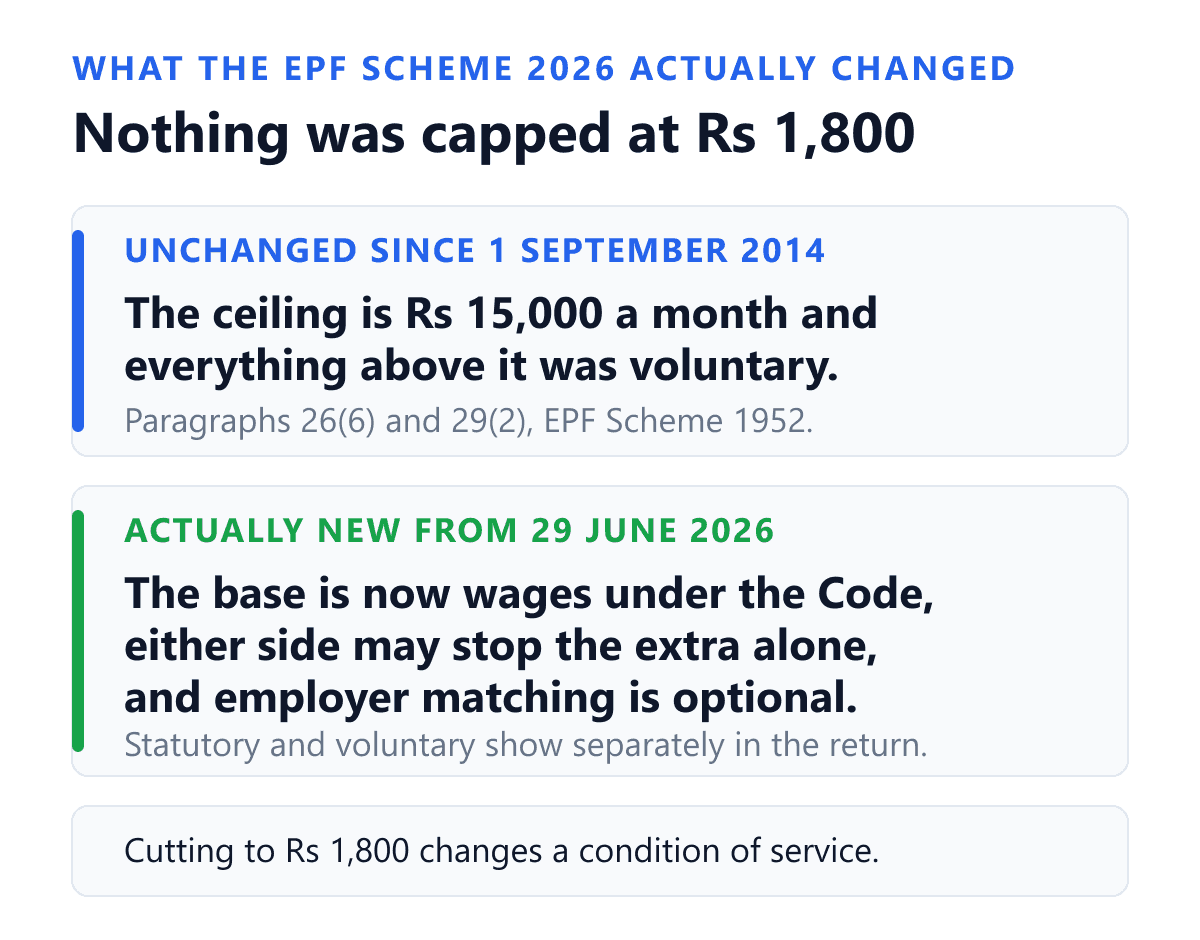
The screenshot is not wrong. It is just not news. The Rs 15,000 statutory wage ceiling has been in force since 1 September 2014, and contributions on wages above it have been voluntary for as long as there has been a ceiling. What the headlines announced in July 2026 as a new rule is a description of the law as it stood in 2015.
What did change on 29 June 2026 is real, and almost none of it is about the ceiling. This is what actually moved, what it costs to act on the headline, and the one fact that makes cutting now the most expensive version of this decision.
The ceiling is not new, and neither is the choice
Under the Employees’ Provident Funds Scheme, 1952, the employer and the employee each contributed 12% of “basic wages”, subject to a statutory wage ceiling. That ceiling was raised to Rs 15,000 a month with effect from 1 September 2014, and 12% of Rs 15,000 is the Rs 1,800 in the headline.
Contributing on wages above the ceiling was always available and never compulsory. Paragraph 26(6) of the 1952 Scheme let an employee and employer jointly ask the Commissioner to contribute on higher wages, and paragraph 29(2) let an employee contribute above the statutory rate. Neither was a duty.
Two things settled that beyond argument, and both are more than a decade old.
- In Marathwada Gramin Bank Karamchari Sanghatana v. Management of Marathwada Gramin Bank (2011), the Supreme Court held that an employer cannot be compelledto contribute above its statutory liability, and specifically that having voluntarily paid more in the past creates no obligation to keep doing so.
- On 27 May 2014, EPFO circularised its own field offices to stop pressing employers to contribute above the statutory ceiling.
So the honest answer to the statutory question is yes.Restricting the employer’s contribution to 12% of Rs 15,000 does not contravene the provident fund law, and it did not contravene it in 2015 either. That is the easy half of the question, and it is the only half the headlines answered. The rest of this article is the half that decides whether you should.
What the EPF Scheme, 2026 actually changed
The Ministry of Labour and Employment notified the Employees’ Provident Fund Scheme, 2026 on 29 June 2026, replacing the 1952 Scheme. One employer note puts implementation at 1 July 2026; the two-day gap does not change anything below. PF now runs under the Code on Social Security, 2020rather than the EPF & Miscellaneous Provisions Act, 1952.
Five things moved. Read them as operational changes, because that is what they are.
| What moved | Before | From 29 June 2026 |
|---|---|---|
| The contribution base | 12% of “basic wages” as defined in the 1952 Act. | 12% of “wages” as defined by the Code on Social Security, which carries the 50% deeming rule. |
| Stopping the extra | Above-ceiling contribution rested on a joint option. Unwinding it was not a one-sided act. | Either the employer or the employee may reduce or discontinue the additional voluntary contribution on their own. |
| Employer matching | Practice and argument. The employee’s extra often pulled the employer’s along with it. | Matching an employee’s voluntary contribution is expressly optional. |
| How much can be voluntary | Effectively open. | Bounded by the wages left after the deductions permitted by section 18(2) of the Code on Wages, 2019. |
| How it is reported | One contribution figure per person. | Statutory and voluntary must be separately identifiable in the remittance and in the Form V return. |
The first row is the one most likely to catch a small employer out, and it moves in the opposite direction to the headline. “Wages” under the Code is not “basic wages”: where the excluded allowances exceed half of total remuneration, the excess is added back into wages. For anyone whose total pay is comfortably above Rs 15,000 this is academic, because the ceiling bites first. For a worker on Rs 14,000 split into a small basic and a pile of allowances, it is not academic at all, and the PF base goes up. That is worked through in the article on the new salary structure and the 50% rule, and this one does not repeat the arithmetic.
What cutting to Rs 1,800 actually saves
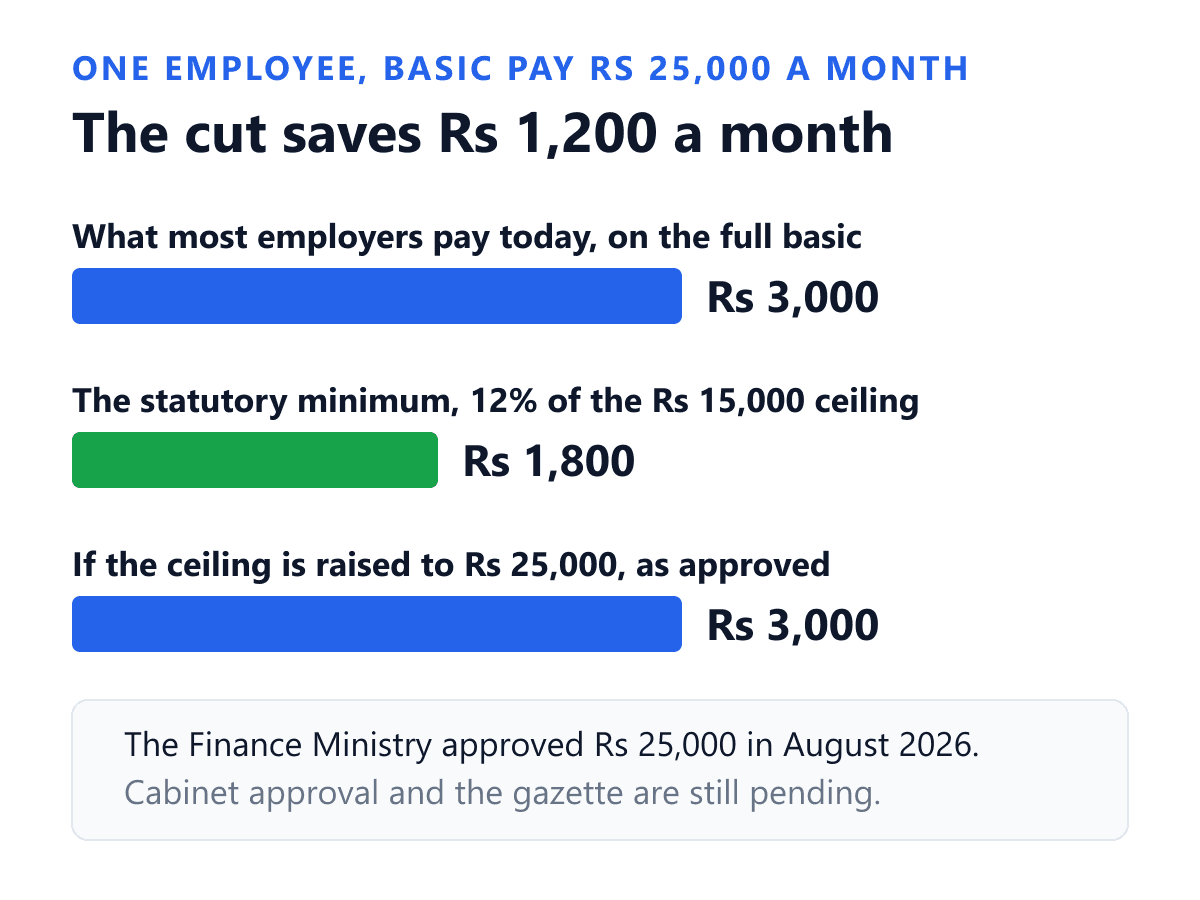
Take one employee with a basic of Rs 25,000 a month, which is an ordinary supervisor’s basic in a mid-sized Indian business. The employer today contributes 12% of Rs 25,000, which is Rs 3,000. Restricted to the ceiling, the employer contributes 12% of Rs 15,000, which is Rs 1,800.
The saving is Rs 1,200 a month per head, or Rs 14,400 a year. Across forty such employees that is Rs 5.76 lakh a year, which is a real number and the reason the question keeps getting asked. It is also the entire benefit, and it has a shelf life.
The ceiling itself is moving, and that is the argument against cutting now
In January 2026 the Supreme Court, hearing a petition that the Rs 15,000 ceiling was arbitrary and had no link to inflation, minimum wages or per capita income, directed the Union and EPFO to decide on revising it within four months. The ceiling had not moved since September 2014.
Press reporting in early August 2026 has the Finance Ministry approving a revision to Rs 25,000, against EPFO’s own ask of Rs 30,000. Twelve per cent of Rs 25,000 is Rs 3,000, which, for the employee in the worked example above, is exactly what the employer pays right now.
And now the symmetry, because the same discipline applies in both directions. The Rs 25,000 ceiling has not been approved by Cabinet and has not been notified in the gazette. The statutory ceiling today is Rs 15,000. The 1 April 2027 date circulating in coverage is journalistic speculation and not official policy. Do not change payroll to Rs 25,000 either. The only correct action on an unnotified ceiling is to budget for it.
Put the two together and the shape of the decision is clear. Cutting to Rs 1,800 buys Rs 1,200 a month per head for as long as the ceiling stands, and the ceiling is under active revision with a Supreme Court direction and a Finance Ministry approval already behind it. What it costs to make that cut lawfully is the next section, and it is not a payroll edit.
What it costs to make the cut lawfully
The provident fund law permits the restriction. Three other things stand between an employer and actually making it, and only the third is arguable.
Section 40 wants 21 days of written notice
The Third Schedule to the Industrial Relations Code, 2020 lists the conditions of service that cannot be changed without notice. One of the items is, in terms, contribution paid or payable by the employer to any provident fund or pension fund. It sits in the same schedule as shift timings and hours of work.
So section 40 applies: no employer may effect a change in a Third Schedule condition without giving the affected workers written notice of the nature of the change, and not until twenty-one days after that notice. There is no headcount threshold on it. A five-person workshop is as bound as a five-hundred-person factory. The mechanics, the prescribed FORM-IV and the narrow exemption are worked through in the article on section 40 and the 21-day notice.
The appointment letter is a contract, and you now have to issue one
If the appointment letter or the CTC sheet says “provident fund: 12% of basic”, that is a term of employment. Changing it is a variation of contract, and a variation of contract needs consent. An employer who has issued that letter to two hundred people has two hundred contracts to vary, not one payroll parameter to edit.
This is worse than it used to be, in one specific way. Appointment letters are now mandatory for every employee under the labour codes. The population of employees holding a written document that states their PF entitlement is about to become everybody.
There is also a plain-money version of the same point that has nothing to do with law. If PF was inside the CTC you quoted, and you cut the contribution by Rs 1,200 without adding Rs 1,200 to take-home pay, you have reduced the package. Your employee will work that out from the payslip in the first month, and the reputational cost of that discovery is not Rs 1,200.
Section 124, and what it does and does not reach
Section 124 of the Code on Social Security, 2020 is headed “Employer not to reduce wages, etc.” and prohibits an employer from reducing, directly or indirectly, the wages of an employee or the total quantum of benefits to which the employee is entitled under the terms of employment: by reason only of the employer’s liability to pay a contribution under the Code.
Be careful with it. That final clause is doing real work. Section 124 is aimed at the employer who recovers the cost of a contribution by cutting pay elsewhere. An employer who simply stops making a voluntary contribution is doing something else, and Marathwada Gramin Bank points the other way on the pure statutory question: past voluntary generosity creates no future obligation.
Where that leaves you. Section 124 is a live argument, not a decisive one. The two grounds that will actually decide this are the section 40 notice and the contract. Both point to the same conclusion the professional commentary has reached: this is a consent-based restructuring exercise, not a unilateral switch. For new hires it is a design choice you make once, in the offer. For existing staff it is a negotiation with a twenty-one day clock on it.
The compliance work that is actually new
While the sector argues about Rs 1,800, the Scheme has quietly imposed a set of duties that every covered employer owes whether or not they touch their contribution rate.
- Form V, within 15 days. A consolidated return is due within fifteen days of the Scheme applying to the establishment, carrying for every employee the UAN, Aadhaar, PAN, Aadhaar-seeded bank account details, gross wages and EPF wages. Monthly returns run on the same fifteen-day clock from month end.
- Gross wages and EPF wages are two numbers. They always were conceptually. They are now two reported fields per person per month, and the statutory and voluntary halves of the contribution have to be separable within the second one.
- Event reporting is electronic. New joiners, exits, changes of ownership and changes of authorised signatory are all reportable events, and records must be maintained digitally and producible electronically at inspection.
- VPF can now change mid-year. The annual lock-in is gone: an employee may start, increase, reduce or stop a voluntary contribution at any point in the year. Your payroll process has to accept that mid-cycle, and each change needs a dated election on file.
- Withdrawals now leave 25% behind. During service a member can draw up to 75% of the eligible amount without documentation, with a 25% minimum balance retained. Full withdrawal is limited to account closure events. On job loss, 75% is available immediately and the balance after twelve months of continuous unemployment.
- Contractor PF sits on the principal employer. Where the contractor is unregistered, the principal employer calculates, deducts and deposits directly; where the contractor is registered and defaults, the principal employer answers to EPFO and recovers from the contractor separately. That is worked through in full here, including the monthly paperwork.
What to do this month
- Do not change your contribution rate this quarter. Nothing obliges you to, the saving is Rs 1,200 a head a month, and the ceiling it depends on is under active revision.
- Map who is actually above the ceiling. You need a list of employees for whom the employer contributes on more than Rs 15,000, and what the excess costs per month. That list is also the list of people any future change would need notice and consent from.
- Get every above-ceiling arrangement into writing. A dated voluntary election per employee, stating the rate and whether the employer matches. The Scheme now requires the two halves to be distinguishable; an undocumented arrangement cannot be.
- Fix the return before the next cycle. Gross wages and EPF wages as separate fields, statutory and voluntary separately identifiable, UAN and Aadhaar complete for everyone. This is the part with a fifteen-day clock on it.
- Rewrite the offer template, not the existing letters. Say what the employer contributes, say whether it is capped at the statutory ceiling, and say whether the employer matches a voluntary contribution. Get this right for new hires and the problem stops growing.
- Budget for Rs 25,000. If it is notified, your mandatory contribution for anyone on a basic of Rs 25,000 or more goes to Rs 3,000. Know that number now.
The part that is a record problem before it is a payroll problem
Read the new duties together and they are one duty wearing five hats. Every month, for every person, you have to be able to state gross wages and EPF wages as two separate figures, show which part of the contribution was statutory and which was voluntary, and produce a dated election for the voluntary part: electronically, on demand, at inspection.
Gross wages is not a number payroll invents. It is what the person actually earned that month, which is days present, shifts worked, overtime, and whatever was deducted for absence. If that comes out of a supervisor’s notebook reconciled on the 29th, the two figures in the return are a reconstruction, and a reconstruction is exactly what a return demanding Aadhaar-level precision per person is designed to catch.
It is the same daily record the codes already require you to keep: see the statutory registers and wage slips the Central Rules name by form number. Shiftelio keeps attendance day by day and per person so that gross wages for a month is a report rather than a reconstruction, and so that the PF-relevant part of it can be stated separately. It has no opinion on whether you should cap your contribution. It decides whether you can prove what you did.
Frequently asked questions
Is PF really capped at Rs 1,800 from 2026?
No new cap was introduced in 2026. The statutory wage ceiling has been Rs 15,000 a month since 1 September 2014, and 12% of that is Rs 1,800. Contributions on wages above the ceiling have always been voluntary. The July 2026 headlines restated existing law.
Can an employer restrict its PF contribution to Rs 1,800 a month?
Under the provident fund law alone, yes: Marathwada Gramin Bank (2011) held that an employer cannot be compelled to contribute above its statutory liability, and EPFO told its field offices the same thing on 27 May 2014. But employer PF contribution is a Third Schedule condition of service, so section 40 of the Industrial Relations Code requires 21 days’ written notice, and where the appointment letter states the rate, changing it varies a contract.
Does the employer have to match an employee’s voluntary contribution?
No. The EPF Scheme, 2026 makes employer matching of a voluntary above-ceiling contribution expressly optional. State your position in the offer letter so it is never assumed.
What is Form V under the EPF Scheme, 2026?
A consolidated employee return due within fifteen days of the Scheme applying to the establishment, carrying UAN, Aadhaar, PAN, Aadhaar-seeded bank account details, gross wages and EPF wages for every employee. Monthly returns follow the same fifteen-day clock from the end of the month.
Has the PF wage ceiling been raised to Rs 25,000?
Not yet. The Supreme Court directed the Union in January 2026 to decide within four months, and press reporting in August 2026 has the Finance Ministry approving Rs 25,000. Cabinet approval and the gazette notification are still pending, so the statutory ceiling remains Rs 15,000 and no payroll change is warranted.
Can an employee stop a voluntary contribution mid-year?
Yes. The annual lock-in is gone. A member may start, increase, reduce or stop a voluntary contribution at any point in the year, and under the 2026 Scheme either side may discontinue the additional contribution on its own rather than by joint option.
What happens to my costs if the ceiling rises to Rs 25,000?
Your mandatory contribution for anyone earning wages of Rs 25,000 or more becomes Rs 3,000 a month, up from Rs 1,800. An employer who cut to the ceiling in 2026 to save Rs 1,200 would be back at Rs 3,000, having spent a notice period and a round of contract variations to get there.
The short version
- Nothing was capped in 2026. The Rs 15,000 ceiling dates from 1 September 2014 and above-ceiling contributions were always voluntary.
- The EPF Scheme, 2026 was notified on 29 June 2026 and runs under the Code on Social Security, 2020.
- What actually changed: the base is “wages” under the Code with the 50% deeming rule; either side may stop the extra alone; employer matching is optional; voluntary contribution is bounded by section 18(2) of the Code on Wages; and statutory and voluntary must be separately identifiable.
- Cutting to Rs 1,800 saves Rs 1,200 a month per head on a Rs 25,000 basic. That is the whole benefit.
- Employer PF contribution is a Third Schedule condition of service, so section 40 requires 21 days’ notice in FORM-IV, with no size threshold.
- Where the appointment letter states the rate, changing it varies a contract: and appointment letters are now mandatory for everyone.
- Section 124 of the Code prohibits reducing wages or benefits by reason only of contribution liability. It is an argument here, not a decisive one.
- The ceiling is under revision: Supreme Court direction in January 2026, Finance Ministry approval of Rs 25,000 reported in August 2026, Cabinet and gazette still pending. Do not change payroll in either direction.
- The genuinely new work is the return: Form V in 15 days, gross wages and EPF wages separately, dated voluntary elections, and digital records producible at inspection.
This article states the position as at 8 September 2026. The gazette notification of the EPF Scheme, 2026 could not be read directly while writing it: indiacode.nic.in and labour.gov.in both returned 403, so the Scheme’s own paragraph numbers are not printed here and its provisions are described in words from the professional summaries listed below, each of which was read in full. The Rs 25,000 ceiling is reported, not notified. This is not legal advice.
Sources
- Employees’ Provident Fund Organisation, for the Scheme, the current wage ceiling, the ECR and the return formats. epfindia.gov.in.
- The Code on Social Security, 2020: section 124, “Employer not to reduce wages, etc.”, and the definition of “wages”. India Code.
- LiveLaw, EPF Scheme, 2026: The Ceiling Was Always Rs 15,000: So What Has Actually Changed, and What Should HR Do Now? livelaw.in. The five changes, the section 18(2) bound and the consent-based restructuring position were taken from this piece.
- BDO Global, India: EPF Scheme, 2026: What Employers Need to Know About the Updated Social Security Rules. bdo.global. For the implementation date, the exempted-trust renewal cycle and the international-worker position.
- greytHR, on the payroll consequences of the Scheme, for the Form V contents, the fifteen-day clocks, the 25% minimum balance rule and the registered-versus-unregistered contractor split. greythr.com.
- Business Today, EPFO new rules 2026: Mandatory PF capped at Rs 1,800; extra savings now voluntary, 2 July 2026: the framing this article corrects. businesstoday.in.
- LiveLaw, on the Supreme Court’s January 2026 direction to the Union to decide the wage ceiling revision within four months. livelaw.in.
- SGC Management Services, EPF Wage Ceiling at Rs 25,000: What Has Been Decided, and What Has Not, 5 August 2026, for the Finance Ministry approval, the pending Cabinet step and the warning that the 1 April 2027 date is speculation. sgcms.com.
- The Industrial Relations Code, 2020: section 40 and the Third Schedule, which lists employer contribution to a provident fund as a condition of service requiring notice. India Code.
Keep reading
See how Shiftelio does this in practice with gross wages and EPF wages from one daily record.
Work your own numbers with the free PF and ESI calculator. No signup, no email.