Unused PT Sessions at Renewal: Carry Them Over Without Paying the Trainer Twice
In short
A PT client renews with 6 sessions unused. How to move them to the new package so the count is right, the trainer gets the old rate and no money goes missing.
- A carried-over session was sold at the old price, so it pays the trainer the old rate.
- Move all the unused sessions or none, and use the moved ones first.
- Check how many of them the client paid for before they move, not after.
Kabir bought 24 personal training sessions for ₹24,000. His trainer earns 40% of every session, so each one is worth ₹1,000 to the gym and ₹400 to the trainer. By the time the package expires he has trained 18 times. He renews for 12 more sessions at the new price, ₹13,200, and asks the question every gym owner hears at the desk: "What about my 6?"
Most gyms say yes. Then the 6 sessions go into the new package by hand, the count becomes 18, and nobody notices that those 6 are now being paid to the trainer at the new ₹440 instead of the old ₹400, that the old package still shows 6 sessions left, or that Kabir never finished paying for the first package in the first place.
This article is about doing the move properly: the three numbers it has to keep straight, the rule to decide before the client asks, and how Shiftelio's PT packages move unused sessions onto a renewal, with the figures worked through.
What moving sessions has to get right
A carried-over session is not a new session. It was sold at the old price, at the old commission, and it may or may not have been paid for. So the move touches three numbers at once, and the arguments come from treating it as a simple "+6".
- The count. The old package must show those 6 as gone, and the new package must show them as there. If both packages still count them, somebody can record a session against either one and the client has trained 6 sessions that exist twice.
- The trainer's rate. The client paid ₹1,000 each for those 6 sessions. The trainer's cut is 40% of what the client paid, ₹400. Pay them at the renewal's ₹440 and the gym has paid ₹240 of commission on money it never received.
- The money still owed. If Kabir paid ₹20,000 of the ₹24,000, his money covers 20 sessions. He used 18, so only 2 of the 6 are paid for. Carry all 6 without saying so and the ₹4,000 balance quietly disappears into the renewal.
The expensive mistake is not being generous with 6 sessions. It is being generous without knowing it, because the move was typed into a number field and the rate, the balance and the old package were left behind.
Three ways gyms handle it today
| Add them to the new count by hand | Extend the old package | Move them onto the renewal | |
|---|---|---|---|
| Old package | Still shows 6 left | Stays open next to the new one | Shows 6 moved, counts them as used |
| Trainer rate on the 6 | The new rate | The old rate, if nobody mixes them up | The old rate, always |
| Which sessions are used first | Nobody decides | Whichever the trainer taps | The moved ones |
| Balance still owed | Easy to forget | Stays on the old package | Shown before you move them |
| Changed your mind | Edit the count back and hope | Close it by hand | Undo, while none is used |
Extending the old package is the careful version, and it works until the client has two open packages, two end dates and a trainer who records every session against whichever one is at the top of the list. Adding to the new count is the common version, and it is the one that pays the new rate on old money.
Decide the rule before the client asks
The desk should not invent the answer at renewal. Write these down once, on the package receipt and in the trainer handbook:
- Is it optional? Moving unused sessions is a goodwill decision, not a right. Say that the gym decides, and that it decides at renewal.
- All or none. Either every unused session moves, or none does. Moving "some" of them is a negotiation that repeats every renewal.
- Only sessions the client paid for. If money is still owed on the old package, the client pays it or the owner decides to move them anyway, knowingly.
- The trainer is paid the rate the client paid. A session sold at ₹1,000 pays commission on ₹1,000, whatever the renewal costs.
- The moved sessions are used first. They are the oldest, so they go before the new ones.
- The trainer may ask, the owner decides. The trainer usually hears the question first, at the end of a session.
A written rule applied the same way to every client protects the gym too. The Consumer Protection Act, 2019 treats a contract term that causes a significant change in the consumer's rights as an unfair contract, in section 2(46), and a client who paid for sessions and lost them at renewal is exactly the kind of complaint that ends up on the National Consumer Helpline. "We move paid-for unused sessions at renewal, used first, all or none" is a sentence a client can read and a trainer can follow.
The numbers, worked through
Take Kabir's two packages and move the 6 unused sessions onto the renewal.
- 18 of 24 : sessions used on the old package
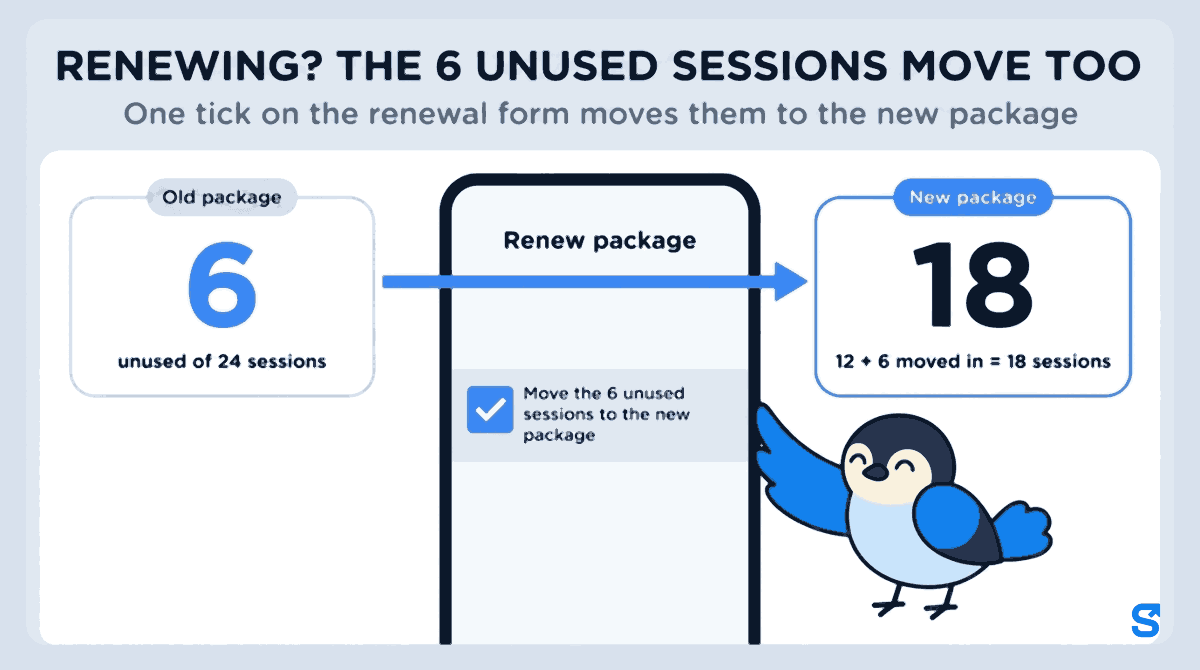
- 6 : unused sessions moved to the new package
- 12 + 6 : the renewal now holds 18 sessions
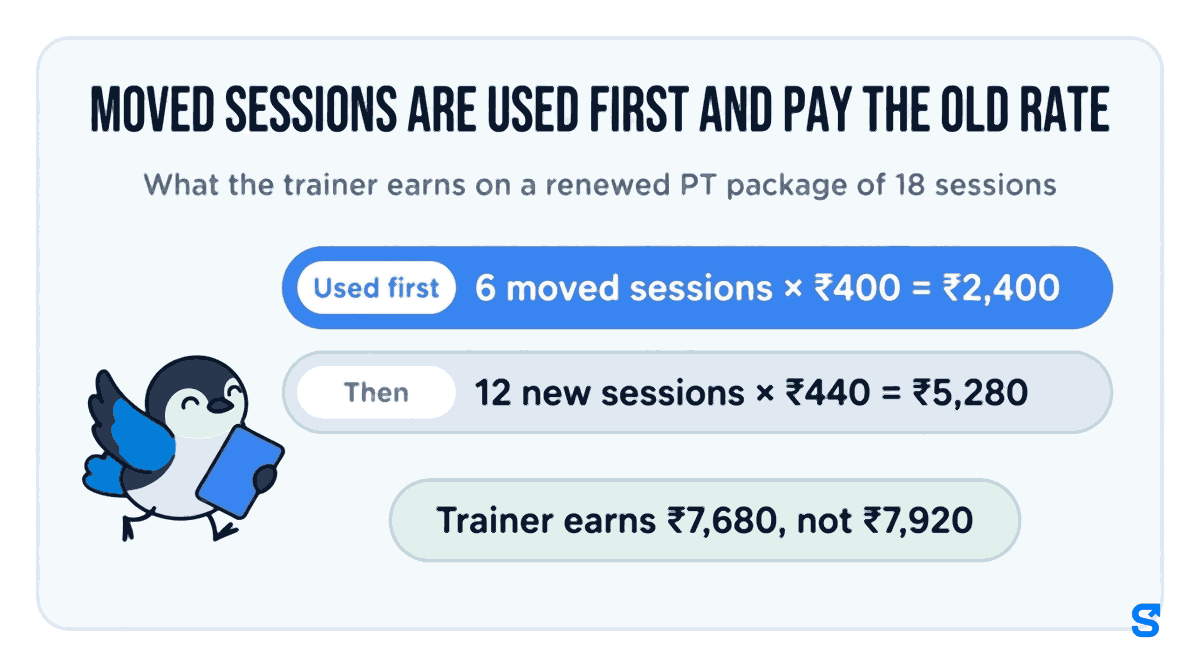
- ₹400 then ₹440 : the trainer's cut on the moved 6, then on the new 12
The first 6 sessions Kabir trains on the renewal are the moved ones, and each pays the trainer ₹400. The 12 after that are the renewal's own and pay ₹440. That is 6 × ₹400 = ₹2,400 and then 12 × ₹440 = ₹5,280, so the trainer earns ₹7,680 across the 18 sessions, not the ₹7,920 that 18 sessions at the new rate would have paid.
Now the case the desk usually misses. If Kabir had paid ₹20,000 of the ₹24,000, only 2 of the 6 unused sessions are paid for. The owner should see that before anything moves, with the ₹4,000 still owed on the old package, and should have to choose to move all 6 anyway rather than find out at the end of the month.
How moving unused sessions works in Shiftelio
Shiftelio's PT packages already count sessions down, work out each session's commission and pay the trainer's cut through payroll. Since September 2026 a renewal can also take over the old package's unused sessions, and the rule above is built into it.
The owner, or a manager whose role has the PT manage tick, renews the client's package. When the old package still has sessions left, the renewal form shows one tick: Move the 6 unused sessions to the new package. It is off until somebody ticks it.
If every unused session is paid for, they move. If some are not, the app says so in one line, for example: Only 2 of them are paid for. ₹4,000 is still owed on the old package. The button then reads Move anyway, and the balance stays owed on the old package, where you collect it as usual.
The renewal shows 6 sessions moved in from the old package, and says they are used first and pay the old package's rate. The old package shows 6 unused sessions moved to the renewal, which count as used there, so nobody can record a session against them twice.
The rules are built into Shiftelio, so they apply whoever is holding the phone:
- All or none. Every unused session moves, or none does.
- The moved sessions are used first, and each pays the trainer the old package's per-session commission, worked out from the price the client actually paid.
- Only onto the renewal of that package, and only once. Nothing moves from or onto a cancelled package, and a session on the old package that is still waiting for an OK has to be decided first.
- Price, sessions and rate are locked on both packages while sessions are moved, because they priced the moved sessions. Undo the move first to change them.
- Undo move puts the sessions back on the old package, as long as none of the moved sessions has been used.
- There is no time limit. If you renewed without ticking the box, the renewal's package page still offers Move them here.
When the trainer is the one who is asked
The client usually asks the trainer, not the owner. So when a trainer sends a renewal for a client from their own phone, the form has its own tick: Ask the owner to move these 6 sessions to the new package. Once the renewal is in place, the ask waits in the owner's inbox under Move unused sessions, with the same line about what is paid for. The owner taps Move them or Don't move, and the trainer is told either way.
The trainer can ask, and only the owner can decide. It is the same split as a paused PT package: the person whose commission depends on the sessions is not the person who approves the change to them.
The product that does this
See how PT packages fit with trainer pay and floor attendance on the gym solutions page.
Questions gym owners ask
Does the client have to renew to keep unused sessions?
In Shiftelio the sessions move onto a renewal of that package, so yes. If you would rather give the client more time instead, extend the end date or pause the package while they are away.
Why not pay the trainer the new rate on the moved sessions?
Because the client paid the old price for them. Commission is a share of what the client paid, so a session sold at ₹1,000 pays 40% of ₹1,000, not 40% of the new ₹1,100.
Can I move only some of the unused sessions?
No. It is all or none. Deciding a number at the desk is exactly the negotiation the rule exists to stop.
What if the client still owes money on the old package?
The app tells you how many of the unused sessions are paid for and how much is owed, before anything moves. You can move them anyway, and the balance stays owed on the old package.
Can I undo it?
Yes, with Undo move on the renewal, as long as none of the moved sessions has been used. After the first one is used, the move stands.
Does the new trainer teach the moved sessions?
Yes. The moved sessions sit on the new package, so whoever teaches the renewal teaches them, at the old package's rate. The old package stays with its own trainer in the history.
Keep reading
Free to use, no signup: HR letter formats.