Weekly Kharchi for Labour: Give the Whole Crew Their Advance From Your Notebook Page
In short
Weekly kharchi is a salary advance. Copy each worker's amount from your notebook page, check the page total, give it in one go and cut it from the pay.
- Kharchi is a salary advance, not a gift and not work cash, so every rupee of it has to come back out of the right person's pay.
- The notebook page is where it goes wrong: one amount copied wrong, one name given twice, one page added up by hand.
- In Shiftelio you tick the whole crew on one Give form, type a different amount for each, and enter the total from your notebook page to catch a mismatch before you give.
Weekly kharchi is an advance on wages: cash you give each worker during the week and cut from the pay they have already earned. The clean way to run it is to give every worker's amount in one go, check it against the total on your notebook page, and let the pay run take each person's cut by itself.
What kharchi is, and why the notebook stops working
On a Thursday evening in a workshop in Ludhiana, the supervisor walks down the line with a notebook. Ramesh wants Rs 2,000 because his rent is due. Suresh wants Rs 1,500. Imran needs Rs 1,000 for his son's school fees. By the time the owner opens the cash box there are six names on the page and Rs 9,500 written at the bottom.
That is kharchi. In factories, construction crews, loading teams and workshops across North and West India, it is the weekly spending money a worker draws against the wages he has already earned. It is not a bonus and it is not a loan with interest. It is his own pay, given early, and it comes back out of his pay at the end of the week or the month.
The money is rarely the problem. The page is. Three things go wrong with it again and again:
- A copied amount is wrong. Rs 1,000 becomes Rs 100 when it moves from the notebook to the salary sheet, and nobody notices until the worker does.
- The same person is paid twice. Suresh took Rs 1,500 from the supervisor at noon and Rs 1,500 again from the owner in the evening, and only one of them was written down.
- The page never reaches payroll. The notebook stays in the supervisor's bag, the salary is paid in full, and the advance is simply lost.
Each of these turns into an argument on pay day, and every argument costs a good worker's trust. The fix is not a better notebook. It is putting the page into the same place the pay is worked out.
Kharchi and the law: an advance is a deduction from wages
Because kharchi is an advance on wages, getting it back is a deduction from wages, and the law limits how much you can deduct.
Under the Code on Wages, 2019, Section 18 lists the deductions an employer may make from wages, and recovery of advances is one of them. The same section caps the total: all deductions in a wage period together cannot exceed 50% of the wages for that period. The Ministry of Labour and Employment says this in one line in its compliance handbook for employers under the four labour codes (checked on 26 November 2026). The PRS Legislative Research summary of the Code on Wages is a readable overview of where that section sits.
What the 50% line means for weekly kharchi. If you pay weekly, the wage period is the week. A worker who earns Rs 4,200 in a week can have at most Rs 2,100 deducted that week, and that Rs 2,100 is shared with every other deduction you make. If the kharchi he took is larger, spread the cut over more than one pay instead of taking it all at once.
Write the advance down the day you give it, with the amount and how you paid it. A written record is what settles the Saturday argument, and it is what an inspector asks to see.
Giving the whole crew their kharchi in one go
In Shiftelio, kharchi goes in as an Advance on pay, on the same Give form you would use for one person. Open Money, go to Advances & loans and tap Give money. The form has three steps: Who?, What for? and Check & give.
Search a name, or pick by department or house and tap Tick everyone shown. For the Ludhiana workshop, the owner picks the Machine shop department and unticks the two people who did not ask this week. The count at the top reads 6 picked.
Choose Advance on pay and a purpose; you can add one called Kharchi once and pick it every week. Under How to split, choose Different for each. Every ticked person gets an empty box, and you copy each amount straight from your notebook page: Ramesh 2,000, Suresh 1,500, Imran 1,000 and so on. A person who did not take anything this week can be removed with one tap, and Give waits while any kept row is still blank.
Enter the figure written at the bottom of the page in Total on my notebook page. Shiftelio adds up the boxes beside it. If they match, you are done. If they do not, the line turns red and says exactly how far apart they are, for example Rs 500 less than your page. In the workshop, Imran's Rs 1,000 had been typed as 500. The owner fixed one box and the line went quiet. It warns, it never blocks: if the page itself was added up wrong, you can still give.
Under How is it cut?, choose Cut in one go for normal weekly kharchi, or Monthly, like a loan for a larger amount. Check & give shows one row per person with the share and the pay it will be cut from. Tap Give Rs 9,500 to 6 people. If you spot a mistake straight after, the confirmation carries an Undo that takes back the whole give while nothing has been cut yet.

If the supervisor gets called away halfway through typing, nothing is lost: the next time the form opens it offers Continue your page with the date of the half-typed page, boxes and page total intact.
Catching the double payment before it happens
The Suresh problem, paid at noon and again in the evening, is the one a notebook can never catch, because the two payments are on two different pages in two different hands.
On the Give form, if the same person was already given the same amount on the same date, the row says so in plain words, for example Suresh was already given Rs 1,500 on 26 Nov. Is this a second one? If Suresh himself had asked for kharchi from his own phone and that request is still waiting, the row asks whether this is the same money. Like the notebook total, these lines warn and never block. A second advance is sometimes real, and you decide.
When a supervisor hands it out, the owner still decides
In many workshops the supervisor or munshi is the one holding the notebook. A manager can be given the right to record advances without the right to approve them. Then the last step reads Ask owner to approve, and nothing counts until the owner says yes.
On the owner's Waiting tab, the pending advances sit in one block. Each row shows the date the money was given, when it was entered and by whom. The owner can tick many at once and tap Approve: a short summary first shows which pay each advance lands in, then one confirm approves the lot. Any advance that should not stand gets Say no with a reason.
Which pay the kharchi comes out of
Every advance says which pay it will be cut from. A business paid monthly sees a line like Cut from December salary. A business that pays weekly sees Cut from the pay on a date, the pay day of the week the cut lands in. In the Ludhiana workshop, which pays on Saturdays, Ramesh's Rs 2,000, Suresh's Rs 1,500 and Imran's Rs 1,000 each read Cut from the pay on 28 Nov. That is the line you read out to a worker who asks when the Rs 2,000 comes back.
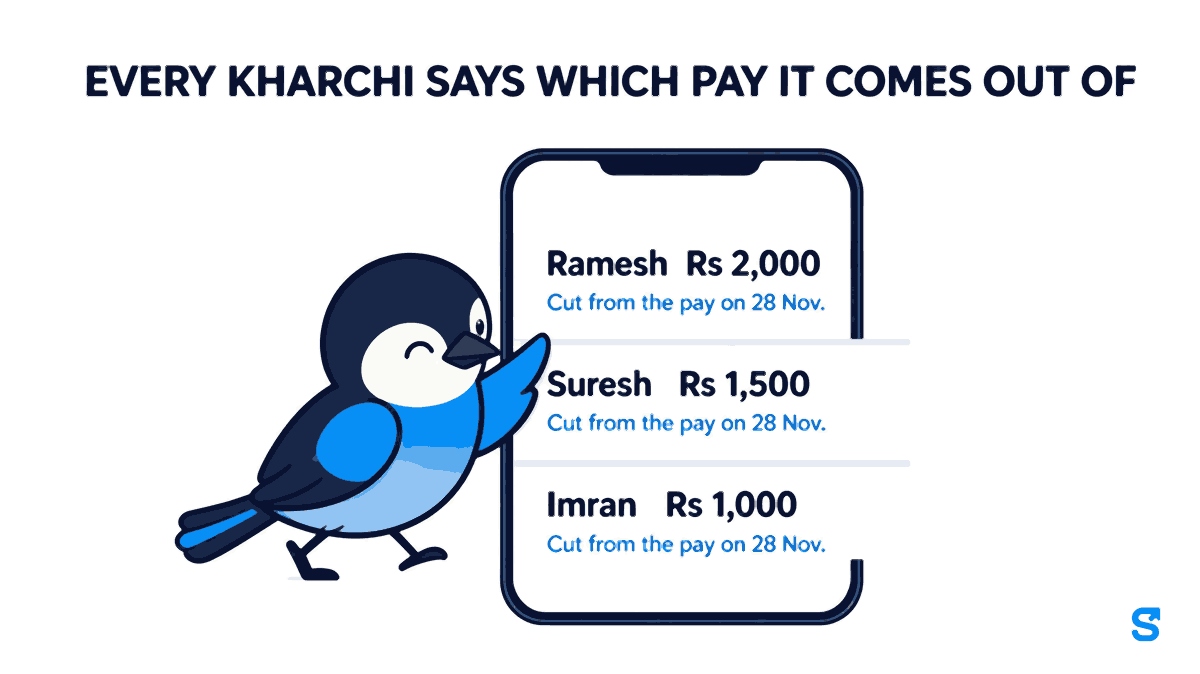
When the pay run for that week or month is worked out, each person's kharchi comes off by itself, and the worker sees the same Salary advance cut on his own payslip in the app. There is no second sheet to copy into, so the Rs 1,000 that became Rs 100 has nowhere to happen.
If you prefer a whole guide to one larger advance, such as a festival advance spread over months, read how to give a Diwali salary advance and recover it from payroll.
Which app records weekly kharchi for the whole crew
Questions owners ask about kharchi
Is kharchi the same as a salary advance?
Yes. Kharchi is a salary advance given in small amounts during the week, against wages the worker has already earned. It is recovered from his next pay, so it should be recorded like any other advance, with the amount, the date and how it was paid.
Can I cut all of the kharchi from one week's pay?
Only if it stays inside the legal limit. Under the Code on Wages, all deductions in a wage period together cannot exceed 50% of that period's wages. If a worker's kharchi is larger than that leaves room for, spread the cut over more than one pay.
What if different workers take different amounts?
That is the normal case. Choose Different for each on the Give form and type each person's amount from your notebook page. Same for each fills only the boxes you have left blank, for the weeks when everybody takes the same.
What is the difference between kharchi and work cash?
Kharchi is the worker's own money given early, so it is cut from his pay. Work cash is money you give for a job, such as buying material or paying a transport bill, and it is settled with bills, not cut from salary. In Shiftelio they are two different choices on the same Give form so they never get mixed up.
Do I still need a paper advance register?
You need a written record of every advance. When the advance is recorded in the app with its date, amount, payment method and the pay it was cut from, that record exists for every worker without copying it from the notebook a second time.
The short version
Kharchi is your workers' own wages, given early. Treat it like an advance, keep every deduction inside the 50% line, and stop copying the notebook page twice. Tick the crew, type each amount, match the page total, and let the pay run take each cut by itself.
Keep reading
Free to use, no signup: Payroll calculators.