Call-Out Policy for Hourly Staff: Call-Outs, No Call No Shows, and How to Log Them
In short
A call-out policy says how and when hourly staff call out, when a missed shift becomes a no call no show, and who records the day off. Here is one to copy.
- A call-out policy answers four questions: how staff call out, how early, to whom, and who records it.
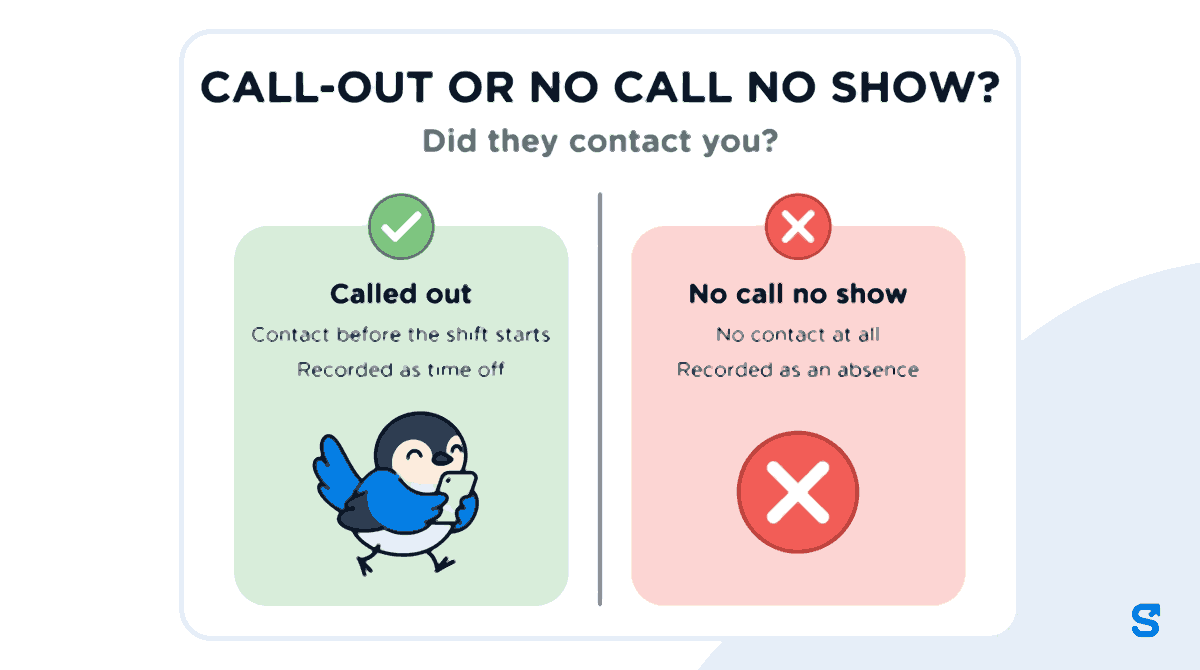
- Draw one clear line: a call-out is contact before the shift starts; a no call no show is no contact at all.
- The manager records the call-out, the same morning, as time off. The employee who is sick should not have to fill in a form.
A call-out policy tells hourly staff exactly how to call out of a shift, how early, and to whom, and it says when a missed shift stops being a call-out and becomes a no call no show. The part most small businesses leave out is the last step: who writes the day down, so the paycheck and the time-off balance are right without anybody chasing it later.
This guide is for owners and managers of restaurants, stores, cleaning crews and home care teams in the US, where a call-out arrives as a phone call or a text an hour before the shift. It gives you a call-out policy you can copy, a clear line between a call-out and a no call no show, what to do when three people call out on the same morning, and how Shiftelio lets a manager log the call-out for the employee in under a minute.
Call-out, late, or no call no show: three different things
Most arguments about attendance start because these three are treated as one. Write them down separately.
| Called out | Late | No call no show | |
|---|---|---|---|
| Did they contact you? | Yes, before the shift | Sometimes | No |
| Are they coming in? | No | Yes, after the start | No |
| What you record | Time off, with the leave type | The late arrival | An absence, and a conversation |
| What you do next | Find cover | Adjust the shift | Call them, then follow your policy |
A call-out is recorded as time off; a no call no show is recorded as an absence. A call-out is a person doing the right thing on a bad day. A no call no show leaves you with an empty station and no idea whether the person is coming at all. Treating both the same way punishes the employee who called, and teaches the team that calling makes no difference.
The five parts of a call-out policy
Say the channel. "Call the manager on duty" is clearer than "let us know". A text to a coworker, a comment in a group chat or a message to the owner who is on vacation is not a call-out, because the person who has to find cover never sees it. If you accept texts, name the number.
Pick a time and put it in writing, for example "at least two hours before your shift starts". For an opening shift, that may mean the night before. Keep it realistic: someone who wakes up with a fever at 5 a.m. for a 6 a.m. shift cannot give two hours, and your policy should say that calling as soon as they can still counts.
Ask only what you need to plan: are you off today, how many days do you expect to be off, and is there anything the next person needs to know. You do not need a diagnosis. Some states limit what you can ask or require, which is covered further down.
The manager does. Asking the sick employee to find their own replacement feels efficient, but it puts the scheduling job on the one person least able to do it, and in some states it is not allowed for paid sick leave.
The manager does, the same morning, before calling around for cover. A call-out that lives only in a text message is the one that turns into a wrong paycheck, a wrong time-off balance and an argument at the end of the month.
A call-out policy you can copy
- To call out, call the manager on duty at the store number, or text it if nobody answers.
- Call at least two hours before your shift starts. If you cannot, call as soon as you can.
- Tell us whether you are off today only, or for how many days.
- You do not need to find your own cover. The manager will arrange it.
- The manager records your time off the same day. You will see it in the app.
- If we do not hear from you within 30 minutes of your shift start, the shift is recorded as a no call no show and we will try to reach you.
- What happens after a no call no show is set out in our attendance policy, and it is the same for everybody.
Change the numbers to fit your business. The point is that every employee reads the same rules, and every manager applies them the same way.
When three people call out on the same morning
Flu season, a stomach bug that went round the kitchen, a storm that closed the roads: call-outs come in groups. A paper notebook or a group chat copes badly with this, because the manager is now making four phone calls for cover and writing nothing down.
The order that works:
- Write down who called and when, as the calls come in.
- Record the time off for all of them in one go, before you start calling for cover.
- Check whose day will be unpaid, because someone who has used up their sick days will want to know before payday, not after.
- Then find cover, from who is free, not from who answers first.
If someone who called out later changes their mind and comes in, cancel their time off rather than leaving both records in place.
How to log a call-out in Shiftelio
In Shiftelio, the manager records the call-out on the employee's behalf from the Leaves screen, with Add leave. It is saved as approved, marked as added by you, and the employee sees it on their phone. Nobody who is sick has to open an app and fill in a request.
Choose One person, Several people, or Everyone at a site. For three cooks who called out, pick Several people and tap their names.
Pick the first and last day. For a single day you can choose Full day or Half day, for someone who went home sick at lunch. Then pick the leave type you set up, for example Sick Leave, and add a note such as "Called out before shift".
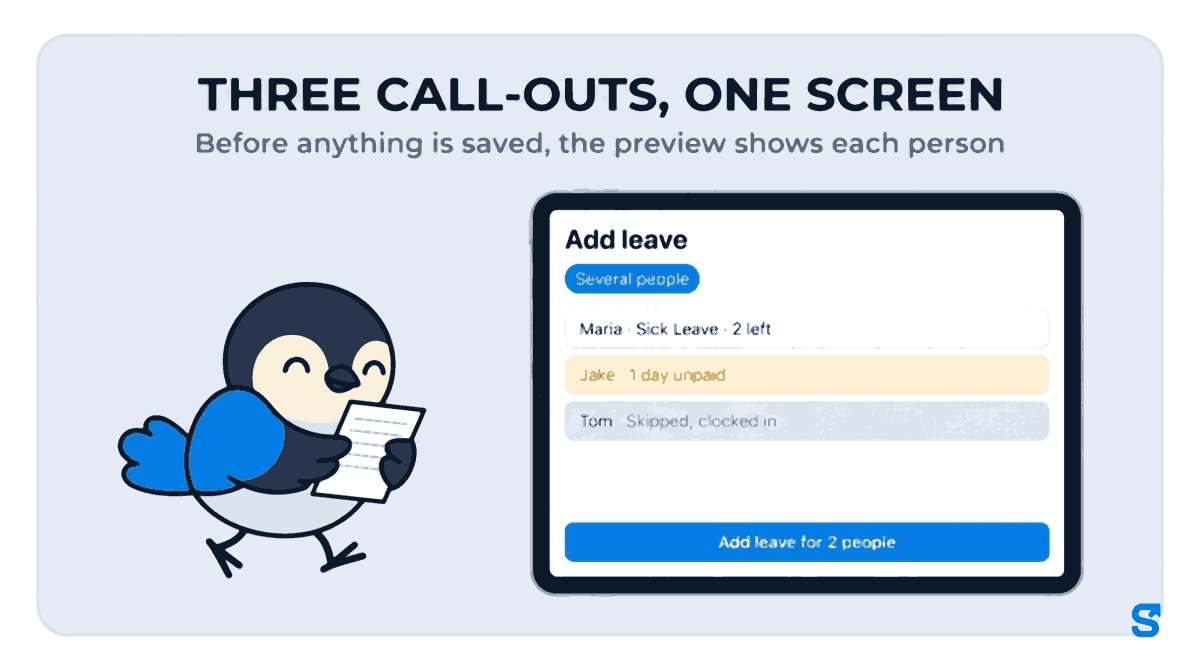
Before anything is saved, the preview shows what happens to each person: how many sick days they have left before and after, and whether any part of the time off goes unpaid because their balance is used up. Weekly days off and holidays inside the dates are not counted as leave. For example, Maria has 2 sick days left after this one, Jake has none left so his day is 1 day unpaid, and Tom is skipped because he clocked in that morning after all.
Tap Add leave for 2 people (the button counts the people who will get it). If someone is skipped, the preview says why, for example because they already clocked in that day or are already on leave. That stops a call-out being recorded for somebody who actually turned up.
If plans change, open the time off in Requests and tap Cancel leave. Staff who know in advance that they need a day off can still ask for it themselves from the app: that side is covered in our guide to a fair time-off request policy for shift teams, and balances in our PTO tracker guide.
What the law says about sick leave: federal and state
This section is a short pointer, not the subject of this article.
Federal. The US Department of Labor's sick leave page says: "Currently, there are no federal legal requirements for paid sick leave." The same page notes that for employers covered by the Family and Medical Leave Act, the Act does require unpaid sick leave. (Department of Labor, sick leave, checked on 14 October 2026.)
State. Several states and cities set their own paid sick leave rules, and they can affect what a call-out policy may say. One example: in California, the Labor Commissioner's paid sick leave page says that since January 1, 2024, employers must generally provide 5 days or 40 hours of paid sick leave a year; that when the need is unforeseeable, the employee need only give notice as soon as practical; and it lists that an employer cannot require employees to find a replacement as a condition for taking paid sick leave. (California Labor Commissioner, paid sick leave, checked on 14 October 2026.)
If you are not in California, look up your own state labor department's page before you write "at least two hours" or "find your own cover" into a policy.
This is general information, not legal advice: check with the agency or an employment lawyer for your case.
Which app lets a manager log a call-out for an employee?
For the rest of the product, see Shiftelio for US businesses and all features.
Questions owners ask
What should a call-out policy include?
A call-out policy should say how to call out, how early, to whom, who finds cover and who records it. Add the point where a missed shift becomes a no call no show, and what happens next.
How much notice should an employee give when calling out?
Most small businesses ask for a set number of hours before the shift, often two. Allow "as soon as you can" for sudden illness, and check your state's sick leave rules, which may limit what you can require.
What is the difference between a call-out and a no call no show?
A call-out is contact with the manager before the shift starts. A no call no show is a missed shift with no contact at all. Record them differently, because they are different behavior.
Can I make an employee find their own replacement when they call out sick?
It depends on the state. California's Labor Commissioner says employers cannot require employees to find a replacement as a condition for taking paid sick leave. Check your own state labor department's page.
Is paid sick leave required by federal law?
No. The Department of Labor says there are currently no federal legal requirements for paid sick leave, although FMLA requires unpaid sick leave for covered employers. Many states and cities have their own paid sick leave laws.
Who should record a call-out, the employee or the manager?
The manager. The employee is sick and will forget or enter the wrong dates. In Shiftelio the manager adds the time off from Leaves with Add leave, and the employee sees it on their phone.
Can I record a call-out for several employees at once?
Yes. In Shiftelio, Add leave lets you pick One person, Several people or Everyone at a site, and the preview shows each person's result before you save it.