Reporting Vacancies to Career Centres in 2026: Form XXV, the Two Clocks, and the Exemption Nobody Claims
In short
Private establishments with 20+ employees must report vacancies to a career centre before filling them. What the Social Security (Central) Rules, 2026 actually require.
There is an obligation in the Code on Social Security, 2020 that almost no Indian employer has heard of, that costs about twenty minutes a year to satisfy, and that carries a right for a government officer to walk into your office and copy your recruitment file. It is the duty to report a vacancy to a career centre before you fill it.
It became operable on 8 May 2026, when the Ministry of Labour and Employment notified the Social Security (Central) Rules, 2026 under G.S.R. 344(E) and brought them into force the same day. The rules supplied what had been missing for five years: a form, a filing route, and two deadlines. Coverage of the Central Rules has concentrated almost entirely on provident fund, employees’ state insurance, gratuity and crèches. Chapter XIII got a line.
This is that line, worked out properly.
What a career centre is, and what happened to the employment exchange
If you have been in business long enough to remember filing an ER-1 return with the local employment exchange, this is the same duty wearing new clothes. The Employment Exchanges (Compulsory Notification of Vacancies) Act, 1959 is one of the statutes subsumed by the Code on Social Security, and Chapter XIII of the Code is where it went.
The Code redefines the institution rather than the obligation. A career centre is any office, place or portal established and maintained by the Central Government for career services, which the Code lists as registration, collection and furnishing of information, whether by keeping registers or otherwise, and expressly whether done manually, digitally, virtually or by any other mode. That last clause is the substantive change. The 1959 Act imagined a counter in a district office. The Code imagines a website, and in practice the website is the National Career Service portal, where employers register as a stakeholder and post vacancies directly.
The distinction that matters operationally. The rules speak of a Career Centre (Regional) and a Career Centre (Central), and they carry different notice periods. Most private employers will only ever deal with the regional one.
Who actually has to report
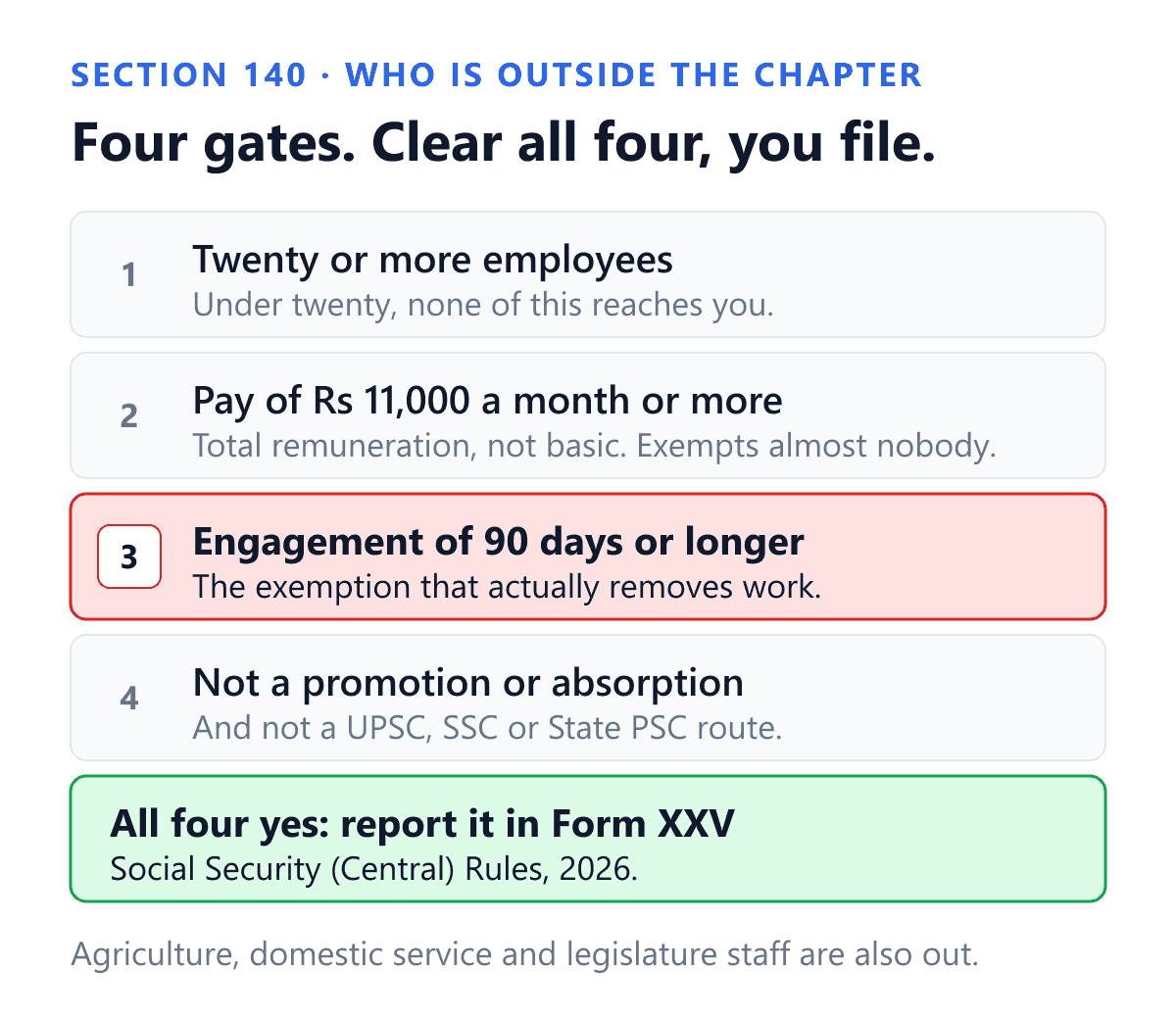
Four gates, and an establishment has to fail all four before it is out. Three of them come from section 140 of the Code, which lists the exclusions from Chapter XIII, and one comes from the rules.
The headline threshold is the familiar one. In the public sector the duty applies to every establishment. In the private sector it applies at twenty or more employees, or such other number as the appropriate Government notifies. Below twenty, Chapter XIII does not reach you at all, and nothing in this article is your problem.
Above twenty, three exclusions can still take an individual vacancy out. Section 140 excludes agriculture other than plantations in the private sector, domestic service, and staff of Parliament or a State Legislature. It excludes vacancies proposed to be filled by promotion or absorption, and vacancies filled through independent recruitment agencies such as the Union Public Service Commission, the Staff Selection Commission or a State Public Service Commission. It excludes employment whose duration is less than ninety days. And it excludes employment carrying a monthly remuneration below an amount the appropriate Government notifies, which the Central Rules set at Rs 11,000.
The exemption everybody quotes is the one that does nothing
Every summary of the Central Rules leads with the Rs 11,000 figure, and it is the least useful number in the chapter. Read it carefully: it is total monthly remuneration, not basic pay, not the wages definition that the labour codes fought over. At a total of Rs 11,000 a month you are below the minimum wage for a skilled worker in most scheduled employments and most states, so in the organised sector almost no full-time role clears it. If your reasoning was “our junior positions are under the limit”, check the gross. They are not.
The exclusion that genuinely removes work is the one nobody prints. Employment of less than ninety days is outside Chapter XIII entirely. A three-week festive season counter, a two-month project engagement, a short site deployment: none of those vacancies has to be reported at all. For a retailer, a caterer or a contractor whose hiring is overwhelmingly short-cycle, that single line can take ninety per cent of the requirement off the table, and it is sitting in the statute unread.
Do not build a policy on it without a record. “Less than ninety days” is a claim about the intended duration of the engagement, and the person who will test it is an inspector reading your appointment letters and attendance a year later. If the letter says the engagement is for sixty days and the attendance shows the person still working in month five, the exemption was never available. Our piece on the appointment letter that is now mandatory for every worker covers the document that has to carry that term.
Two clocks, and everyone conflates them
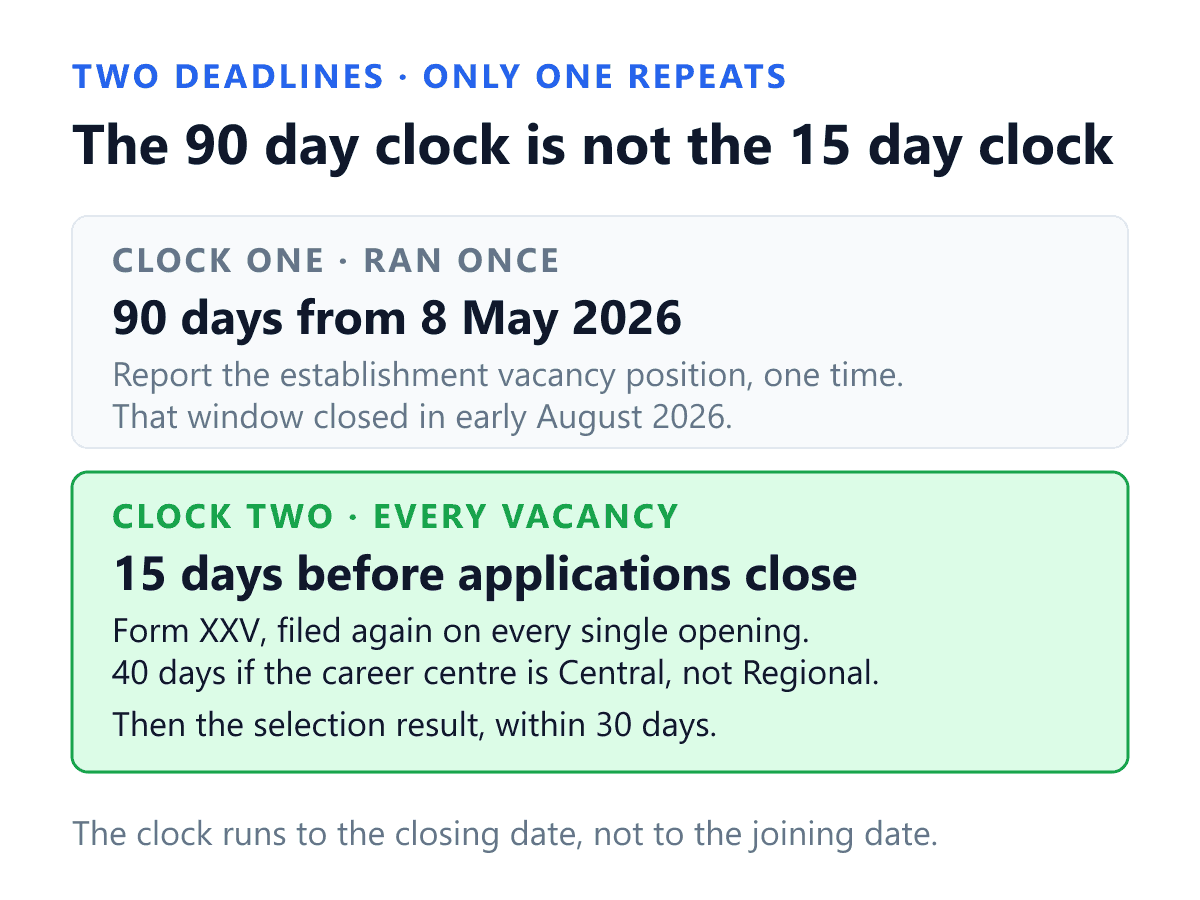
This is the single most common misreading of the new rules, and it matters because the two deadlines have completely different shapes. One is a one-off. The other repeats for the rest of your business’s life.
Clock one: ninety days from notification, once
The Central Rules give every covered establishment, public and private, ninety days from the date of notification of the rules to report its vacancy position to the concerned career centre. The rules were notified and came into force on 8 May 2026. Ninety days from that is early August 2026, which has passed.
If you are reading this in September 2026 and you are a covered central-sphere establishment that has never registered on the portal, you are late, and the remedy is to register and file rather than to wait for the position to become tidier. Nothing about the duty lapses because the window closed; a duty that was not performed on time is simply a duty that is now overdue.
Clock two: fifteen or forty days, on every vacancy, forever
The recurring obligation is the one with teeth. A vacancy is reported in Form XXV, which may be filed manually, electronically or digitally, and it has to reach the career centre with a lead time measured backwards from the closing date for applications:
| Where the vacancy is reported | How far in advance | Measured from |
|---|---|---|
| Career Centre (Regional) | At least 15 days | The last date for receipt of applications |
| Career Centre (Central) | At least 40 days | The last date for receipt of applications |
Read the third column again, because it is not the column an HR team expects. The clock does not run to the date you want the person to start, or the date you make the offer. It runs to the date you stop accepting applications. A manager who decides on a Monday that a role needs filling, advertises it internally, and closes applications on the Friday has already made compliance impossible, no matter how fast the paperwork moves afterwards.
In practice that means the reporting step has to sit at the front of the recruitment process rather than beside it. Then, after the hiring is done, the outcome goes back: the result of the selection has to be reported within thirty days of the date of selection.
And a third filing: the yearly return in Form XXVI
Separately from any individual vacancy, employers furnish a yearly Employment Information Return in Form XXVI to the concerned Career Centre (Regional), within thirty days from the due date. This is the descendant of the old biennial employment return, and it is about the establishment rather than a job: who you employ, in what categories, and what moved during the year.
It is worth noticing that this is the only one of the three filings you cannot do from memory. A Form XXV is written the day the vacancy arises. Form XXVI asks what your headcount did over twelve months, which is a records question, and it lands in the same annual reporting season as the unified return in Form XXIII for gratuity and maternity benefit, due by the end of February. Our guide to the statutory registers and wage slips the labour codes now require covers the underlying records these returns are drawn from.
The sphere question, which decides whether you are actually late
Here is the nuance that turns this from an alarm into a decision, and it is missing from every summary read while writing this piece.
Section 139(1) does not impose the duty directly. It says that the appropriate Government may, by notification, require that an employer, before filling up any vacancy, report that vacancy to such career centre as may be specified in the notification. The duty attaches to a notification that names a career centre. The Central Rules of 8 May 2026 supply the forms and the timelines, and they do that for establishments in the central sphere.
For a business in the state sphere, which is most private employers in most sectors, the operative instrument is the state’s own rules, and those are still arriving. Haryana published draft Code on Social Security (Career Centre) Rules in February 2026. Other states have not published at all. The consequence is uncomfortable but real: two identically sized companies, in the same industry, in different states, can have genuinely different answers to “is this live for me today”.
What to do with that. Do not treat the ambiguity as permission to ignore it. Registering on the portal and filing a Form XXV costs an afternoon once and a few minutes per vacancy afterwards. Establishing whether your state has notified costs a similar afternoon and has to be redone every quarter until it has. The cheaper of the two is to comply. This is the same central-versus-state split that decides which minimum wage applies to you, worked through in our piece on the October 2026 minimum wage revision.
What it costs to get wrong, and the thing that makes it worth doing anyway
Chapter XIII does not carry its own bespoke penalty, so a failure falls to the residual provision. Section 133 of the Code punishes an employer who fails to submit a return, report, statement or other document required under the Code, and who is otherwise guilty of a contravention for which no special penalty is provided, with a fine which may extend to Rs 50,000. First offences punishable with fine only can be compounded, at up to half the maximum.
Fifty thousand rupees is not, by itself, a number that changes behaviour at a company large enough to have twenty employees. The provision that should is one subsection earlier.
Section 139(4) gives an executive officer of a career centre the power to access an employer’s records or documents relating to vacancies, and to enter, at any reasonable time, any premises where he believes such record or document to be, and inspect or take copies of such records. That is a right of entry attached to your recruitment file, exercisable to verify a form you could have filed in twenty minutes. Set against the effort of compliance, the asymmetry is absurd, and that is the whole argument for just doing it.
And the reassurance that removes the usual objection. Section 139(3) states that nothing in the reporting duty imposes any obligation on an employer to recruit any person through the career centre merely because a vacancy has been reported. You report the opening. You hire whoever you were going to hire. The portal is a notification channel, not a recruitment mandate, and the fear that it is one is the main reason employers avoid registering.
A worked example
A Pune manufacturing company employs thirty-four people. In October it needs a quality inspector at a gross of Rs 32,000 a month, permanent, and eight packers for the festive season on a fifty-day engagement at Rs 15,500 a month.
| Vacancy | Gate it hits | Reportable? |
|---|---|---|
| Quality inspector, permanent, Rs 32,000 | Clears 20 employees. Above Rs 11,000. Duration over 90 days. Not a promotion. | Yes. Form XXV, at least 15 days before applications close. |
| Eight packers, 50 day engagement, Rs 15,500 | Above Rs 11,000, but the engagement is under 90 days. | No. Section 140 puts it outside Chapter XIII. |
| A supervisor promoted from the shop floor | Filled by promotion. | No. Expressly excluded. |
One Form XXV, filed fifteen days before the inspector applications close. A selection result filed within thirty days of picking the candidate. A Form XXVI once a year. That is the entire annual burden for a thirty-four person factory, and notice how much of it was decided by the duration of an engagement rather than by its pay.
The part of this that is a records problem before it is a compliance problem
Look back at the four gates and at Form XXVI, and a pattern shows up. Almost every question this rule asks is a question about your own employment records on a specific date, and none of them can be answered from a general impression of the business.
Did the establishment have twenty or more employees when the vacancy arose? That is a headcount on a date, including the people who joined in March and left in July. Is this engagement shorter than ninety days? That is a term in an appointment letter, which has to still exist and still say what you remember it saying. What did employment do across the year, by category, for Form XXVI? That is twelve months of joiners and leavers.
An employer whose staff list lives in a WhatsApp group, a spreadsheet that gets overwritten, and the memory of one long-serving supervisor cannot answer any of the three without reconstructing the year, and reconstruction under an inspection is the worst possible time to discover the records disagree. This is a filing cabinet problem before it is a software problem, and a business that keeps a clean joiner and leaver register in any form is already most of the way there.
What a system buys you is that the register keeps itself. In Shiftelio, every employee carries a joining date, a designation, an engagement type and an exit date, so a headcount on any past date is a query rather than an archaeology project, and the short-duration engagements that section 140 exempts are visibly short rather than notionally short. That is the same records base the labour codes already require for wage registers and appointment letters, which is why it is worth getting right once rather than three times.
What to do this month
- Count. If the establishment is under twenty employees, stop here and re-check when you cross it.
- Find your sphere. Central-sphere establishments are covered by the 8 May 2026 rules now. State-sphere employers should check whether the state has notified its Career Centre rules, and re-check quarterly.
- Register on the National Career Service portal as an employer, whichever answer step two gave. It costs nothing and it is the filing route.
- Move vacancy reporting to the front of your hiring process. Form XXV has to be in at least fifteen days before applications close, so it belongs with the requisition, not with the offer letter.
- Diarise two returns. The selection result within thirty days of selection, and Form XXVI yearly.
- Tag short engagements explicitly in your own records, with the duration in the appointment letter, so the ninety-day exemption is documented rather than asserted.
For the wider picture of what changed when the Central Rules landed, our labour code compliance checklist for 2026 runs through the obligations in the order they bite, and the piece on Shram Suvidha establishment registration covers the registration that has to happen before any of this does.
Sources
Section 139 of the Code on Social Security, 2020, including sub-sections (3) and (4), was read in full at Indian Kanoon. The structure of the Code, its arrangement of clauses and the statutes it subsumes are set out by PRS Legislative Research. Employer registration and vacancy posting are done through the National Career Service portal of the Ministry of Labour and Employment.
The Social Security (Central) Rules, 2026 were notified as G.S.R. 344(E) on 8 May 2026 and came into force the same day. Form numbers, the ninety day window, the fifteen and forty day lead times, the thirty day selection report and the Rs 11,000 floor are consistent across the published analyses of those rules. Where a summary conflicted with the bare Act on section numbering, the Act was preferred.
This is general information about Indian labour law as it stands in September 2026, not legal advice. State rules under Chapter XIII are still being notified and the position in your state may have moved since publication. Check the current notification for your establishment’s sphere, or take advice, before relying on an exemption.
Keep reading
See how Shiftelio does this in practice with the joiner and leaver record a headcount on a past date is read from.
Work your own numbers with the free attendance register template. No signup, no email.