Central Minimum Wages October 2026: Why 1 October Is Probably Not Your Date
In short
Central minimum wages from 1 October 2026 start at ₹840 a day. Who they bind, why your state runs its own date, and the Section 2(y) test that decides it.
Central minimum wages went up on 1 October 2026. The Labour Bureau's orders dated 30 September 2026 raised only the variable dearness allowance, so an unskilled worker in construction, sweeping and cleaning, or loading and unloading in an Area A city must now be paid at least ₹840 a day, up from ₹827. The new rates run until the next revision on 1 April 2027.
Within a day the same headline was on every HR blog in the country. Minimum wages hiked. New rates from 1 October. Check the table.
For most of the businesses that read those posts, the table is not theirs, the date is not theirs, and the number that decides whether they are compliant is not the number they are looking at. All three of those are worth ten minutes, because the penalty for getting the last one wrong has no warning step in front of it.
This article covers what actually changes on 1 October and who it reaches, how to find your own revision date, why a state that is late is more dangerous than a state that is on time, and the arithmetic the Code on Wages asks you to do that almost nobody does.
Looking for the central sphere rates themselves? The full table for every category and area, from the Labour Bureau's order of 30 September 2026, is in CLC minimum wages from 1 October 2026.
Looking for your state's rate? The latest rate each state has actually notified, with its date, is in state minimum wages in October 2026.
What actually changes on 1 October 2026
Minimum wages in India are not one number that moves once. They are a basic rate, fixed rarely, plus a variable dearness allowance recalculated against inflation on a fixed cycle. The basic rate is the policy decision. The VDA is the arithmetic, and the arithmetic is what moves twice a year.
For the central sphere the cycle is set by rule 7 of the Code on Wages (Central) Rules, 2026, notified on 8 May 2026. The cost of living allowance is computed once before 1 April and again before 1 October each year, to revise the variable dearness allowance payable on minimum wages, and the computation runs on the average Consumer Price Index Number for Industrial Workers published by the Labour Bureau.
That is why the April 2026 order carried an end date. The order dated 30 March 2026 raised rates with effect from 1 April 2026 and was expressly good to 30 September 2026. It moved on an increase of 11.28 index points, from 413.52 to 424.80 on the linked series.
The October orders, File No. 6/1/2026-VDA dated 30 September 2026 and signed by the Director General of the Labour Bureau, Chandigarh, moved on a further 6.62 points: the average index reached 431.42 on 30 June 2026. Basic rates did not change; only the VDA did, rounded to the next higher rupee. For construction, sweeping and cleaning, and loading and unloading, the old and new rates per day are:
| Category | Area A | Area B | Area C |
|---|---|---|---|
| Unskilled | ₹827 → ₹840 | ₹693 → ₹704 | ₹556 → ₹565 |
| Semi-skilled and unskilled supervisory | ₹918 → ₹933 | ₹781 → ₹794 | ₹650 → ₹661 |
| Skilled and clerical | ₹1,008 → ₹1,024 | ₹918 → ₹933 | ₹781 → ₹794 |
| Highly skilled | ₹1,094 → ₹1,111 | ₹1,008 → ₹1,024 | ₹918 → ₹933 |
Per day, central sphere. Left of each arrow: 1 April to 30 September 2026, as reported. Right of the arrow: from 1 October 2026, read from the Labour Bureau's October 2026 VDA orders. Watch and ward, agriculture and mines have their own rates; every category is in the full table linked above.
Turned into a month the way the Rules do it, by multiplying the daily rate by twenty six, the unskilled Area A floor moved from ₹21,502 to ₹21,840 a month. That ₹338 is the whole of the October change for that worker, and it applies only if your business is in the central sphere at all.
Whether 1 October is your date at all
This is the question to settle before you look at any table, and it takes one minute.
What the central sphere actually is
The Code on Wages (Central) Rules, 2026 apply to central sector establishments. PRS Legislative Research, reviewing the Rules, lists them as railways, mines, oilfields and banking companies, and establishments carried on by or under the authority of the central government. Contractors working directly for major central government departments are pulled in the same way.
Underneath that sits section 2 of the Code on Wages, which decides the appropriate Government for every establishment. The Central Government is the appropriate Government for its own establishments, railways, mines, ports and public sector entities. For any other establishment, the State Government is.
The practical test. If your business is a shop, a restaurant, a gym, a clinic, a salon, a private factory, a private construction firm, a logistics operator or an agency supplying staff to private clients, you are almost certainly state sphere. The 1 October headline is not about you. It is not irrelevant either, because states watch the central movement, but it does not change your obligation on 1 October.
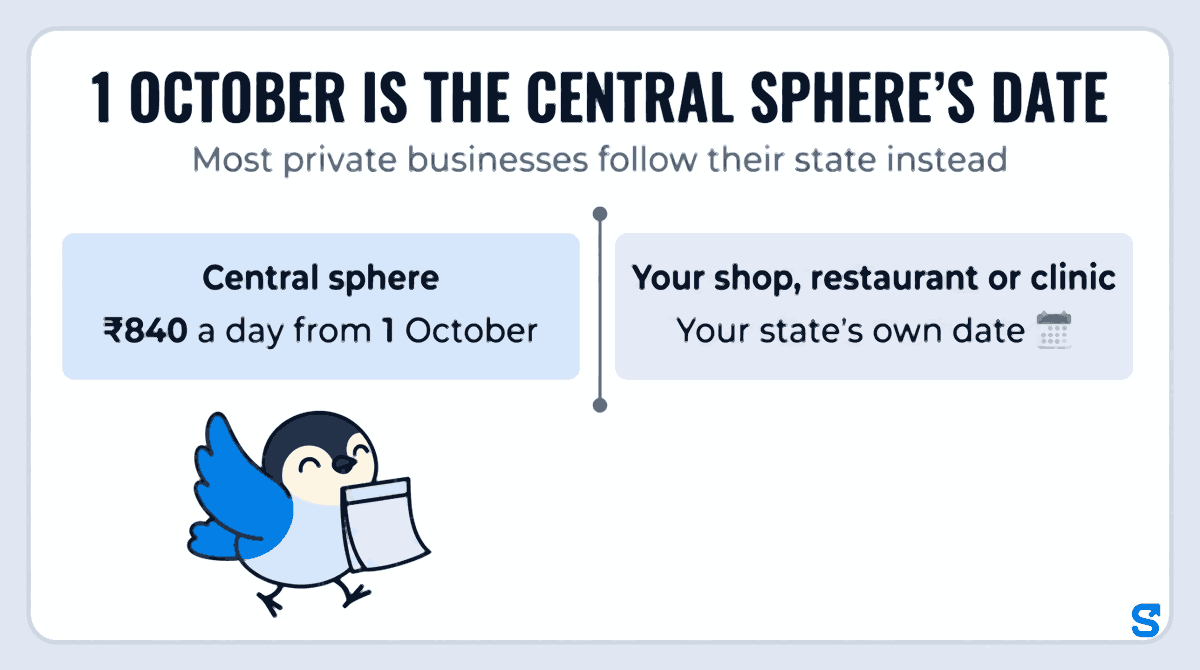
Put as plainly as possible: 1 October is the central sphere's date. In the central sphere that means ₹840 a day from 1 October for unskilled Area A work. For your shop, restaurant or clinic it means your state's own date, because most private businesses follow their state instead.
Your state runs its own clock
Most states do follow an April and October cycle for their VDA equivalent, which is why the central headline feels like it fits. Not all of them do. Maharashtra runs January and July, and its current special allowance rates cover 1 July 2026 to 31 December 2026. Karnataka's current notification runs 1 April 2026 to 31 March 2027, an annual cycle rather than a half yearly one.
So the answer to "when do my minimum wages change" is not a national fact. It is a property of one state and, within that state, sometimes of your scheduled employment and your zone. Maharashtra alone applies its revision across sixty scheduled employments and three zones, where zone one is municipal corporation limits, cantonment areas and industrial areas within twenty kilometres of a corporation limit.
The state that is late is more dangerous than the state that is on time
Here is the part that costs real money, and it is almost never covered, because it is not news. It is the absence of news.
Late, then backdated
Maharashtra declared its revised special allowance rates on 5 August 2026, with effect from 1 July 2026. Read that twice. The rate that governed July payroll was published five weeks after July began, and roughly a month after most employers had already closed and paid July.
Nothing about that is improper. A revision keyed to an index cannot be published before the index exists. But it means the employer who waited for the notification before acting was underpaying for a month by the time it arrived, and owes arrears on a wage period that is closed, reconciled and out the door.
The arithmetic is small per head and unpleasant in aggregate. Suppose the daily rate for your category moves by ₹30 and you had twenty six paid days in July. That is ₹780 per person for one month. Across forty staff it is ₹31,200, on a payroll you have already reported. Those numbers are illustrative rather than Maharashtra's actual movement, but the shape is exactly right, and the shape is what matters: a backdated revision converts a closed month into a liability.
Late, then nothing
Delhi is the other failure mode. Delhi's stated cycle is April and October. As at 5 October 2026, the newest order on the Delhi Labour Department's own page was still the one effective 1 April 2025. Three revision dates, October 2025, April 2026 and October 2026, have passed without new rates being issued.
An employer who assumed the schedule was self executing, budgeted for three hikes and told staff their wages were rising has made a promise the gazette did not make. An employer who noticed nothing has, for now, been paying correctly by accident. And an employer relying on a table found by searching is in the worst position of the three, because the Delhi pages available online do not agree with each other: one publishes ₹18,456 a month for unskilled work in shops and establishments and dates it to 1 April 2025, another publishes a range of ₹19,800 to ₹20,500 and cites no notification at all.
The rule that falls out of both cases. Your compliance position is set by the last notification your state actually published, not by the cycle it says it follows. And because a late notification can be backdated, the risk of a quiet period is not zero. It is a liability accruing invisibly at whatever the eventual rate turns out to be.
The number you compare against the floor is not your gross
This is the finding most likely to change what a reader does today, and it survives every revision date question above, because it is wrong or right regardless of which cycle you are on.
Section 5 of the Code on Wages prohibits an employer from paying an employee wagesless than the minimum rate of wages notified by the appropriate Government. "Wages" is not a loose word there. It is the defined term in section 2(y), and section 2(y) is a definition built out of exclusions.
What it excludes, at clauses (a) to (i): bonus not forming part of the terms of employment, the value of house accommodation and utilities, employer contributions to provident fund or pension, conveyance allowance and travel concession, sums paid to defray special expenses, house rent allowance, remuneration under an award or settlement, overtime allowance, and commission. Gratuity and retrenchment compensation are excluded separately.
Then the proviso that stops the definition being gamed: if the total of clauses (a) to (i) exceeds one half of all remuneration, the excess over one half is added back into wages. This is the fifty per cent rule that HR has been talking about since the codes were notified, and we worked through its effect on pay structures in the article on restructuring CTC for the 50 per cent wage rule.
The Ministry of Labour and Employment addressed the relationship directly in its Additional FAQs on the Labour Codes dated 16 March 2026. Asked whether wages and minimum wages can be treated as the same thing, the answer is:
"No, minimum wages are the statutory wages fixed by the appropriate government. An employer is legally prohibited from paying an employee less than the prescribed minimum wage."
The same document settles two adjacent questions that come up constantly. Overtime allowance forms part of the fifty per cent wage calculation. And for arriving at the fifty per cent, only statutory components such as employer provident fund and pension contributions and statutory bonus are included; gratuity, ESI and other retirement benefits are not. Annual performance based incentives do not form part of wages.
A worked example, because the arithmetic is the point
Take a Delhi shop paying an unskilled worker ₹19,000 a month, structured the way a great many Indian SMEs structure it.
| Component | Amount | Counts as section 2(y) wages? |
|---|---|---|
| Basic | ₹9,000 | Yes |
| House rent allowance | ₹5,000 | No, clause (f) |
| Conveyance allowance | ₹2,500 | No, clause (d) |
| Special allowance | ₹2,500 | Yes, not an excluded head |
| Gross | ₹19,000 | Wages: ₹11,500 |
Run the proviso first, because it can rescue you. Excluded heads total ₹7,500. One half of total remuneration is ₹9,500. ₹7,500 does not exceed ₹9,500, so nothing is added back. Statutory wages stay at ₹11,500.
Now compare. Against a Delhi unskilled floor reported at ₹18,456 a month, this employee is short by ₹6,956 a month, on a gross that sits ₹544 above the floor. The payslip looks compliant. The comparison the Code makes does not.
The consequence for anyone paying near the floor. Because the proviso only ever caps exclusions at one half of remuneration, statutory wages can never be less than half of gross, and can never be more than gross. To clear a floor of ₹18,456 on a gross of ₹19,000, you may exclude at most ₹544. In practice that means allowance heavy structures are simply unavailable for staff paid anywhere near the minimum. They remain available higher up the payroll, which is where the fifty per cent rule bites instead.
One older authority is worth knowing because it is quoted at you in the other direction. In Airfreight Ltd v State of Karnataka (Supreme Court, 4 August 1999), decided under the Minimum Wages Act, the Court held that the minimum rate of wages is one pay package and is not amenable to being split up, and that an employer already paying a total higher than the minimum including the cost of living component need not pay VDA separately. That is a rule about not double counting the dearness component. It is not authority for counting a house rent allowance that the statutory definition excludes, and the definition it was decided against was narrower than section 2(y) is.
The arithmetic when the rate moves inside a wage period
Minimum wages in the central sphere are fixed on a day basis. The Rules then convert: divide the daily rate by eight for an hourly rate, multiply it by twenty six for a monthly rate. There is a third case people miss. For a working week shorter than six days, the hourly rate is used to derive the daily minimum wage, rather than the daily rate simply carrying over.
Twenty six is a deliberate number and it is the source of a great deal of confusion, because the divisor runs in opposite directions depending on what you are computing. Building a monthly floor from a daily rate uses twenty six. Deducting for an unpaid day out of a monthly salary is a different question with a different answer, and we covered why in the loss of pay calculator, which shows the working rather than just the result.
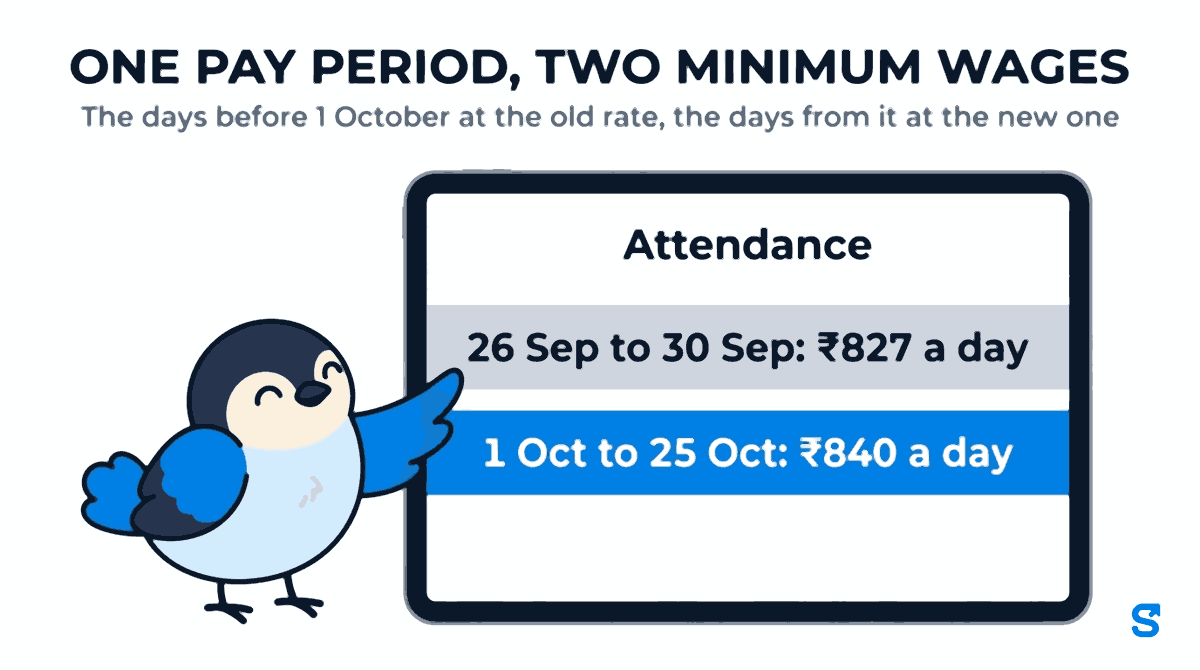
The revision-date arithmetic follows from all of this. When a new rate takes effect part way through a wage period, the period splits at the effective date. Days before it are due at the old rate and days on or after it at the new one. Two situations produce that split routinely:
- A wage period that is not a calendar month. If you run 26 September to 25 October, a 1 October revision cuts straight through it. Five days at the old rate, twenty five at the new. For a central sphere unskilled worker in an Area A city, every day worked from 26 Sep to 30 Sep is paid at ₹827 a day and every day from 1 Oct to 25 Oct at ₹840 a day.
- A backdated notification. The Maharashtra case above. The split has already happened; you are reconstructing it after the fact, for a month you have closed.
Both are ordinary arithmetic and both need the same input: how many days each person actually worked, by date, at a level of detail that survives the month being closed. That is the practical link between a wage floor and an attendance record, and it is covered in more depth in the step by step payroll calculation guide. If overtime is in the picture, note that the overtime rate is built on the wage rate too, so a revision moves it as well; the formula is in the overtime pay article.
What happens if you turn out to be short
Most compliance failures under the labour codes come with a built in second chance. This one does not, and the asymmetry is worth understanding before you decide how much attention the topic deserves.
Section 54(1)(a) of the Code on Wages: an employer who pays an employee less than the amount due under the Code is punishable with a fine which may extend to fifty thousand rupees. Section 54(1)(b): a second conviction for a similar offence within five years is punishable with imprisonment up to three months, or a fine up to one lakh rupees, or both.
Section 54(3) is the provision that usually softens all this. It requires the Inspector-cum-Facilitator to give the employer a written direction and a period to comply before launching a prosecution. Read what it attaches to: contraventions under clause (c) and under sub-section (2). Underpayment sits in clause (a), and clause (a) is not in that list.
Two consequences, and the second is the one people do not see coming. First, there is no statutory warning letter for paying below the minimum. Second, PRS reports that rule 50(1) of the Code on Wages (Central) Rules, 2026 bars an employer from appealing a decision on a claim unless the claim amount has been deposited with the appellate authority, and flags that as possibly going beyond the power delegated by the parent Code, which imposes no such condition. Whether or not that survives challenge, the operating assumption for now is: contest a wage claim and you fund it first.
The floor wage that was supposed to make this simpler
One more thing to know, because it explains why none of the above resolves into a single national number you could just look up.
Section 9 of the Code on Wages requires the Central Government to fix a floor wage on the basis of the minimum living standards of a worker, and no minimum wage fixed by any government may be lower than it. That is the provision quoted in nearly every explainer about the codes raising wages.
It is not yet operative. Rule 10 of the 2026 Rules says the floor wage will be decided on minimum living standards including food, clothing, housing and other appropriate factors, may be revised every five years, and may be adjusted for cost of living variation. It does not specify the norms, and it does not say how geographic differences feed in. PRS notes the gap directly.
The gap is not an oversight of drafting so much as a decision. The draft Rules circulated for consultation on 30 December 2025 did contain a detailed method: three consumption units, a calorific requirement of 2,700 calories per adult per day, housing rent at ten per cent of food and clothing expenditure, and fuel, lighting and miscellaneous items at twenty per cent of minimum wage. Those are the 15th Indian Labour Conference norms of 1957, reaffirmed at the 44th and 46th conferences and endorsed by the Standing Committee that reviewed the Code. None of it appears in the final Rules of 8 May 2026. The criteria for calculating minimum wages themselves were also left out, deferred to a special or general order the Central Government has not yet issued.
In August 2026 the Ministry began the exercise of fixing the first binding national floor wage, revising the consumption basket and constituting the Central Advisory Board of employers, employees, independent members and five state governments. Until that finishes, the practical position is the one this article started from: your obligation is whatever your state last notified, and there is no national backstop underneath it.
What this asks of your records, and why most payroll cannot answer it
Step back and look at what an employer needs to hold in order to answer the minimum wage question at all. It is a short list and it is not the list payroll software is usually built around.
- Wage components separated, not just a gross figure. The section 2(y) test cannot be run on a single number. It needs each head, tagged as included or excluded, so the one half proviso can be applied.
- A rate history with effective dates. Not the current rate. The rate that applied on each date, so a period can be recomputed when a notification arrives late.
- Attendance by date, retained after the month is closed. A backdated revision asks how many days each person worked in a month you have already paid. A monthly total will not split at an effective date.
- Skill category and location per employee. The floor is not one number; it varies by category and by zone or area, and both are attributes of the person, not of the company.
Most SMEs hold none of this in a form that survives the month. Attendance is in a register or a chat group, wages are a gross figure in a spreadsheet, and the rate that applied in July is whatever someone remembers. When a notification lands in August with effect from 1 July, the reconstruction is manual and the arrears calculation is a guess.
This is the gap Shiftelio is built for, and it is worth being precise about what software does and does not do here. No product tells you your state has notified a revision, and none of this is a minimum wage feature. What it does is make the recomputation ordinary: attendance is stored per person per day and stays that way after payroll closes, salary is held as components rather than one gross figure, and each employee carries their own designation and location. So when a rate moves, including a rate that moved six weeks ago, working out who is owed what for which days is a query against records you already have, rather than an evening with last quarter's registers.
Which app keeps attendance by date after payroll closes?
A checklist for this month
- Establish your sphere. Railway, mine, oilfield, banking company, or an establishment under central government authority: central sphere, and 1 October is your date. Anything else: state sphere. Do this first, because everything below depends on it.
- Find the last notification your state actually published, with its date and its effective period, and put a copy in a file. Not a blog table. The notification.
- Check whether a revision date has passed without one. If so, assume a backdated notification is possible and do not spend the difference.
- Rerun the comparison on section 2(y) wages, not on gross. Total your excluded heads, check them against one half of remuneration, add back any excess, and compare what is left to the floor for that person's category and area.
- Look hardest at your lowest paid staff on the most structured pay. The failure mode is a gross figure above the floor with an allowance heavy structure underneath it. That is where the shortfall hides.
- Check the divisor you use. Daily to monthly is twenty six. A working week shorter than six days derives the daily rate from the hourly rate, and that is easy to get wrong.
- Confirm you can split a wage period at a date. If your wage period is not a calendar month, or if arrears ever have to be computed, this is not optional.
- Keep attendance at day level after payroll closes. It is the only input a backdated recomputation needs that you cannot reconstruct later.
- Budget for the movement rather than the announcement. Whichever cycle you are on, an increase is coming; a business that has not priced it will meet it as a cash event.
The short version
The 1 October 2026 revision took the central sphere unskilled Area A rate from ₹827 to ₹840 a day. It is a central sphere event, governed by rule 7 of the Code on Wages (Central) Rules, 2026, and it reaches railways, mines, oilfields, banking companies and establishments under central government authority. If you run a shop, a restaurant, a site or a clinic, your appropriate Government is your state and your date is whatever your state says it is, which is January and July in Maharashtra and April to March in Karnataka.
A schedule is not a promise in either direction. Maharashtra notified on 5 August 2026 with effect from 1 July, which creates arrears on a closed month. Delhi has passed three revision dates without notifying at all. The safe assumption is that a quiet period is a liability accruing, not a saving.
And the comparison that decides compliance is between the notified floor and section 2(y) wages, which exclude house rent and conveyance allowance unless the excluded heads pass one half of remuneration. A ₹19,000 gross can be six thousand rupees short of an eighteen thousand rupee floor. There is no warning letter for getting that wrong, and on the current Rules you deposit the claim before you may appeal it.
Keep reading
See how Shiftelio does this in practice with attendance kept per person per day, and salary held as components rather than one gross figure.
Work your own numbers with the free loss of pay calculator, which shows the divisor working. No signup, no email.