ESI Contribution Period 2026: What Happens When a Salary Crosses Rs 21,000 Mid-Year
In short
A raise past the ESI ceiling in June does not end coverage. Contributions run to 30 September, on the full wage. And the Rs 21,000 figure itself has a date on it.
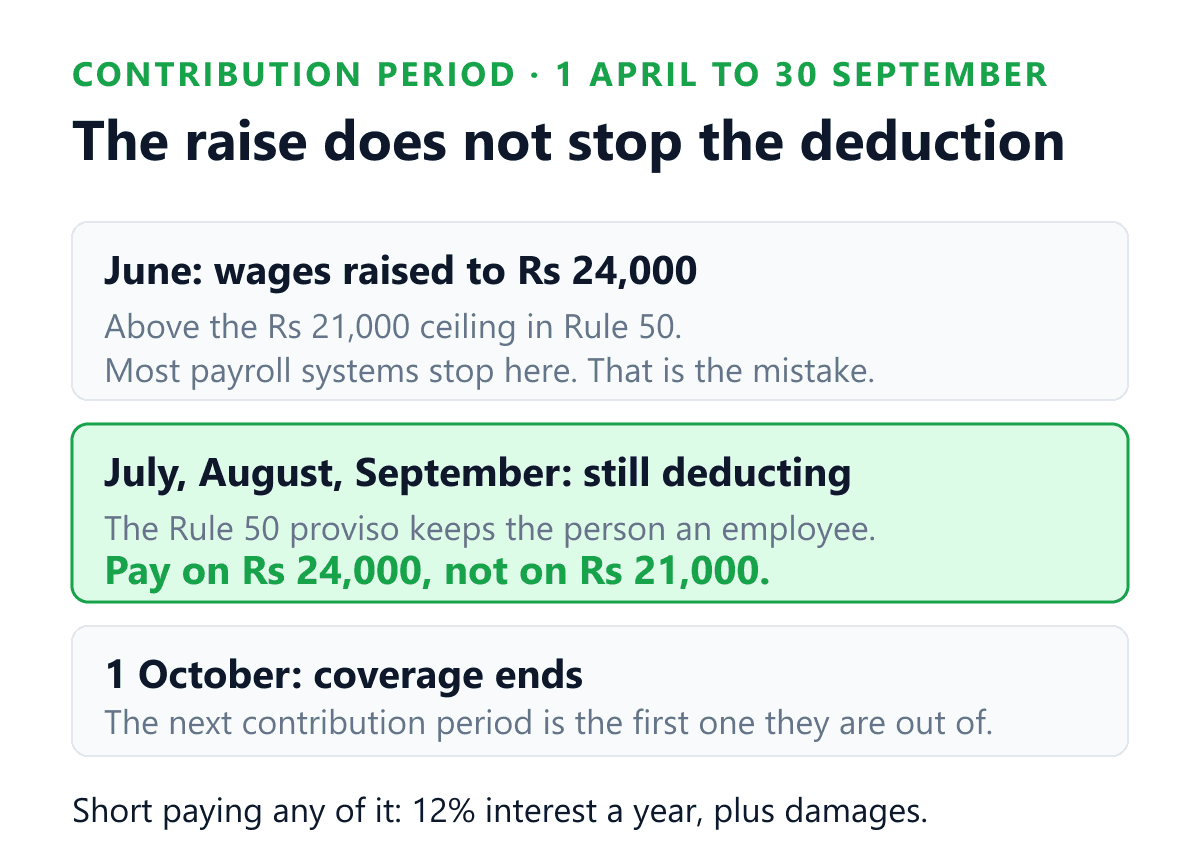
In June you gave one of your people a raise, from Rs 19,500 to Rs 24,000. Your payroll software noticed that the new figure is above Rs 21,000, and from July it stopped deducting ESI for that person. It looked right. Everybody you asked said the same thing: above the ceiling, out of ESI.
It is wrong, and the month it becomes expensive is this one. That person was still an insured employee in July, in August, and is still one now. The contribution was payable for all three months, on the full raised wage and not on Rs 21,000, and it stops only on 1 October. Three months of short payment on one employee is not a big number, but it carries twelve per cent simple interest for every day of delay and damages on top of that, and neither of the two amnesty schemes running in India right now will touch it.
This is the first thing to fix before 30 September. The second thing is longer term and almost nobody has noticed it: the Rs 21,000 figure itself is written in the rules of an Act that was repealed last November, and the clause keeping those rules alive expires on 20 November 2026.
The ESI Act does not exist any more
Start here, because everything else follows from it. Section 164(1) of the Code on Social Security, 2020repeals nine enactments by name, and the second on the list is the Employees’ State Insurance Act, 1948. That repeal took effect on 21 November 2025 along with the rest of the Codes.
ESI now lives in Chapter IV of the Code. The Corporation is still the ESIC, the money still goes to the same place, and to a business owner nothing visible changed. What changed is where each rule you rely on is written down, and some of them are now in places with expiry dates on them.
The clearest example: grep the printed text of the Code for the phrase "contribution period". It does not appear. Not once, in a 100-page statute that governs a scheme organised entirely around contribution periods. The concept survives in Regulation 4 of the ESI (General) Regulations, 1950, and that is subordinate legislation made under the repealed Act.
The 30 September cut-off, and what it actually does
Regulation 4 sets two contribution periods and pairs each with a benefit period. The pairing is the part that explains why the rule exists at all.
| Contribution period | Corresponding benefit period |
|---|---|
| 1 April to 30 September | 1 January of the following year to 30 June |
| 1 October to 31 March of the following year | 1 July to 31 December |
Contributions made now buy medical and cash benefits that start months later. That is why a person cannot be dropped out of the scheme in the middle of a period: the benefit they are already accruing towards has not started yet, and their family may be in the middle of treatment.
So the rule is written into the ceiling itself. Rule 50 of the ESI (Central) Rules, 1950 fixes the wage limit at twenty-one thousand rupees a month, and then adds:
"Provided that an employee whose wages (excluding remuneration for overtime work) exceed twenty-one thousand rupees a month at any time after and not before the beginning of the contribution period, shall continue to be an employee until the end of that period."
Read the two halves. After and not before. If somebody was already above Rs 21,000 on 1 April, they are outside ESI for the whole of this period and there was never anything to deduct. If they crossed it on any day from 2 April onwards, they stay in until 30 September.
The second mistake: capping the contribution at Rs 21,000
The first mistake is stopping the deduction in July. The second is subtler and shows up in businesses that got the first part right: they keep deducting, but they compute 3.25 and 0.75 per cent on Rs 21,000 rather than on the Rs 24,000 actually paid.
There is nothing in Rule 50 or in Rule 51 that caps the contribution base. Rule 51 fixes the contribution as a percentage "of the wages payable to an employee", full stop. Rs 21,000 is a test for whether the person is in the scheme, not a lid on what you pay once they are. On Rs 24,000 the employer share is Rs 780 a month and the employee share Rs 180; capping at Rs 21,000 pays Rs 682.50 and Rs 157.50 and leaves you Rs 120 a month short per head, quietly, indefinitely.
Short payment is treated exactly like non-payment. It is arrears, and arrears carry interest and damages.
What late or short ESI actually costs
Three separate charges stack, and only the first is the money you already owed.
The contribution itself. Regulation 31 gives you fifteen days from the last day of the calendar month in which the contribution fell due. That is the familiar 15th.
Interest. Regulation 31A: "simple interest at the rate of 12 per cent per annum in respect of each day of default or delay". Per day, from the day it was due. Section 127 of the Code carries the same idea forward in general terms, at a rate the Central Government notifies.
Damages. Regulation 31C sets a slab by how long you were late, and section 128 of the Code caps the whole thing at "an amount not exceeding the amount of arrears".
| Period of delay | Maximum damages, per annum, on the amount due |
|---|---|
| Less than 2 months | 5% |
| 2 months and above, less than 4 | 10% |
| 4 months and above, less than 6 | 15% |
| 6 months and above | 25% |
Note the shape of that table. The jump from the third row to the fourth is ten points, and it lands at six months. A short payment that started in July crosses into the second slab in the autumn and the fourth slab next January. Fixing it in September and fixing it in February are not the same decision.
Section 128 requires the employer to be "given an opportunity of being heard" before damages are levied, so this arrives as a notice you can answer, not as a debit. And on 8 May 2026 the Central Government notified, by S.O. 2362(E), which ESIC officers may act as compounding officers under section 138 for Chapter IV matters. The machinery is being switched on, not wound down.
The money you deducted is not your money
One provision is worth knowing on its own. Section 31(4) of the Code says any sum deducted by the employer from wages "shall be deemed to have been entrusted to him by the employee for the purpose of paying the contribution in respect of which it was deducted".
That is trust language, and it is deliberate. Failing to pay the employer’s own share is a debt. Deducting the employee’s share from their wages and then not depositing it is holding somebody else’s money, and it is why the penalties on that limb are the harshest in the chapter. If cash is tight and you are choosing what to remit, this is the one you remit.
The ceiling test is on "wages", not on gross pay
Here is where most of the borderline cases are actually decided, and it runs the opposite way to everyone’s instinct.
Section 2(88) of the Code defines wages as all remuneration, and then excludesa long list: house rent allowance, conveyance allowance, overtime allowance, commission, the employer’s own PF contribution, gratuity, and more. The first proviso then claws back: if the excluded items add up to more than one half of all remuneration, the excess is deemed to be remuneration and added back into wages.
So a person your payroll system prints at Rs 24,000 gross, made up of Rs 14,000 basic, Rs 6,000 HRA, Rs 2,000 conveyance and Rs 2,000 overtime that month, is not obviously above the ceiling. Strip the excluded heads and the wage figure is Rs 14,000, well inside ESI. The exclusions total Rs 10,000 against Rs 24,000 of all remuneration, which is under one half, so nothing is added back. That person is covered and probably is not being deducted for.
Rule 50’s proviso says the same thing in miniature by excluding overtime remuneration from the crossing test specifically. A big overtime month must not be allowed to push somebody out of the scheme.
The practical consequence. Employers looking for people to remove from ESI usually go down the gross-pay column. That is the wrong column. Restructure a salary to comply with the fifty per cent rule, which the Codes push everyone towards anyway, and statutory wages go up, so people move out of ESI as a side effect of a change you made for a different reason. See the salary structure piece for what that rule does to the rest of the payslip.
Who has to be registered at all now
Under the old ESI Act, the scheme only bit in areas the Government had notified. Whole districts were outside it, and a small employer there could run for twenty years without ever hearing from ESIC. That geography is gone. The First Schedule to the Code, read with section 1(4), sets the applicability of Chapter IV as:
"Every establishment in which ten or more persons are employed other than a seasonal factory", with a proviso extending it to an establishment carrying on a hazardous or life-threatening occupation notified by the Central Government "in which even a single employee is employed".
Three things in that sentence that repay attention.
It says persons, not employees. Compare the row directly above it in the same table: Chapter III, provident fund, is "every establishment in which twenty or more employees are employed". Two adjacent rows, two different nouns. "Employee" is the word the wage ceiling is attached to, by the first proviso to section 2(26). "Persons employed" carries no such qualification. And in case the point was missed, the second proviso to section 2(26) says it outright: for counting employees for coverage, "the employees, whose wages are more than the wage ceiling so notified by the Central Government, shall also be taken into account".
So a twelve-person design studio where nine people earn Rs 40,000 is covered by Chapter IV. Nine of them will never contribute a rupee. Three of them must be insured, and the establishment must be registered. Counting only the people below the ceiling is the commonest way to conclude, wrongly, that you are out.
It counts people, not payroll rows. Contract staff engaged through a contractor are employed in your establishment. This is the same counting problem the crèche threshold and the POSH committee threshold turn on, worked through in the crèche piece and the POSH piece. If your headcount answer comes from the payroll system, it is the wrong answer, because the payroll system was never asked to list people it does not pay.
Once in, always in. Section 1(8): where a Chapter applies at the first instance it "shall continue to be applied thereafter even if the number of employees therein at any subsequent time falls below the threshold". Going from eleven people to eight does not deregister you. This is a one-way door and it is not widely known.
Covered and liable are two different dates
The third proviso to that same First Schedule row is the one nobody quotes, and for an employer in a district ESIC has never operated in, it is the only sentence that matters. Contribution is payable under section 29:
"on and from the date on which any benefits under Chapter IV relating to the Employees State Insurance Corporation are provided by the Corporation to the employees of the establishment and such date shall be notified by the Central Government."
The logic is fair: ESI is insurance, and you should not be charged premiums in a place where the Corporation cannot yet deliver the medical benefit. But it means coverage under the Schedule and the duty to contribute do not begin together, and the second one waits on a notification. Lakshmikumaran & Sridharan, reviewing the position, note that this benefit-commencement date has not been formally notified, which leaves the contribution obligation in newly covered areas in an odd state.
This is not a licence to do nothing. Registration and coverage are not the same as contribution, the notification can name a retrospective date, and section 1(8) means there is no way back out. If you are at ten or more people in an area ESIC has not historically covered, get registered and ask your regional office in writing what the position on contribution is for your establishment. A written answer costs nothing and is the only thing that will help you later.
The Rs 21,000 figure has an expiry date attached
Now the longer-term point, and it is a genuine drafting problem rather than a scare.
Section 2(89) of the Code defines the wage ceiling as "such amount of wages as may be notified by the Central Government, for the purposes of becoming a member under Chapter III and Chapter IV". A notified figure, then. For provident fund a figure has been notified. For Chapter IV, none has.
The number twenty-one thousand appears in exactly one place: Rule 50 of the ESI (Central) Rules, 1950. And read how Rule 50 opens. It fixes the wage limit "for coverage of an employee under sub-clause (b) of clause (9) of Section 2 of the Act". It is anchored to a section of a statute that no longer exists.
What keeps it alive is section 164(2)(b), which says the rules, regulations and schemes made under the ESI Act, 1948 "shall remain in force, to the extent they are not inconsistent with the provisions of this Code for a period of one year from the date of commencement of this Code". One year from 21 November 2025 is 20 November 2026. That is about ten weeks from now.
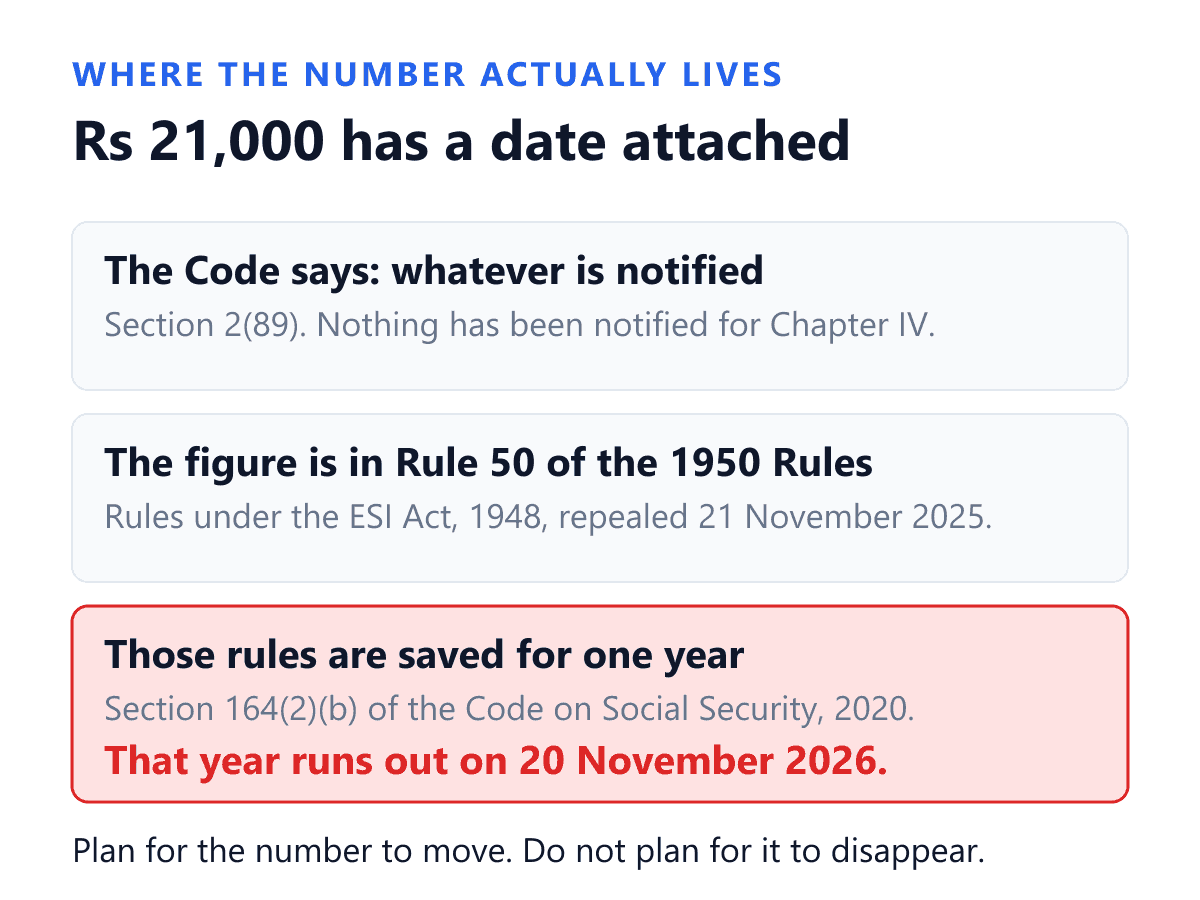
What this does not mean. It does not mean ESI stops on 21 November 2026, and it does not mean the ceiling vanishes. Section 164(2)(a), immediately above, is drafted much more broadly: anything done under a repealed enactment, including any rule, regulation or notification, is deemed to have been done under the corresponding provisions of the Code and stays in force "till they are repealed", with no year attached. So the Code contains both an open-ended saving and a one-year one, and the one-year clause is the one that names ESI subordinate legislation specifically.
Which governs is not settled by any ruling, and it may well be answered administratively long before anybody argues it, by the Central Government simply notifying a ceiling under section 2(89). Industry bodies have been pressing for Rs 25,000 or Rs 30,000 for some time, and no notification has issued.
Lakshmikumaran & Sridharan, who looked at this in detail, record that no corresponding wage-ceiling provision appears in the Social Security (Central) Rules, 2026, which is the natural place a replacement would have gone and which does carry the contribution rates. That absence is theirs, not ours; the Rule 50 half of it is checked directly against Rule 50.
What to actually do about it. Nothing dramatic. Budget on the basis that the ceiling can move, most plausibly upward, and that a move would pull a band of employees you currently do not contribute for into the scheme at 3.25 per cent of their wages. Do not budget on the basis that it disappears, and do not deregister anybody on 21 November on the strength of an argument about which saving clause wins.
The amnesty has already closed
If any of the above has made you realise you should have registered years ago, the obvious next question is whether there is a scheme that lets you come clean cheaply. For PF there is, right now. For ESI there was, and it is shut.
SPREE, the Scheme to Promote Registration of Employers and Employees, ran from 1 July 2025 to 31 December 2025 and was extended by one month, to 31 January 2026. An establishment registering inside that window faced no demand for past contributions, no inspection of the prior period, and no requirement to produce old records. That is as clean a slate as Indian social security law has ever offered, and the window has been closed for seven months.
Registering today means the ordinary machinery: arrears for the period you should have been covered, interest under Regulation 31A, and damages on the 31C slab, with the six-month band at 25 per cent doing most of the damage on an old default.
VISHWAS is not an ESI scheme. The settlement window open until 28 December 2026 is a provident fund scheme, dealing with damages for delayed PF remittances. It does nothing for ESI arrears. If you have both problems, only one of them currently has a discount attached. See the VISHWAS piece for what that scheme does and does not reach.
Two details worth having
Below Rs 176 a day, the employee pays nothing.Rule 52 exempts an employee from paying the employee’s share where average daily wages in a wage period are up to and including Rs 176. The employer’s 3.25 per cent is still payable in full. On low-wage rosters this comes up constantly and is almost never applied, so the deduction is taken from people who are exempt from it.
Disability raises the ceiling.The second proviso to Rule 50 sets the wage limit at twenty-five thousand rupees a month for a person with disability within the meaning of the 1995 and 1999 Acts. Rule 51A goes further and provides that the employer’s share for such employees is reimbursed to the Corporation by the Central Government, subject to the conditions there.
The attendance record decides the answer
Everything above is a question asked of a monthly figure, and a monthly figure is days worked.
A person on Rs 21,500 is outside ESI in a full month and can be inside it in a month with four unpaid days, because the wages actually payable that month fall under the ceiling. The contribution base moves with loss of pay, half-days, and the difference between a week the person was on site and a week they were not. You cannot compute a contribution, or answer the ceiling question honestly, from an offer letter. You can only do it from a closed day-by-day record of who worked, on which days, for how long.
The other half is the headcount. Ten or more persons employed, contractor staff included, at each place you operate, not ten names on a payroll list. Businesses that run one site on their own staff and a second on a labour contractor routinely count the first and forget the second.
This is the ordinary case for keeping attendance somewhere that closes the month on time and holds the closed month afterwards. Shiftelio is built around exactly that: a check-in per person per day tied to a site, a month that closes into a wage figure rather than into a WhatsApp scroll, and a headcount that counts the people who are on site rather than only the people on your own payroll. It will not tell you what the law is. It will mean that when somebody asks what a given person was paid in August, the answer takes a minute rather than an afternoon.
If you want the arithmetic checked, the free PF and ESI calculator takes a wage figure and returns both shares, and the loss of pay calculator is the step before it when the month was not a full one.
What to check before 30 September
- Pull every employee whose wages rose above Rs 21,000 on or after 2 April 2026. Every one of them should still be contributing, and through September.
- For each of those, check the contribution was computed on the actual wage, not capped at Rs 21,000.
- Check nobody was dropped because a single big overtime month pushed their gross over the line. Overtime remuneration is excluded from the crossing test by Rule 50 itself.
- Re-run the ceiling test on statutory wages under section 2(88), not on printed gross. Expect some people to move into the scheme.
- Count persons employed at each location, contractor staff included, and compare against ten.
- If you find arrears, fix them this month. The damages slab steps up at two, four and six months.
Frequently asked questions
My employee’s salary crossed Rs 21,000. Do I stop ESI?
Not immediately. If the wages crossed the ceiling at any time after the contribution period began, the proviso to Rule 50 of the ESI (Central) Rules, 1950 keeps that person an employee until the period ends. For a crossing between 2 April and 30 September 2026, contributions run to 30 September and coverage ends on 1 October. If they were already above Rs 21,000 before 1 April, there was nothing to deduct in the first place.
Do I contribute on Rs 21,000 or on the full salary?
On the full wages payable. Rule 51 fixes the contribution as a percentage of the wages payable to the employee and sets no cap. Rs 21,000 decides whether the person is in the scheme; it does not limit the base once they are.
What are the ESI contribution periods in India?
Two: 1 April to 30 September, and 1 October to 31 March. Regulation 4 of the ESI (General) Regulations, 1950 pairs them with benefit periods running from 1 January to 30 June and 1 July to 31 December respectively. Someone becoming an employee for the first time starts a contribution period from the date of employment, with the benefit period beginning nine months later.
Is the ESI wage ceiling changing in 2026?
Nothing has been notified. The figure of Rs 21,000 sits in Rule 50 of the 1950 Rules, kept in force by section 164(2)(b) of the Code on Social Security, 2020 for one year from 21 November 2025. Section 2(89) of the Code contemplates a ceiling notified by the Central Government, and no notification has issued under Chapter IV. Plan for the number to move rather than to disappear.
How many employees before ESI registration is compulsory?
Ten or more persons employed, other than a seasonal factory, under the First Schedule to the Code read with section 1(4). People earning above the wage ceiling count towards that ten, by the second proviso to section 2(26), even though they never contribute. For a notified hazardous or life-threatening occupation, a single employee is enough.
If my headcount drops below ten, can I deregister?
No. Section 1(8) of the Code says a Chapter that applies at the first instance continues to apply even if the number of employees later falls below the threshold.
What is the penalty for late ESI payment?
Simple interest at 12 per cent a year for each day of delay under Regulation 31A, plus damages under Regulation 31C on a slab of 5, 10, 15 and 25 per cent by length of delay, with section 128 of the Code capping damages at an amount not exceeding the arrears. You must be given an opportunity of being heard before damages are levied.
Does ESI now apply everywhere in India?
Coverage no longer depends on the area having been notified: the First Schedule applies Chapter IV to every establishment with ten or more persons employed. But the third proviso to that entry makes contribution payable only from the date the Corporation actually provides benefits to the establishment’s employees, a date the Central Government is to notify. Coverage and the duty to contribute are two different dates.
Is there an ESI amnesty scheme open now?
No. SPREE ran from 1 July 2025 to 31 December 2025 and was extended only to 31 January 2026. VISHWAS 2026, open until 28 December 2026, is a provident fund damages scheme and does not reach ESI arrears.
The short version
- A raise past Rs 21,000 after the period began does not end coverage. Contributions run to 30 September.
- Contribute on the actual wage. Rs 21,000 is a coverage test, not a cap on the base.
- Already above the ceiling on 1 April? Then there was never anything to deduct this period.
- The ceiling test runs on section 2(88) wages, not printed gross. HRA, conveyance, overtime and commission come out first, and people move into the scheme.
- The First Schedule counts persons employed, contractor staff included, and above-ceiling people count towards the ten.
- Section 1(8) is a one-way door. Falling below ten does not deregister you.
- Coverage and liability are two different dates: the third proviso ties contribution to benefits actually being provided.
- Rs 21,000 lives in Rule 50 of a repealed Act’s rules, saved by section 164(2)(b) for one year to 20 November 2026. Unsettled, and worth watching.
- Late or short: 12% simple interest a year, per day, plus damages at 5/10/15/25 per cent by delay.
- Deducted-but-unpaid employee share is entrusted money under section 31(4). Remit that first.
- SPREE closed on 31 January 2026. VISHWAS is PF only.
- Below Rs 176 average daily wages, the employee share is exempt under Rule 52. The employer share is not.
This article states the position as at 6 September 2026. Sections 1, 2(26), 2(88), 2(89), 28, 29, 31, 127, 128, 129 and 164 of the Code on Social Security, 2020 and the First Schedule were read from the printed gazette text, as were rules 50, 51, 51A and 52 of the ESI (Central) Rules, 1950 and regulations 4, 31, 31A, 31C and 31D of the ESI (General) Regulations, 1950. Contribution rates of 3.25 and 0.75 per cent are cited to G.S.R. 423(E) of 13 June 2019, effective 1 July 2019. The statement that the Social Security (Central) Rules, 2026 contain no Chapter IV wage ceiling is Lakshmikumaran & Sridharan’s and is linked below rather than asserted here. Whether section 164(2)(a) or section 164(2)(b) governs the ESI subordinate legislation after 20 November 2026 is stated above as a reading of the text and is not settled law. State practice and your own ESIC regional office may differ on the contribution-commencement question in newly covered areas. This is not legal advice, and arrears already on your books are worth an hour of a professional’s time.
Sources
- The Code on Social Security, 2020 (Act 36 of 2020), sections 1, 2, 28, 29, 31, 127, 128, 129 and 164 and the First Schedule, read from the printed gazette text. PRS India, which mirrors the gazette PDF.
- The Employees’ State Insurance (Central) Rules, 1950, rules 50, 51, 51A and 52, and the Employees’ State Insurance (General) Regulations, 1950, regulations 4, 31, 31A and 31C, from the Corporation’s own prints. esic.gov.in.
- Ministry of Labour and Employment, for the four Codes, the commencement of 21 November 2025, and the Central Rules notified on 8 May 2026. labour.gov.in.
- Lakshmikumaran & Sridharan, Status of ESI Compliance under the Code on Social Security, 2020, for the section 164(2)(b) transition and the absence of a Chapter IV wage ceiling in the Social Security (Central) Rules, 2026. lkslaw.com.
Keep reading
See how Shiftelio does this in practice with a month that closes into a wage figure rather than a WhatsApp scroll.
Work your own numbers with the free PF and ESI calculator. No signup, no email.