The ESIC Amnesty Closes on 30 September 2026, and Your Records Decide What It Costs
In short
Produce wage records and you settle an ESI dispute at the actual contribution with damages waived. Produce nothing and the floor is 30% of the Corporation’s own assessment.
If you have an Employees’ State Insurance case that has been sitting in a court or a tribunal for years: a coverage dispute you never conceded, an ad-hoc assessment you appealed, a damages order you paid under protest, a prosecution nobody has moved on since 2014: there is a window that closes on 30 September 2026 and it will not be reopened.
It is called the Amnesty Scheme 2025. Almost everything written about it prints the same four categories of dispute in the same order. Almost none of it states the thing that decides what you will actually pay, which is not the category your case falls into. It is whether you can still produce the wage records for the period being argued about.
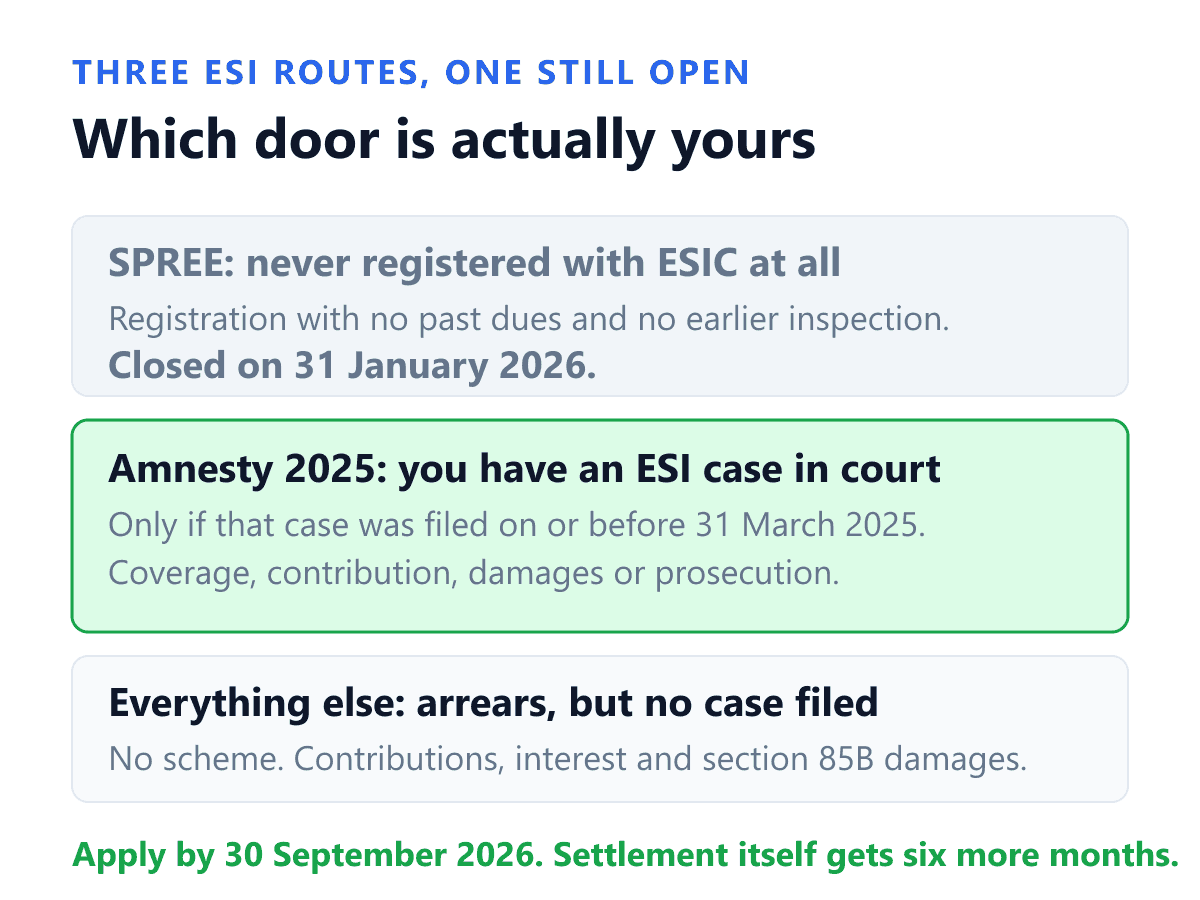
The first thing to check is whether this scheme is yours at all
Search for “ESI amnesty 2026” and you get results that blend two entirely different schemes into one deadline. They are for different employers, and one of them is already closed.
SPREE, the Scheme to Promote Registration of Employers and Employees, was the route for a business that had never registered with ESIC at all. Register during the window, and you were not liable for past contributions and were not inspected for any period before the coverage date you declared. It opened on 1 July 2025, was extended once, and closed on 31 January 2026. There is nothing left of it.
The Amnesty Scheme 2025 is something else. It is not an amnesty for default. It is an amnesty for litigation. It settles cases that are already in a court or before an Employees’ Insurance Court, and the eligibility line reported by more than one professional summary is that the case must have been filed on or before 31 March 2025.
The consequence most employers will not like. If you have an ESI liability you know about, and nobody has filed anything, this scheme does not reach you. There is no window for a quiet voluntary clean-up of ESI arrears the way VISHWAS 2026 reprices old provident fund damages. You pay contributions, interest and damages under section 85B in the ordinary way. The scheme that would have helped you was SPREE, and it shut in January.
What the scheme actually is
The Amnesty Scheme 2025 was approved at the 196th meeting of the Employees’ State Insurance Corporation, held at Shimla under the chairmanship of the Union Minister for Labour and Employment. It runs from 1 October 2025 to 30 September 2026 and its stated purpose is the reduction of a litigation backlog: one professional summary puts that backlog at roughly 20,000 cases worth about Rs 1,700 crore, another at nearly 27,000 cases pending as at 31 March 2025. The two figures cannot both be right and nothing here turns on which is.
The scheme covers four families of dispute, which map onto sections of the Employees’ State Insurance Act, 1948.
| Dispute | Where it lives | What settles it |
|---|---|---|
| Coverage Whether the ESI Act applied to you at all, or from when. | Section 75, section 82, or a writ under Article 226 | Produce the records, pay the accepted dues with interest. No damages. A unit closed more than five years with the case pending more than five years and no assessment made has the case withdrawn outright. |
| Contribution How much was due, usually after an ad-hoc assessment. | Sections 45A and 45AA, then 75, 82 or 226 | Pay the actual contribution, both shares, with interest, on your records. No damages. With no records at all, the floor is 30% of the assessed amount. |
| Damages The penalty for having paid late. | Section 85B | Where the contribution and interest are already paid, the case is withdrawn on payment of 10% of the determined damages. |
| Prosecution Criminal proceedings, against an employer or an insured person. | Sections 84, 85 and 85A | Pay contributions and interest, undertake future compliance, case withdrawn. Fraud, forgery and criminal conspiracy are excluded. |
Two additions in this scheme that did not exist in earlier ones are worth knowing about, because they clear cases nobody has looked at in a decade. Prosecutions under section 85(a) and 85(g) that have been pending fifteen years or more with outstanding dues of Rs 25,000 or lesscan be withdrawn: outright where the business is closed or untraceable, and on payment of 30% with interest where it is still running. And prosecutions under section 85(e), for not filing contribution returns, are withdrawable on the footing that the requirement is redundant now that returns are filed electronically.
The two prices, and what decides which one you get
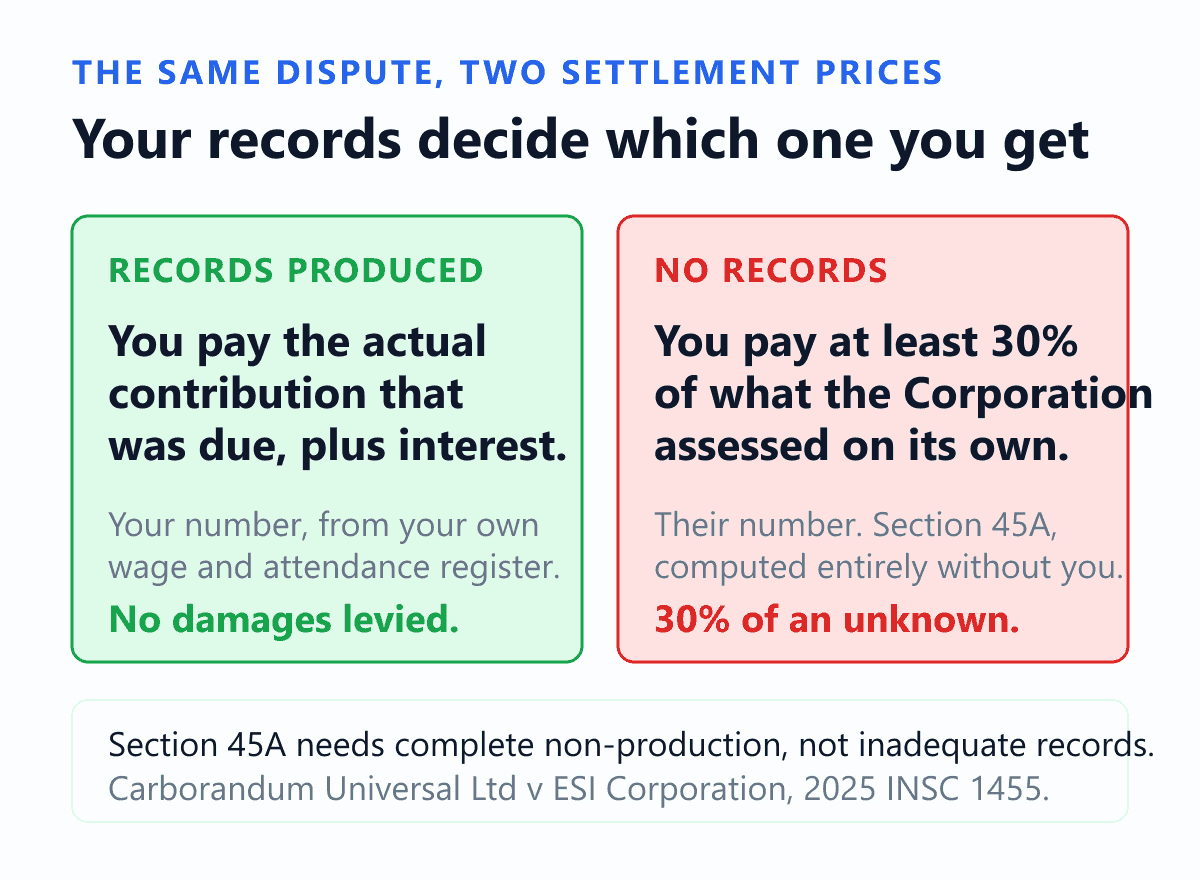
Look again at the contribution row, because it contains the whole argument of this article and it is written as though it were one rule with a footnote. It is not. It is two different prices for the same dispute.
An employer who produces wage records settles at the actual contribution that was payable, employer’s share and employee’s share, plus interest. Where the ESI registers themselves are gone, the guidelines accept substitutes: EPFO records, income tax filings, a Social Security Officer’s survey report. That is your own number, arrived at from your own documents, and no damages are levied on top of it.
An employer who can produce nothing pays a floor of 30% of the assessed contribution. And “assessed” here means assessed by the Corporation under section 45A, which is a best-judgment determination made because the records were not there. Where there is nothing at all, the guidelines say dues may be worked out on declared wages, on survey reports, or on the minimum wage applied to a headcount.
Those two are not a discount and a bigger discount off one figure. They are two unrelated figures. The first is what you owed. The second is 30% of what somebody else estimated you owed, computed without you, in a document you are being asked to settle rather than to check. For a small employer with a fifty-person headcount assessed at minimum wage across four disputed years, 30% of that estimate can comfortably exceed 100% of the contribution that was genuinely due, and the scheme offers no route back to the real number once the records are gone.
And the Supreme Court changed what a 45A order is worth
This is the part that is not in any of the amnesty coverage, because it is not part of the amnesty. On 18 December 2025 the Supreme Court decided Carborandum Universal Ltd v ESI Corporation, 2025 INSC 1455, and held that section 45A is an exceptional power, not an alternative one.
It can be invoked on two pre-conditions only: complete non-production, non-submission or non-maintenance of the returns, particulars, registers and records required by section 44; or a Social Security Officer being prevented from carrying out an inspection under section 45. The Court drew the line explicitly. The statutory threshold is complete non-production, not inadequateproduction. An employer who produced what they had, even if the Corporation considered it insufficient, is not within section 45A at all, and the Corporation must go the ordinary route instead.
Why this matters this month. If you are holding a section 45A assessment made against a period for which you did hand over records, the judgment is a question worth putting to your advocate before you settle at 30% of it. The amnesty is a commercial route out, not a finding that the assessment was sound. Those are different things, and only one of them has a deadline on it.
30 September is the date to apply by, not to finish by
The single most useful thing to know about the deadline is that it is an application deadline. The guidelines give each case a six-month window from the date of application for the settlement itself to be completed. An application filed in September 2026 therefore runs to around March 2027.
That changes what has to happen in the next three weeks. You do not have to have found the money, reconciled four years of wage registers and paid. You have to have filed. The reconciliation happens inside the six months.
Two more procedural points, both of which have caused employers to sit on their hands.
- You do not need the court’s permission first. ESIC clarified on 25 March 2026 that seeking the court’s leave for an out-of-court settlement is procedural, not a mandatory pre-condition. The court is informed and the affidavits for withdrawal are filed after the settlement. Employers who read the original guidelines as requiring a listed hearing before they could even apply lost five months to that reading.
- The decision is taken locally. Applications go to the Regional or Sub-Regional Office and are reviewed by an amnesty committee of legal and finance officers and panel advocates, with the officer who made the original assessment kept off the committee. Regional Directors and Joint Directors have full approval authority; nothing routes through headquarters.
Settlement under any category is conditional on current compliance. A withdrawn prosecution for 2016 will not survive an employer who is not filing contributions correctly in 2026, and an undertaking of future compliance is part of the paperwork in most of the categories.
What to do in the next three weeks
- Establish that you have a case, and when it was filed.Your advocate or the panel advocate on the file will have this in a minute. If the filing date is after 31 March 2025, stop here: confirm with the Regional Office, because that cut-off is the clause most worth verifying against the guidelines themselves rather than against a summary of them.
- Work out which category the case is in. Coverage, contribution, damages or prosecution. The settlement arithmetic is completely different in each and there is no point estimating the cost before you know which row you are on.
- Find out what records still exist for the disputed period.This is the step that decides the price. Wage registers, attendance registers, the ESI returns as filed, and the substitutes the guidelines accept: EPFO records and income tax filings. Do this before you apply, not after.
- Apply at the Regional or Sub-Regional Office in the prescribed format, before 30 September 2026. Do not wait for a court date.
- Fix current compliance first if it is broken. The settlement is conditional on it, and it is the one item on this list entirely within your control.
The part that is a process problem before it is a software problem
Section 44 of the ESI Act is, in substance, a record-keeping duty: submit returns of the persons employed, and maintain the prescribed registers and records. Every consequence in this article runs off it. Whether section 45A could lawfully be invoked runs off it. Which of the two settlement prices you get runs off it. Whether Carborandum helps you runs off it.
And the reason a small Indian employer cannot produce a 2019 wage and attendance register is almost never refusal. It is that attendance for 2019 lived in a WhatsApp group that has been cleared, a notebook that went home with a supervisor who left, and a spreadsheet on a laptop that was replaced. Nobody destroyed anything. It simply was never in a form that survives six years and a change of staff.
That is a filing problem, and the honest fix is a filing discipline, not a purchase. Whatever you keep it in, the test is the one this scheme has just applied to thousands of employers: can you produce, for an arbitrary month four years ago, who worked which days and what they were paid. If the answer is no, you are not choosing between two settlement prices. You are being handed the second one.
It is the same record the labour codes now require you to retain for five years anyway: see the statutory registers and wage slips the Central Rules name by form number. Shiftelio keeps that day-by-day, per person, for exactly this reason: a twelve-month or four-year look-back should be a report, not an excavation. It will not do anything for a dispute already in court. It decides which side of this picture you are on the next time.
Frequently asked questions
What is the ESIC Amnesty Scheme 2025 deadline?
The scheme runs from 1 October 2025 to 30 September 2026. That is the last date to apply. Each case then has six months from the application date for the settlement itself to be completed.
Can I use the ESIC amnesty if I have no court case?
No. It settles pending litigation, and the eligibility line reported by professional summaries is that the case must have been filed on or before 31 March 2025. An employer with arrears and no case has no scheme open to them: SPREE, which was the registration route, closed on 31 January 2026.
How much do I pay to settle an ESI damages case?
Where the contribution and the interest have already been paid, a damages dispute is settled and the case withdrawn on payment of 10% of the damages determined under section 85B.
What if I have lost the wage records for the disputed period?
The guidelines accept EPFO records, income tax filings and Social Security Officer survey reports as substitutes. If there is genuinely nothing, the settlement floor is 30% of the amount the Corporation assessed, and you have no way to argue that figure down to what was actually due.
Does the amnesty waive ESI interest?
Not in the contribution and coverage categories: interest is payable there. What is waived across those categories is damages. Interest is expressly not charged in the section 84 category, which is prosecutions against insured persons for wrong declarations, where the remedy is a refund of what was over-drawn.
Do I need the court’s permission before applying?
No. ESIC clarified on 25 March 2026 that this is procedural rather than a pre-condition. Inform the court and file the affidavits for withdrawal after the settlement is reached.
Is this the same as the PF VISHWAS scheme?
No. Different statute, different regulator, different deadline. VISHWAS 2026 reprices provident fund damages under section 14B and closes on 28 December 2026. This is ESI litigation and closes on 30 September 2026. One employer can need both.
The short version
- The ESIC Amnesty Scheme 2025 runs 1 October 2025 to 30 September 2026. That is the date to apply by; settlement gets six months from the application.
- It settles litigation, not default. The case must already have been filed: on or before 31 March 2025 per the reported eligibility line.
- SPREE, the registration route for a never-registered business, closed on 31 January 2026. Nothing replaced it.
- Coverage and contribution disputes settle at the actual contribution plus interest, with damages waived: if you can produce records.
- With no records, the floor is 30% of the Corporation’s own section 45A assessment. That is a different number, not a bigger discount.
- Damages disputes settle at 10% of the damages determined, where contribution and interest are already paid.
- Old prosecutions under sections 85(a) and 85(g), pending 15+ years with dues of Rs 25,000 or less, can be withdrawn.
- No court permission is needed to apply: clarified 25 March 2026. Regional Directors approve locally.
- The Supreme Court held in Carborandum Universal (2025 INSC 1455) that section 45A needs complete non-production of records, not inadequate production. Worth raising before settling a 45A order made against records you did provide.
- Every settlement is conditional on current compliance.
This article states the position as at 7 September 2026. ESIC’s own guidelines could not be read directly while writing it: pib.gov.in and labour.gov.in both returned 403, and the PDF on esic.gov.in failed certificate verification, so every figure here comes from the professional summaries listed below, which were each read in full and which agree with one another. The 31 March 2025 filing cut-off in particular is carried by two of the four and is the clause to confirm with your Regional Office before you rely on it. This is not legal advice.
Sources
- Employees’ State Insurance Corporation, for the scheme guidelines, the prescribed application format and the Regional Office that will process it. esic.gov.in.
- The Employees’ State Insurance Act, 1948: sections 44, 45, 45A, 45AA, 75, 82, 84, 85, 85A and 85B. India Code. The section references throughout this article are to this Act.
- Taxguru, ESIC Amnesty Scheme 2025: Guidelines for ESI Case Settlement. taxguru.in. The four categories, the 30% floor and the 10% damages figure were taken from this write-up.
- Compliance Calendar, on the same guidelines, for the 31 March 2025 filing cut-off, the six-month settlement clock, the 15-year and Rs 25,000 band, and the composition of the regional amnesty committees. compliancecalendar.in.
- Bhatt & Joshi Associates on Carborandum Universal Ltd v ESI Corporation, 2025 INSC 1455, for the two section 45A pre-conditions and the complete-versus-inadequate distinction. bhattandjoshiassociates.com. Cross-checked against the CaseMine commentary on the same judgment.
- Karma Management, for the ESIC clarification of 25 March 2026 that court permission is procedural and not a pre-condition. karmamgmt.com.
Keep reading
See how Shiftelio does this in practice with a day by day record that can still answer for a month four years ago.
Work your own numbers with the free PF and ESI calculator. No signup, no email.