Expense Approval: Why No Manager Should Approve Their Own Bill
In short
A manager should never approve their own expense bill, work cash or advance. The owner approves it. Here is the maker-checker rule and how to set it up.
- A manager should never approve their own expense bill: the person who spends and the person who approves must be different people.
- The rule is one line: your own bill, work cash and advance are approved by the owner.
- Shiftelio refuses a manager's approval of their own bill, refuses a bulk approval that includes it, and keeps their own work cash and advance for the owner.
A manager should never approve their own expense bill. The person who spends the money and the person who signs it off must be two different people, so a manager's own bill, work cash or salary advance goes to the owner instead.
That is the whole rule, and banks have a name for it: maker-checker. One person makes the entry, a second person checks it. Most small businesses follow it for staff without thinking about it, and then quietly break it for the one person who holds the approve button. This article shows where that gap sits, what the rule looks like in a business with field staff, and how Shiftelio now enforces it on every money screen.
The gap in most expense approval systems
In a small business the expense approval process usually works like this. A salesperson pays for fuel, takes a photo of the bill and sends it in. Their supervisor looks at it and approves it. The money comes back in cash or on the next payslip.
That flow has two people in it, so it is already a maker-checker system. The salesperson is the maker. The supervisor is the checker. If a fuel bill is approved for a day the salesperson was on leave, two people saw it, and the owner can ask either of them.
The gap is the supervisor's own bill. Supervisors travel too. They buy diesel, pay a courier, take a client for tea. Their bills go into the same list, and the only person with the approve button for that list is the supervisor. So the one bill that nobody checks is the bill of the person who checks everybody else.
The supervisor and the fuel bill
Take a distributor in Lucknow with 30 field staff and two area supervisors. Imran is one of them. He holds the right to approve bills, because he signs off his team's fuel and parking every day.
On a Friday he files his own fuel bill for Rs 1,850. It sits in the expense list with eleven others from his team, among them a fuel bill from Ravi and a parking bill from Sana. He ticks all twelve and presses approve. His bill goes through with the rest, and at the end of the month Rs 1,850 is added to his pay.
The bill may be perfectly honest. Imran did drive to three retailers that day. The problem is that an honest bill and an inflated one look exactly the same when the person filing it and the person approving it are the same person. The owner would only find a padded bill by reading every approval line by line, and most owners never do.
Now add the other money a supervisor touches. Work cash: the float a supervisor hands out for petrol and small purchases. A salary advance: money ahead of payday, taken back from the next salary. If a supervisor can give themselves work cash or approve their own advance, it is the same gap with a bigger number.
Why your own money is different
When a supervisor approves a salesperson's bill, the salesperson knows what they spent. If the approved amount is wrong, they notice on their payslip and complain. That second person is the check.
When a supervisor approves their own bill, nobody else is involved. Nobody notices, nobody complains, and real money moves. Expense reimbursement schemes are one of the categories of occupational fraud the Association of Certified Fraud Examiners studies in its Report to the Nations, and the way it starts is rarely a big theft. It is a small claim that nobody else looks at.
Larger companies call this segregation of duties, and for a listed company it is not optional. Section 134(5)(e) of the Companies Act, 2013 asks the directors of a listed company to state that internal financial controls are in place and working, and Section 143(3)(i) asks the auditor to report on them. A 30-person distributor does not file that statement. The idea behind it still costs nothing to copy: whoever approves the money should not be the person receiving it.
The rule: nobody signs off their own money
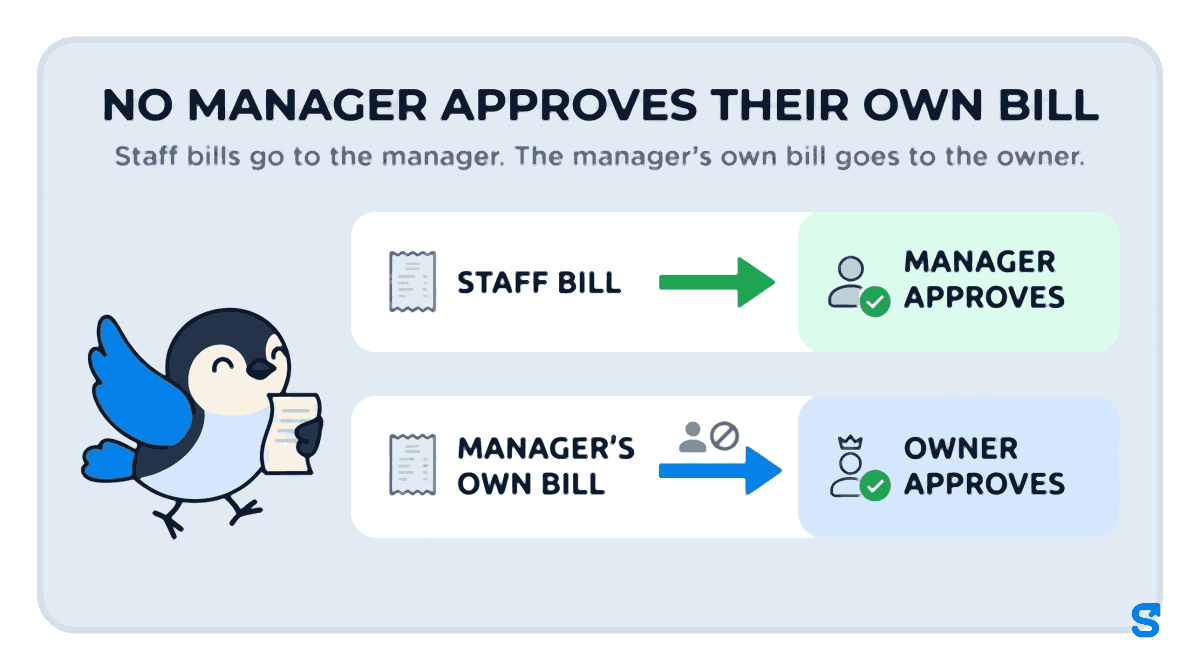
The rule fits in one line: your own bill, your own work cash and your own advance are approved by the owner.
- Staff file their own bills, and only their own.
- A manager approves the bills of the staff they look after.
- A manager's own bill, work cash and advance go to the owner.
- The owner, or a co-owner, may approve anything, including their own.
The last line is deliberate. The owner's money is the owner's money, and many small owners also sit on their own payroll. If a business has two partners, adding the second as a co-owner means each can check the other.
How Shiftelio enforces it
In Shiftelio, the right to approve bills is a tick in a manager's role called Approve bills and give work cash. Since October 2026 that tick no longer covers the manager's own money. You do not switch this on. It applies to every business on the app.
A manager's own bill cannot be approved by them
If Imran opens his own fuel bill and presses approve, reject or send back for changes, the app refuses with one plain message: "You cannot approve or change your own money. Ask an owner." The bill stays waiting, and the owner sees it in the same list as every other bill.
Bulk approval refuses the whole batch, not half of it
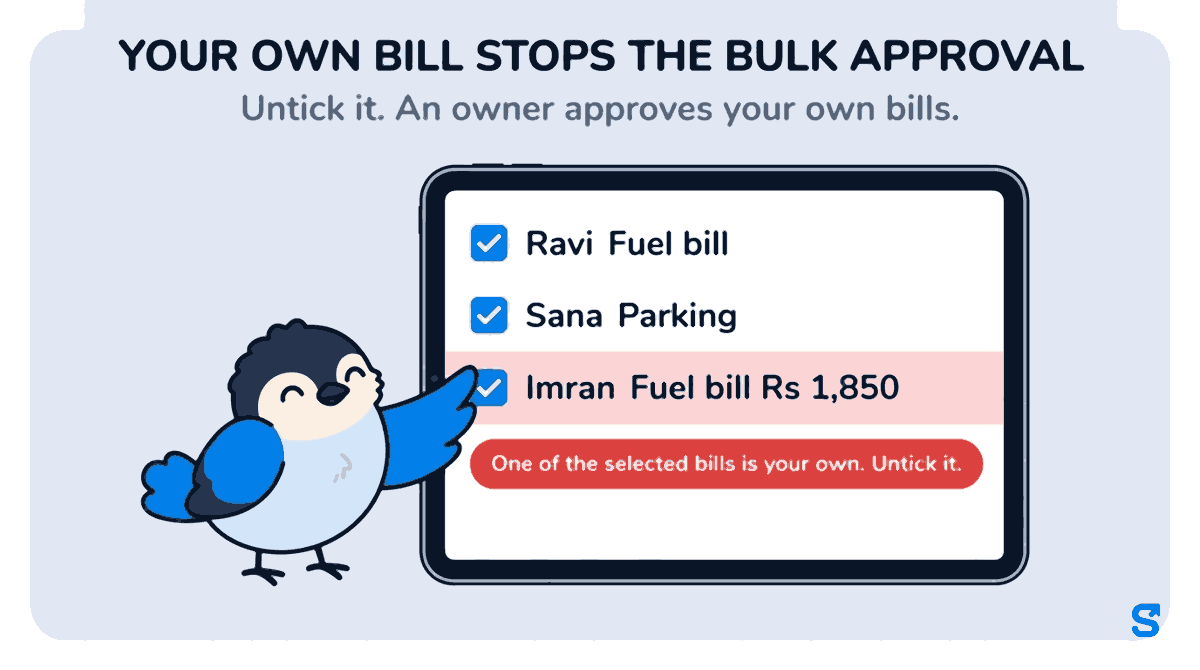
If Imran ticks twelve bills and one of them is his own, nothing is approved. The app says: "One of the selected bills is your own. Untick it - an owner approves your own bills." He unticks it, approves the other eleven, and his bill waits for the owner. No batch is ever left half approved.
Work cash and salary advances follow the same rule
A manager cannot hand work cash to themselves, alone or as part of a group they are issuing to. When staff ask for work cash from their phone, the manager decides the asks of their team, and the manager's own ask goes to the owner. A manager also cannot record a loan or advance for themselves.
Staff can only file their own bills
A staff member files a bill for themselves and nobody else, so nobody can put a bill in a colleague's name. The bill keeps the photo of the receipt and the amount, and an approved bill reaches the payslip the way it always has. If you want the whole path from receipt to payslip, it is in Expense Claims from Field Staff.
The same idea already runs on attendance: a manager cannot regularize their own day either. That rule is in Attendance Regularization: Why No Manager Should Approve Their Own Day.
Setting it up for your business
Create a role with Expenses View and the Approve bills and give work cash tick. The supervisor approves their team's bills and nothing of their own.
If two people own the business, add the second as a co-owner. Each can then approve the other's bills, and neither has to approve their own.
They file the bill exactly as their staff do. It waits for you in the expense list. Check that list once or twice a week so a supervisor's fuel money is not held up.
Compare what each team claims. A supervisor whose team claims far more than the others is worth a conversation.
See all the expense, advance and payroll controls on the Shiftelio features page.
Which expense approval app stops a manager approving their own bill?
Frequently asked questions
What is maker-checker in expense approval?
Maker-checker means one person makes a claim and a different person approves it. In expenses, the person who spent the money files the bill and somebody else signs it off.
Can a manager approve their own expense claim in Shiftelio?
No. A manager cannot approve, reject or send back their own bill, alone or in a bulk approval. The owner or a co-owner approves it.
Who approves the owner's own bills?
The owner or a co-owner may approve their own bills. A sole owner approves their own, because there is nobody above them.
Can a manager give themselves work cash or a salary advance?
No. A manager cannot hand themselves work cash, decide their own work cash ask, or record a loan or advance for themselves. The owner does that.
Does this change bills that were already approved?
No. The rule decides who may approve from now on. Bills approved before it stay as they are.
Keep reading
Free to use, no signup: Payroll calculators.