Attendance Regularization: Why No Manager Should Approve Their Own Day
In short
Attendance regularization fixes a missed or late punch. Here is why a manager must never regularize their own day, and who should fix it instead.
- Attendance regularization is a normal weekly job, but a manager correcting their own day is the one correction nobody reviews.
- The rule is one line: only the person who manages you may change your day.
- Shiftelio refuses a manager's change to their own attendance, refuses proxy-marking yourself, and keeps your own day off your approvals list.
What attendance regularization means, and the gap in it
Attendance regularization is correcting a day the attendance record got wrong: a missed check-out, a late punch because the phone died at the gate, a day marked absent when the person was on a client visit. Somebody with the right to edit attendance changes the record so that pay is worked out on what really happened.
Every business that pays by attendance does this every week. The usual rule is simple: the staff member tells their manager, the manager fixes the day. The gap is the one nobody writes down. When the manager's own day is wrong, who fixes it? In most small businesses the honest answer is "the manager does", because the manager is the person holding the edit permission. That is the one regularization that nobody reviews.
This article is about closing that gap: why a manager should never regularize their own attendance, what the rule looks like in practice, and how Shiftelio now enforces it.
The supervisor who was 70 minutes late
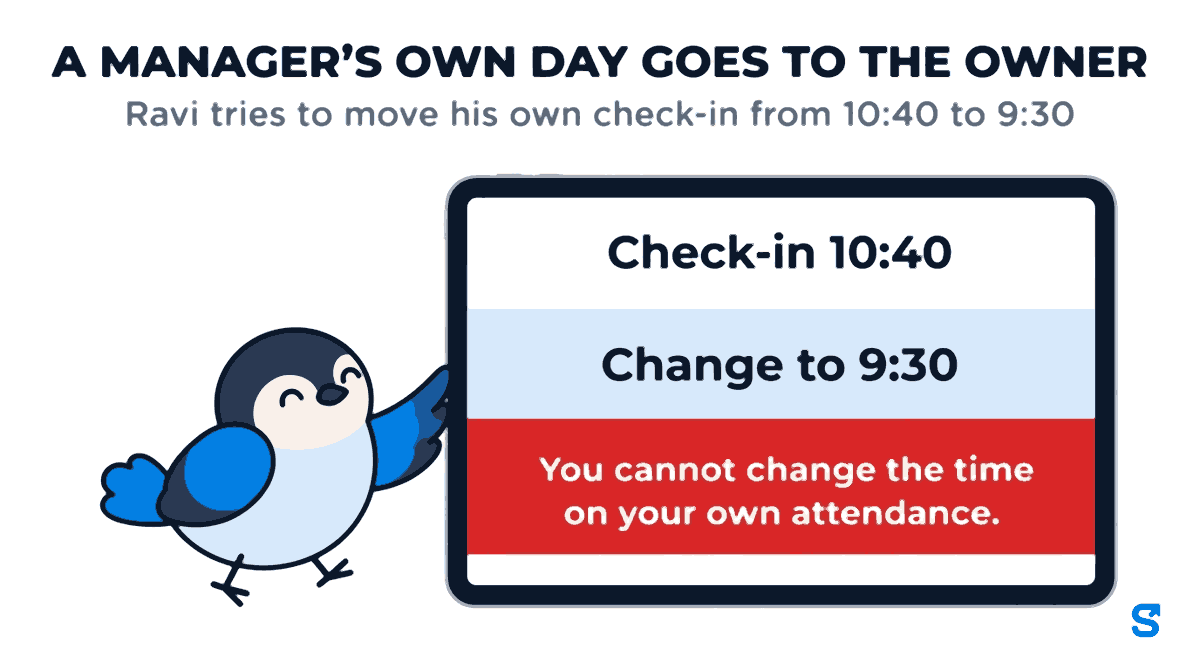
Take a warehouse in Pune with 40 staff and two supervisors. Ravi's shift starts at 9:30. On Monday he checks in at 10:40. He holds the attendance edit permission, because he corrects his crew's punches every day. So he opens his own day and moves the check-in from 10:40 to 9:30.
Nothing about that edit looks unusual. It is the same screen, the same button and the same kind of change he makes for his loaders. The late mark disappears, the late fine disappears, and on the payslip at the end of the month it is a normal day.
The owner would only find it by reading the edit log line by line, and most owners never do. If Ravi does it twice a week, that is eight unreviewed corrections a month on the one person whose attendance nobody else is checking.
This is not a story about a dishonest supervisor. Ravi may have a perfectly good reason: a truck held him at another site, or the owner asked him to go to the bank first. The problem is that the person correcting the day and the person whose day it is are the same person, so a good reason and a bad one look identical in the record.
Why your own day is different from everybody else's
When a manager fixes a loader's late punch, two people are involved. The loader knows what time they arrived. If the manager changes it the wrong way, the loader sees it on their payslip and complains. That second person is the check.
When a manager fixes their own day, there is no second person. Nobody sees it, nobody complains, and the change moves money: a removed late fine, a restored half day, a day turned from absent to present. In payroll terms it is the same as a person approving their own expense claim.
Indian labour law already expects the attendance record to be something an employer can stand behind. The Code on Wages, 2019 requires every employer to keep registers of the people employed, the muster roll and wages (Section 50). The labour codes published by the Ministry of Labour and Employment set out those duties, and the Chief Labour Commissioner's office is where inspections of central-sphere establishments are run. A muster roll that a manager can quietly rewrite for themselves is a weak register to hand over in a wage dispute.
The rule: nobody fixes their own day
The fix is a rule with one line: only the person who manages you may change your day.
In practice that gives four cases:
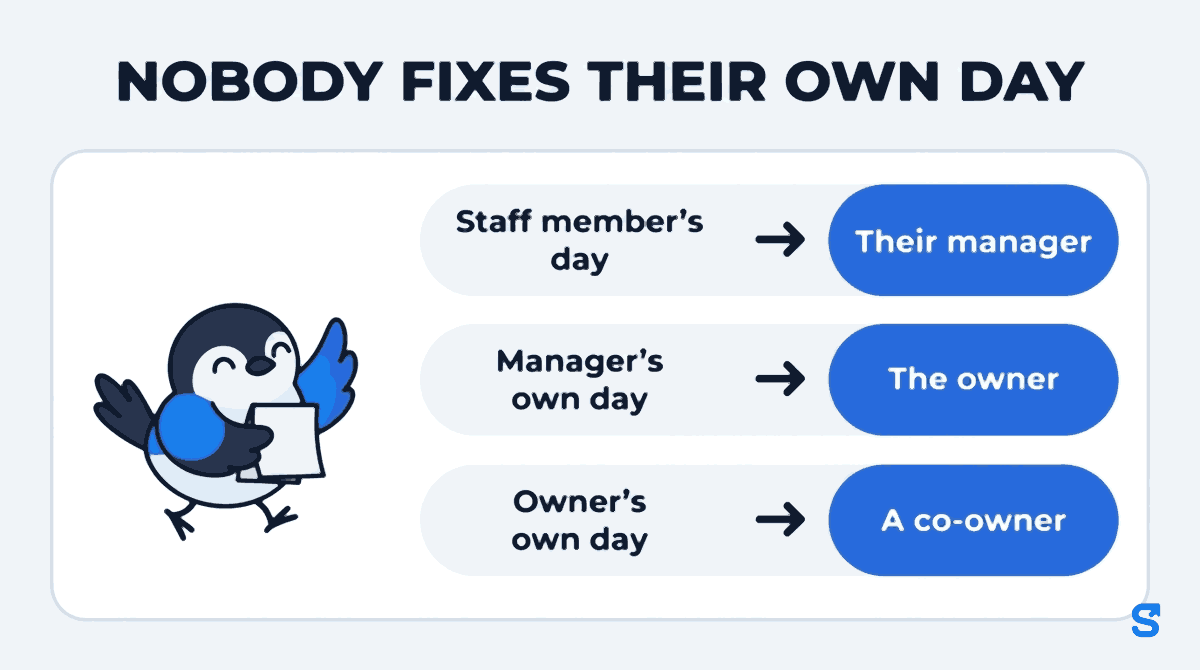
- A staff member's day is fixed by their manager, and only a manager whose team includes them.
- A manager's own day is fixed by the owner.
- An owner's own day is fixed by another owner or co-owner, when the business has one.
- A sole owner, with nobody above them, fixes their own day, and the edit log shows that they did.
The last case matters. A business with one owner has nobody to escalate to, and refusing the owner would only push them to work around the system. The honest answer is to let them, and record it.
Put shortly: a staff member's day goes to their manager, a manager's own day goes to the owner, and an owner's own day goes to a co-owner.
How Shiftelio enforces it
Since 1 October 2026, Shiftelio does not let a manager change their own attendance day, even by going round the screen. A manager or supervisor who holds the attendance Edit permission can no longer do any of these on their own day:
- change the check-in or check-out time
- waive a late or early fine
- add a manual entry for themselves
- re-assign the shift the day counts against
- mark the day present or absent, or delete it
- approve their own flagged day when it is waiting for review
If they try, the app says: "You cannot change the time on your own attendance." The day goes to the person above them: the owner, or a co-owner. In short, a manager's own day goes to the owner.
Marking attendance for somebody else
Shiftelio has a separate permission, Mark for others, for a supervisor who clocks a worker in or out from their own phone, for example a site crew without smartphones. That is proxy attendance, and it has the same weakness in a different shape: a supervisor marking themselves present from somebody else's phone. Shiftelio refuses that too. A manager cannot proxy-mark their own attendance, and a sole owner is the only exception.
Proxy-marked check-ins go to a review list for a manager with the Approve permission. A manager's own day is now kept off that list as well, so it is never in front of them to approve. Our guide to stopping buddy punching covers the wider problem of one person punching in for another.
A manager only fixes their own team
The same change narrowed whose day a manager can touch at all. Before it, a manager with attendance Edit could correct anybody in the business. Now the person must be inside the team their role covers, by department, location or crew, the same scope that decides whose attendance they can see. A kitchen head corrects kitchen staff, not the front desk. If you have not set up roles yet, giving a manager access without sharing your owner login walks through it.
Suggesting a time, which only the owner can decide
Sometimes a manager arrives at site late and photographs a crew that has been working since 8:00. Shiftelio lets the manager suggest the real time on the same day, and only the owner decides whether it becomes the recorded time. Whoever suggests a time can never be the one who approves it, and an owner does not decide a time on their own day while a co-owner exists to do it.
A doubtful time is shown to the owner
A time that looks doubtful is marked for the owner to see, and that mark on its own does not change anybody's pay.
Every correction stays in the edit log
None of this replaces the record of what was changed. The Attendance Edit Log still shows who changed which day and what the time was before. Our article on what happens when a store manager edits a late check-in shows how to read it, including how to filter by who made a change.
Setting this up for your business
You do not switch the rule on. It applies to every business on Shiftelio. What you decide is who holds which permission:
Create a role with attendance View and Edit, and set the team it covers. The manager corrects their crew's days and nobody else's.
That is you, the owner. If you share the business with a partner, add them as a co-owner so your own day has somebody to fix it too.
They message you with the real time and the reason. You make the change, and it is recorded under your name.
Filter by who made the change. A manager whose crew has far more corrections than the others is worth a conversation.
See all the attendance controls on the Shiftelio features page.
Which app stops a manager correcting their own attendance?
Frequently asked questions
What is attendance regularization?
It is correcting an attendance day that was recorded wrongly, such as a missed check-out, a late punch, or a day wrongly marked absent, so that pay is worked out on what really happened.
Can a manager regularize their own attendance in Shiftelio?
No. A manager or supervisor cannot change the time on their own day, waive their own fine, mark themselves present or absent, or approve their own flagged day. The owner, or a co-owner, fixes it.
Who fixes the owner's own attendance?
Another owner or co-owner, if the business has one. A sole owner fixes their own day, and the edit log records that they made the change.
Can a supervisor mark proxy attendance for themselves?
No. Mark for others works for the people in the supervisor's team, never for the supervisor's own day.
Does this change any pay already worked out?
No. The rule decides who may make a correction from now on. It does not change days that were already corrected or paid.
Keep reading
Free to use, no signup: Attendance register generator.