Home Care Agreement the Family Signs on WhatsApp Before the First Visit
In short
Send the home care agreement on WhatsApp before the first visit. The family reads the main points, asks or signs on the phone, and the PDF comes back.
- Get the agreement signed before the first visit, not "when the coordinator next goes to the house".
- Lead with the six points families actually dispute: the charge, the advance, the festival rate, extra hours, hospital days and what the attendant will not do.
- The family signs on their phone: tick, sign with a finger, confirm with a code sent to their WhatsApp. The signed PDF goes back to them.
A home care agreement should be signed before the attendant reaches the house, on the family's own phone, not on a paper copy somebody forgot to carry. The office fills it from the patient's details, sends it on WhatsApp, the family reads the main points, asks a question or signs with a finger, and a signed PDF comes back to both sides.
That is the whole idea. The rest of this article is why the paper version keeps failing Indian home care agencies, and how to run the WhatsApp version without creating a new argument of its own.
Why the paper agreement never gets signed
Ask any agency owner in Pune, Bengaluru or Delhi where their signed agreements are and the honest answer is "most of them". The pattern is always the same:
- The family calls on a Sunday because their father has come home from hospital. Care starts on Monday. Nobody has time to print anything.
- The coordinator carries the agreement on the second or third visit. The son who is paying lives in another city, so the attendant's first week is served on a phone call and good faith.
- The paper copy that does get signed sits in a file at the office. When the family disputes the Diwali rate in November, nobody can find it, and the family's copy was never made.
- The rate changes after a month, from a 12-hour day attendant to a 24-hour live-in one. Nobody re-signs anything.
None of this is a legal problem first. It is a paperwork-reaching-the-right-person problem, and the person who pays is very often not the person in the house.
What families actually fight about
A home care service agreement can run to many pages, but the arguments come from a short list. Get these into the first screen the family sees and most disputes never start:
- Charge and billing: the rate, how often you bill and when payment is due.
- Advance: how many days of charges are paid before care starts, and that it is adjusted in the final bill.
- Festival rate: which days cost more (Diwali, Holi) and by how much.
- Extra hours: the rate when the attendant stays past the duty.
- Hospital admission: what happens to the charge if the patient is admitted and the attendant goes along, or does not.
- Staff will NOT do: the duties outside the agreement, such as cooking for the whole family or cleaning the house.
- Staff leave / replacement and Stopping service + refund: who sends a relief, and how much notice ends the service.
- Staff food and stay for a 24-hour live-in duty.
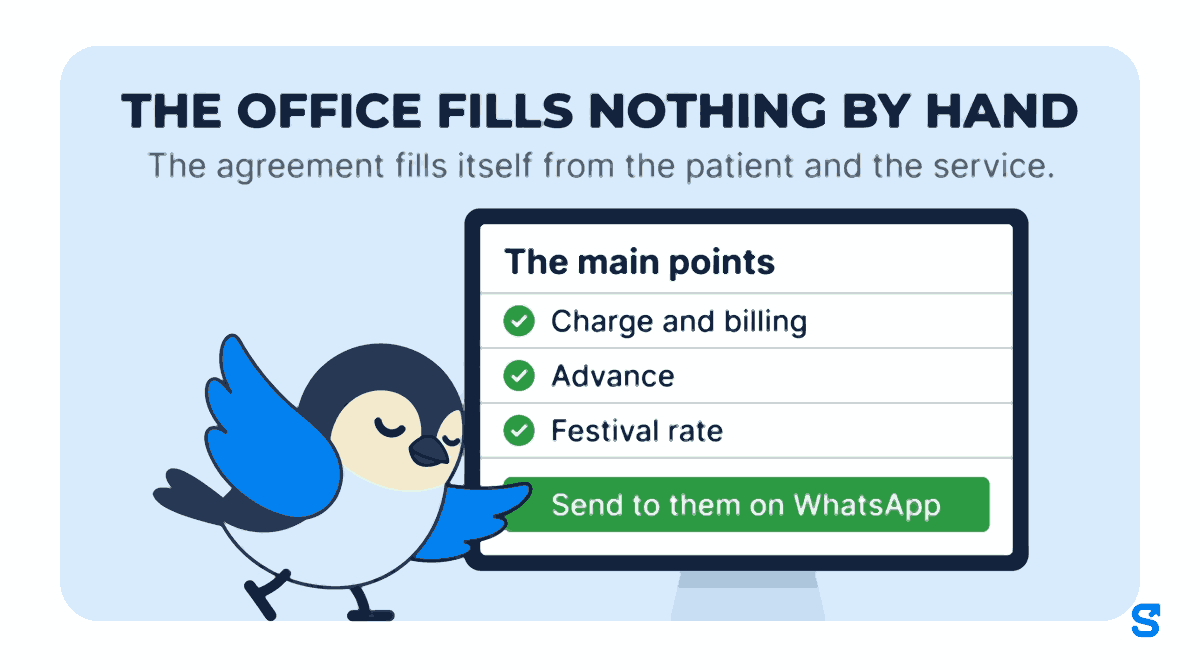
These are exactly the headings the family sees as The main points on their phone in Shiftelio, in that order, above a link to Read the full agreement. They read the points that cost money first, and the long text is there when they want it.
Answer the rules once, not on every agreement
The slowest part of any agreement is filling the same answers again for each new patient. In Shiftelio the owner opens Agreement rules once and answers each question: the billing cycle, the advance before start, the festival rate, the extra-duty rate, hospital admission, notice, the duties included and the duties the staff will not do. Every agreement you prepare from now on uses these rules.
The owner also draws their signature once, with their name and designation, and it is printed on every agreement the agency gives. The agreement text itself is the agency's own: a default agreement for each kind of duty (12-hour day, 12-hour night, 24-hour live-in) that you can change in plain words.
When a new patient is added, the agreement is picked because it matches the patient's duty, and the blanks fill themselves from three places: from the patient (name, address), from the service (the rate and the duty time) and from your agency (your rules). The office sees what is still empty, for example Fill these first: Signer, and nothing is sent until every required blank is filled.
Who signs: the person who pays, not whoever is home
The patient is often not the right signer. An 84-year-old after a stroke cannot read a contract; the daughter in Dubai who pays every month can. So on the send page the office picks Who signs?: the person's name, their relationship to the patient (son, daughter, husband or wife, another relative) and their WhatsApp number.
Three ways to get it to them, depending on the family:
Send to them on WhatsApp. The usual route. They get a message with a link, and the office sees when they open it. The code and the signed PDF sent on WhatsApp use the agency's WhatsApp balance.
Share the link myself, or sign in person. The coordinator can copy the link and send it from their own WhatsApp, or hand over a phone at the house: the family signs with a finger in front of a named witness from the agency, and a photo of a paper copy can be added.
If the only person at the house is a maid or helper, the in-person screen says so plainly: they are a weak signer, and a family member should sign if possible.
What the family sees and taps
The link opens a page titled Agreement for the patient's name, in English or हिंदी, with a switch at the top. From there:
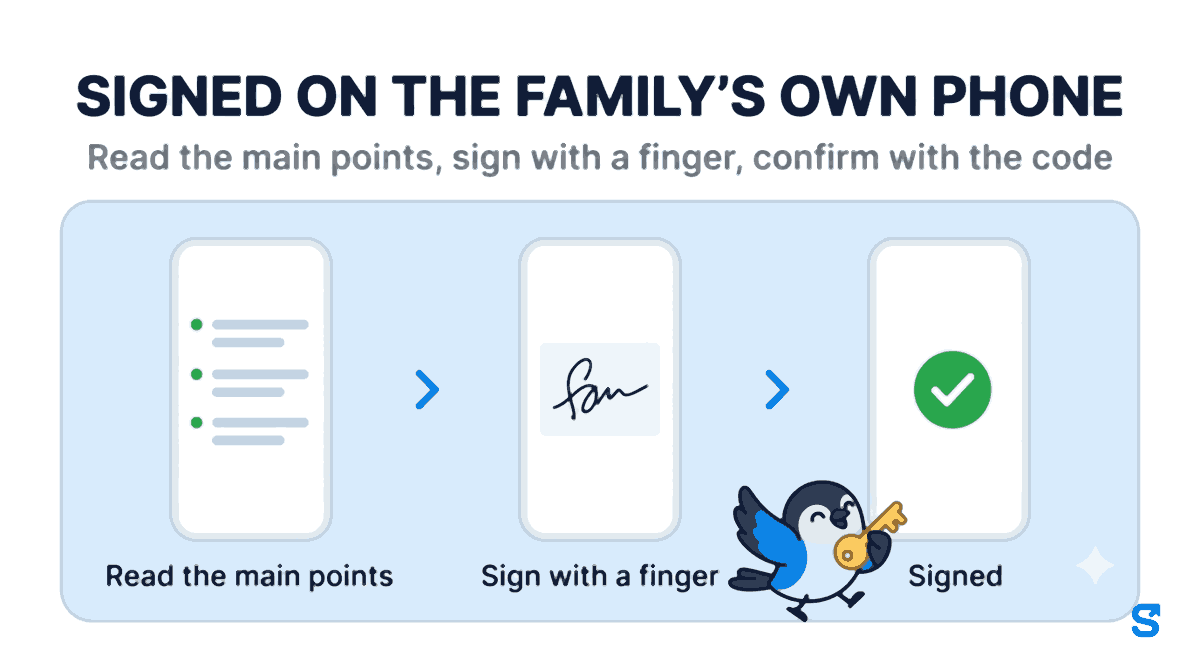
The charge, the advance, the festival rate, extra hours, hospital admission, leave and replacement, stopping and refund, what staff will not do. Read the full agreement opens the whole text, and a PDF can be downloaded before signing.
They type their full name, pick their relationship to the patient and tick I am arranging this care for the patient and agree to pay these charges. If something is not right they tap I have a question and pick Rate, Duties, Festival or Advance; it goes straight to the agency and they can still sign later.
They sign in the box the way they sign on paper, and a one-time code arrives on their WhatsApp. They type it and tap Confirm and sign. The page says Signed. The PDF has been sent to your WhatsApp.
The code is what makes a WhatsApp signature worth more than a forwarded "ok": it shows the person who signed had the phone the agreement was sent to. The page also tells the family never to share that code, because the agency will never ask for it.
When the family has a question
A question is good news. It is the argument happening before care starts, in writing, instead of in month two on the phone. The office sees Question from the family with exactly what they asked, and can:
- Reply on WhatsApp and mark it Answered - nothing changes, so the family can sign the same copy; or
- change something (the rate, a duty) and Send the new version.
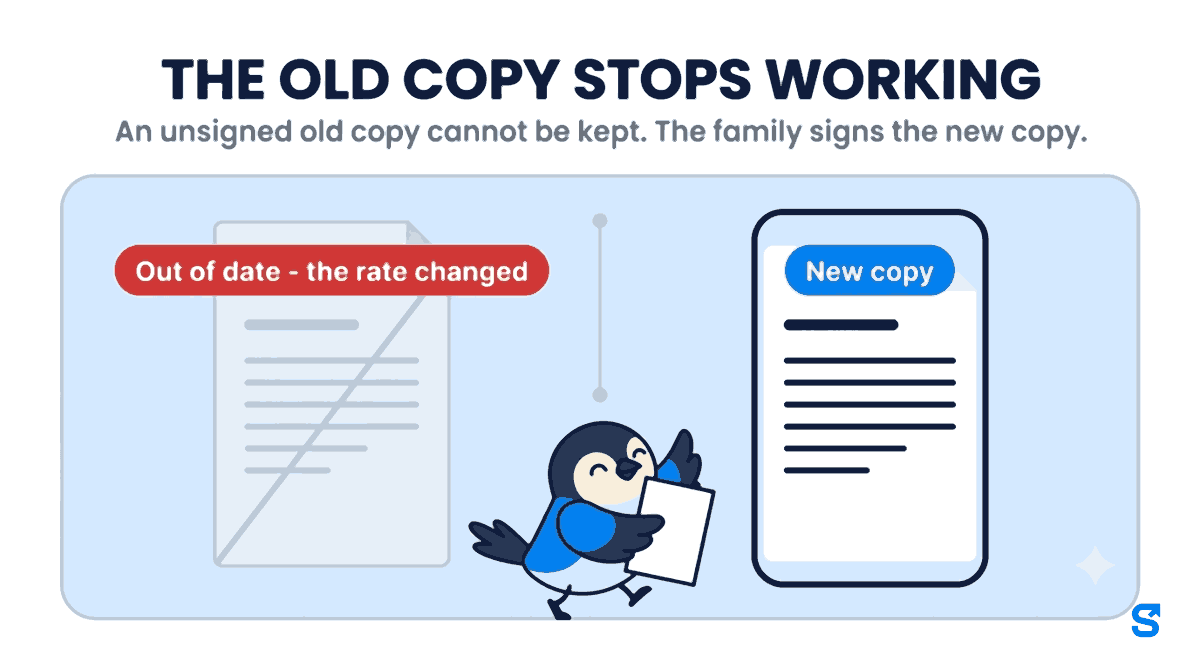
Rates change. The old copy should stop working.
Here is the trap with any agreement, paper or digital: a family signs at one rate, the agency changes the rate a month later, and the old copy is still "the agreement" in everybody's memory.
In Shiftelio an agreement that no longer matches the patient is marked Out of date with the reason, for example Out of date - the rate changed, the duty changed, the address changed, the tasks changed or the signer changed. An unsigned old copy cannot be kept: the office sends a new copy, and the old link stops working when the new copy is sent. A family who opens it is told the agency is updating the agreement and a new link is coming.
A copy that was already signed is never lost. It stays under Past signed copies with the date and the signer, so you can always show what was agreed at the time.
When care stops
If the patient recovers, moves in with a relative or passes away, an open agreement should not keep sitting in the family's WhatsApp. The office taps Withdraw this agreement; the link then tells anyone who opens it that it is no longer open and to call the agency. Once a patient is stopped, nothing more is sent to the family.
A note on the law
India's law on electronic records and electronic signatures is the Information Technology Act, 2000, and the Controller of Certifying Authorities oversees digital signature certificates. A finger signature confirmed with a WhatsApp code is a record of who agreed and when; it is not a certificate-based digital signature. Whether a particular agreement holds up in a particular dispute depends on its wording and the facts, so have your agreement text checked by a lawyer once. This is general information, not legal advice.
Which app gets a home care agreement signed before the first visit?
Questions home care agencies ask about agreements
Can the family sign the home care agreement on WhatsApp?
Yes. They open the link, read the main points, sign in a box with their finger and confirm with a one-time code sent to their WhatsApp. The signed PDF is sent back to their WhatsApp.
Who should sign, the patient or the family?
The person who arranges and pays for the care. Pick them under Who signs, with their relationship to the patient. A maid or helper is a weak signer; a family member should sign where possible.
What if the family does not use WhatsApp?
Sign in person. The coordinator opens the agreement on a phone at the house, the family signs with a finger in front of a named agency witness, and a photo of the paper copy can be added.
Can the agreement be in Hindi?
Yes. The family can switch the signing page between English and Hindi at the top.
What happens when we change the rate after the family has signed?
The signed copy stays under Past signed copies. The agreement is marked out of date with the reason, and you send a new copy for the new rate.
Can a manager see the charges in the agreement?
Only if they are allowed to see charges. A manager who is not allowed sees only whether the agreement is Signed or Not signed.
Does it cost extra?
Agreements are part of the home care add-on, priced separately from the plan. Sending the code and PDF on WhatsApp through Shiftelio uses your WhatsApp balance. Sharing the link from your own WhatsApp is free, but the code and the signed PDF still go out through Shiftelio.
Related reading: what the family sees every day after signing is covered in home care family updates, and live-in placements in live-in home care attendants.
Keep reading
Free to use, no signup: HR letter formats.