Live-In Home Care Attendants: One Stay, Many Days, Paid and Billed Per Care Day
In short
A live-in attendant is one stay over many days. Count care days, check daily that she is still there, and pay and bill only the days she was on duty.
- A live-in placement is one stay across many days, not a row of separate shifts. Record it that way.
- Ask the attendant once each care day whether she is still on duty. One tap is enough, and an unanswered day is the one to look at.
- When she leaves, record the time she actually left, not the time somebody noticed.
A live-in home care attendant is not a shift. She is one stay that runs for days or weeks, and the only honest way to pay her and bill the family is to count the care days she was really there. That means a short check each day that she is still on duty, a clear end to the stay when she leaves, and pay and the family's bill worked out from the same list of days.
Most agencies in India still run a live-in placement on a paper register and a phone call. The attendant moves in on a Monday, the office hears nothing for nine days, and the trouble starts at month end: the family says she left on the 20th, the attendant says the 24th, and nobody has anything better than memory.
Why a live-in stay breaks an ordinary attendance app
An attendance app is built around arrival. Somebody comes, checks in, works, checks out, and the day closes. A live-in attendant does none of that. She arrives once with her bag, and then she is simply there, sleeping in the patient's house, until the placement ends or she is replaced.
Put her in a normal attendance app and one of three things happens:
- The day closes by itself. An automatic clock-out at the end of the shift marks her gone at night, and the next morning she shows as absent in a house she never left.
- One check-in covers nine days. Nothing goes wrong on screen, and nothing tells the office she walked out on day six.
- The office types it in at month end. Somebody counts days off a WhatsApp chat, and the count becomes an argument the first time the family disputes the bill.
The 24-hour shift article covers the single round the clock duty and why recording it as twenty four hours of work is a trap. A live-in stay is the longer version of the same problem: the question is not how many hours, but which days was she actually on duty.
The care day is the unit, not the hour
For a live-in placement the number that matters to everybody is the count of care days. The family is charged per care day, or a monthly amount that only holds if the month was fully covered. The attendant is paid per day, or a monthly salary that should shrink if she was there for half of it.
So the record has to be able to answer three questions, for every stay, without anyone counting by hand:
- On which days was somebody on duty at this patient's house?
- On which days was nobody there, and since when?
- When did the stay actually end?
Ask once a day: are you still on duty?
You do not need a GPS trail for a live-in attendant, and most of them would not keep one running anyway. You need one small answer each day.
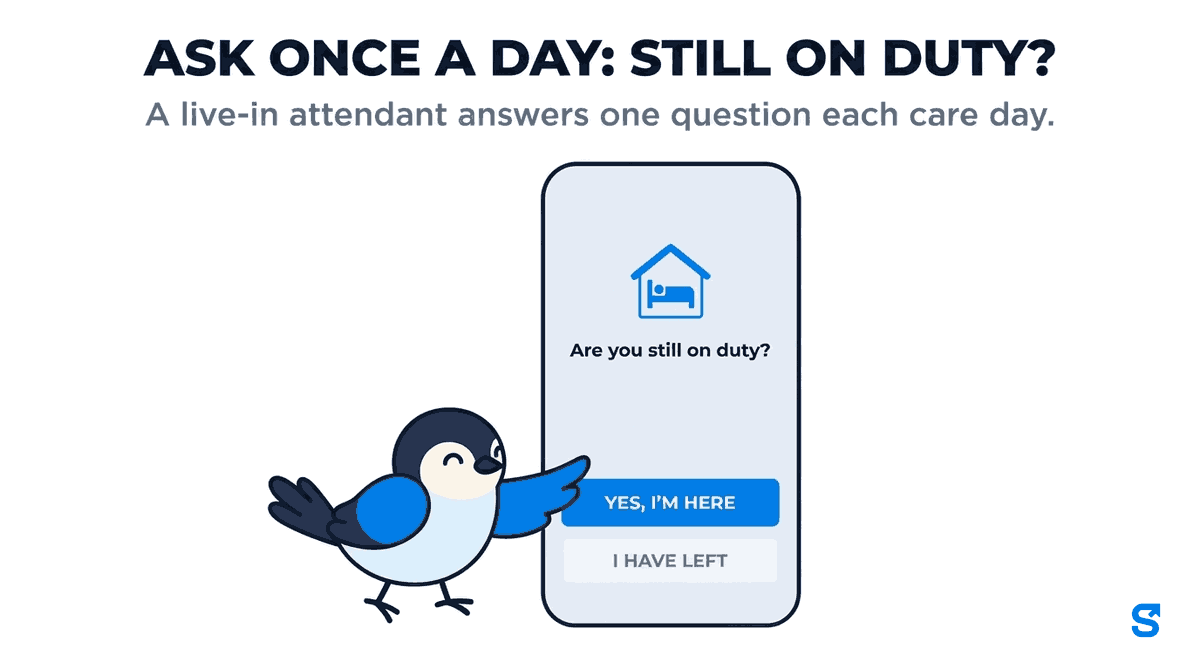
In Shiftelio's home care add-on, when a new care day starts the attendant's phone asks "Are you still on duty?" with two buttons: Yes, I'm here and I have left. One tap and the office knows. If she taps yes, she sees "Thank you, the office knows you are here." If her location could not be confirmed when she answered, the answer is still saved and the office is told to check that day, so a weak signal never turns into a missing day.
The point is not to catch her out. The point is that the day she does not answer is the day the office should phone the house, and the office is alerted when a care day goes unconfirmed, instead of finding out at month end.
What the office sees: Duty ends at, Duty ended, Duty not started
The office does not want a map. It wants to know, per patient, whether the house is covered. Each live-in patient shows one of a few plain states:
| What the office sees | What it means | What to do |
|---|---|---|
| Duty ends at a date | A stay is running and has a planned end | Nothing, unless a relief needs booking |
| Duty not started | The stay should have begun and nobody has arrived | Call the attendant or send another |
| No one on duty since a time | The attendant left and nobody has taken over | Tap Decide now and arrange cover |
| Duty ended, settle the last days | The stay is over and the final days are waiting | Check them and close the stay |
The No one on duty since warning is the one that matters most. An elderly patient alone overnight because a live-in attendant left after a family quarrel is the call every agency dreads, and the warning appears on the patient's page with a Decide now button, not in a report somebody reads next week. Sending relief is covered in when an attendant can't come.
On the attendance report a live-in day reads Present (24-hour duty), so a care day is never mistaken for a short day or an absence.
When she leaves: record the time she really left
Attendants leave live-in placements early. A family member falls out with her, she gets a call from her village, a better placement comes up. What breaks the record is not that she left, it is that the stay is ended later by somebody else at whatever time they noticed.
On her phone the attendant taps End duty. The sheet asks "Did you hand over?" and "When did you leave?" with two choices: I am leaving now, or Left earlier, where she picks the time she actually walked out. The office gets an alert that the live-in attendant left, carrying that time. The last day is then counted from what happened, not from when the office got round to it.
This matters for money more than anything else in this article. Section 17(2) of the Code on Wages, 2019 says that when an employee resigns or is removed, the wages due must be paid within two working days. Checked on 1 November 2026. An agency that needs a week to work out how many days a live-in attendant who has resigned was on duty has already missed that window. One that has the care days counted can pay her before she leaves town.
The expensive record is the one written later.If the stay is closed by the office three days after she left, those three days look like care days. The family is billed for them, and the attendant's claim and the family's complaint now point at the same three days from opposite sides. Let her record the time she left, and check it against the family's word before you pay.
Pay and the family's bill from the same days
This is where most agencies lose money without seeing it. The attendant's pay is worked out on one sheet, the family's invoice on another, and the two count days differently.
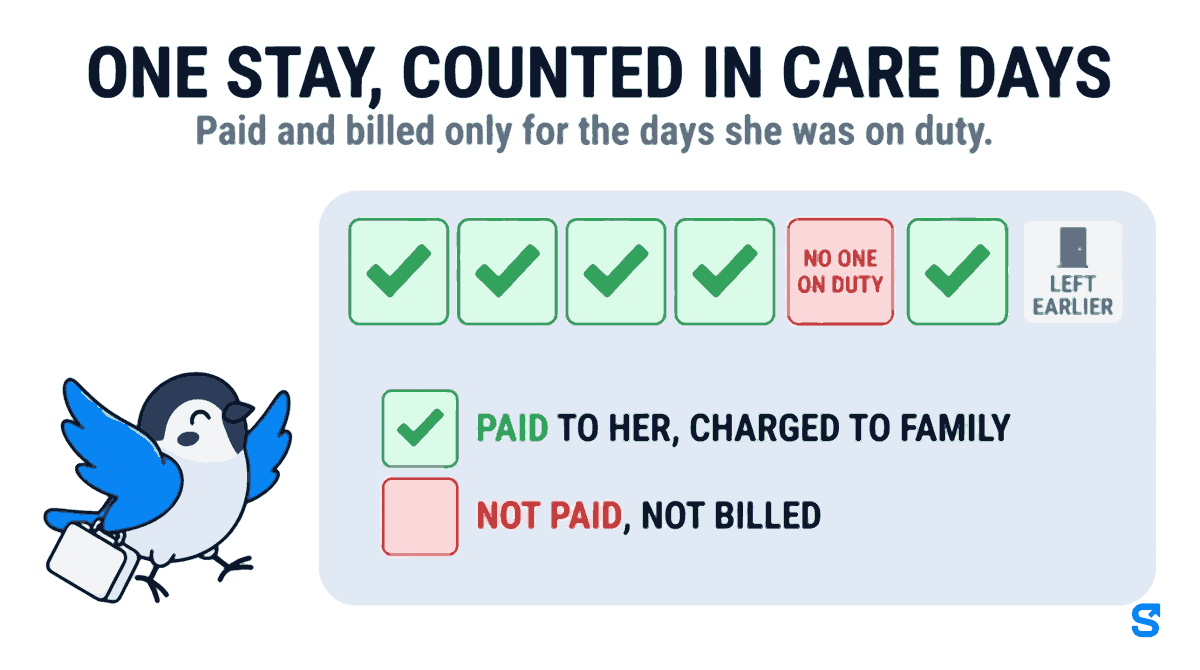
In Shiftelio a live-in plan is paid by the day or by the month, never per visit or per hour. The plan form will not take a per-visit or per-hour rate for a live-in, because a stay has no visits to count. Both pay and charge are then worked out per care day from the one list:
- A day she confirmed is a care day: paid to her, charged to the family.
- A day nobody was on duty is not a care day: not paid, not billed.
- A monthly salary or monthly charge is shared out by the care days in that month, so half a month covered is half a month paid and billed.
- A day the family turned her away at the door is paid to her and not billed to them, which is a separate rule covered in turned away at the door.
Because both numbers come from the same days, the margin on the placement is a real figure per patient. If you also give the attendant food and stay, that is set on the plan for the 24-hour duty, so it is not forgotten in the count.
A month that has already gone into a payroll that was paid or approved is not changed by a late correction. If a stay began before you set it up in the app, the plan offers Add past visits, and the attendant's card shows "Added by the office" with the date, so nobody mistakes a backdated day for one she confirmed herself.
Setting up a live-in placement, start to finish
- Open the patient and add a plan as a live-in duty. There is no daily arrival time, because she does not arrive daily.
- Set the pay and the family's charge per day or per month. The form moves a per-visit or per-hour rate to per day for you.
- Choose the attendant and the handover time if the stay changes hands to a relief.
- Let the daily check run. Look only at days that go unconfirmed or that the office was asked to check.
- When the stay ends, check the last days shown under Duty ended, settle the last days, then pay her within the time the law gives you.
Which app runs live-in stays for an Indian home care agency?
What no register can do is this: tell you, on the morning it happens, that a patient has had nobody with them since last night.
Questions home care agencies ask about live-in attendants
How do I mark attendance for a live-in attendant?
Count care days, not check-ins. She checks in once when the stay begins, confirms each care day with one tap, and ends the stay with the time she left. Each confirmed day is one day of attendance, shown as Present (24-hour duty).
Should a live-in attendant be paid per day or per month?
Either works, as long as both are tied to care days. A day rate pays exactly the days she was on duty. A monthly salary should be shared out by the care days in the month, so a half-covered month is not paid in full.
What if the attendant does not answer the daily check?
Phone the house. The office is alerted when a care day goes unconfirmed, so it can find out what happened before that day is paid or billed.
What if she leaves without telling the office?
The patient's page shows No one on duty since a time, with a Decide now button to arrange cover. When she or the office ends the stay, the time she actually left is what counts for pay and the bill.
Is a live-in attendant the same as a 24-hour shift?
No. A 24-hour shift is one round the clock duty, often handed over to a relief the next day. A live-in stay runs for days or weeks with the same attendant living in. The 24-hour shift article covers the single duty.
Can the family see the attendant's daily check?
The daily check is for the office. What the family sees is set separately, covered in home care family updates.
This is general information on the Code on Wages, not legal advice: check with your state labour department or an employment lawyer for your own placements. The Ministry of Labour lists the four labour codes on its labour codes page.
Keep reading
Free to use, no signup: HR letter formats.