When a Home Care Attendant Can't Come: See It Early, Send Relief
In short
An attendant can't come on a day she has visits? Shiftelio tells your office at once, lists every visit that needs someone, and sends relief.
On Tuesday night Rekha's mother falls ill in her village, and Rekha knows she will not be in the city on Thursday. On Thursday she has two visits: Mr Rao at 08:00 and Mrs Iyer at 09:00. She sends a voice note to the coordinator's personal number. The coordinator is at a family function and hears it on Thursday at 07:40, twenty minutes before Mr Rao's daughter starts phoning the office.
Nobody in that story did anything wrong. Rekha told somebody. The coordinator would have sent relief in a minute if she had known. What failed is the road between "I can't come" and "somebody else is going", and in a home care agency that road is walked every week: a fever, a wedding, a child's exam, a bus strike.
This piece is about shortening that road: what usually goes wrong, and how the home care side of Shiftelio now turns an attendant's "I can't come" into a list of visits the office has to fill, with a Send relief button beside each one.
Why an attendant's absence reaches the office late
A shop or a factory finds out someone is absent when they do not turn up at the gate. A home care agency often finds out from the patient's family, because the attendant goes straight from her own home to the patient's door. The Healthcare Sector Skill Council's Home Health Aide qualification (HSS/Q5102) puts the work in the patient's home, which is exactly why nobody at the office sees an empty chair.
So everything depends on the message. And the message usually travels in the weakest possible way: a WhatsApp to whoever the attendant knows best, a call that goes unanswered, a word to a colleague who forgets to pass it on. Even when the office does hear, somebody still has to work out which visits that person had on that day. The attendant knows "Thursday". The office needs "Mr Rao at 08:00 and Mrs Iyer at 09:00".
The WHO's patient safety note on communication during patient hand-overs treats every hand-over of care as a point where information gets lost. A relief visit is a hand-over that nobody planned, arranged at short notice. It needs the most care and usually gets the least.
The usual ways an agency hears about it
| How the attendant tells you | What the office learns | Where it breaks |
|---|---|---|
| WhatsApp or a call to the coordinator | That she can't come, if the coordinator sees it | One person's phone is the whole system |
| A message in the staff group | The news, among forty other messages | Nobody owns finding relief |
| She tells a colleague | Maybe, later | The office hears it second hand, or not at all |
| She does not tell anybody | Nothing until the family calls | The patient waits at home |
Every one of these tells the office about a person. None of them tells the office about the visits, and the visits are what the family is waiting for.
What changes when she says it on her phone
In Shiftelio's home care add-on, each attendant has a When I'm available screen on her phone. It holds her usual week, headed Every week, and the days that are different. On a day she cannot come she taps I can't come on a day, picks the day on the month grid, and the phone shows her what that day holds before she sends anything: "You have 2 visits that day. They stay yours until the office sends someone." Then she taps Tell the office.
The same thing happens when she adds a day through + Add a day and picks Not available instead of Available, different times: if she has visits that day, the phone says so before she saves.
That sentence matters. Saying she can't come does not quietly drop Mr Rao off the roster. The visits stay hers until somebody else is sent, so nothing falls through the gap between her message and the office's answer. If the office has saved its number, a Call the office button sits right there as well, because a phone message should never be the only way she tells you. And if her phone has no signal and the save fails, it says "Not sent yet. Call the office." instead of pretending it worked.
So in the story above, Rekha can't come on Thursday, and the office sees every visit that needs someone on Tuesday night, not on Thursday morning from the family.
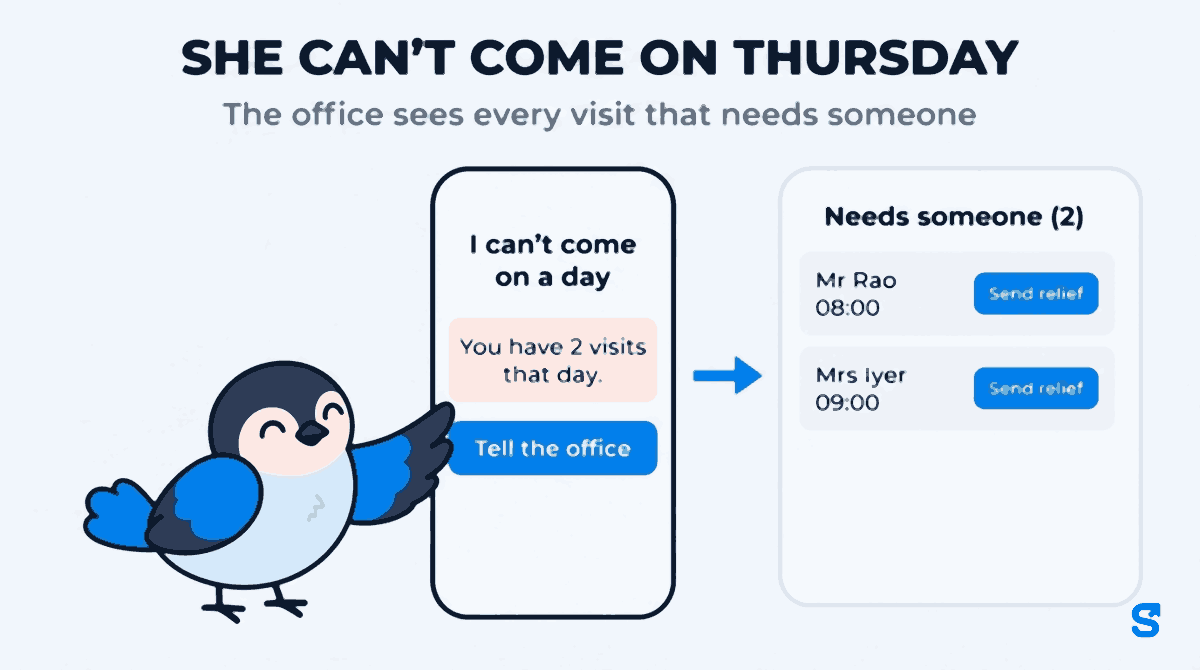
What the office sees: Needs someone, with Send relief
The moment she saves, the people who run home care in your office get a notification in their own language: "Rekha is absent Thu 9 Oct (said they can't come). 2 visits need someone."
On the Week tab of the visits roster, a Needs someone list sits above the grid with its count, Needs someone (2) for Rekha's Thursday, and one row per visit that lost its person:
- Thu 9 Oct · Mr Rao 08:00, marked Absence · Rekha, with a Send relief button.
- Thu 9 Oct · Mrs Iyer 09:00, marked Absence · Rekha, with a Send relief button.
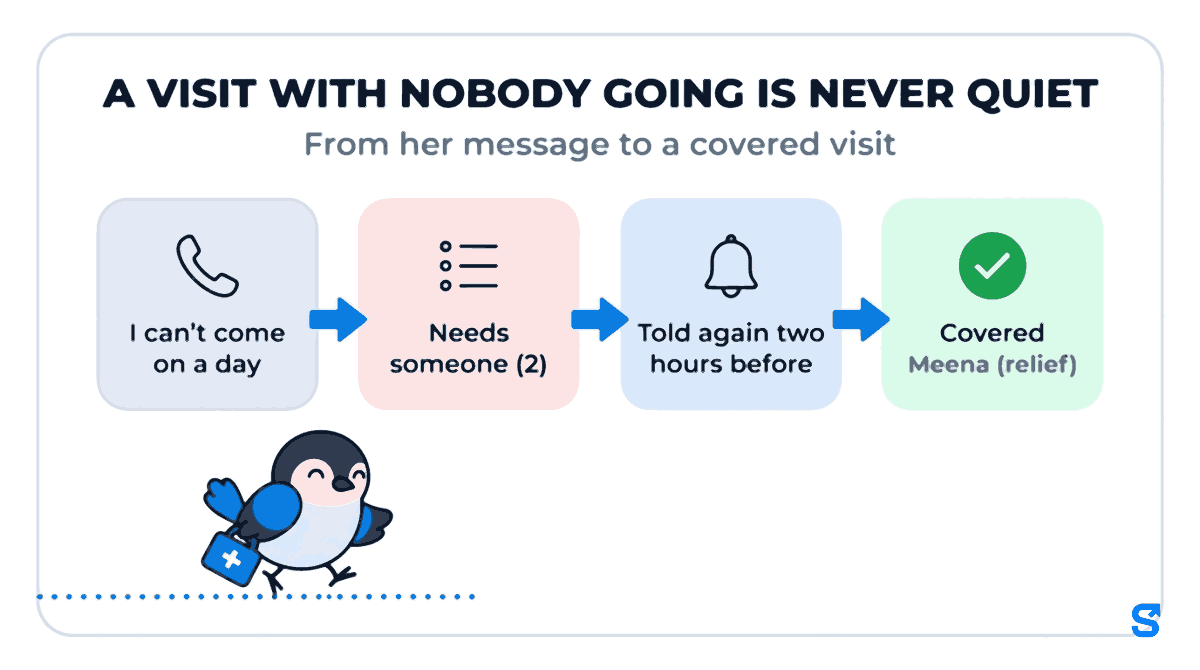
- Once somebody is sent, the visit moves down to Covered: "Mr Rao 08:00 · Meena (relief)".
Send relief opens the same cover sheet the roster grid uses, already set to that patient and that day. In Who goes? the attendants who have said they are available come first, then the ones who Hasn't said, then those not available that day. It never blocks a choice; it only puts the likely people at the top. The relief attendant is told on her own phone, as described in when a home care patient changes hands.
The list is not only for "I can't come". A leave, a day marked absent by the office, and a Not available day all land in the same place. Nothing is un-booked silently.
If nobody has been sent, the office is told again
Busy offices miss notifications. So if a visit today or tomorrow still has nobody going two hours before it starts, the office gets a second alert: "Rekha said they can't come. Nobody goes yet", followed by the visits. A visit with nobody going is never quiet.
When she messages you instead
Plenty of attendants will still send a WhatsApp. That is fine. The office opens her profile, goes to the Available card and enters the day for her, in the same screen her phone uses. The visits she had that day show up the same way, and the Needs someone list fills the same way.
The Available card also shows one plain line: "Said can't come on 3 booked days (last 30 days)". It is counted when she says it, so moving her visits around later does not change a number you have already seen. It is shown only to the owner and to managers who handle home care, in plain text with no colour, as information for planning, not a score.
What the office still decides
The app shortens the road. It does not choose for you. Who is the right relief for a bedridden patient who does not like new faces is a judgement only your coordinator can make, and the family deserves a call telling them who is coming. Use the Needs someone list as the to-do list and make that call anyway.
If a relief attendant is turned away because the family did not expect her, see paying an attendant turned away at the door. For everything else about patients, visits and charge against pay in one place, see Shiftelio for home care agencies.
A home care app that turns "I can't come" into a relief list
A checklist for an agency that wants to hear first
- Save the office phone number in Home Care settings, so every attendant sees a Call the office button.
- Show each attendant where I can't come on a day is on her phone, on her first week.
- Ask attendants to fill in their usual week, so Who goes? can put available people first.
- When a WhatsApp comes instead, enter the day on her Available card straight away.
- Open the Week tab every morning and clear the Needs someone list before the first visit.
- Call the family whenever relief is going, and tell them her name.
Questions home care agency owners ask
Does saying she can't come remove her from the roster?
No. Her visits that day stay hers until the office sends someone. They show under Needs someone so the office can see they have to be filled.
Who in the office is notified?
The people who receive home care alerts for your business, in the language each of them has set in the app. If a visit today or tomorrow still has nobody going two hours before it starts, they are told again.
Can the office enter the day for an attendant who only sent a WhatsApp?
Yes. On her profile, the Available card lets the office enter the day in the same screen her phone uses, and the visits she had show up the same way.
What does the relief attendant get?
A message on her phone that she is visiting that patient on those days, and the visit moves to Covered on the Week tab with her name marked relief.
Is this part of the normal plans?
It is part of the home care screens, which are an add-on we switch on for your account on request.
The short version
- In home care, the office usually hears about an absence last, and from the family.
- In Shiftelio's home care add-on, the attendant says it on her phone with I can't come on a day, and sees the visits that day before she sends it.
- Those visits stay hers until relief is sent, and each one appears under Needs someone on the Week tab with a Send relief button.
- If nobody has been sent two hours before a visit today or tomorrow, the office is told again; once somebody goes, the visit moves to Covered.
Sources, and how these were checked
- The home care attendant's role, working in patients' homes: Healthcare Sector Skill Council, Home Health Aide qualification pack HSS/Q5102 version 2.0, read in September 2026.
- Hand-overs of care as a point where information is lost: WHO Collaborating Centre for Patient Safety Solutions, Communication During Patient Hand-Overs, read in September 2026.
- The product behaviour was read from the Shiftelio code as shipped by 28 September 2026: the When I'm available screen and I can't come on a day, the warning about visits that day, the office notification and its wording, the Needs someone and Covered lists with Send relief, the order in Who goes?, the second alert two hours before a visit, the Office phone setting, and the can't-come count on the Available card.
Keep reading
Free to use, no signup: HR letter formats.