When a Home Care Patient Changes Hands, Tell the Attendant Before She Leaves Home
In short
Changed the attendant, put care on hold or sent relief? Shiftelio tells every attendant whose visits changed, on her phone, in her own language.
On Saturday evening the Rao family calls your office. Mr Rao is not comfortable with Rekha any more, and from Monday they would like Meena instead. Your coordinator agrees, changes the attendant on the roster and goes home. On Monday at 7:50 Rekha is at the Rao gate anyway, because nobody told her, and Meena is at home, because nobody told her either.
Nothing about that morning was a care failure. Both women know their work. What broke was the message between the office and the two phones in their pockets, and in a home care agency that message changes hands every week: a patient goes into hospital, a family stops the evening visit, an attendant takes three days off and somebody covers.
This piece is about that message: why it goes missing, what the usual fixes cost, and how the home care side of Shiftelio now sends it by itself, to exactly the attendants whose own visits changed.
Why reassignment messages go missing
The World Health Organization's patient safety note on communication during patient hand-overs names breakdown in communication as the leading root cause of the serious incidents reported to the Joint Commission in the United States between 1995 and 2006. A hospital at least has a nurses' station and a shift change where people stand in one room. A home care agency has neither. The Healthcare Sector Skill Council's Home Health Aide qualification (HSS/Q5102) places the work in patients' homes, and in practice attendants start from their own homes and go straight to the patient's door.
So the office has to reach each person separately, and it has to remember who that is. When the Raos swap Rekha for Meena, two people need to hear it, and they need to hear different things. When a patient goes on hold, every attendant who visits that home needs a message, including the one who only does the Sunday bath. Miss one and she is the person standing at a locked gate.
The usual ways the office tells staff
| How it is done | What the attendant gets | Where it breaks |
|---|---|---|
| The coordinator phones each person | The news, if she picks up | Remembering everybody affected, every time |
| A message in the staff WhatsApp group | One line among forty | Read by the wrong people, missed by the right one |
| The updated duty roster sent as a picture | The whole roster, not her change | She has to spot what moved |
| She finds out when she opens the app | The truth, eventually | Often at the door, after the journey |
The phone call is the most reliable of the four, and it is also the one that depends entirely on the coordinator's memory on a busy Saturday evening. The duty roster picture is complete but makes every attendant do the comparison herself.
What Shiftelio sends, and to whom
In Shiftelio's home care add-on, every change the office makes to a patient's visits already rewrites the roster. Since 25 September 2026 it also sends a notification to each attendant whose own visits changed, and only to them. Tapping it opens her My Patients list. The owner or coordinator who made the change is not messaged about their own action.
- Start care or Add a service: the attendant put on the patient is told "You will visit Mr Rao from 5 Oct, at 08:00."
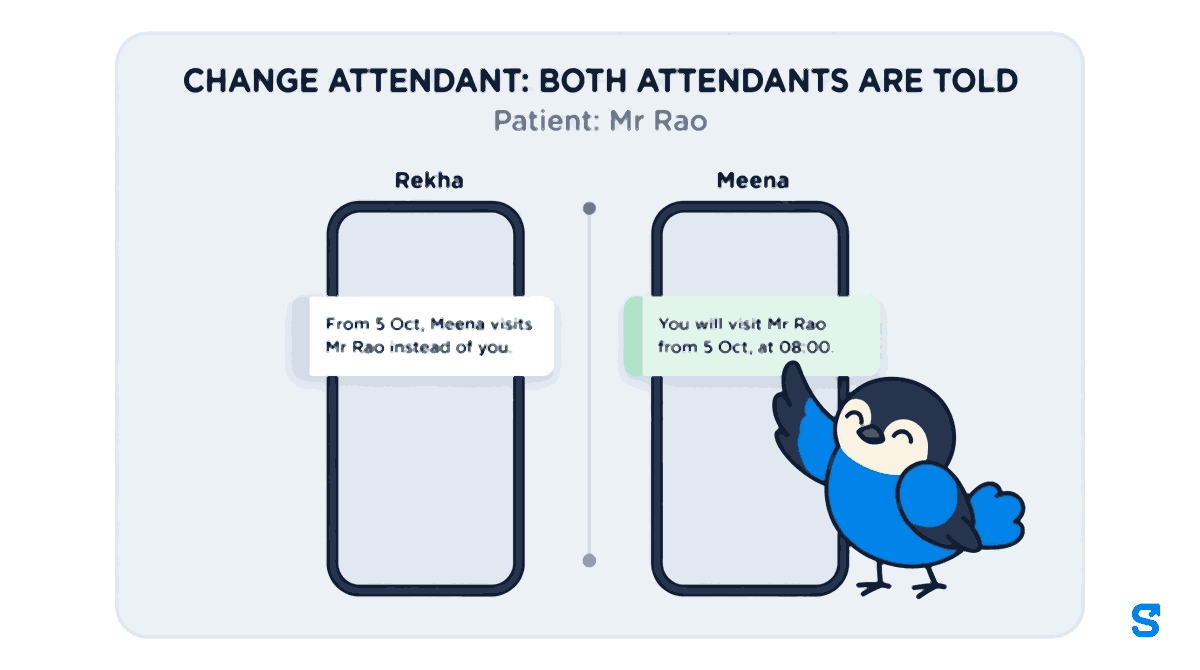
- Change attendant: the person coming off is told "From 5 Oct, Meena visits Mr Rao instead of you." The person going on gets the new visits message.
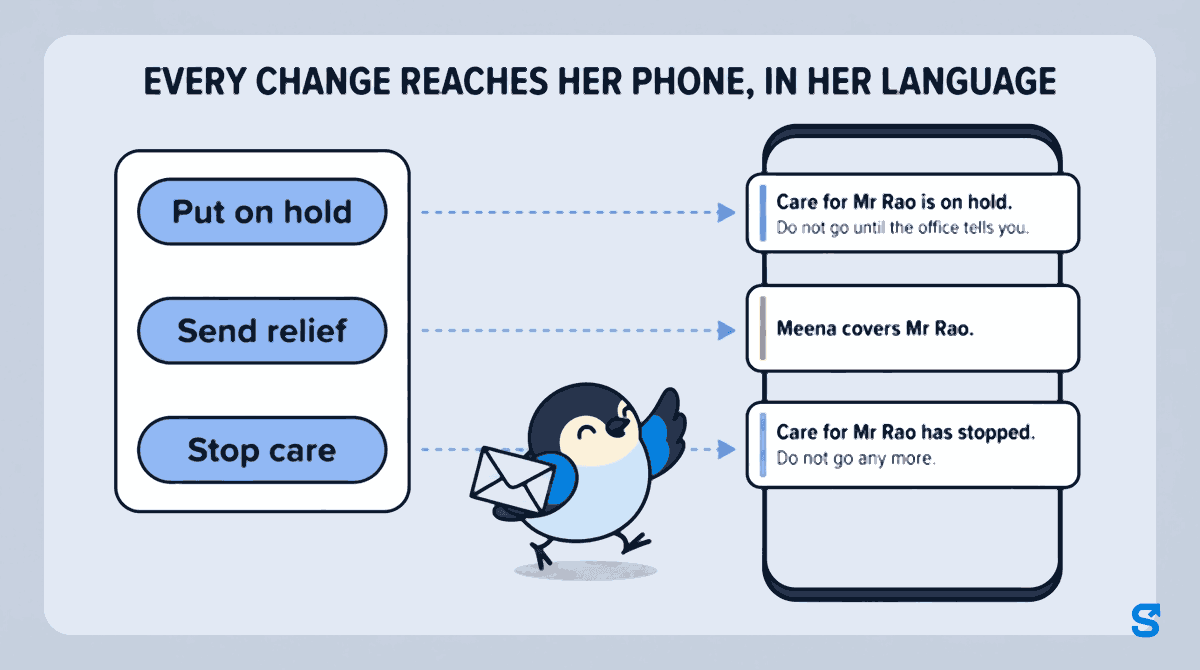
- Put on hold: everybody who would have gone is told "Care for Mr Rao is on hold until" a day, and "Do not go until then."
- Send relief: the relief attendant is told she will be visiting the patient and that the usual times and routine apply. The regular attendant is told "Meena covers Mr Rao", with the days.
- Stop this service or Leave it open - find someone: whoever held those times is told "you no longer visit Mr Rao", from the day it takes effect.
- Stop care: everybody still going is told "Care for Mr Rao has stopped. Do not go any more."
Two details matter more than they look. When care stops from a later day, the message says "Keep going until then", because a visit dropped too early is the worse mistake. And when a patient goes into hospital with a live-in attendant who goes too, that live-in attendant is left alone: her work carries on, only the place changed.
When the office fills a time that was left open, with Choose who goes, the person chosen gets the same new visits message as anybody put on a patient. Until somebody is chosen, the screen says plainly that nothing reaches anyone's phone.
In the language she reads
Each message goes out in the language that attendant has set in her own app, not the language of the person who made the change. The sentences are written in English, Hindi, Bengali, Gujarati, Kannada, Marathi, Punjabi, Tamil and Telugu, and the patient's name and the day are filled in for her. An attendant who reads Marathi gets the whole sentence, the date included, in Marathi, even when the coordinator works in English.
If her phone is off or the message cannot be delivered, the change on the roster is still saved and still shows in her My Patients list the next time she opens the app. The message is a heads up, never the only copy of the truth.
What the coordinator still does
The notifications take away the remembering, not the conversation. A family that asks for a different attendant is often a family with a complaint, and Rekha deserves to hear that from a person, not only read "Meena visits Mr Rao instead of you" on her phone. Use the message as the record and make the call anyway when the reason is sensitive.
A hold with no end date says "Do not go until the office tells you", so restarting that patient is still a call your office makes. And none of these messages goes to the patient's family. For what the family sees, see home care family updates without showing your rates. For what happens when an attendant is the one who cannot come, see paying an attendant turned away at the door.
For patients, visits, relief and charge against pay in one place, see Shiftelio for home care agencies.
A home care app that tells attendants when their patients change
A checklist for the week a patient changes hands
- Make the change in the app first, before you phone anybody, so the message and your call say the same thing.
- If the reason is a complaint, call the attendant coming off yourself as well.
- Ask each attendant to keep notifications on for Shiftelio on her phone.
- Check that each attendant has picked her own language in the app.
- For a hold with no end date, put a reminder in the office to restart care and tell the staff.
- On the first day of any change, look at the visits screen for the first door and confirm the right person started.
Questions home care agency owners ask
Who gets a message when I change the attendant?
Two people: the attendant coming off, told who goes instead and from which day, and the attendant going on, told which patient, from when and at what time. Other staff on that patient are not messaged, because their visits did not change.
Does a relief attendant hear about it?
Yes. The relief attendant is told she will be visiting that patient on those days and that the usual times and routine apply, and the regular attendant is told who covers her patient. If relief is ended early, the relief attendant is told not to go.
What if the attendant does not see the notification?
The change is saved either way and shows in her My Patients list when she opens the app. The notification only saves her the trip if she sees it, so on the first day of a change, check who started the first visit.
Which languages are the messages in?
English, Hindi, Bengali, Gujarati, Kannada, Marathi, Punjabi, Tamil and Telugu, following the language each attendant chose in her own app.
Is this part of the normal plans?
It is part of the home care screens, which are an add-on we switch on for your account on request.
The short version
- In home care, the message that a patient has changed hands has to reach each attendant separately, and missing one means a wasted trip or an empty door.
- Shiftelio's home care add-on now sends that message by itself for Start care, Change attendant, Put on hold, Send relief, Stop this service, Leave it open and Stop care.
- Only the attendants whose own visits changed are told, each with the sentence that fits her: new visits, who goes instead, on hold until when, who covers, or stop.
- Each message is in the attendant's own language and opens her My Patients list; the call to the family and the sensitive conversations are still yours.
Sources, and how these were checked
- Communication breakdown as the leading root cause of sentinel events reported to the Joint Commission, 1995 to 2006: WHO Collaborating Centre for Patient Safety Solutions, Communication During Patient Hand-Overs, read in September 2026.
- The home care attendant's role, working in patients' homes and reporting to those who run their care: Healthcare Sector Skill Council, Home Health Aide qualification pack HSS/Q5102 version 2.0, read in September 2026.
- The product behaviour was read from the Shiftelio code as shipped on 25 September 2026: which office actions send a message, to whom, the wording of each message, the hospital hold exception for a live-in attendant, the languages, and that a message that fails never undoes the change.
Keep reading
Free to use, no signup: HR letter formats.