Labour Welfare Fund 2026: Karnataka Just Added You, and December Is the Only Payroll to Act In
In short
LWF survived the labour codes. Karnataka cut its threshold to 10 employees on 7 January 2026. Who pays, how much, and why a missed December run costs you twice.
There is a shop in Bengaluru with 22 people on the roll. It has run payroll the same way for six years: PF, ESI, professional tax, done. On 7 January 2026 it became liable for a fourth statutory deduction it has never made, and nobody told it, because the change was a two-line amendment to a 1965 State Act rather than anything on the front page.
The Labour Welfare Fund is the smallest statutory deduction in Indian payroll and the one most often missing entirely. In Karnataka it is Rs 50 a year off an employee. That is the reason it gets skipped, and it is also the reason skipping it is a bad trade: the amount is too small to argue about and too small to be worth the penalty, the interest, or the line in an inspection report.
This article is about who owes it in 2026, why the labour codes did not remove it, and the one structural feature that turns a forgotten December payroll into money you never get back.
The labour codes did not abolish the Labour Welfare Fund
This is the first thing to clear, because it is the most common belief and it is wrong.
The four labour codes consolidated 29 central labour Acts. Every one of the laws they swallowed was an Act of Parliament. The Labour Welfare Fund is not one law - it is sixteen separate State Acts, each passed by a State legislature, each with its own Board, its own rates, its own forms and its own calendar. The Maharashtra Labour Welfare Fund Act is from 1953. The Karnataka one is from 1965. Neither of them was in the list of 29, and neither was repealed.
If your 2026 compliance calendar was rebuilt around the four codes, LWF has probably fallen off it. That is the specific failure mode this year. The codes reorganised the central obligations so thoroughly that a State obligation sitting outside them looks, on a fresh checklist, like something that was cleaned up. It was not.
Everything else on a payslip that behaves this way behaves the same: professional tax is also State law, also survived, and also has to be tracked State by State. If you want the wider picture of what the codes did change, the 2026 labour code compliance checklist covers it.
Karnataka moved the line from 50 employees to 10
The Karnataka Labour Welfare Fund (Amendment) Act, 2025received the Governor's assent on 6 January 2026 and was published in the Karnataka Gazette on 7 January 2026, taking effect immediately. It did one thing, and it did it to a single number.
| Before 7 January 2026 | From 7 January 2026 | |
|---|---|---|
| Establishments covered | More than 50 employees | 10 or more employees |
| Employee contribution | Rs 50 a year | Rs 50 a year |
| Employer contribution | Rs 100 a year | Rs 100 a year |
| Deducted in | December | December |
| Paid to the Board by | 15 January | 15 January |
The rate did not move. The population did, and it moved a long way: every shop, restaurant, clinic, salon, agency and small factory in Karnataka sitting between 10 and 50 people was outside this Act in 2025 and is inside it now. That is a very large number of establishments whose payroll has genuinely never carried the line.
Because the amendment took effect on 7 January 2026, it bites on calendar year 2026, not 2025. The first payroll that has to act is December 2026 and the first payment falls due 15 January 2027. That is one quarter away, which is why this is worth reading in September rather than in the last week of December.
You owe for who is on the register, not for headcount
LWF does not work like PF. PF is a percentage of what a person actually earned in a month, so it self-adjusts when somebody joins on the 20th. LWF is a flat rupee figure attached to a date.
Section 6BB of the Maharashtra Act is the clearest drafting of it. Contribution is payable in respect of employees who are on the register of the establishment on 30 June and 31 December respectively. Not average headcount. Not everyone who worked during the half-year. Whoever is on the roll on the day.
Two consequences fall straight out, and both of them are money:
- Somebody who joined on 15 December and is on the roll on the 31st is a full contribution. There is no pro-rating for a fortnight, because the section counts people and not days.
- Somebody who worked eleven months and resigned on 20 December is nothing. They were not on the register on the counting date.
So the number you owe is a snapshot, and the snapshot is taken on a day when a lot of Indian workplaces have people mid-exit, mid-joining and mid-notice. Getting it right means knowing exactly who was on the roll on 31 December, which is a question about your records rather than about the law.
December is the only payroll you can recover it in
This is the part that makes LWF worth an article rather than a footnote, and it is almost never quoted.
Section 6BB does not merely say the employer must pay. It also says how the employer may get the employee's half of it back: the employer may recover the employee's contribution only by deduction from the wages of the months of June and December. That is the statutory permission, and it is bounded by month.
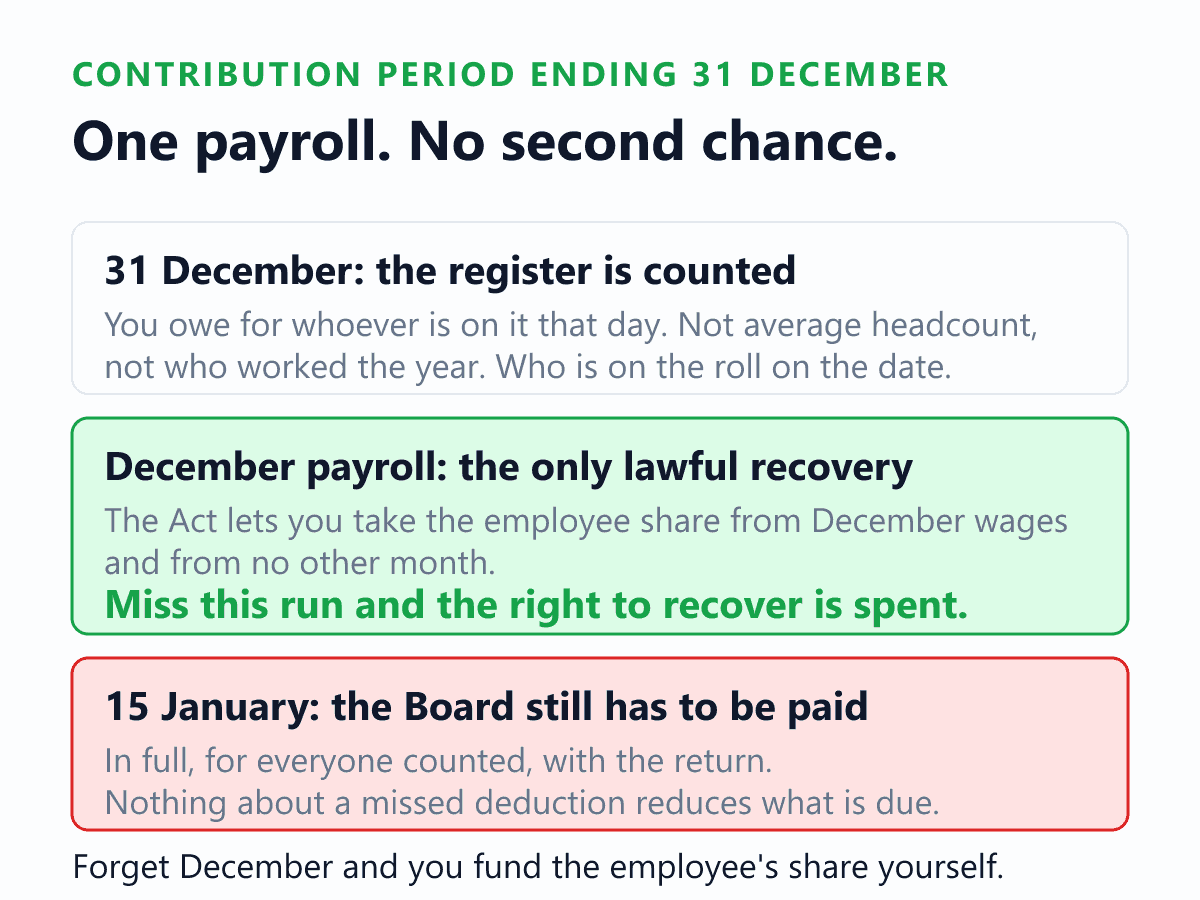
Read those two facts together and the trap is obvious. The obligation to pay survives the missed payroll. The right to recover does not. An employer in Karnataka who closes December 2026 without the line still owes the Board Rs 150 a head on 15 January 2027 - Rs 100 that was always theirs, and Rs 50 that was supposed to come off a payslip that has now been paid and closed.
Why you cannot just take it in January. A deduction from wages is lawful only if the law authorises it, and the authority here is specific to June and December. Taking Rs 50 off a January payslip for a December liability is a deduction outside the closed list in section 18(2) of the Code on Wages, which is a different and larger problem than the Rs 50. The salary deduction rules guide works through why consent does not fix that.
For a 40-person establishment the sum at stake is Rs 2,000. Nobody is going bankrupt. But it is a clean example of a rule where the cost of being three weeks late is not interest - it is the permanent loss of a right, and it repeats every single year the line is missing.
What you deduct is not what you pay
The employee contribution is the number everyone quotes, and it is the smaller part. Every State sets the employer share as a multiple of it, and the multiple is not the same everywhere.
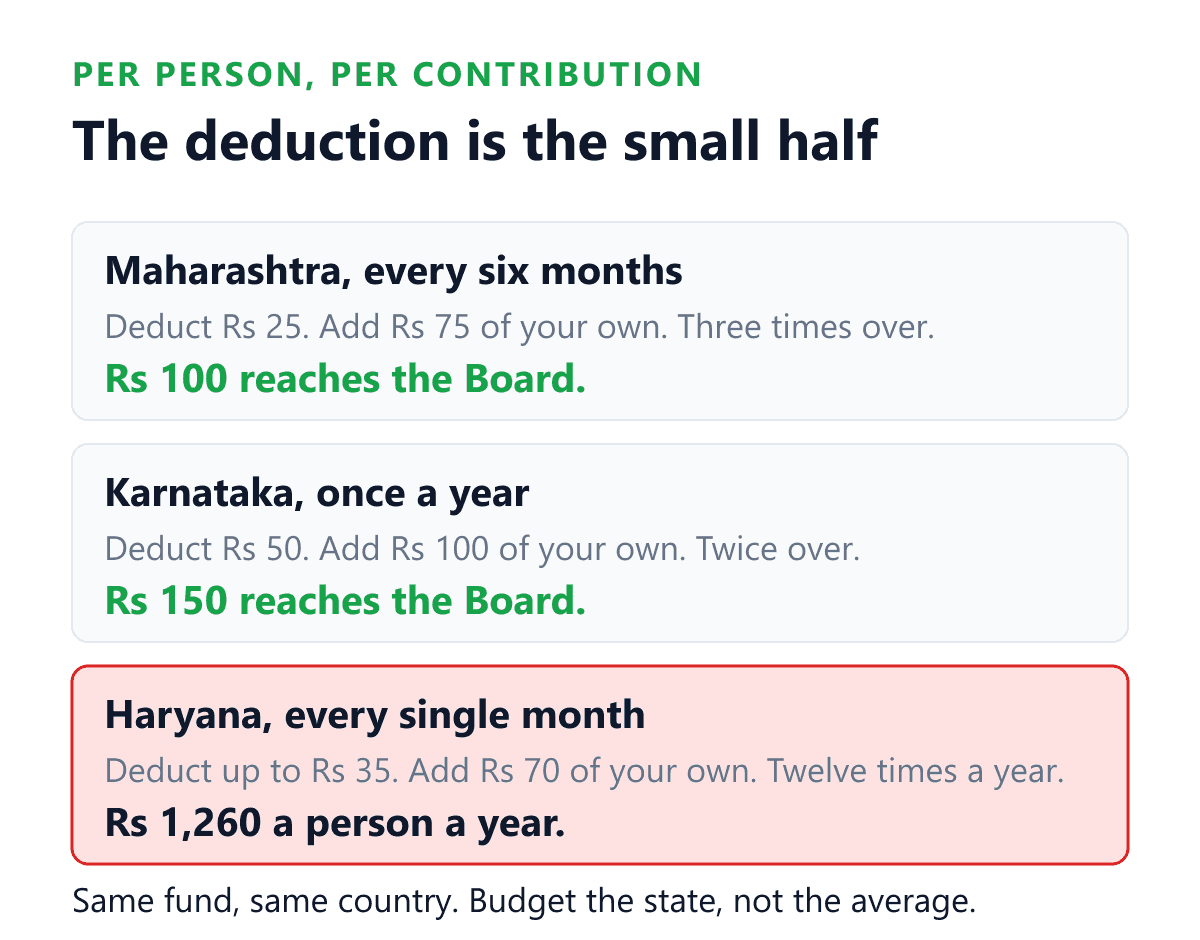
Maharashtra and Delhi both run at three times: Rs 25 deducted against Rs 75 from the employer in Maharashtra, Rs 0.75 against Rs 2.25 in Delhi. Karnataka and Haryana run at twice. In Maharashtra and Delhi the State Government then adds a further amount equal to twice the employee share, which is where the fund actually gets its size.
Haryana is the structural exception and deserves its own paragraph, because a payroll built on the assumption that LWF is a flat rupee figure will get it wrong. Haryana charges 0.2% of wages, not a fixed amount, with the employee contribution capped per month - and that cap was raised from Rs 34 to Rs 35 with effect from 1 January 2026. The employer pays twice the employee share, so Rs 70. And it is monthly, which means Rs 105 a head reaching the Board twelve times a year. For one employee that is roughly Rs 1,260 a year against Karnataka's Rs 150.
If you run people in more than one State, that is the practical point: LWF is not one deduction with sixteen rates. It is a percentage in one State and a flat figure in fifteen, monthly in some and annual in others, and the budget line is three to twelve times the number on the payslip.
The sixteen States, and the three rhythms
As of 2026, LWF legislation is in force in sixteen States and Union Territories:
Andhra Pradesh · Chandigarh · Chhattisgarh · Delhi · Goa · Gujarat · Haryana · Karnataka · Kerala · Madhya Pradesh · Maharashtra · Odisha · Punjab · Tamil Nadu · Telangana · West Bengal
Uttar Pradesh, Bihar, Jharkhand, Rajasthan and most of the north-east have no LWF obligation for ordinary private establishments. If every one of your locations is in that group, this article costs you nothing and you can stop here.
Everything runs on one of three rhythms, and the rhythm matters more operationally than the rate does, because it decides which payroll run has to carry the line:
| Rhythm | Deducted in | Verified example |
|---|---|---|
| Monthly | Every payroll run | Haryana - 0.2% of wages, employee capped at Rs 35 from 1 January 2026, employer twice that |
| Half-yearly | June and December | Maharashtra - Rs 25 employee, Rs 75 employer, paid by 15 July and 15 January Delhi - Rs 0.75 employee, Rs 2.25 employer, return by 15 July and 15 January |
| Annual | December | Karnataka - Rs 50 employee, Rs 100 employer, paid by 15 January |
Note what the middle and bottom rows share. Half-yearly States and annual States both land on the December payroll, so for most multi-State employers December is the single busiest LWF month of the year and January is the single busiest filing month.
Who is not an "employee" for this
LWF Acts carry their own definition of employee, and it is narrower than the one payroll normally uses. The Maharashtra definition is representative: a person employed for hire or reward to do skilled, unskilled, manual, clerical, supervisory or technical work, whether directly or through a contractor,
"but does not include any person who is employed mainly in a managerial capacity, or who, being employed in a supervisory capacity, draws wages exceeding three thousand and five hundred rupees per mensem."
Three things follow that are easy to get wrong in either direction.
- Contract workers count. "Directly by the employer or through a contractor or any other agency" is in the definition. A principal employer relying on a contractor to have handled it is exposed the same way it is on PF - see principal employer liability for contract workers.
- Managerial staff are out, on function and not on title. "Employed mainly in a managerial capacity" is about what the person does. Calling a shift lead an Assistant Manager does not take them out.
- The Rs 3,500 supervisory ceiling is not a general wage ceiling. It applies only to people in a supervisory capacity. A skilled worker on Rs 40,000 is still an employee for LWF, because there is no wage cap on the main limb of the definition. This is the opposite of ESI, where the Rs 21,000 ceiling does the work - which is covered in the ESI contribution period guide.
The figure in that clause has not been revised for decades, so in practice it now excludes almost nobody. Treat it as a technicality that removes a handful of supervisors rather than as a threshold that will thin your list.
Why every LWF rate table on the internet disagrees
While researching this article, two well-ranked state-wise LWF rate tables were compared field by field. They contradict each other on Delhi, Tamil Nadu, Telangana, Punjab, Kerala, and on the employer share in Madhya Pradesh and West Bengal. One says Tamil Nadu is half-yearly; the other says annual. One puts Telangana at Rs 10 every six months; the other at Rs 2 a year. Both are published as settled fact.
Free bare-act mirrors are not a safe fallback either. A widely-cited copy of section 6BB still shows the pre-2024 Maharashtra slab rates of Rs 6 and Rs 12, which were replaced by the flat Rs 25 in the March 2024 amendment. Nothing on the page says it is out of date.
There is a structural reason for all of this. Sixteen legislatures revise these figures independently, by notification rather than by amendment, often mid-year, and there is no central register that consolidates them. A page written in 2023 and given a 2026 date in the title looks identical to one that was actually checked.
Do not take a rate from a blog, including this one, and put it into a payroll run.Three states are given in full above because they were verified against the Act and the 2026 notifications, and the other thirteen are deliberately not tabulated here for exactly that reason. Take the figure from your State Board's own site or its latest notification, and write the date you checked it next to the number in your payroll configuration.
The check is quick, and it is three questions per State: is the establishment over the headcount threshold, what is the current employee figure and the employer multiple, and which month does the deduction fall in. Once a year, in October, for every State you operate in. That timing is deliberate - it lands before the December run rather than during it.
The record that makes the December number right
Almost everything above reduces to one question that the law does not answer for you: who was on the register on 31 December?
That sounds trivial until you try to answer it in the second week of January for a business with staff turnover. A resignation processed on the 3rd of January for a last working day of 28 December, a joiner whose paperwork was completed after the break, a worker on a contractor's roll who has been on your site since November - each of those changes the count, and the count is the entire liability. Reconstructing it from memory is how the number ends up wrong in both directions at once.
Shiftelio holds the joining and exit date against each person, so the roll on any given date is a fact you can read rather than a number somebody assembles. Contract staff sit on the same register as direct employees, which matters here because the LWF definition of employee covers both and a separate contractor spreadsheet is precisely where people get missed.
The deduction side is the other half. LWF is unusual in that it fires on onepayroll run a year in most States, which is exactly the kind of thing an annual routine forgets - there is no monthly rhythm to remind anybody. Shiftelio's payroll holds per-State statutory deductions against each location, so the December run in a Karnataka branch carries the Rs 50 line and the June and December runs in a Maharashtra branch carry Rs 25, without anyone remembering to switch it on. The same record then supports the return, because the count and the names behind it are already there.
For the deductions that sit next to it on the same payslip, the professional tax calculator handles the other State-wise levy, and the PF and ESI calculator covers the two central ones.
Frequently asked questions
Is the Labour Welfare Fund still applicable after the labour codes?
Yes. The four labour codes consolidated 29 central Acts. The Labour Welfare Fund exists under sixteen separate State Acts, which are State legislation and were not repealed or subsumed. Maharashtra's Act of 1953 and Karnataka's of 1965 both remain in force in 2026, with their own Boards, rates, forms and due dates.
Which states have a Labour Welfare Fund in India?
Sixteen: Andhra Pradesh, Chandigarh, Chhattisgarh, Delhi, Goa, Gujarat, Haryana, Karnataka, Kerala, Madhya Pradesh, Maharashtra, Odisha, Punjab, Tamil Nadu, Telangana and West Bengal. Uttar Pradesh, Bihar, Jharkhand, Rajasthan and most north-eastern States have no LWF obligation for ordinary private establishments.
What is the Karnataka Labour Welfare Fund limit in 2026?
Ten or more employees. The Karnataka Labour Welfare Fund (Amendment) Act, 2025 cut the threshold from more than 50 to 10 or more, with effect from 7 January 2026. The contribution is unchanged at Rs 50 from the employee and Rs 100 from the employer per year, deducted in December and paid by 15 January.
Can I deduct Labour Welfare Fund in a later month if I forget?
No. The Act permits recovery of the employee's share only from the wages of the contribution month - June and December in Maharashtra, December in the annual States. The liability to pay the Board is unaffected, so a missed December run means the employer pays both halves. Recovering it from a January payslip would be a deduction the Code on Wages does not authorise.
Is Labour Welfare Fund deducted from employees who left during the year?
No, provided they were off the register before the counting date. Contribution is payable in respect of people on the establishment's register on 30 June and 31 December. Somebody who resigned on 20 December is outside that count entirely, and somebody who joined on 15 December is a full contribution with no pro-rating.
Does the Labour Welfare Fund apply to contract workers?
Yes. The definition of employee expressly covers a person employed "directly by the employer or through a contractor or any other agency". Contract staff on your premises on the counting date are part of your count, and relying on the contractor to have dealt with it leaves the principal employer exposed.
Is there a salary limit for the Labour Welfare Fund?
Not a general one. The only wage figure in the Maharashtra definition applies to people in a supervisory capacity, who are excluded above Rs 3,500 a month, and to nobody else. A skilled worker earning Rs 40,000 is still covered. This is unlike ESI, where the Rs 21,000 ceiling applies across the board.
The short version
- LWF is State law. The four labour codes consolidated 29 central Acts and did not touch it. If it fell off your 2026 calendar, that is why.
- Karnataka cut its threshold from more than 50 employees to 10 or more on 7 January 2026. First affected payroll: December 2026. First payment: 15 January 2027.
- You owe for whoever is on the register on the counting date, not for average headcount. A December joiner is a full contribution; a December leaver is nothing.
- The employee's share may be recovered only from that month's wages. Miss the run and you pay both halves, permanently.
- The employer share is two or three times the deduction depending on the State, so budget the multiple and not the payslip line.
- Haryana is the exception: 0.2% of wages, employee capped at Rs 35 a month from 1 January 2026, employer twice that, charged monthly.
- Published LWF rate tables contradict each other on at least seven States. Verify against your Board's notification in October, and record the date you checked.
Position as at 6 September 2026. Rates and dates stated for Maharashtra, Karnataka, Delhi and Haryana were checked against the relevant State Act and the 2026 notifications; figures for the other twelve States are deliberately not stated here because the published sources conflict. LWF rates are revised by State notification without amendment to the parent Act and can change mid-year. This is general information, not legal advice for a particular establishment - confirm every figure with your State Labour Welfare Board before applying it to a payroll run.
Sources
- The Maharashtra Labour Welfare Fund Act, 1953, India Code (Government of India) - section 2 for the definition of employee, section 6BB for the contribution, the counting dates and the recovery clause.
- India Code, Government of India - the consolidated text of the State Labour Welfare Fund Acts and their amendments.
- Ministry of Labour and Employment, Labour Codes - the 29 central Acts the four codes consolidated, which is the list the State LWF Acts are not on.
- Department of Labour, Government of Karnataka - the Labour Welfare Board and the notifications under the Karnataka Labour Welfare Fund Act, 1965.
- Labour Department, Government of Haryana - the Haryana Labour Welfare Board and the contribution limits revised with effect from 1 January 2026.
- Delhi Labour Welfare Board - the notifications constituting the Fund for the National Capital Territory and the current contribution.
Keep reading
See how Shiftelio does this in practice with a joining and exit register that answers the 31 December count.
Work your own numbers with the free professional tax calculator. No signup, no email.