Maternity Benefit Rules in India 2026: Who Actually Pays the 26 Weeks
In short
Chapter VI of the Code on Social Security worked through: when ESIC pays, when section 61 makes you pay, the 80 day test, and what 26 weeks really costs.
Two women work in the same office. Both are pregnant, both are due in March, both are entitled to twenty six weeks of paid leave. One of them costs the business nothing at all. The other costs it close to two lakh rupees in cash, spread over six months in which she does no work.
The only difference between them is a number on a payslip, and most employers do not find out which of the two they are dealing with until the notice arrives. This is a guide to the part of the maternity rules that decides money: who pays, how much, on what arithmetic, and the eligibility test that turns entirely on records almost nobody keeps.
Where the duty comes from, and the threshold that is not ten
Maternity benefit in India is no longer the Maternity Benefit Act, 1961. It is Chapter VI of the Code on Social Security, 2020, sections 59 to 72, which came into force on 21 November 2025 and swallowed the 1961 Act whole. The section numbers changed. The substance mostly did not.
Almost every summary you will read says Chapter VI applies to establishments with ten or more employees. Read the First Schedule to the Code, which is where applicability actually lives, and it says something different:
Chapter VI applies (a) to every establishment being a factory, mine or plantation, including one belonging to Government; and (b) to every shop or establishment in which ten or more employees are employed, or were employed, on any day of the preceding twelve months.
Limb (a) carries no headcount whatsoever. A factory with six people on the floor is covered by Chapter VI in full: twenty six weeks, medical bonus, the lot. The ten employee test in limb (b) is only for shops and establishments, and even there it is not a test of today. It is "or were employed on any day of the preceding twelve months". A shop that peaked at eleven during Diwali and has been at eight ever since is still inside the Chapter.
This is the same counting trap that runs through the codes, and it bites differently at each threshold. Our piece on why "fifty employees" is three different numbers works the crèche version through, one section further on in the same Chapter.
Who actually pays the twenty six weeks
This is the question the coverage skips, and it has a precise statutory answer in a section almost nobody quotes.
Section 60(1) says that every woman is entitled to maternity benefit "and her employer shall be liable for"paying it. That is the default: the money comes out of the business. But a woman covered by Employees’ State Insurance draws maternity benefit from ESIC instead, under section 32(1)(b) of the same Code, and ESIC pays her directly.
What decides between them is the ESI wage ceiling. As at September 2026 that ceiling is Rs 21,000 a month in gross wages, and Rs 25,000 for an employee with a disability. A hike to Rs 25,000 or Rs 30,000 has been under discussion for most of the year and has been widely reported, but no gazette notification has issued, so 21,000 is the live number.
The bridge in section 61, and the case nobody budgets for
Being under the ceiling is not enough on its own. ESIC pays maternity benefit only to an insured woman who satisfies a contributory condition: broadly, seventy days of contribution across the two contribution periods immediately preceding the date of confinement or the expected date. A woman who joined four months ago is under the ceiling, is enrolled, is having contributions paid, and does not have seventy days.
Section 61 decides who carries her, and it is worth reading in full because it is one sentence and it is the whole answer:
"Every woman entitled to the payment of maternity benefit under this Chapter shall, notwithstanding the application of Chapter IV to the factory or other establishment in which she is employed, continue to be so entitled until she becomes qualified to claim maternity benefit under section 32."
Chapter IV is the ESI chapter. So the sentence says: being an ESI covered establishment does not switch off your Chapter VI liability. It only suspends it once she personally qualifies with ESIC. Until then the employer pays, at the employer’s own cost, for a woman whose payroll deductions have been going to ESIC every month.
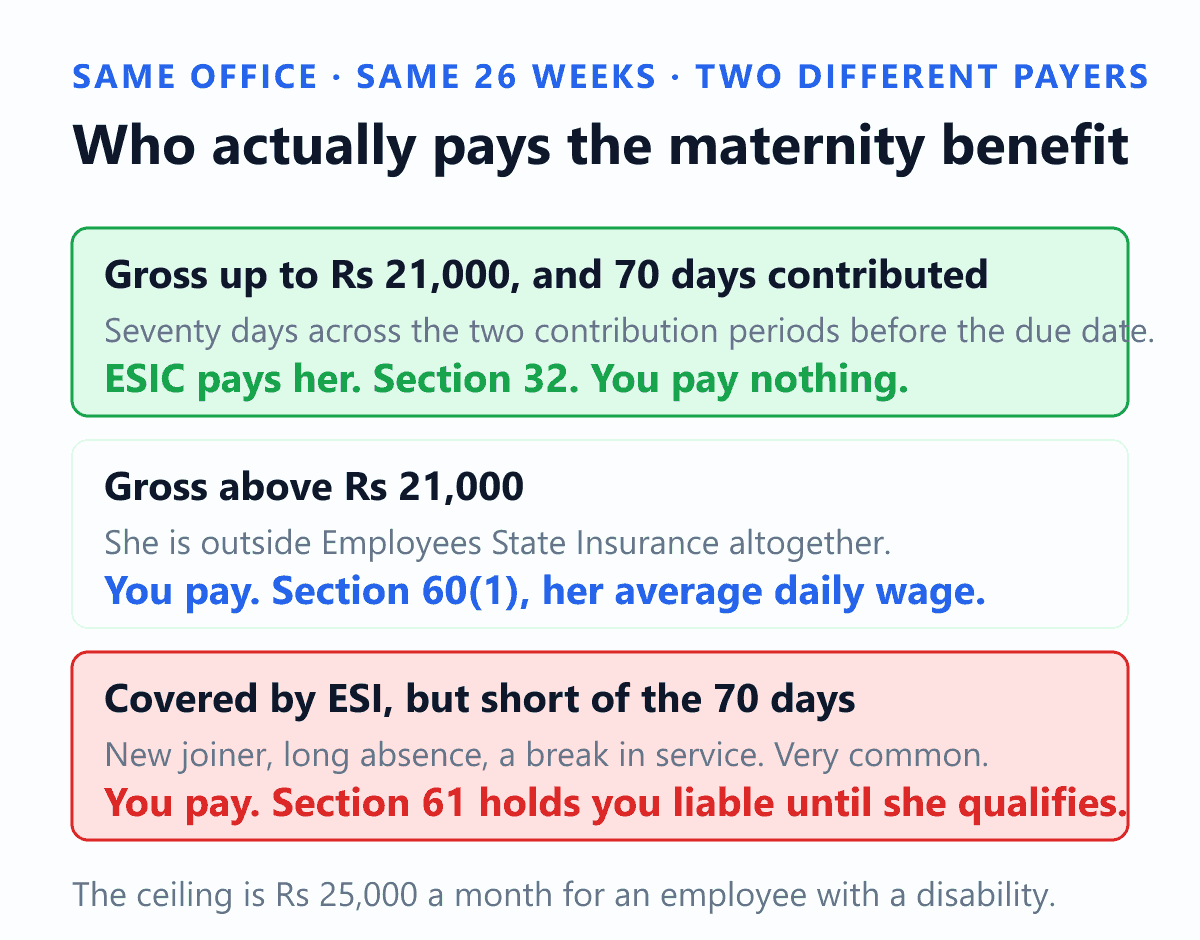
The practical consequence for a small employer: your exposure is not "the women above the ESI ceiling". It is those women, plus every recent joiner below it, plus anyone whose contribution history has a gap in it from a break in service or a long absence.
The eighty day test, and why it is an attendance question
Before any of that matters, there is a gate. Section 60(2):
"No woman shall be entitled to maternity benefit unless she has actually worked in an establishment of the employer from whom she claims maternity benefit, for a period of not less than eighty days in the twelve months immediately preceding the date of her expected delivery."
Note the words actually worked. Not employed. Not on the rolls. Worked. And the sub-section carries its own Explanation setting out what may be counted, which is where employers go wrong, because the list is shorter than anyone expects. It counts the days she actually worked, the days for which she was laid off, and days declared under any law to be holidays with wages.
That is the list. Weekly offs are not in it. Casual leave is not in it. Sick leave is not in it. Earned leave is not in it. A woman can be paid for a day and have that day count for nothing towards her eighty.
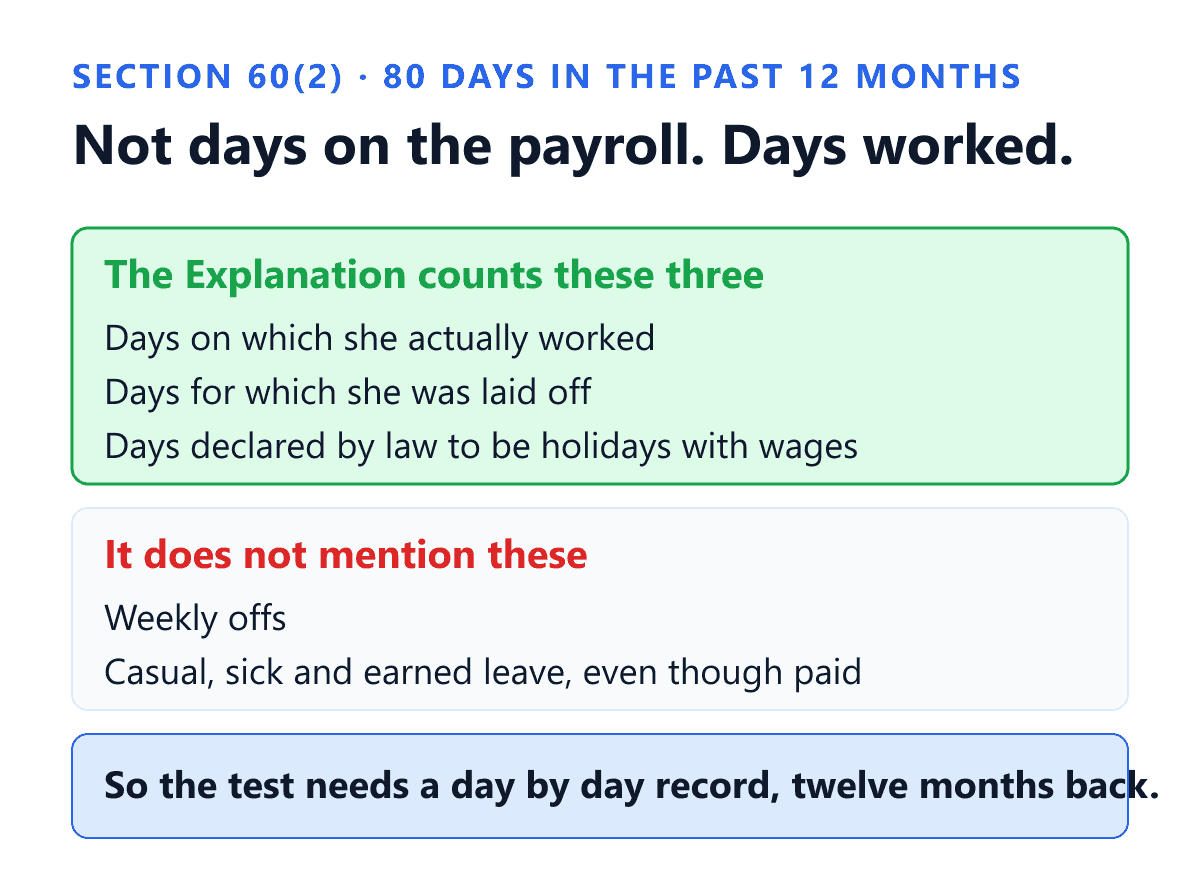
On a six day week a full month is about twenty six worked days, so eighty days is roughly three months of steady attendance. That sounds easy until you run it against a real twelve months. A woman who joined seven months ago, took three weeks off for a family wedding, and was on certified sick leave for a fortnight during a difficult first trimester can land close enough to eighty that the answer depends on a handful of individual days.
And here is the asymmetry. If you cannot prove she fell short, you cannot refuse. Section 72 lets her complain to the Inspector-cum-Facilitator, who can inquire and simply direct the payment. Section 62(6) goes further: failing to give notice does not disentitle her at all. The burden of the record sits with the employer, and a WhatsApp group is not a record.
What twenty six weeks actually costs
Maternity benefit is paid "at the rate of the average daily wage for the period of her actual absence". The Explanation to section 60(1) defines average daily wage as the average of her wages payable for the days on which she has worked during the three calendar months immediately preceding the date she starts her absence, subject to a floor at the minimum wage fixed under the Code on Wages, 2019.
Read that against the entitlement and you find the thing that makes maternity more expensive than employers assume. The divisor is days worked. The multiplier is days of absence. Those two counts are not the same, and the difference is the weekly offs.
Take a woman on Rs 28,000 a month gross, above the ESI ceiling, so this is the employer’s money. She works a six day week and does not take unpaid leave. In the three calendar months before she goes, she is paid Rs 84,000 and works about seventy eight days.
| Step | Divide by worked days | Divide by calendar days |
|---|---|---|
| Wages, three months | Rs 84,000 | Rs 84,000 |
| Divisor | 78 days worked | 90 calendar days |
| Average daily wage | Rs 1,076.92 | Rs 933.33 |
| Times 182 days, being 26 weeks | Rs 1,96,000 | Rs 1,69,867 |
Six months of her salary is Rs 1,68,000. The right hand column lands almost exactly there, which is why it feels correct and why it is the number most spreadsheets produce. The left hand column follows the words of the Explanation, and it is Rs 26,133 higher on a single maternity, about a sixth more.
This point is genuinely contested and this article does not pretend otherwise. For a monthly rated employee it is arguable that the Rs 28,000 already covers her weekly offs, so dividing it by worked days double counts them. The counter argument is that the Explanation says what it says. Long practice under the 1961 Act, which carried an identically worded explanation, divided the monthly wage by twenty six. Budget on the higher figure and take advice before paying the lower one.
One more input worth checking before you compute anything. "Wages" under the Code carries the new statutory definition with its floor at half of total remuneration, so a salary structured as a small basic and a large pile of allowances no longer produces a small wage base. Our piece on the fifty per cent rule and what it does to a salary structure works that out in full, and the same recomputed base feeds gratuity, provident fund and this.
The dates: eight weeks before, six weeks after, and the prohibition
The twenty six weeks are not hers to place anywhere she likes, and neither are they entirely the employer’s to schedule.
- Not more than eight weeks may fall before the expected date of delivery (section 60(3)). The rest follows the birth.
- A woman with two or more surviving children gets twelve weeks, of which not more than six may precede the expected date.
- Section 59 is a prohibition, not an entitlement. No employer shall knowingly employ a woman during the six weeks immediately following delivery, miscarriage or medical termination, and no woman shall work during those six weeks. She cannot waive it and you cannot accept the offer.
- Arduous work is barred earlier than that. On request, a pregnant woman cannot be required to do work of an arduous nature, or involving long hours of standing, or likely to interfere with the pregnancy, for the month preceding the six weeks before her expected date, and through those six weeks for any part she has not taken as leave.
- Payment timing is fixed. The pre-natal portion is paid in advance on proof of pregnancy. The rest is due within forty eight hours of proof of delivery (section 62(5)). This is not a payroll-cycle obligation, and a business that pays on the last working day of the month can breach it without ever intending to.
- Work from home is available but only by agreement, after the benefit has been availed, on terms the employer and the woman mutually agree (section 60(5)). It is not a substitute for the leave and it cannot be imposed.
Everything else Chapter VI asks for
| Section | What it requires |
|---|---|
| 63 | If she dies before receiving the benefit, it is paid to her nominee, or to her legal representative if she named none. |
| 64 | Medical bonus of Rs 3,500, payable only if the employer does not provide pre-natal confinement and post-natal care free of charge. |
| 65 | Six weeks paid leave after miscarriage or medical termination. Two weeks after tubectomy. A further month for illness arising out of pregnancy, delivery, premature birth, miscarriage or termination, on proof, in addition to the twenty six weeks. |
| 66 | Two nursing breaks a day until the child is fifteen months, on top of normal rest intervals. The Social Security (Central) Rules, 2026 set these at fifteen minutes each, plus up to fifteen minutes of travel depending on how far the crèche is. |
| 67(1) | Crèche at fifty employees, with four visits a day allowed to the mother. Worked through separately, because the count is harder than it looks. |
| 67(2) | Intimate in writing and electronically to every woman at the time of her initial appointment every benefit available under the Chapter. Note where this sits: it is inside the crèche section but it is not limited to fifty employee establishments. It binds every establishment the Chapter applies to. |
| 69 | No deduction from her normal daily wages for the lighter work required by section 59, or for nursing breaks. |
| 70 | She forfeits the benefit for any period during which she works for remuneration elsewhere while on maternity leave. |
| 71 | Exhibit an abstract of the Chapter, in the language of the locality, in a conspicuous place in every part of the establishment where women are employed. |
Section 67(2) is the one most commonly missed, because it is filed under a heading that suggests it belongs to somebody else. It is a per-hire duty with a written and an electronic limb, which means an offer letter alone does not discharge it. If you are already revising what goes out at hiring, our piece on the appointment letter that is now compulsory covers the other document that has to travel with it.
The line in the gazette that is no longer law
Section 60(4) gives an adoptive or commissioning mother twelve weeks from the date the child is handed over. As printed, it grants this only to "a woman who legally adopts a child below the age of three months".
On 17 March 2026, in Hamsaanandini Nanduri v. Union of India, the Supreme Court struck that age cap down as unconstitutional, holding it arbitrary and in violation of Articles 14 and 21. Adoptive mothers are entitled to the twelve weeks regardless of the age of the child at adoption. The reasoning is plain enough once stated: adoptions in India very rarely involve infants under three months, so the qualification excluded almost everyone it purported to cover.
The practical trap is that the gazette text has not changed. An employer who drafts an adoption leave policy by reading the Code, correctly and carefully, will draft an unlawful one. This is the single most likely place for a 2026 policy document to be wrong, and nothing in the source warns you.
What getting it wrong costs
Chapter VI has teeth, and they are criminal rather than civil.
- Failing to provide maternity benefit is an offence under section 133(i), punishable under section 133(iii) with imprisonment up to six months, or a fine up to Rs 50,000, or both.
- Dismissing, discharging, reducing in rank or otherwise penalising a woman in contravention of Chapter VI is a separate offence under section 133(d), carrying the same punishment.
- A repeat offence is section 134, and for a failure to pay maternity benefit it is not discretionary: imprisonment of not less than two years and up to three, plus a fine of Rs 3,00,000.
- Section 135 reaches the individuals. Where a company commits the offence, everyone who was directly in charge of the conduct of its business at the time is deemed guilty, unless they prove the offence happened without their knowledge or that they exercised all due diligence.
- Section 68 makes the dismissal itself unlawful, and it is broader than a sacking: it also catches giving notice timed to expire during her absence, and varying any condition of her service to her disadvantage. Dismissal during pregnancy does not strip her of the benefit or the medical bonus. She has sixty days to appeal to the competent authority, whose decision is final.
"Due diligence" in section 135 is the word that should get a director’s attention, because it is defended with records or not at all.
A records problem before it is an HR problem
Step back from the law for a moment and look at what it actually asks a business to be able to produce, on demand, about one employee.
Whether she worked eighty days in the twelve months before a date in the future. Which of those days were worked, which were lay-off, which were statutory paid holidays, and which were ordinary paid leave that does not count. What she was paid for the days she worked in the three calendar months before she left. Her contribution history, to know whether ESIC will take her or you will. And all of it reconstructable months later, in front of an Inspector-cum-Facilitator, for a claim you may have refused in good faith.
Almost none of that is an HR question. It is an attendance question wearing an HR question’s clothes, and the reason it goes wrong in small businesses is not carelessness. It is that the underlying record was never designed to be looked at twelve months later, one person at a time.
It is worth being blunt that this is a records problem before it is a software problem. A business with an honest paper muster roll that closes every day is in better shape than one with unreliable data in an app. What software changes is whether the eighty day question is a query or an excavation: Shiftelio holds a check-in per person per day with leave type and loss of pay attached to it, so a twelve month look-back separates worked days from paid leave without anyone counting backwards through a diary. The same record answers the section 66 look-back in a retrenchment, which is the other place the codes ask for days actually worked rather than days employed.
On the money side, whether a given woman falls above or below the ESI ceiling is worth knowing before she tells you she is pregnant, not after. The free PF and ESI calculator settles it for one salary in a minute, and the PF and ESI compliance checklist covers the contribution side that decides whether ESIC will carry her at all.
Frequently asked questions
Does the employer or ESIC pay maternity leave in India?
Both, in different cases. If she is covered by Employees’ State Insurance, meaning gross wages of Rs 21,000 a month or less, and she has around seventy days of contribution in the two contribution periods before the expected date, ESIC pays her directly and the employer pays nothing. If she is above the ceiling, the employer pays under section 60(1). If she is below the ceiling but short of the contributory condition, section 61 keeps the employer liable until she qualifies.
Does maternity leave apply to a company with fewer than ten employees?
It depends what kind of establishment it is. For a shop or establishment the test is ten or more employees now, or on any day in the preceding twelve months. For a factory, mine or plantation the First Schedule imposes no headcount at all, so a six person factory is covered.
Do weekly offs and paid leave count towards the eighty days?
No. The Explanation to section 60(2) counts days actually worked, days of lay-off, and days declared by law to be holidays with wages. Weekly offs, casual leave, sick leave and earned leave are not in that list, even where the woman was paid for them.
How much maternity leave does an adoptive mother get in 2026?
Twelve weeks from the date the child is handed over, regardless of the child’s age. The three month age cap printed in section 60(4) was struck down by the Supreme Court on 17 March 2026 and can no longer be applied, even though it still appears in the text of the Code.
Is the Rs 3,500 medical bonus always payable?
No. Section 64 makes it payable only where the employer does not provide pre-natal confinement and post-natal care free of charge. An employer who genuinely provides that care does not owe it.
Can an employer dismiss a woman who is on maternity leave?
Not for or during that absence. Section 68 makes it unlawful, and also catches a notice timed to expire during the leave and any variation of her service conditions to her disadvantage. Dismissal during pregnancy does not deprive her of the benefit or the medical bonus. Only dismissal for prescribed gross misconduct can, and it must be by written order communicated to her.
What is the penalty for not paying maternity benefit?
Up to six months in prison or a fine up to Rs 50,000, or both, under section 133 read with clause (i). On a repeat, section 134 fixes it at not less than two years and up to three, with a fine of Rs 3,00,000.
The short version
- The law is Chapter VI of the Code on Social Security, 2020, sections 59 to 72, in force since 21 November 2025.
- A factory, mine or plantation has no headcount threshold. Only shops and establishments get the ten employee test, and that test looks back twelve months.
- ESIC pays if she is at or under Rs 21,000 gross and has the contributory days. You pay if she is above the ceiling, and section 61 says you also pay if she is under it but not yet qualified.
- The eighty day test counts days actually worked, lay-off days and statutory paid holidays. Not weekly offs, not paid leave.
- The benefit divides by days worked and multiplies by days of absence, so twenty six weeks costs roughly a sixth more than six months of salary. On Rs 28,000 a month that is about Rs 1,96,000.
- Not more than eight weeks may precede the due date. The six weeks after delivery are a prohibition, not an option.
- Pre-natal money is paid in advance; the rest within forty eight hours of proof of delivery.
- Section 67(2) requires written and electronic intimation of every Chapter VI benefit at initial appointment, and it is not limited to fifty employee establishments.
- The three month adoption age cap in section 60(4) is dead law since 17 March 2026, though it is still printed.
- Failure is criminal: six months or Rs 50,000, rising to two to three years and Rs 3,00,000 on repeat, with directors personally in scope under section 135.
This article states the position as at 6 September 2026. Chapter VI, the First Schedule and sections 32, 133, 134 and 135 were read from the printed text of the Code. The seventy day ESIC contributory condition lives in the ESI rules and regulations rather than in section 32 and is stated here as ESIC states it. The Rs 21,000 ceiling was current and unamended on the date of writing; a hike has been proposed but not notified. This is not legal advice, and a borderline eighty day case is worth an hour of a professional’s time before you refuse it.
Sources
- The Code on Social Security, 2020 (Act 36 of 2020), Chapter VI and the First Schedule. India Code. Every section number, quoted phrase and penalty figure in this article was taken from the printed text.
- Ministry of Labour and Employment, for the Code and the Social Security (Central) Rules, 2026. labour.gov.in.
- Employees’ State Insurance Corporation, for the maternity benefit contributory condition, the wage ceiling and the direct payment route. esic.gov.in.
- Hamsaanandini Nanduri v. Union of India, Supreme Court of India, 17 March 2026, striking down the three month age cap in section 60(4). Reported by Down To Earth and analysed by Herbert Smith Freehills Kramer and DLA Piper.
Keep reading
See how Shiftelio does this in practice with a day by day attendance record that separates worked days from paid leave.
Work your own numbers with the free PF and ESI calculator. No signup, no email.