Petty Cash for Staff: Give a Float, Match the Receipts, Settle What Is Left
In short
Give a staff member a set petty cash float, take each approved receipt off it, then settle what is left: handed back, carried over or made an advance.
- A petty cash float is money you hand a member of staff up front to buy supplies for work. It is your money, not theirs.
- Every receipt they bring back comes off the float once someone approves it. Float minus approved receipts is what they still hold.
- What is left is settled one of five ways in Shiftelio: cash returned, carry to next job, turn into salary advance, settled outside the app, or write off.
Petty cash for staff works in three steps: you hand a member of staff a set float, every receipt they bring back is taken off it once it is approved, and whatever is left at the end is settled. Settled means it comes back to you, stays with them for the next job, or is turned into money they owe and repay from their wages.
That is the whole system. Where small businesses come unstuck is not the idea but the record of it: a tin in the office, an envelope of receipts, and a balance that only lives in the supervisor's head. This guide shows how to run a petty cash float for staff in a café, a shop or a cleaning firm, what to put in a one-page policy, and how Shiftelio keeps the float, the receipts and the settling in one place. In Shiftelio this money is called work cash.
How does petty cash work in a small business?
A float is a fixed amount you choose, say £150 for a cleaning supervisor or £50 for the café's morning shift lead. They spend it on things the business needs: milk and cups, bin bags and mop heads, a replacement kettle at a client's office. For each purchase they keep the receipt.
At any moment the sum is simple:
- Given: the float you handed over, plus anything you added later.
- Spent: the receipts that have been checked and approved.
- Left: given minus spent. This is the cash the person should still be holding.
Accountants call the classic version an imprest system: at the end of each week you top the float back up by exactly the total of the receipts, so it always starts the week at the same figure. It works well for a fixed tin in a shop. It works less well when the cash is in a supervisor's pocket on the way to three client sites, because nobody can see the balance until the receipts are handed in.
Petty cash or salary advance? Keep the two apart
The commonest muddle in a small business is mixing two kinds of money handed to staff:
| Petty cash (work cash) | Salary advance | |
|---|---|---|
| Whose money is it? | The business's | The member of staff's own pay, early |
| What is it for? | Supplies and jobs for work | Anything they need |
| How does it end? | Receipts, then the rest is settled | Repaid from their wages |
| What do they show you? | Receipts | Nothing, it is theirs |
When both sit in the same tin, a £20 note handed over on Friday could be either, and by the end of the month nobody remembers which. Shiftelio asks the question every time money is handed over. Under Give money, the screen asks What kind of money? and offers two answers: Work cash, money for jobs that is backed by bills, and Salary advance, their own money, cut from salary. If you are lending staff their own pay early, our guide to an advance on wages for UK small businesses covers that side.
A worked example: Sam's £150 for the week
Sam is the evening supervisor for a small office-cleaning firm in Leeds, with a crew across four client buildings. Supplies run out mid-week, so the owner gives Sam a float rather than paying for every bottle of bleach personally.
- Monday: the owner opens Money, then Staff money, taps Give money, picks Sam, chooses Work cash and enters £150. The button reads Give £150 work cash. Sam sees the float on their phone straight away.
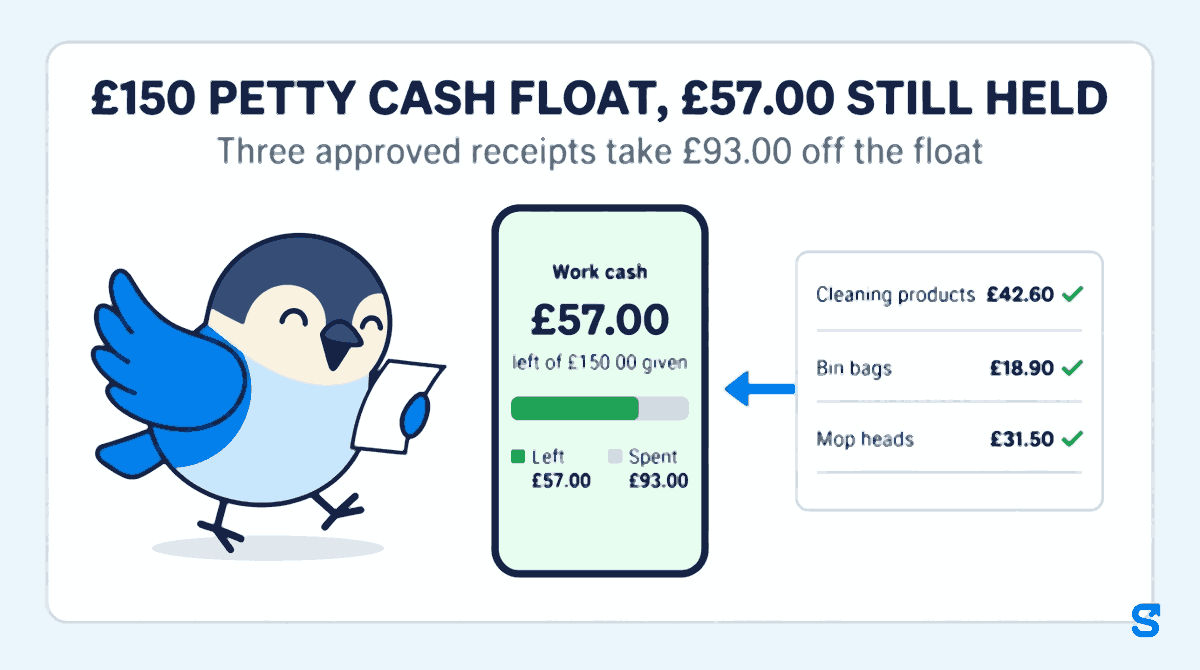
- Tuesday: Sam buys cleaning products for £42.60. In the Shiftelio app Sam adds a bill, photographs the receipt and chooses My work cash rather than My own money. The screen shows how much work cash is left before sending.
- Wednesday: bin bags, £18.90, the same way.
- Thursday: replacement mop heads, £31.50.
- Friday: the owner approves the three bills. They now count as spent.
Sam's work cash card in Staff money now reads £57.00 left of £150.00 given, with Spent £93.00 under it. The £57.00 is the cash Sam should still have, and the owner can see it without asking.
If Sam had spent more than the float, the app does not block the bill. It tells Sam that the company will owe them the difference if the bill is approved, so nobody quietly ends up out of pocket.
Settling what is left: five honest endings
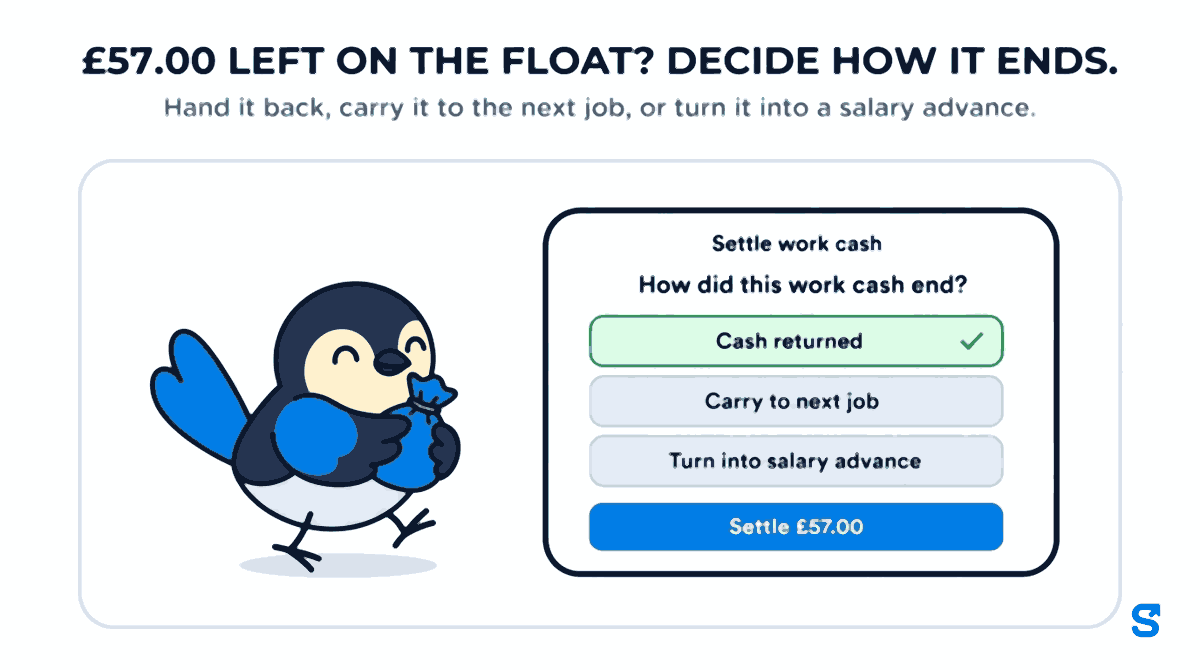
A float should not drift on for months. At the end of the week, the job or the month, decide how it ends. In Shiftelio you tap Settle on the person's work cash, and the screen asks How did this work cash end?
Sam hands back the £57.00. Work cash goes down to nothing and the record shows the return.
Sam keeps the £57.00 for next week's supplies. Nothing moves; you pick a Settle by day so the float does not sit open for ever. If you want the float back at £150 for the new week, use Give more for the £93.00 that was spent, which is the imprest top-up done in two taps.
The cash cannot be accounted for and you have agreed Sam repays it. The £57.00 becomes a salary advance, cut from salary over the number of months you choose, and Sam is told. Read the gov.uk section below before you use this one.
It was sorted some other way, for example Sam bought something for the business without a receipt and you accept it. A note saying how is required.
The business takes the loss and nobody pays it back. The app asks you to press the button a second time, because a write-off cannot be undone.
You can also settle part of it. Enter a smaller amount and the rest stays open.
Your petty cash policy for a small business, on one page
A petty cash policy does not need to be long. Answer these six questions and pin it next to the staff rota.
- Who can hold a float, and how much (for example: shift leads £50, cleaning supervisors £150).
- What it can be spent on, and what it cannot (supplies for work yes, a staff lunch no).
- A receipt for every purchase, photographed the day it is spent.
- Who approves the receipts. Nobody approves their own: see why no manager should approve their own expense claim.
- When floats are settled: every Friday, at the end of each job, or monthly.
- What happens to cash that cannot be accounted for, agreed in writing before any float is handed over.
The last line matters more than it looks, and the next section explains why.
What gov.uk says about taking money back from pay
Law is not the point of this article, and we are not lawyers. These are the lines from the official guidance that matter if a float is turned into money a member of staff repays from their wages.
The gov.uk guide Understanding your pay: deductions from your pay (checked on 8 October 2026) says an employer is not allowed to make deductions unless, among other reasons, it is required or allowed by law, the worker agrees in writing, or the contract says the employer can. The same page says a deduction cannot normally reduce pay below the National Minimum Wage even if the worker agrees, with exceptions that include repayment of a loan or advance of wages.
For workers in retail, such as shops and restaurants, the same gov.uk page says the employer cannot take more than 10% of gross pay each pay period to cover shortfalls.
For your own records, the gov.uk guide Business records if you're self-employed (checked on 8 October 2026) says records are kept for at least 5 years after the 31 January submission deadline of the relevant tax year. A limited company should ask its accountant what applies to it.
This is general information, not legal advice: check with the agency or an employment lawyer for your case.
Which app keeps a petty cash float and its receipts together?
See what else the owner's app covers on the features page, or start from Shiftelio for UK businesses.
Questions owners ask
How does petty cash work in a small business?
You give a member of staff a set float and take each approved receipt off it. Whatever is left is settled at the end of the week, the job or the month.
What is a petty cash float?
It is a fixed amount of the business's money held by a member of staff for small work purchases, such as cleaning supplies or milk for a café.
What should petty cash be used for?
Small supplies the business needs day to day: cleaning products, bin bags, milk and cups, a spare part for a client job. Write the list into your petty cash policy.
How do I reconcile petty cash?
Add up the approved receipts and take them off the float. What is left should match the cash the person holds. Shiftelio shows that figure as left of the amount given.
Is a petty cash float the same as a salary advance?
No. A float is the business's money and is backed by receipts. A salary advance is the worker's own pay given early and repaid from wages. Shiftelio keeps them as Work cash and Salary advance.
Can I take unaccounted petty cash out of someone's wages?
The gov.uk deductions page says an employer cannot make deductions unless the law allows it, the contract says so or the worker agrees in writing (checked on 8 October 2026). Agree it in writing first.