Prorated PTO for Part-Time Employees and New Hires: Set It Once Per Group
In short
Prorated PTO gives a new hire only the months left in the year, and part-time staff their own days. Set one plan per group and every new hire comes out right.
- Prorated PTO for a new hire is the yearly days times the full months left in the leave year, divided by 12, rounded to the nearest half day.
- Part-time and full-time staff can have different PTO: give each group its own plan instead of one number for everyone.
- The federal FLSA does not define full-time or part-time employment and does not require payment for time not worked, such as vacations, per dol.gov, checked on 12 October 2026. Your PTO policy is your choice, and some states add rules.
Prorated PTO means a new hire gets paid time off only for the part of the year they will actually work, and a part-time employee gets a smaller yearly number than a full-time one. The simplest way to run it is to write one PTO plan per group, full-time and part-time, and let every new hire's days be counted from their start date by the months left in the year.
Most small US businesses with hourly staff do neither on purpose. The owner gives every new hire the full 10 days in their first week, or nothing until January, and part-time servers get "whatever full-time gets" because nobody wrote a second rule. This guide is for owners and managers of restaurants, cafés, retail stores and cleaning companies who want PTO that is fair to a part-timer, fair to a full-timer, and does not need a calculator every time someone is hired.
Why one PTO number for everyone stops working
A single rule ("everyone gets 10 days of PTO a year") is fine with five full-time staff who all started the same year. It breaks the moment you hire through the year and mix part-time and full-time shifts, which describes almost every restaurant, store and cleaning crew in the country.
- The new hire in October. Give them the full 10 days and they can take two weeks off before they have worked two months. Give them nothing until January and they are the only person on the team with no PTO at Thanksgiving.
- The part-time server. They work three shifts a week. Giving them the same 10 days as a full-time line cook feels generous until the full-timers notice.
- The second location. Your downtown store gives more PTO than the mall store because a different manager set it up, and nobody can say which number is the policy.
Each of these is an argument you have with a person at the worst possible moment: when they are asking for a day off. Writing the rule down per group, once, is what ends it.
How to prorate PTO for a new hire
The common method for front-loaded PTO, where the year's days are given up front, is to scale the yearly number by how much of the year is left:
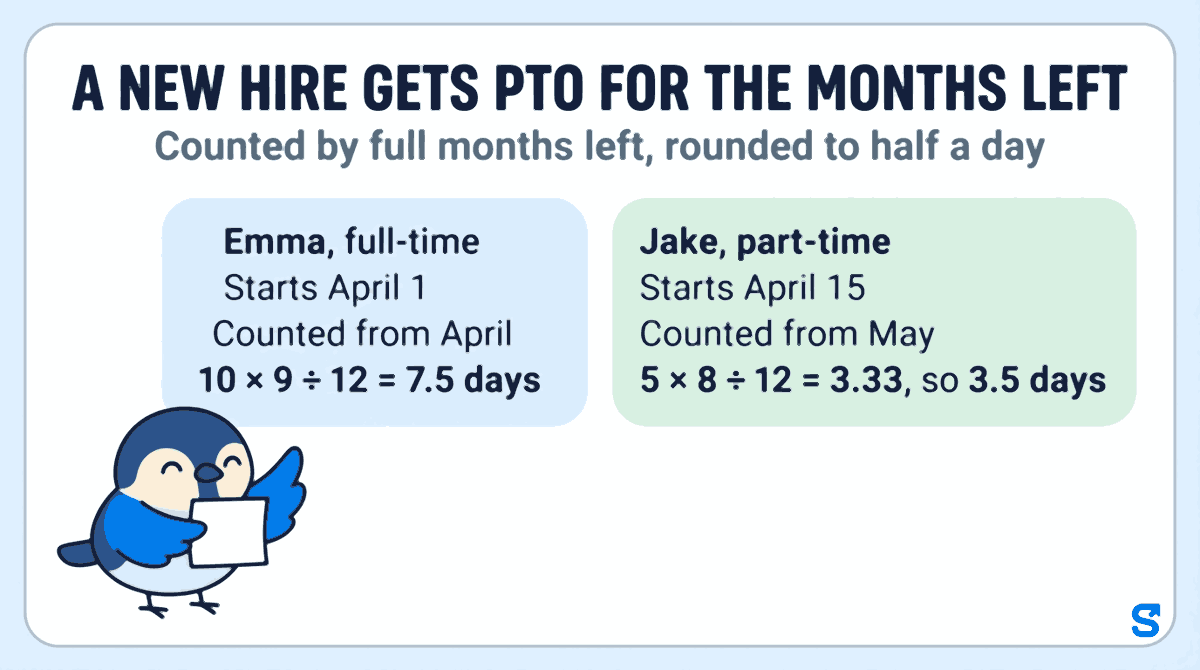
Prorated PTO = yearly PTO days × full months left in the leave year ÷ 12, rounded to the nearest half day.
Decide one thing before you use it: which month counts as the first. A clear rule is that someone who starts on the 1st of a month counts that month, and someone who starts later in the month counts from the next month. Here it is for a café with a leave year that runs January to December, 10 PTO days a year for full-time baristas and 5 for part-time:
| New hire | Starts | Counted from | Full months left | Prorated PTO |
|---|---|---|---|---|
| Emma, full-time | April 1 | April | 9 | 10 × 9 ÷ 12 = 7.5 days |
| Jake, part-time | April 15 | May | 8 | 5 × 8 ÷ 12 = 3.33, so 3.5 days |
Two weeks apart, two different groups, two different answers, and both are easy to explain to the person: "you get the PTO for the months you are here this year."
If your PTO is earned every month instead of given up front (an accrual policy), there is nothing to prorate: the new hire simply starts earning from the month they join.
PTO for part-time employees: give each group its own plan
There is no single right number for part-time PTO. What matters is that the number is written down per group, so every part-timer gets the same rule and every full-timer gets theirs. Common ways small teams split it:
- By job type: full-time staff get 10 days a year, part-time staff get 5.
- By location: the store that opens seven days a week gives more PTO than the weekend kiosk.
- By a named group: managers or shift leads get a few more days than the rest of the floor.
- Unpaid only: seasonal or on-call staff get unpaid time off and no paid days.
- Everyone else: one standard plan for anybody who does not fit a group.
Write the plan before you hire the next person, not after. A plan written after the fact is a negotiation with whoever asked first.
What the law says, federal
This is background to the policy, not the point of this guide.
- The Department of Labor's full-time employment page says the FLSA "does not define full-time employment or part-time employment" and that this "is a matter generally to be determined by the employer." Checked on 12 October 2026.
- The Department of Labor's vacation leave page says the FLSA "does not require payment for time not worked, such as vacations" and that these benefits are matters of agreement between an employer and an employee. Checked on 12 October 2026.
States and cities can have their own rules, including paid sick leave laws that may cover part-time staff. Check your state labor department for every place your staff work.
This is general information, not legal advice: check with the agency or an employment lawyer for your case.
How Shiftelio gives each group its own PTO
Shiftelio is employee scheduling, a time clock and time off in one app for small teams with hourly staff. Time off lives under Leaves, and the setup is under Leave settings, in a card called Leave plans.
In Leave settings, create a paid leave type such as PTO with its Days per year, and choose how the days are given: all on the first day of the leave year (front-loaded) or earned every month. This number is what anyone not on another plan gets.
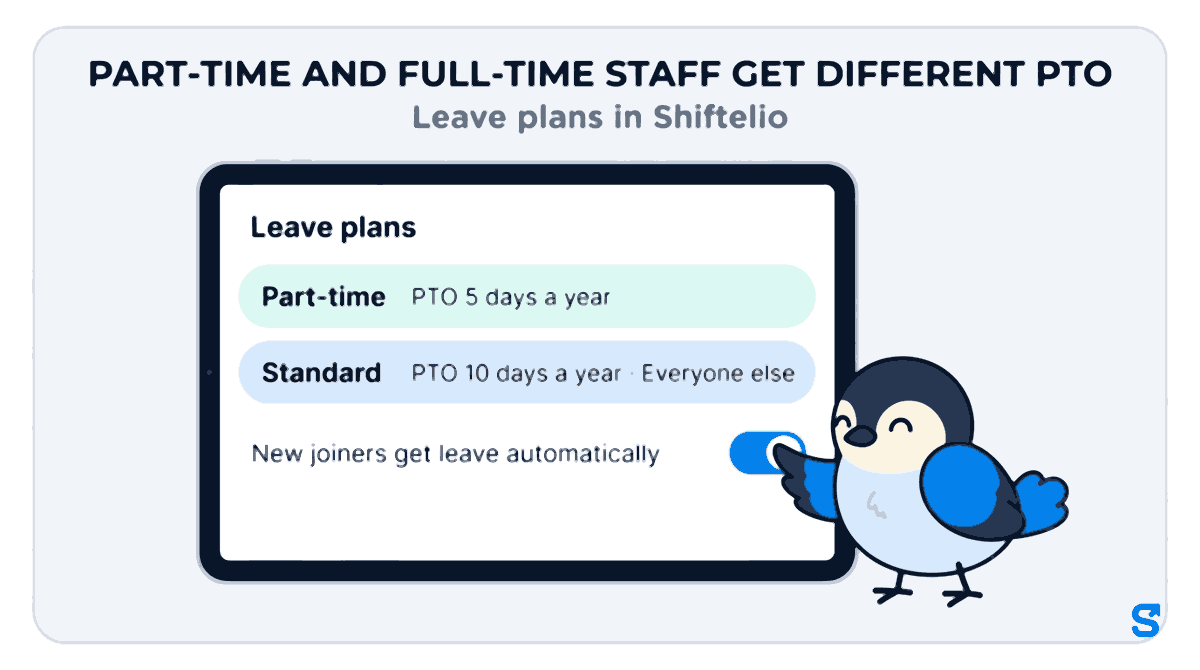
Tap Add leave plan, give it a Plan name such as Part-time, and set its Days per year for each paid type, for example PTO 5 days a year. Under Who is on this plan, pick the departments, the sites or the hand-picked people it covers. A plan can also be unpaid only, with no paid leave days, for seasonal staff.
Standard is always last in the list and covers everyone else, so your full-time staff get PTO 10 days a year without being picked one by one. Someone who matches two plans gets the one higher in the list, and you can move plans up or down.
With New joiners get leave automatically on, every new hire gets their plan's days for the current leave year the moment they are added. Days are counted from their joining date, by full months left, rounded to half a day. If no joining date is saved, the date they were added is used. You get a note in your feed saying who joined, when, and what they got.
Saving or changing a plan does not change anyone's days this year. It is used for new joiners from now on and when the next leave year opens, so you can set it up mid-year without surprising the people already on the team. Their current balances stay on the Balances screen, and if you need to see every person's days on one screen before year-end, read the PTO tracker guide for hourly staff.
Your staff see their own days left in the Shiftelio app and send time off requests from it. For how to approve those requests from your phone on a busy shift, see time off requests for shift teams.
Which app prorates PTO for part-time staff and new hires?
You can see how it fits a US business on the Shiftelio US page, and how schedules and shift rates work on the shift scheduling page.
Questions owners ask
What does prorated PTO mean?
Prorated PTO means giving someone only the share of a year's paid time off that matches the part of the year they work. It usually applies to a new hire who starts mid-year.
How do I calculate prorated PTO for a new hire?
Multiply the yearly PTO days by the full months left in the leave year, divide by 12, and round to the nearest half day. Ten days with 9 months left is 7.5 days.
Do part-time employees get PTO?
Not by federal requirement. The FLSA does not require payment for time not worked, such as vacations. Many employers still give part-time staff PTO, often a smaller number than full-time staff.
Can part-time and full-time employees have different PTO?
Yes, many employers set different PTO by group. Write the number per group in your policy so every part-timer gets the same rule, and check your state labor department for any state rules.
What is front-loaded PTO?
Front-loaded PTO gives the whole year's days on the first day of the leave year instead of earning them each month. It is the kind that needs prorating for someone who joins mid-year.
Should a new hire who starts mid-month count that month?
Pick one rule and use it for everybody. A simple one: starting on the 1st counts that month, starting later counts from the next month. That is how Shiftelio counts it.