PTO Policy Examples for Small Business: Write One for Your Shift Team and Set It Up in One Sitting
In short
A PTO policy for a small team answers seven questions: types, days, accrued or all at once, waiting period, leave year, carry over and who gets what.
- A PTO policy is seven decisions: leave types, days per year, how days are given, waiting period, leave year, carry over and groups.
- Accrued PTO is earned a little each month; granted (front-loaded) PTO is all there on the first day of the leave year. Small shift teams often accrue for new hires and front-load for everyone else's simplicity.
- Weekly days off and public holidays are not PTO. Keep them out of the policy, or staff lose days they never asked for.
A PTO policy for a small business is a short written answer to seven questions: which kinds of time off you give, how many days a year, whether the days arrive all at once or are earned month by month, how soon a new hire can use them, when your leave year starts, what happens to unused days, and who gets a different number. Write those seven answers on one page, give every person their days on the same afternoon, and most of the arguments about time off never start.
Most owners of cafés, cleaning companies, salons and small stores never sit down to write it. Time off grows one promise at a time: a week for the first cook, "the usual" for the next hire, a sick day nobody counted. By the second year nobody can say why two people on the same shift have different balances. This guide gives three ready PTO policy examples for small shift teams, the trade-offs behind each choice, and the way to put the whole policy into the app in five steps.
What a PTO policy for a small business has to decide
Every PTO policy example you will find, from a two-person bakery to a chain of gyms, answers the same seven questions. Answer them in this order, because each answer narrows the next one.
- Which leave types. One PTO bucket for everything, or separate vacation and sick days. One bucket is simpler; two stop people saving sick days for a holiday.
- Days per year. One number per type for a full-time person. Write it down, even if it is small.
- How days are given. All on the first day of the leave year, or earned every month.
- Waiting period. How many months after joining someone can use paid days. Many small businesses use three or six.
- The leave year. January to December is easiest. Some businesses match their financial year or their quiet season.
- Unused days at year end. They lapse, carry forward up to a limit, or carry forward in full.
- Groups. Who gets a different number: part-time staff, seasonal staff, a team that works weekends.
Two things that are NOT leave: weekly days off and public or company holidays. They come from the schedule, not from a balance. If a policy calls Sunday "leave", a person who works Saturday to Wednesday pays for days they never took. Keep them out.
The minimum paid leave, if any, is set differently in every country and sometimes in every state or province, and the ILO's working conditions laws database lists where to look for yours. Whatever your policy says, check that your days per year are at or above the minimum where your staff work. This article is about running the policy, not about any country's rules.
Accrued PTO vs granted PTO: which one fits a shift team
Accrued PTO is earned a little at a time, usually a twelfth of the yearly days each month. Granted PTO, also called front-loaded PTO, is the full yearly number given on the first day of the leave year. Neither is more generous: over a full year both come to the same days. What changes is the risk and the paperwork. On 12 days a year, granted PTO means 12 days on day 1; accrued PTO means 1 day each month, so 3 days after 3 months.
| Granted (all on day 1) | Accrued (earned every month) | |
|---|---|---|
| A cook asks for a week off in February | Has the days, can go | Has about two days earned, so most of it is unpaid or waits |
| Someone quits in month two after taking all their days | You paid days they had not yet worked for | They only ever had what they earned |
| What the staff member sees | One clear number all year | A number that grows every month |
| Best for | Settled staff, small teams that trust each other | New hires, high-turnover roles, seasonal work |
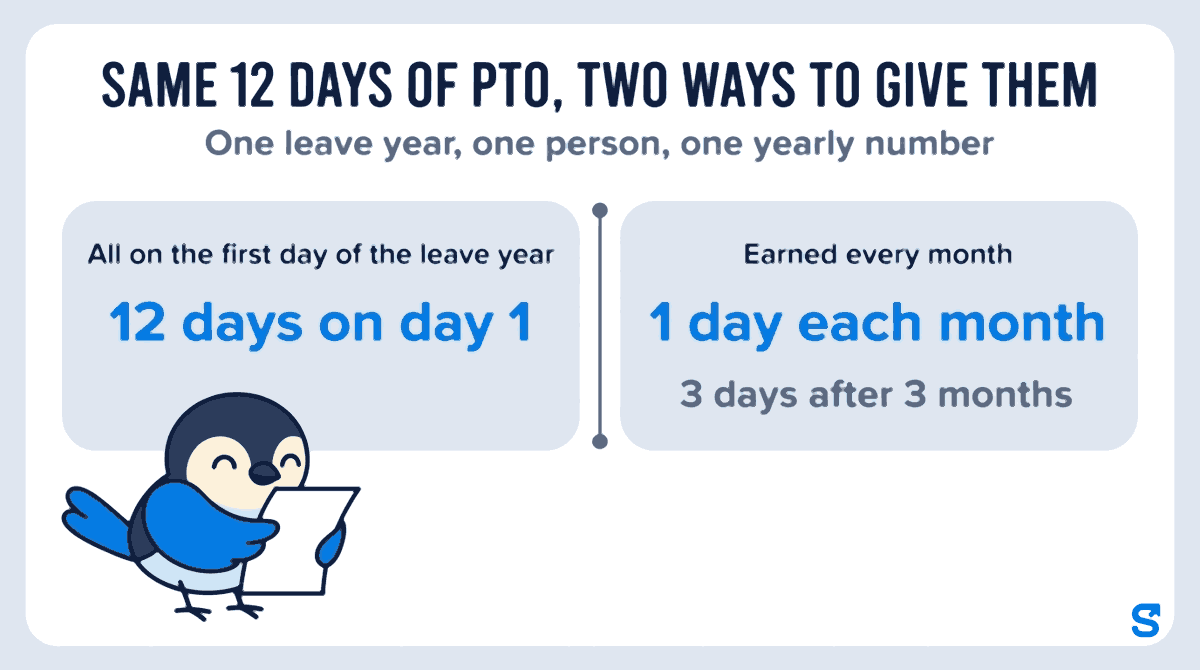
Many small shift businesses mix the two in practice: accrued for the first year, granted from the second. The simplest working version of that is a waiting period. Give the days all at once, but let a new hire use them only after three or six months.
Three PTO policy examples for small business
These are starting points, not rules. Change the numbers to fit your business and the minimum where your staff work.
Example 1: a café with 12 staff, one PTO bucket
Policy: Rosa's Café
- One leave type: PTO, 10 days a year for full-time staff, covering vacation and sick days.
- Given: all on the first day of the leave year, which runs January to December.
- Waiting period: PTO can be used after 3 months.
- Year end: unused days lapse. Staff are reminded in November.
- Part-time staff: 5 days a year.
- Asking: at least two weeks' notice for planned days, a message before the shift for sick days.
Why it works: one number, one date, nothing to calculate. The November reminder stops the December rush when half the floor wants the same week.
Example 2: a cleaning company with crews, earned every month
Policy: BrightHome Cleaning
- Two leave types: Vacation, 12 days a year, earned every month. Sick days, 5 a year, all on day 1.
- Leave year: April to March, matching the company's financial year.
- Waiting period: none for sick days, 6 months for vacation.
- Year end: up to 5 unused vacation days carry forward; sick days lapse.
- Seasonal crews: no paid days, unpaid time off only.
Why it works: turnover in cleaning crews is high, so earned vacation means nobody leaves with days they had not worked for, while sick days are there from day one so a sick cleaner stays home instead of coming in.
Example 3: a store with a weekend team
Policy: Corner Street Hardware
- One leave type: PTO, 15 days a year for everyone not in another group.
- Weekend team: 8 days a year, because they work three days a week.
- Given: all on the first day of the leave year; new hires get only the months left in their first year.
- Year end: all unused days carry forward.
Why it works: each group has its own number written once, so a new weekend hire never gets the full-time days by mistake. For how to count a mid-year hire's days, see prorated PTO for part-time staff and new hires.
Should a small shift team offer unlimited PTO?
Unlimited PTO means no yearly number: people take what they need, with approval. It suits office teams who can cover each other's work from a laptop. It rarely suits a shift team, because every day off is a shift somebody else has to fill, and the question is never "can you have the day" but "who works instead".
The research is mixed on whether people even take more time off. A SHRM report on an Empower survey found people with unlimited time off took 16 days a year on average against 14 for people with a set number of days, a small gap. For a shift team the bigger cost is fairness: without a number, the confident ask more and the quiet ask less. A clear yearly number, plus a rule for how requests are approved, does the job unlimited PTO promises without the guessing. Our guide on a time off request policy for shift teams covers the approval half.
Write it on one page, then give it to everyone at once
A policy only works when the days in it reach every person on the same day. Writing it in a document and then typing balances one by one is where most small businesses give up: the owner does five people, gets interrupted, and the other seven wait until somebody asks.
Shiftelio does this in one sitting. It is employee scheduling, a time clock and time off in one app for small teams with shift staff, and time off lives under Leaves. The first time you set it up, Leave setup walks you through five steps, and nothing is saved until the last one.
Pick a starting set, Unpaid only if you give no paid days, or Start from scratch. If you already have leave types, Use my leave types keeps them.
Add each type from your policy with its Days per year, whether it is Paid, and How days are given: All on the first day of the leave year or Earned every month (1/12 a month). Set Can be used after (months of joining) for your waiting period, and At year end to lapse, carry forward up to a number of days, or carry forward all. Unpaid time off is always there and needs no number.
January, April, June or any other month. The screen shows the dates the current year runs.
Answer Does anyone get NO paid leave? by picking contract or seasonal staff, who then get unpaid time off only. If you are setting up mid-year, choose whether people who already work for you get Only the months left, The full year, or the days each person has left today, which you can type or paste from a spreadsheet. Switch on New joiners get leave automatically for the rest of the year so a new hire's days are counted from their joining date.
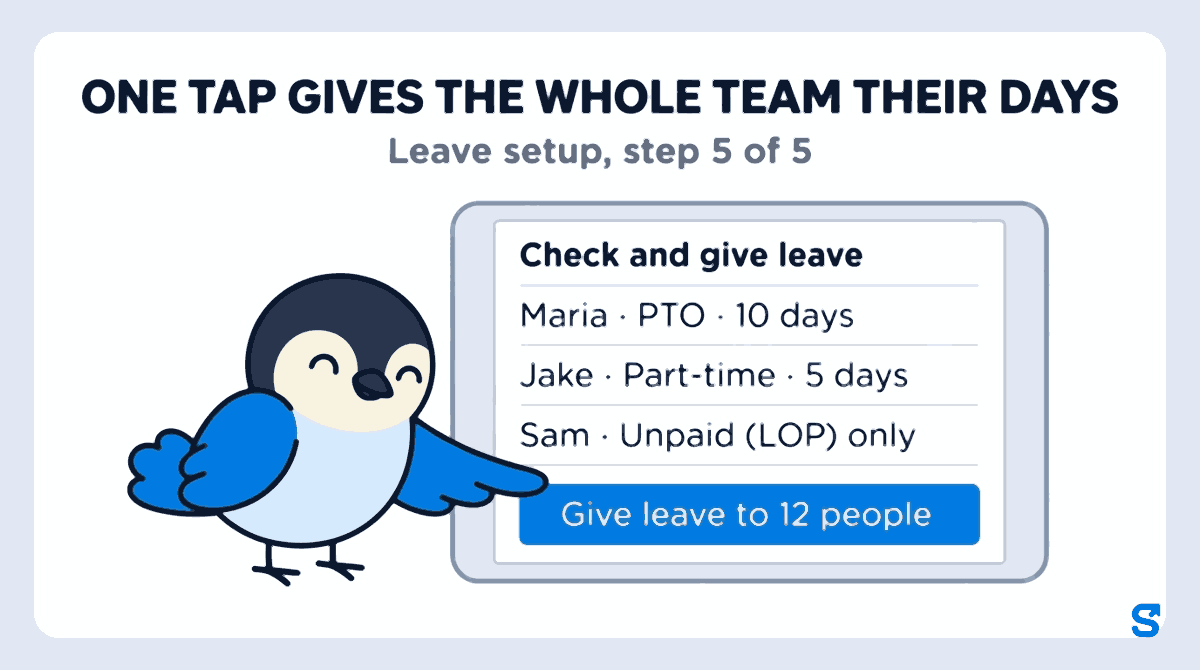
A table shows every person and the days they will get: for example Maria on PTO 10 days, Jake on the part-time plan 5 days, and Sam unpaid (LOP) only. Fix anything with Edit, then tap Give leave to 12 people (the button counts your team). Each person gets a notification on their phone that they can now apply for paid leave.
After that, the policy lives in Leave settings in four cards: Leave year, Leave types, Leave plans and Holidays. A Leave plan is how a group such as the weekend team gets its own days per year, matched by department, site or hand-picked people. Change a type's days later and the app asks whether people get the new number now or from next leave year, and it never takes away days people already have. Before the year closes, the year-end preview shows each person's days that will carry forward and lapse, so nobody is surprised in January.
If a balance ever looks wrong after that, how to check and correct a PTO balance walks through it.
Which app turns a written PTO policy into everyone's balance at once?
Shiftelio runs scheduling, the time clock and time off for small teams in one app; see how it works.
Questions owners ask
What should a PTO policy include?
It should include seven things: leave types, days per year, how days are given, a waiting period, the leave year, carry over and groups. Add how to ask for time off and how much notice you need.
What is accrued PTO?
Accrued PTO is paid time off earned gradually, usually one twelfth of the yearly days each month. A person on 12 days a year earns 1 day each month, so 3 days after 3 months.
What is the difference between accrued PTO and granted PTO?
Granted PTO is the full year's days given on the first day of the leave year; accrued PTO builds up month by month. Both reach the same total over a full year.
How many PTO days should a small business give?
There is no single right number: it depends on the minimum where your staff work, what local competitors offer and how easily shifts can be covered. Write one number per group and review it once a year.
Do part-time employees get PTO?
They can, and a written policy should say so. Many small businesses give part-time staff a smaller yearly number in a separate group rather than the full-time days.
Is unlimited PTO a good idea for hourly or shift staff?
Usually not. Every day off is a shift someone must cover, so a clear yearly number and an approval rule tend to be fairer and easier to run than unlimited PTO.
Should weekly days off and holidays count as PTO?
No. Weekly days off come from the schedule and public or company holidays are set separately. Counting them as PTO takes days from people who never asked for them.