Sole Negotiating Union in India: The 30, 51 and 20 Percent Rules Under the IR Code
In short
One union needs 30 percent to be recognised. Two or more need 51 percent of the muster roll, verified by a secret ballot the employer pays for.
A 140-person auto-components unit outside Aurangabad receives a letter in September. A registered trade union writes that it represents the workers of the establishment and asks to be recognised for negotiation. The letter encloses a registration certificate, a list of members and a subscription statement.
The founder does what most founders do. He reads it as a demand he can accept, negotiate or decline, and he declines politely.
That is the wrong frame, and it is the frame almost every business brings to this. Section 14 of the Industrial Relations Code, 2020 does not ask an employer whether they would like a bargaining counterparty. It says there shall be a negotiating union or a negotiating council in an industrial establishment having a registered trade union. The only live question is which of the two shapes you end up with, and that question is answered by arithmetic done against your own muster roll, on a date somebody else chooses, in a ballot you are required to pay for.
What section 14 actually creates
Sub-section (1) is the whole architecture in one sentence:
"There shall be a negotiating union or a negotiating council, as the case may be, in an industrial establishment having registered Trade Union for negotiating with the employer of the industrial establishment, on such matters as may be prescribed."
Two things follow immediately. The obligation is triggered by the existence of a registered union, not by a headcount, so there is no size threshold at all. A 40-person courier depot with one registered union is inside section 14 on exactly the same terms as a 4,000-person plant. And the matters are prescribed, not negotiated. Rule 9(1) of the Industrial Relations (Central) Rules, 2026 lists ten of them: grades and categories of workers, orders passed under the standing orders, wages including wage period, dearness allowance, bonus, increments and allowances, hours of work, rest days, working days in a week, rest intervals and the working of shifts, leave with wages and holidays, promotion, transfer and disciplinary procedure, quarter allotment, safety, health and working conditions, any other terms of employment not covered above, and anything else the two sides agree to add.
Read that list against what a small manufacturer actually decides on a Tuesday morning. Shift rosters, overtime, the leave calendar and the disciplinary procedure are all on it. Recognition is not a ceremonial status. It converts a set of unilateral management decisions into negotiated ones.
The 30 per cent floor the Code does not contain
Sub-section (2) covers the single-union case, and it contains a trapdoor:
"Where only one Trade Union of workers registered under the provisions of this Chapter is functioning in an industrial establishment, then, the employer of such industrial establishment shall, subject to such criteria as may be prescribed, recognise such Trade Union as sole negotiating union of the workers."
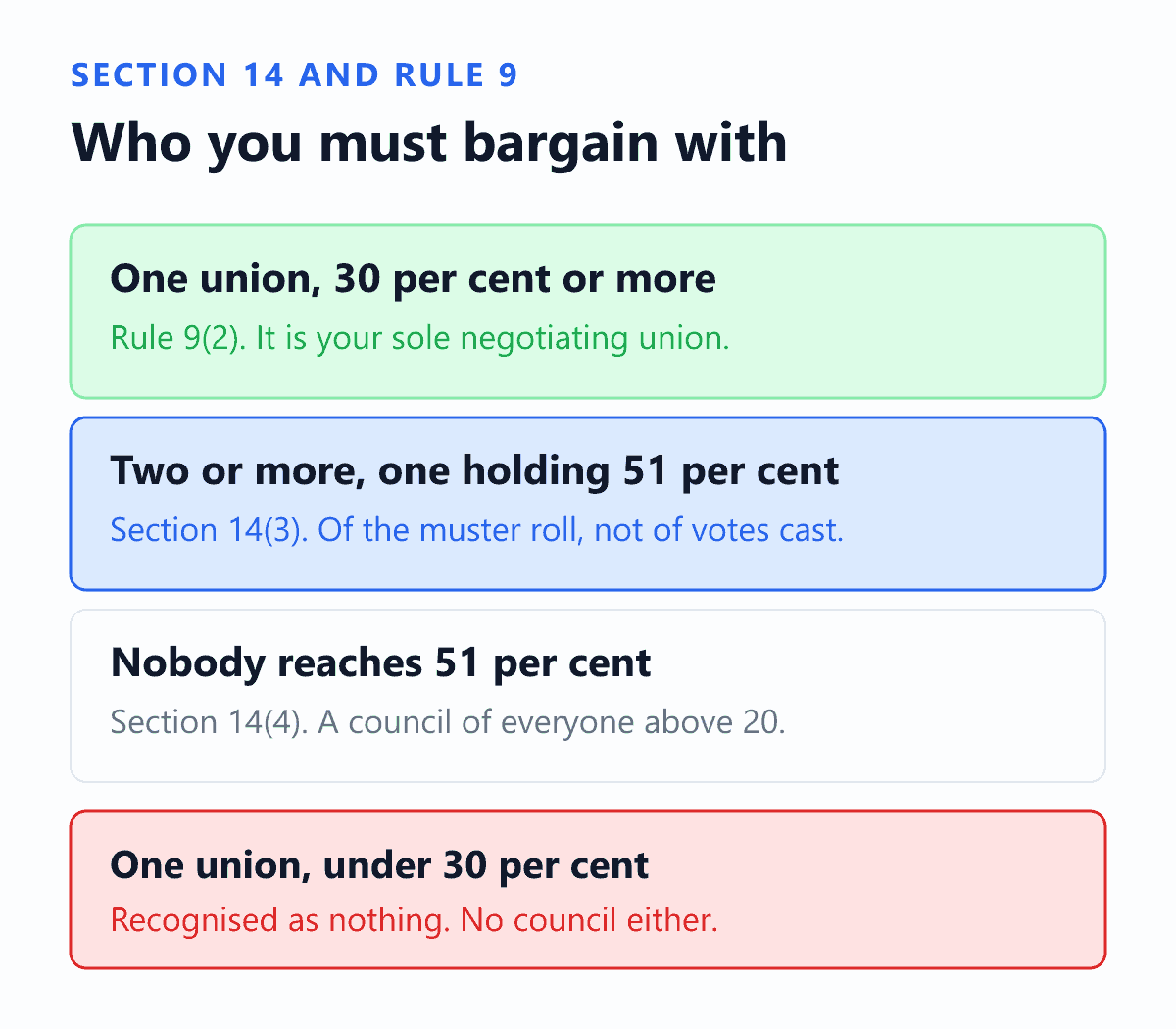
The Code prescribes no criteria. The Rules do. Rule 9(2) requires membership of not less than thirty per cent of the total workers employed in the industrial establishment before the duty to recognise arises. That number appears nowhere in the Act, and an employer reading only the Code would conclude that any lone registered union must be recognised.
The consequence at the other end is sharper, and it is the single most useful thing in this article for a business with one small union on site. A sole union sitting below thirty per cent is recognised as nothing, and no negotiating council is constituted in its place.Section 14(4), the council provision, opens with "if more than one Trade Union ... are functioning". One union does not satisfy it. So an establishment with a single registered union at twenty-five per cent has no negotiating union, no negotiating council, and no statutory bargaining counterparty at all.
Two warnings sit on top of that, because the gap is narrower than it looks. It does not make the union disappear: it stays registered, its members keep every protection in the Second Schedule, and any individual grievance still runs through the Grievance Redressal Committee and the conciliation machinery. And it is a temporary state by design. Recruit ten more members and the duty switches on.
Registration is 10 per cent. Recognition is 30.
These two numbers get conflated constantly, usually by an employer who has just been handed a registration certificate and assumes it is a recognition claim.
Under section 6(2), a trade union of workers cannot be registered unless at least ten per cent of the workers or one hundred workers, whichever is less, employed in the establishment or industry are members on the date of the application. Section 6(4) requires it to keep that level, subject to a minimum of seven members. Section 6(1) needs seven or more members to apply in the first place.
So in a 140-person unit, fourteen members is a lawfully registrable union. It is also, on its own, a union you owe nothing to under section 14. A registration certificate proves that a union exists and is entitled to the protections in the Code. It says nothing whatever about whether you must sit across a table from it.
"Worker" in Chapter III is not the worker you count elsewhere
This is the finding that moves the arithmetic most, and it is missing from every secondary summary read while writing this piece.
Section 2(zr) defines a worker narrowly. It excludes a person employed mainly in a managerial or administrative capacity, and a person employed in a supervisory capacity drawing wages above Rs 18,000 a month. Those exclusions are what make a 26-person agency with nine managers a 17-worker establishment for the purposes of the twenty-worker Grievance Redressal Committee, and they are what most people reach for by reflex.
Then comes the proviso:
"Provided that for the purposes of Chapter III, ‘worker’ (a) means all persons employed in trade or industry; and (b) includes the worker as defined in clause (m) of section 2 of the Unorganised Workers’ Social Security Act, 2008."
Chapter III of the Code is Trade Unions, sections 5 to 22, and section 14 lives inside it. For the 30, 51 and 20 per cent calculations the narrow definition is switched off and replaced with all persons employed in trade or industry. Managers count. Administrative staff count. Supervisors on Rs 60,000 count.
Worked on the Aurangabad unit, with 140 people of whom 25 are managerial, administrative or supervisory above the line:
| Question | Which definition | The count |
|---|---|---|
| Do we owe a Grievance Redressal Committee at 20 workers? | Narrow, section 2(zr) | 115 |
| Do we cross 300 workers for standing orders? | Narrow, section 2(zr) | 115 |
| What is 30 per cent for a sole union under rule 9(2)? | Wide, Chapter III proviso | 42, not 35 |
| What is 51 per cent under section 14(3)? | Wide, Chapter III proviso | 72, not 59 |
| What is the 20 per cent council floor under 14(4)? | Wide, Chapter III proviso | 28, not 23 |
Thirteen people, on the 51 per cent line, from nothing but which definition applies. That difference is larger than most recognition contests are decided by.
An honest tension worth knowing about. Sub-sections 14(3) and 14(4) do not say "workers" on their own. They say workers on the muster roll of the industrial establishment. The wide Chapter III definition governs who is a worker; the muster roll governs who is counted. Where a business keeps a muster roll covering only its non-managerial staff, the two produce different denominators and the Code does not say which yields. There is no reported decision on it. The practical answer is not to litigate it: decide, in advance and on principle, who your muster roll covers, and be able to prove that the answer did not change the week a union wrote to you.
The muster roll is the electorate
Where two or more registered unions are functioning, the strength of each is established by verification, and rule 9 sets out how. Two clauses in it are worth reading slowly, because between them they turn an attendance record into an electoral roll.
Rule 9(4)(e): "All workers whose names are borne on the muster roll of the industrial establishment on the date of reckoning shall be eligible to cast their vote."
Rule 9(4)(f): "The voters list shall be prepared by the employer of the industrial establishment on the basis of names of the workers borne on the muster roll referred to in clause (e) and the voters list shall contain the name, father’s name, designation, worker number or identity card number issued by the employer and place of posting of the worker."
Five fields per worker, and the employer produces them. Not the union, not the verification officer. And the date is not yours either: under rule 9(3)(d)(ii) the date of reckoning is fixed by the verification officer for the establishment, which means the list has to describe the workforce as it stood on a day you did not choose and may already have passed.
Everything downstream of that list is contestable if the list is. A worker left off it is a vote lost, and a name on it that should not be is a challenge to the whole result. Rule 9(4)(g) then requires the employer to publish the final list, after the verification officer approves it, on the notice board at the main entrance and on the establishment website if there is one, within two days of finalisation, with copies to every participating union by hand, speed post or electronic mode. It is a public document, checked by people with an incentive to find errors in it.
This is where a business discovers what its records are actually worth. A register signed at the end of the month from memory, a site headcount posted in a WhatsApp group, or a payroll export that knows salaries but not worker numbers or places of posting cannot produce that list in the time available. A daily, contemporaneous attendance register with a stable worker number attached to each person produces it as an export. That is the same record the statutory registers and wage slips rules already require you to keep for five years, which is the point: nothing new is being asked for here, only that the thing you already owe is real.
Where this site’s subject actually touches the law. The question "who was on the roll on 14 August, and what was each person’s worker number and place of posting" is either a database query or a fortnight of reconstruction, and which one it is was decided years before the letter arrived. Shiftelio keeps the daily attendance register and the employee record in one place, so a roll for a past date, with the worker number and site against every name, is something you export rather than rebuild. That is worth having for the wage register on an ordinary month. On the month a verification officer fixes a date of reckoning, it is the difference between filing a voters list and contesting one.
Fifty-one per cent of the roll, not of the votes
Section 14(3) recognises the union "having fifty-one per cent. or more workers on the muster roll of that industrial establishment ... supporting that Trade Union". The denominator is the roll. It is not the votes cast, and rule 9(4)(e) confirms the reading by making everyone on the roll an eligible voter rather than everyone who turns up.
So abstentions are not neutral. They count against every union at once.
- 400 workers on the roll. Turnout 100 per cent. A union needs 204 votes to be the sole negotiating union, which is 51 per cent of the ballot.
- 400 on the roll. Turnout 70 per cent, so 280 votes are cast. That same union still needs 204, which is now 72.9 per cent of the votes cast.
- 400 on the roll. Turnout 55 per cent, so 220 votes. 204 of 220 is 92.7 per cent, and in practice nobody clears it.
Which is why the negotiating council in section 14(4) is the ordinary outcome of a contested verification and the sole negotiating union is the unusual one. An employer expecting the ballot to produce a single clean counterparty is usually going to get a committee instead.
The council arithmetic, worked
Sub-section (4) constitutes the council out of "such registered Trade Unions which have the support of not less than twenty per cent. of the total workers on the muster roll ... and such representation shall be of one representative for each twenty per cent. and for the remainder after calculating the membership on each twenty per cent."
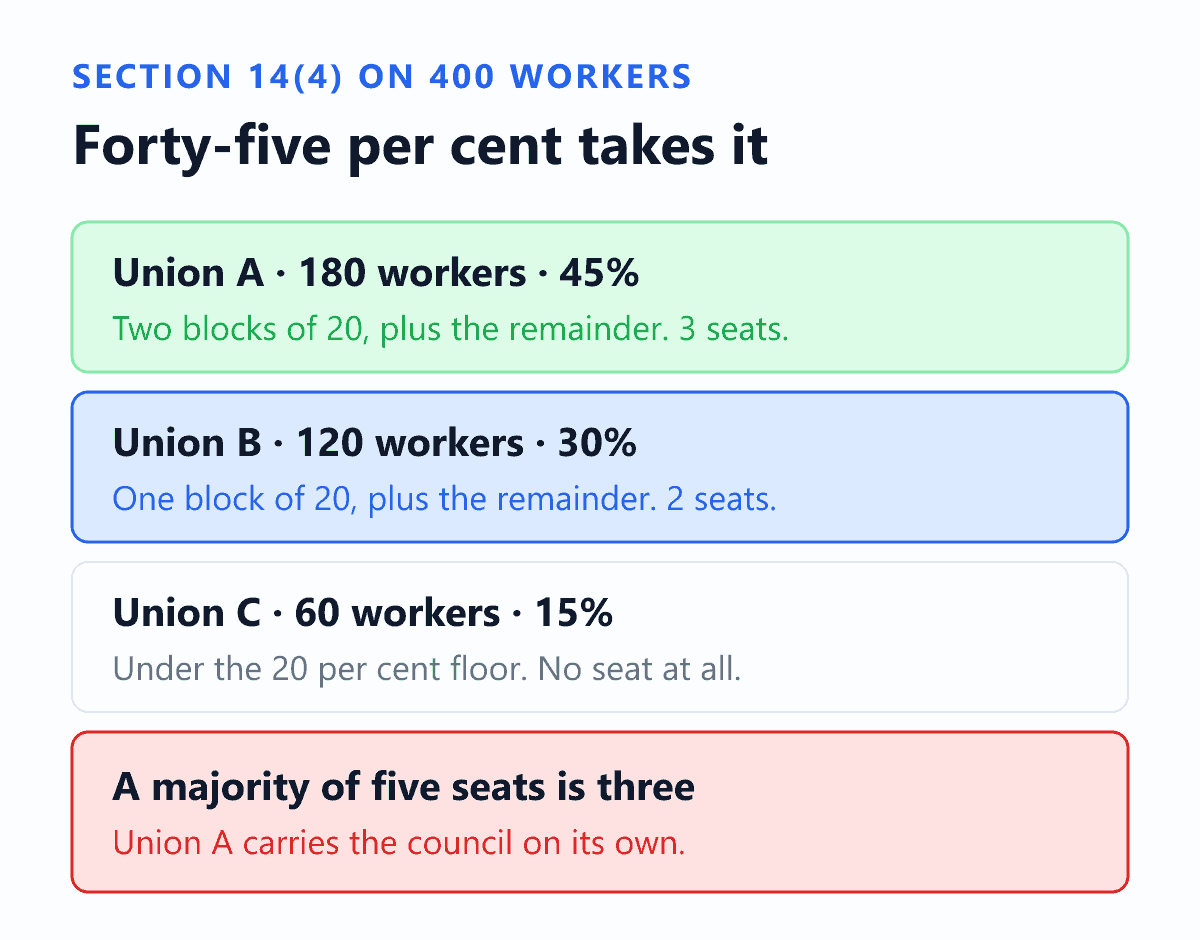
Take the 400-worker establishment. Three unions stand. Union A polls 180, Union B polls 120, Union C polls 60, and 40 workers do not vote.
| Union | Supporters | Per cent of the roll | Seats |
|---|---|---|---|
| A | 180 | 45.0 | Two complete blocks of 20, plus one for the remaining 5. 3 |
| B | 120 | 30.0 | One complete block of 20, plus one for the remaining 10. 2 |
| C | 60 | 15.0 | Below the 20 per cent floor. 0 |
| Did not vote | 40 | 10.0 | Counted in the denominator, represented by nobody |
Nobody reached 204, so there is no sole negotiating union. The council has five seats. Union A holds three of them.
Then section 14(5) closes the loop: an agreement reached in the council is an agreement "if it is agreed by the majority of the representatives of the Trade Unions in such negotiating council". A majority of five is three. Union A, supported by 45 per cent of the floor, carries the council on its own, and Union C, supported by 60 real people, is not in the room.
One reading, flagged as such."One representative for each twenty per cent. and for the remainder after calculating the membership on each twenty per cent" is read here as one seat per complete block of twenty and one further seat for whatever is left over. That is the plain reading and the one the arithmetic above uses. It is not a settled one: no reported decision construes the phrase, and a reading that ignores remainders would give Union A two seats and Union B one, which changes who controls the council without changing a single vote. If a council is being constituted at your establishment, get the seat count in writing from the verification officer before it sits.
You pay for the ballot
Rule 9(3)(b) is nine words long and it is the line that costs money: "The employer of the industrial establishment shall bear all the expenses and make arrangements in connection with the verification of membership of Trade Unions."
The verification officer is appointed by the government, not by you, and rule 9(3)(a)(i) requires that they hold no interest in any of the unions being verified. The employer’s role is administrative and financial throughout. The calendar around it is fixed and long:
| When | What happens, and who does it |
|---|---|
| Not later than 3 months before an existing recognition expires | The employer initiates the process. Rule 9(3)(d)(i), and the proviso to 9(3)(a)(i) says the process shall commence three months before expiry. |
| On application | Unions apply to the employer with a registration certificate, member list, subscription details and the latest annual return filed with the Registrar. Rule 9(3)(c). |
| Next | The employer forwards those documents to the verification officer, who scrutinises them and fixes the date of reckoning. Rule 9(3)(d)(iii) and (iv). |
| 60 days before the vote | The officer convenes all unions to settle the voters list, the date, time, mode and place of voting, the counting, and the symbols. Rule 9(4)(a) to (c). |
| Within 2 days of finalisation | The employer publishes the voters list on the main-entrance notice board and the website, and sends it to every union. Rule 9(4)(g). |
| Polling day | Secret ballot under the officer’s supervision, union agents present at the count. Rule 9(4)(i). An electronic process may be deployed if the employer and the officer agree, under rule 9(3)(d)(vi). |
| After | The officer reports with a result sheet; the employer then grants recognition on the basis of that report. Rules 9(5) and 9(6)(a). |
Note what rule 9(6)(a) does and does not leave open. Recognition is granted by the employer, on the basis of the verification report. There is no discretion in the second half of that sentence. The report decides; the employer executes.
What recognition costs after the ballot
Rule 9(7) sets out the facilities. Four of them apply to every establishment and the fifth has a threshold:
- A notice board for the negotiating union or council to display its activities.
- Venue and facilities for discussions with the employer, on a schedule and agenda settled between the two sides.
- Venue and facilities for the union or council to hold its own internal discussions.
- Entry for office bearers into the establishment to ascertain matters relating to working conditions.
- At 300 or more workers, suitable office accommodation with necessary facilities.
Two further clauses land squarely on payroll and attendance, and both are easy to get wrong in the ordinary run of a month.
Rule 9(7)(b): check-off runs on the worker’s written consent. The employer deducts union subscription "on the basis of the written consent of the worker". Not on a list supplied by the union, and not on a blanket authorisation negotiated with it. Every deduction needs a consent traceable to the individual, which is the same discipline the deduction rules impose on everything else that comes off a wage.
Rule 9(7)(c): office bearers are treated on duty. While holding meetings with the employer they are on duty, which means the attendance record has to show them as on duty and the wage register has to pay them as such. An establishment whose attendance system only understands present, absent and leave will book a four-hour negotiation as a half-day absence, and the correction will be made by hand a fortnight later, if at all. It is a small thing that becomes a documented grievance the second time it happens.
Three years, and a clock you start yourself
Section 14(6) and rule 9(6)(b) agree: a recognition, or a council constitution, is valid for three years from the date of recognition or constitution, or such further period not exceeding five years in total as may be mutually agreed between the employer and the union.
The extension is a genuine option and it is worth taking seriously, because the alternative is another verification, another ballot and another bill. Five years is the ceiling; the Code does not permit a longer settlement.
The renewal clock is the employer’s to start. The proviso to rule 9(3)(a)(i) says the recognition process shall commence three months before the existing term expires, and rule 9(3)(d)(i) puts the duty on the employer to initiate action "sufficiently in advance but not later than three months before the expiry". That is a diary entry made on the day recognition is granted, thirty-three months out. Businesses that do not make it discover the deadline from the union.
What happens if you simply refuse
There is no penalty in section 86 attached to section 14 by name. Section 86(1), the Rs 1 lakh to Rs 10 lakh band, is tied to sections 78, 79 and 80, which are lay-off, retrenchment and closure. Reading only the penalties section, an employer might conclude that ignoring a recognition claim is free.
It is not, because the route runs through the Second Schedule instead. Item (15) of Part I lists, as an unfair labour practice on the part of employers, "to refuse to bargain collectively, in good faith with the recognised Trade Unions". Section 86(5) makes any unfair labour practice punishable with a fine of not less than Rs 10,000 which may extend to Rs 2 lakh, and section 86(6) raises a repeat of the same offence to not less than Rs 50,000, extending to Rs 5 lakh, or imprisonment up to three months, or both.
The same schedule catches the more inventive responses, which matters more than the headline number because these are the things a business does without thinking of them as breaches:
| Second Schedule, Part I | What it looks like in practice |
|---|---|
| (1)(c) | Announcing a wage increase at a crucial period of union organisation, with a view to undermining it. |
| (2)(b) | Showing partiality or granting favour to one of several unions attempting to organise, where it is not the recognised one. |
| (3) | Establishing an employer-sponsored trade union of workers. |
| (4)(f) | Discharging office bearers or active members on account of their union activities. |
A well-timed increment before a verification ballot is not a clever manoeuvre. It is a named unfair labour practice, and it is named in a schedule that a verification officer, three union agents and the workers who did not get the increment can all read.
Disputes arising out of all of this go to a Tribunal. Rule 9(8) allows an aggrieved worker or union to apply in Form-II, within one year from the date the dispute arises, electronically, by speed post or in person.
Central Rules, State rules
Every rule number in this article comes from the Industrial Relations (Central) Rules, 2026, notified as G.S.R. 342(E) on 8 May 2026 under section 99 of the Code. Those rules govern establishments for which the Central Government is the appropriate government, which for most private employers it is not. Your appropriate government is usually the State, and the State frames its own rules under section 100.
The distinction matters unevenly, and it is worth knowing which half of this article is portable.
- Statutory, and identical everywhere. The 51 per cent, the 20 per cent council floor, the seat formula, the three-year term with a five-year ceiling, the majority-of-representatives rule, the Second Schedule and the penalties. These are in the Code and no State rule can move them.
- Prescribed, and therefore variable. The 30 per cent criterion in rule 9(2), the ten negotiable matters, the composition of the voters list, the 60-day meeting, the two-day publication window, and the facilities. A State rule may set these differently.
Several States had not notified their rules under the Code at the date of writing. Where yours has, read rule 9 of your State’s rules before relying on any prescribed number here. The broader position across all four codes is in the 2026 compliance checklist.
What to do before the letter arrives
- Know your Chapter III denominator. It is all persons employed, not the narrow worker count you use for the Grievance Redressal Committee and standing orders. Write the number down and know how it is derived.
- Decide what your muster roll covers, and decide it now. Not after a union writes to you. A roll whose scope changed in the same quarter as a recognition claim is a roll that will be challenged.
- Make the five fields exist. Name, father’s name, designation, worker number or identity card number, place of posting. If any of those live only in somebody’s head or in a payroll sheet that does not carry them, the voters list is a manual project on a deadline you did not set.
- Diarise the three-month date the day recognition is granted. Thirty-three months from grant, the process must commence, and the duty to initiate is yours.
- Budget the ballot. Rule 9(3)(b) puts every expense and every arrangement on the employer. It is a line item, not a surprise.
- Do not try to manage the result. Four of the responses that occur naturally to a business under organising pressure are named unfair labour practices carrying a fine up to Rs 2 lakh and, on repetition, imprisonment.
Questions employers ask
Do we have to recognise a union if we are a small business?
Section 14 carries no size threshold. It applies to any industrial establishment in which a registered trade union is functioning, and "industrial establishment" covers any place where an industry is carried on, including offices, shops, restaurants, clinics and software companies. What decides the answer is not your headcount but the union’s share of it: 30 per cent under rule 9(2) where it is the only union, 51 per cent of the muster roll under section 14(3) where it is not.
What is the difference between a negotiating union and a negotiating council?
A negotiating union is a single union recognised as the sole bargaining agent, either because it is the only union and holds at least 30 per cent, or because it is supported by 51 per cent or more of the workers on the muster roll. A negotiating council is constituted where more than one union is functioning and none reaches 51 per cent. It seats every union supported by at least 20 per cent, with one representative for each complete 20 per cent and one for the remainder, and an agreement is reached when a majority of the representatives agree.
Is 51 per cent of the votes cast, or of the workforce?
Of the workforce. Section 14(3) counts workers on the muster roll of the establishment, and rule 9(4)(e) makes everyone borne on that roll on the date of reckoning an eligible voter. Workers who do not vote remain in the denominator. At 70 per cent turnout a union needs 72.9 per cent of the ballot to reach 51 per cent of the roll, which is why contested verifications usually produce a council rather than a sole negotiating union.
Who pays for the secret ballot?
The employer. Rule 9(3)(b) of the Industrial Relations (Central) Rules, 2026 requires the employer to bear all the expenses and make the arrangements in connection with the verification of membership. The verification officer is appointed by the government and must have no interest in any of the unions being verified. An electronic voting process may be deployed where the employer and the officer agree, under rule 9(3)(d)(vi).
Does a union with only 10 per cent membership have to be recognised?
No. Ten per cent of the workers, or one hundred workers whichever is less, is the threshold for registration under section 6(2), not for recognition. Where it is the only union in the establishment, rule 9(2) requires 30 per cent membership before the duty to recognise arises. Below that, the union remains registered and fully protected, but there is no negotiating union, and no negotiating council either, because section 14(4) applies only where more than one union is functioning.
How long does recognition last?
Three years from the date of recognition or constitution, extendable by mutual agreement between the employer and the union to a total not exceeding five years. Section 14(6) and rule 9(6)(b) are identical on this. The employer must initiate the re-recognition process not later than three months before the term expires.
What happens if an employer refuses to negotiate?
Refusing to bargain collectively in good faith with a recognised trade union is an unfair labour practice under item (15) of Part I of the Second Schedule. Section 86(5) makes it punishable with a fine of not less than Rs 10,000, extending to Rs 2 lakh; a repeat of the same offence carries not less than Rs 50,000, extending to Rs 5 lakh, or imprisonment up to three months, or both. There is no separate penalty attached to section 14 by name, so the Second Schedule route is the operative one.
Do managers count towards the 30 and 51 per cent thresholds?
Yes, on the face of the Code. Section 14 sits in Chapter III, and the proviso to section 2(zr) provides that for the purposes of Chapter III "worker" means all persons employed in trade or industry. The managerial, administrative and above-Rs-18,000 supervisory exclusions that apply elsewhere in the Code are switched off. The qualification is that sub-sections 14(3) and 14(4) count workers on the muster roll, so where a muster roll is narrower than the workforce the two provisions pull against each other and the point is untested.
The short version
- Section 14 has no size threshold. One registered union functioning in the establishment is the trigger.
- One union alone needs 30 per cent membership under rule 9(2). Below that it is recognised as nothing, and no negotiating council is constituted in its place.
- 10 per cent is registration under section 6(2). It is not recognition. The two numbers are constantly confused.
- For the thresholds, "worker" is the wide Chapter III definition: all persons employed. Managers and senior supervisors are in the denominator.
- 51 per cent is of the muster roll, not of the votes cast. At 70 per cent turnout that means 72.9 per cent of the ballot.
- Where nobody clears 51 per cent, a council seats every union at 20 per cent or more, one seat per complete 20 and one for the remainder, decided by a majority of representatives.
- The employer prepares the voters list from the muster roll, on a date of reckoning fixed by the verification officer, with five fields per worker, published within two days.
- The employer bears every expense of the verification, under rule 9(3)(b).
- Recognition lasts three years, extendable to five, and the employer must restart the process three months before expiry.
- Refusing to bargain in good faith is an unfair labour practice: Rs 10,000 to Rs 2 lakh, and Rs 50,000 to Rs 5 lakh or three months on a repeat.
Position as at 7 September 2026. Sections 2(zr), 6, 14 and 86 and the Second Schedule are quoted from the Gazette of India text of the Industrial Relations Code, 2020. Rule 9 is quoted from the Gazette text of the Industrial Relations (Central) Rules, 2026, G.S.R. 342(E) of 8 May 2026. Both were read directly for this article, which is why rule numbers are cited. The Central Rules apply where the Central Government is the appropriate government; most private employers fall under their State, and several States had not notified rules under the Code at the date of writing. This is general information and not legal advice for a particular establishment.
Sources
- The Industrial Relations Code, 2020, Gazette of India, 29 September 2020 - section 2(zr) and its Chapter III proviso, section 6 for registration, section 14 for recognition, section 86 for penalties and the Second Schedule for unfair labour practices.
- The Industrial Relations (Central) Rules, 2026, G.S.R. 342(E), Gazette of India, 8 May 2026 - rule 9 in full: the negotiable matters, the 30 per cent criterion, the verification procedure, the secret ballot, the voters list and the facilities.
- Ministry of Labour and Employment, Labour Codes - the four codes in force from 21 November 2025 and the Central Rules notified on 8 May 2026.
- PRS Legislative Research, Industrial Relations (Central) Rules, 2026 - the rules as notified, alongside the 2021 draft they replaced.
Keep reading
See how Shiftelio does this in practice with the labour law compliance hub for Indian employers.
Free to use, no signup: Payroll calculators.