Grievance Redressal Committee Rules 2026: 20 Workers, 30 Days, and a Vote Your Half Cannot Carry
In short
Section 4 of the IR Code makes a grievance committee compulsory at 20 workers. The composition, the 30 day clock, and why the employer half can never carry a vote.
A 24-person logistics office in Pune has an argument in March. A loader says he worked four Sundays in the quarter and was paid for two. The supervisor says the roster shows two. It is settled the way most of these are settled: a conversation, a raised voice, and nothing written down. The loader stops mentioning it.
In February the following year he files an application. He is inside his one year. The office does not have a Grievance Redressal Committee, has never heard of one, and has thirty days from an application it is not constituted to receive.
Section 4 of the Industrial Relations Code, 2020 makes that committee compulsory at twenty workers. It is one of the shortest obligations in the four labour codes and one of the least understood, because almost every summary of it stops before sub-section (7) - which is the only sub-section that decides anything, and which says, in effect, that your half of the committee cannot win a vote.
The rule, in one sentence
Sub-section (1) is the whole obligation:
"Every industrial establishment employing twenty or more workers shall have one or more Grievance Redressal Committees for resolution of disputes arising out of individual grievances."
Three words in that sentence are doing more work than they look like they are: industrial establishment, twenty, and workers. Take them in that order, because the first one is where most readers wrongly decide the rule is not theirs.
"Industrial establishment" does not mean factory
This is the most common reason a business skips section 4. The phrase reads like something with a shop floor in it.
An industrial establishment under the Code is an establishment in which an industry is carried on, and industry in section 2(p) is any systematic activity carried on by co-operation between an employer and worker for the production, supply or distribution of goods or services, whether or not it is carried on for profit. The exclusions are narrow: activity that is spiritual or religious in nature, institutions owned by or engaged in charitable, social or philanthropic service, domestic service, and the sovereign functions of government.
A software company supplies services. So does a restaurant, a diagnostic lab, a courier depot, a coaching centre, a salon chain and a security agency. All of them carry on an industry. If you are not a charity, a place of worship, a household employer or an arm of the state, you are an industrial establishment, and the only question left is the count.
Twenty workers is not twenty people
The threshold counts workers, which is a defined term and a narrower one than employees. Section 2(zr) excludes a person employed in a managerial or administrative capacity, and a person employed in a supervisory capacity drawing wages above Rs 18,000 a month.
That is the same Rs 18,000 line the 21-day shift change notice turns on, and it produces the same two surprises here.
- A 26-person digital agency where 9 people are managers, account directors or team leads on Rs 40,000 has 17 workers, and no committee is owed.
- A 21-person restaurant with one manager has 20 workers, and one is.
Unlike section 28 for standing orders, which counts workers employed on any day of the preceding twelve months, section 4 is written in the present tense: an establishment employing twenty or more workers. There is no look-back clause. In practice that means the duty switches on when you cross the line and does not vanish the week somebody resigns, and an establishment hovering at nineteen or twenty should simply constitute one, because the committee costs nothing to have and the argument about whether it was owed costs more than the committee.
Contract workers. Section 4 says workers, not workers on your own payroll, and the Code's definition of worker turns on employment in the establishment rather than on whose books the salary sits on. If your site runs on contract labour, count them and expect them to be represented. The contract labour rules guidecovers where the principal employer's other duties start and stop.
What the committee has to look like
Sub-sections (2) to (4) set the shape, and the Industrial Relations (Central) Rules, 2026, notified on 8 May 2026, fill in the manner.
| Requirement | What it means in a 30-person business |
|---|---|
| Equal members from each side | Pick a number and match it. Three and three is a valid committee. |
| Not more than ten members in total | A ceiling, not a target. Five a side is the maximum, not the norm. |
| Women in at least their proportion of the workforce | 40% women on the rolls means at least 40% of the committee. Arithmetic, not a gesture. |
| Chairperson alternates by year | Employer side chairs one year, worker side the next. Written into sub-section (3). |
| Worker members chosen, not appointed | The negotiating union nominates them. Where there is none, the workers choose. |
| One or more committees | Multi-site employers may constitute one per location, and usually should. |
The row that trips people is the fifth. A great many committees constituted in 2026 were constituted by an email naming three people from HR and three employees the founder trusts. That is not a Grievance Redressal Committee, because the worker members were not chosen by the workers. Where a negotiating union or negotiating council is recognised under Chapter III, it nominates them; where none is - which is most SMEs in this segment - the workers choose their own, and the employer's job is to run the choosing and record it, not to make it.
The proportional-women rule bites harder than it reads. In a garment unit that is 70% women, a six-member committee must have at least four women in it, and they cannot all be on the employer side if the employer side is three. The composition is arithmetic before it is policy.
Sub-section (7) is the one nobody quotes
Here is the sentence that changes what this committee is:
"The decision of the Grievance Redressal Committee on any application filed under sub-section (5) shall be made on the basis of majority view of the Committee, provided more than half of the members representing the workers have agreed to such decision, otherwise it shall be deemed that no decision could be arrived at by the Committee."
Read it twice. There are two conditions and they are not symmetric. A decision needs the majority view of the committee and the agreement of more than half of the worker members. Nothing anywhere requires more than half of the employer members to agree.
So on a six-member committee with three from each side:
- Two worker members and one employer member vote to uphold the grievance. That is not a majority of six. No decision.
- All three employer members vote to reject it and the worker members split. Even where that carries as a view, more than half of the worker members did not agree. Deemed no decision.
- Two worker members and two employer members agree. Majority, and more than half the worker side. That is a decision.
The employer nominees have no combination that produces an outcome without at least two of the three worker members. They can block, but a block is not a win: sub-section (8) treats a deemed non-decision exactly the way it treats a decision the worker dislikes.
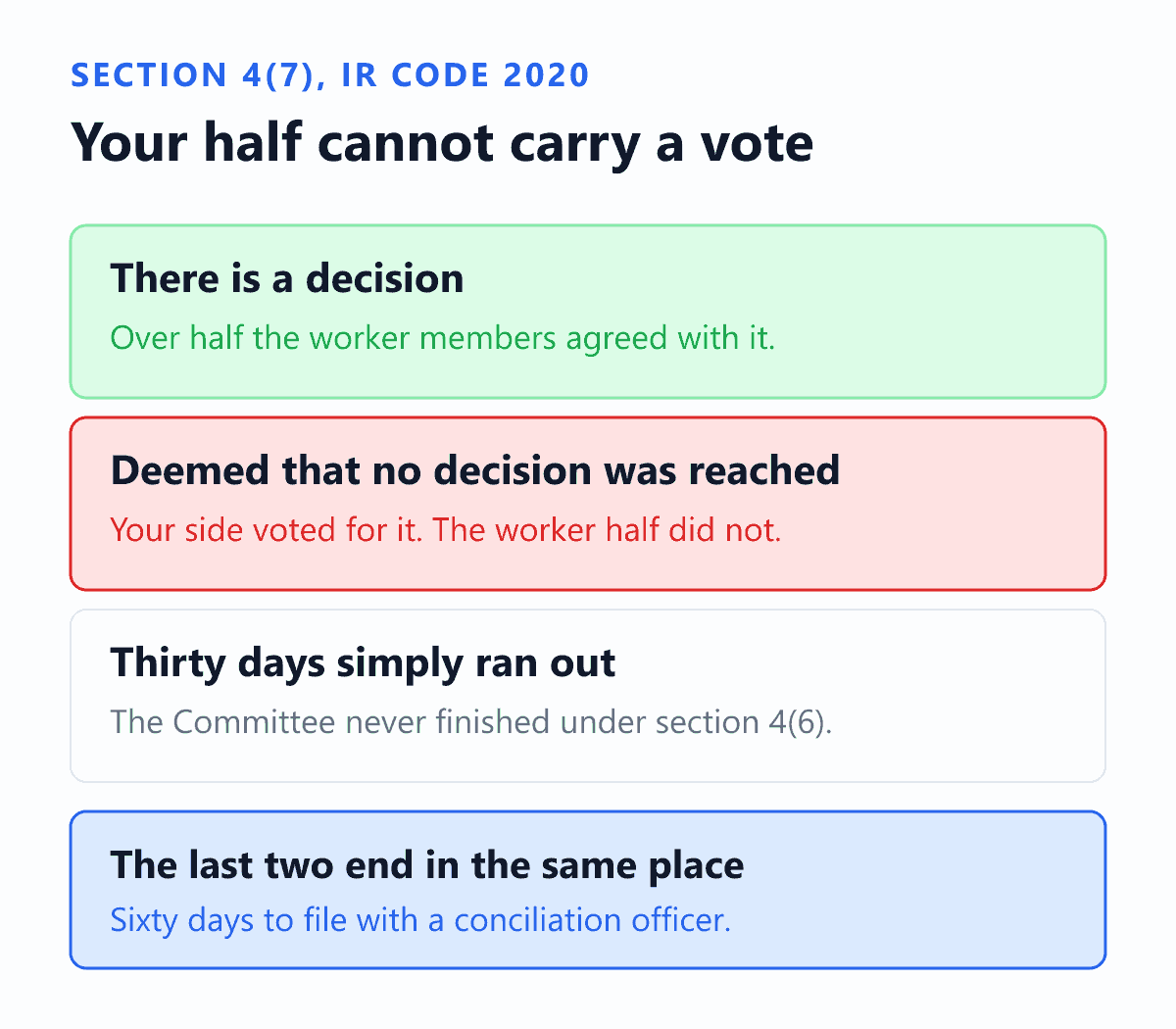
The practical consequence is worth stating plainly, because it changes how you should use the committee. A Grievance Redressal Committee is not a forum for winning arguments. It is a forum for settling them, and the arithmetic is deliberately built so that an employer who wants a grievance to end has to persuade the worker side rather than out-vote it. Businesses that treat it as a tribunal they chair will find every contested grievance leaving the building on day 31.
Thirty days is permissive, and still a deadline
Sub-section (6) says the committee may complete its proceedings within thirty days of receipt of the application. Several published summaries read that may as breathing room. It is not.
Sub-section (8) gives the aggrieved worker sixty days to escalate, running either from the date of the decision orfrom "the date on which the period specified in sub-section (6) expires". The permissive drafting means nobody prosecutes you for taking thirty-five days. It does not mean the grievance waits. On day 31 the worker acquires a right they did not have on day 29, and the matter stops being yours to settle.
That is the entire operational point of section 4 for an employer: thirty days is the only clock in the section you control, and it is the cheapest one to run out.
The other four clocks
Section 4 contains five time limits, and reading them together is what turns a committee from paperwork into a risk position.
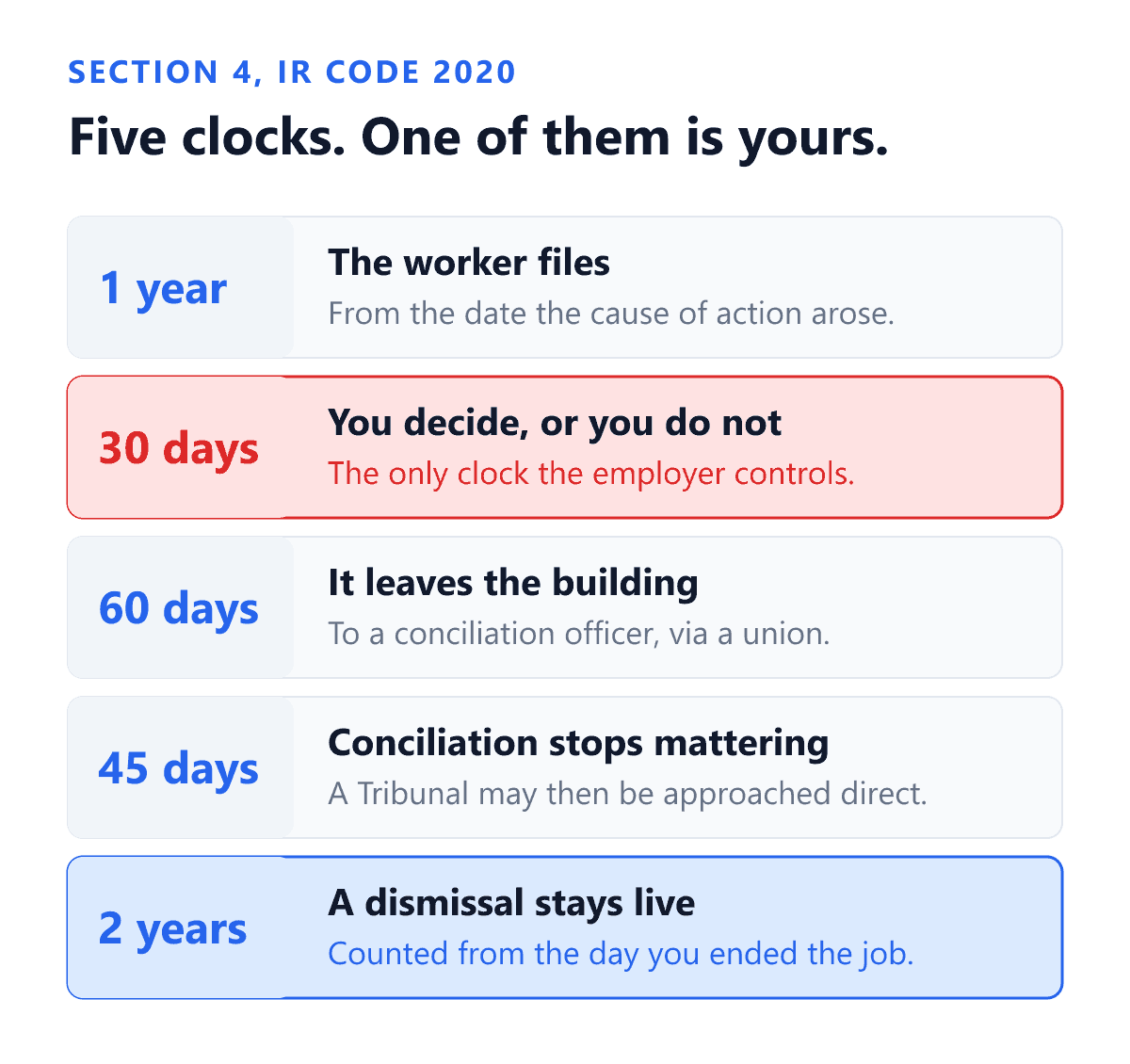
The one-year filing window in sub-section (5) is the one that should change your record keeping. A worker may file "within one year from the date on which the cause of action of such dispute arises". Not one year from when you last discussed it. Not one year from the end of the financial year. One year from the underpaid Sunday.
Which means the committee's thirty days will frequently be spent trying to establish what happened eleven months ago. That is not a legal problem. It is a records problem, and it is the part of section 4 that is actually within an employer's control.
The union clause in sub-section (8), and why it is unsettled
Sub-section (8) lets the aggrieved worker file for conciliation "to the conciliation officer through the Trade Union, of which he is a member".
Read strictly, a worker in a non-unionised establishment - which describes the overwhelming majority of the businesses this article is written for - has no route under sub-section (8) at all, because there is no trade union to route it through. Some employers will read that as a comfortable dead end. It is not a safe assumption, for two reasons.
- Sub-section (9) says the opposite for terminations.Where an employer discharges, dismisses, retrenches or otherwise terminates an individual worker, the resulting dispute is deemed an industrial dispute "notwithstanding that no other worker nor any Trade Union is a party to the dispute". The Code is explicit that the absence of a union does not close that door.
- No court has read sub-section (8) yet. The Code has been in force since 21 November 2025 and the Central Rules since 8 May 2026. It is at least arguable that the union clause is machinery rather than a condition precedent, and that a worker with no union files directly. Nobody knows, and a business planning around the narrow reading is planning around an untested one.
The honest position in September 2026: the union clause is a real feature of the text and it may well narrow the escalation route in a non-unionised workplace, but it does nothing at all for a termination dispute, which is where the money is. Treat it as an open question, not a defence.
A dismissal does not end at your committee
Sub-sections (9) to (11) are where the exposure actually sits, and they are usually reported as a separate topic from the committee they are attached to.
- (9) deems any dispute arising out of a discharge, dismissal, retrenchment or termination of an individual worker to be an industrial dispute, with no need for a union or a second worker to join it.
- (10) lets that worker apply directly to the Tribunal once forty five days have passed since the conciliation application, without waiting for conciliation to finish.
- (11) sets the outer limit: the Tribunal application must be made before two years from the date of the discharge, dismissal, retrenchment or termination.
Two years. An exit you processed in September 2026 is contestable until September 2028, and the committee proceedings are one early step on that road rather than the end of it. That is the correct frame for the whole section: the Grievance Redressal Committee is a filter that keeps disputes cheap if it works, and it is the first thing read back to you if it did not.
The exit paperwork itself is the other half of the same exposure. Retrenchment under section 70 and the two-day full and final settlement window are the two things a Tribunal will look at first.
What it costs to not have one
Several well-ranked pages state that failing to constitute a committee attracts the Rs 1 lakh to Rs 10 lakh penalty band. That is wrong, and it is worth correcting rather than repeating, because an employer who checks the citation and finds it does not say that will discount the rest of the advice too.
Section 86(1) reads: "An employer who contravenes the provisions of section 78 or section 79 or section 80 shall be punishable with fine which shall not be less than one lakh rupees, but which may extend to ten lakh rupees." Sections 78, 79 and 80 are lay-off, retrenchment and closure. Section 4 is not mentioned in any of sub-sections (1) to (19).
It therefore falls to the residual clause, sub-section (20): "Any person who contravenes any other provision of this Code not covered under sub-sections (1) to (19) or the rules or regulations framed under this Code shall be punishable with fine which may extend to one lakh rupees."
Up to Rs 1 lakh, and that is not the reason to have one. The reason is that without a committee there is no forum, so a grievance that would have been settled internally in three weeks starts life as a conciliation matter. And under the 2026 inspection rules, a missing committee is exactly the kind of thing an inspector-cum-facilitator writes into a written direction.
There is a second, quieter cost. Section 40(c) of the same Code lets an employer change shift working in an emergent situation without the usual twenty-one days notice - but only "in consultation with the Grievance Redressal Committee". An establishment with no committee has no access to the only emergency exemption Chapter V provides. The shift timings article works that through in full.
The record the committee actually runs on
Everything above reduces to a single practical question, and it is not a legal one: when a worker files in month eleven, can you show what happened in month one?
The grievances that reach a Grievance Redressal Committee in a 20 to 200 person business are overwhelmingly the same four. Hours worked that do not match hours paid. A weekly off that was taken away. A deduction nobody explained. An overtime rate applied to the wrong base. Every one of those is decided by a record, and every one of them arrives long after the memory of it has gone.
Shiftelio keeps that record as a by-product of running the day rather than as an archive somebody has to maintain. Each shift carries what was rostered, what was actually clocked, where it was clocked from, and who changed it afterwards if anyone did. When the application names a Sunday in March, the answer is a row that already exists, with the manager who approved it on it.
Three things follow that matter specifically to a thirty-day clock:
- The record predates the dispute. A punch log written on the day carries weight that a reconstruction assembled after the application does not, and the committee is going to notice which one it is being handed.
- Both halves of the committee can read the same thing. The arithmetic in sub-section (7) means you have to persuade worker members, not out-vote them. A neutral timestamped record is the only artefact in the room that does that.
- Thirty days is enough time if the answer is a query, not an investigation. Most missed deadlines here are not stubbornness. They are three weeks spent finding out what happened.
For the two things a committee will ask for most often, the free statutory attendance register gives the format the codes expect, and the overtime calculator settles the rate argument before it becomes a grievance.
How to constitute one this month
It is genuinely a one-afternoon job, and there is no filing, no fee and no approval to wait for.
- Count your workers, excluding managerial and administrative staff and supervisors above Rs 18,000. Write the count and the date down; it is the evidence that the duty applied or did not.
- Work out the women's proportion of that count. It sets a floor on the committee, so do it before you pick a size.
- Pick an even size that satisfies the floor, up to ten. Four or six is right for most businesses in this range.
- Let the workers choose their half. Where a negotiating union or council is recognised, it nominates. Where none is, run a simple show of hands or a written nomination and minute it.
- Name the chairperson for year one and record that it alternates to the other side next year.
- Publish how to file. The Central Rules contemplate electronic filing, so an email address or a form is enough, and it should say what an application must contain: who the worker is, what the grievance is, and what relief they want.
- Diary the thirty days from receipt, on the day of receipt. This is the only step in the list that fails silently.
For multi-site employers, constitute one per site. Sub-section (1) says "one or more", and a committee that has to travel is a committee that misses the thirty days.
Frequently asked questions
Is a Grievance Redressal Committee mandatory in India?
Yes, for every industrial establishment employing twenty or more workers. Section 4(1) of the Industrial Relations Code, 2020 is worded as a duty with no exemption for small businesses, non-factories or non-unionised workplaces. The count uses "worker" as defined in section 2(zr), which excludes managerial and administrative staff and supervisors earning above Rs 18,000 a month.
Does it apply to offices, shops and IT companies, or only factories?
It applies to any establishment carrying on an "industry" under section 2(p), which covers the supply or distribution of services and not merely the production of goods. Offices, shops, restaurants, clinics, agencies and software companies are all inside it. The exclusions are religious or spiritual activity, charitable and philanthropic institutions, domestic service and the sovereign functions of government.
What is the composition of a Grievance Redressal Committee?
An equal number of members representing the employer and the workers, with a total not exceeding ten, and representation of women workers at least in proportion to their share of the workforce. The chairperson is chosen from the employer side and the worker side alternately on a rotational basis every year. Under the Industrial Relations (Central) Rules, 2026, worker members are nominated by the negotiating union or council where one is recognised, and chosen by the workers where none is.
Can the employer side outvote the worker members?
No. Section 4(7) requires both a majority view of the committee and the agreement of more than half of the members representing the workers. Where that second condition fails, the Code deems that no decision could be arrived at, and the worker gets the same sixty-day right to escalate that a decision against them would have given. There is no combination of employer votes that produces a binding outcome on its own.
What happens if the committee does not decide within thirty days?
The worker may, within sixty days of the expiry of that period, apply for conciliation of the grievance to a conciliation officer. Section 4(6) is drafted permissively - the committee "may" complete proceedings within thirty days - but section 4(8) attaches the escalation right to the expiry of that same period, so missing it hands the matter out of the establishment rather than extending the time to settle it.
What is the penalty for not constituting one?
A fine which may extend to Rs 1 lakh, under the residual penalty in section 86(20). It is not the Rs 1 lakh to Rs 10 lakh band that several published summaries quote: section 86(1) applies that band to contraventions of sections 78, 79 and 80, which are lay-off, retrenchment and closure. Section 4 is not named in sub-sections (1) to (19) of section 86.
How long does a worker have to file a grievance?
One year from the date on which the cause of action arose, under section 4(5). For a dispute arising out of a discharge, dismissal, retrenchment or termination, section 4(11) allows a Tribunal application up to two years from the date of that termination, so the outer exposure on an exit is two years rather than one.
Do we need a committee if we have no trade union?
Yes. Section 4(1) contains no union condition. Where no negotiating union or negotiating council is recognised, the Industrial Relations (Central) Rules, 2026 provide for the worker representatives to be chosen by the workers themselves. The trade union appears only in section 4(8), as the route by which a worker takes an unresolved grievance to a conciliation officer.
Is this the same as the POSH Internal Committee?
No, and one cannot do the other's job. The Internal Committee under the POSH Act, 2013 handles complaints of sexual harassment and has its own composition, presiding officer and external member requirements. The Grievance Redressal Committee under section 4 handles individual grievances of a different kind entirely. Most businesses over twenty workers owe both. The POSH Internal Committee guide covers the other one.
The short version
- Twenty or more workers, not employees. Managers, administrative staff and supervisors above Rs 18,000 are outside the count.
- "Industrial establishment" means anywhere an industry is carried on, which includes offices, shops, restaurants and software companies.
- Equal halves, ten members maximum, women at least in proportion, chair alternating annually. The worker half is chosen by the workers or nominated by the negotiating union, never appointed by you.
- Section 4(7) needs more than half of the worker members to agree before there is any decision at all. Deadlock is a deemed failure, not a result you can bank.
- Thirty days is drafted as "may" and behaves as a deadline, because the sixty-day escalation right attaches to its expiry.
- A worker may file within one year of the cause of action. A termination stays contestable at a Tribunal for two years.
- The penalty is section 86(20), up to Rs 1 lakh - not the Rs 1 lakh to Rs 10 lakh band that applies to lay-off, retrenchment and closure.
- No committee also means no access to the emergency shift-change exemption in section 40(c).
Position as at 6 September 2026. Section 4 and section 86 are quoted from the text of the Industrial Relations Code, 2020 as in force. The manner of choosing members, the contents of an application and the provision for electronic filing are described from the Industrial Relations (Central) Rules, 2026 notified on 8 May 2026; rule numbers are deliberately not cited here because the published summaries differ and the gazette text was not read directly for this article. Several States had not notified their own rules under the Code at the date of writing, and a State rule may prescribe additional detail. This is general information and not legal advice for a particular establishment.
Sources
- The Industrial Relations Code, 2020, India Code (Government of India) - section 2(p) and 2(zr) for the definitions, section 4 for the Grievance Redressal Committee, section 40 for the notice of change, and section 86 for the penalties.
- Ministry of Labour and Employment, Labour Codes - the four codes in force from 21 November 2025 and the Central Rules notified on 8 May 2026.
- PRS Legislative Research, The Industrial Relations Code, 2020- the bill text, the Standing Committee's objection that "supervisor" and "manager" are left undefined, and the passage history.
- Press Information Bureau, Government of India - the official summary of the Industrial Relations Code and the dispute resolution machinery it establishes.
Keep reading
See how Shiftelio does this in practice with a shift record that answers a grievance filed eleven months later.
Work your own numbers with the free statutory attendance register. No signup, no email.