Weekly Off and Comp Off Rules in India: Twelve Days in a Row, Both Weeks Legal
In short
The Factories Act capped consecutive working days at ten. Section 26 of the OSH Code counts six days per fixed week instead, and two legal rosters give twelve.
A facility management company gives its housekeeping staff Sunday off. One week the site needs cover on Sunday, so the supervisor moves that worker's rest day to the following Saturday. Nobody worked seven days in a week. Nobody was denied a rest day. Both weeks show six worked days on the roster, and both are compliant.
That worker has just gone twelve days without a day off. Put the identical roster inside a factory and the Factories Act barred it outright until 21 November 2025. It does not any more, because it no longer exists.
This is not a loophole somebody found. It is the ordinary consequence of how the Occupational Safety, Health and Working Conditions Code, 2020 counts, and of a guard that was in the Factories Act and did not make the journey across.
What section 26 actually says
Section 26 of the OSH Code is headed Weekly and compensatory holidays. It has three sub-sections and it is short enough to read in full, which is worth doing, because almost nothing written about comp off in India tracks it.
26(1) No worker shall be allowed to work in an establishment for more than six days in any one week, with a proviso permitting a motor transport undertaking to require work on a weekly holiday so arranged that the worker does not work for more than ten days consecutively without a holiday for a whole day intervening.
26(2) The appropriate Government may, by notification, exempt such workers as it thinks fit from sub-section (1), subject to prescribed conditions.
26(3) Where, as a result of the passing of an order or the making of a rule under this Code exempting an establishment or the workers therein from sub-section (1), a worker is deprived of any of the weekly holidays, the worker shall be allowed, within the month in which the holidays were due or within the two months immediately following that month, compensatory holidays of equal number to the holidays so deprived.
Two things follow immediately, and both cut against what is usually said.
The first is that 26(1) is a prohibition, not a price. It does not say a seventh day costs extra. It says the worker shall not be allowed to work it. There is no sub-section that lets you buy your way past it with double pay or with a day off later.
The second is the trigger on 26(3). The compensatory holiday is owed where the rest day was lost because an exemption made under the Code removed the rest day requirement. It is not the general remedy for somebody coming in on a Sunday. If you rostered a seventh day with no exemption in force, you did not incur a comp off obligation. You breached 26(1), and giving a day off afterwards does not unbreach it.
"Week" is a defined term, and it is probably not your payroll week
Section 2(zzk) of the Code defines it. A week means a period of seven days beginning at midnight on Saturday night, or such other night as may be approved in writing for a particular area by the Chief Inspector-cum-Facilitator.
So unless somebody has obtained a written approval for your area, the statutory week runs Sunday to Saturday. Not Monday to Sunday, which is what most Indian rosters and most payroll cycles use. Not a rolling seven days counted back from whenever you last looked.
This matters more than it sounds. "Six days in any one week" is a count inside a fixed block with a start line and a finish line. It is not a statement about how many days in a row a person may work. The Code nowhere makes one.
The twelve day run that two legal weeks make
Put the two provisions together and the arithmetic is uncomfortable.
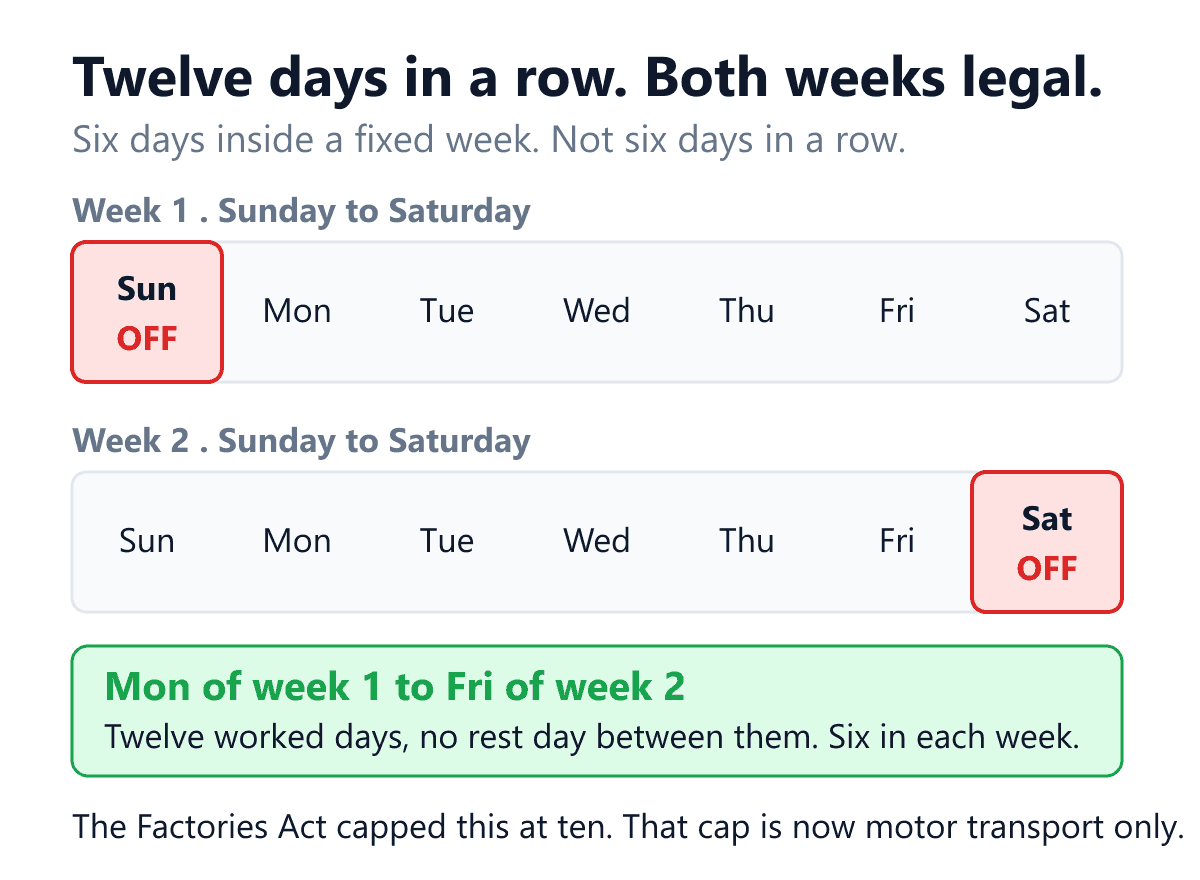
Week one: the rest day falls on Sunday, its first day. The worker works Monday to Saturday. Six days. Compliant.
Week two: the rest day falls on Saturday, its last day. The worker works Sunday to Friday. Six days. Compliant.
Between the two rest days there are twelve consecutive worked days, and nothing in section 26 addresses them. Each week was audited on its own and each passed.
In a factory, this roster was barred outright until the Codes came into force. Section 52 of the Factories Act, 1948 allowed a factory to work an adult on the first day of the week only where a whole-day holiday fell on one of the three days immediately before or after, and only where the manager had first delivered notice to the Inspector and displayed it in the factory. Then the proviso: no substitution shall be made which will result in any worker working for more than ten days consecutively without a holiday for a whole day intervening.
The OSH Code repealed the Factories Act along with twelve other enactments. The ten-day guard came across into exactly one place, the proviso to section 26(1), which applies to motor transport undertakings and to nobody else. A bus operator still cannot push a driver past ten consecutive days. A hospital, a hotel, a security agency, a warehouse and a restaurant can.
Read that as a compliance risk if you like, but read it as a retention risk first. Twelve days without a rest day is the pattern that produces the resignation nobody saw coming, and it is invisible on a roster checked one week at a time. Our guide to what staff attrition actually costs a restaurant puts numbers on the second half of that.
Two numbers that are not in this Code
Search for comp off rules in India and the same two figures come back almost every time. Both are worth tracing, because both are quoted as current central law and neither is. The last two rows of the table are the numbers that are real, put beside them because these four get swapped for each other constantly.
| What gets repeated | Where it actually comes from | Status in 2026 |
|---|---|---|
| The substituted day must fall within three days before or after | Section 52(1)(a) of the Factories Act, 1948 | Repealed by the OSH Code. A three-day window survives in some State national and festival holidays Acts, which are a different statute about a different kind of day |
| A comp off expires after 30, 60 or 90 days | Company leave policy | Never was central law. If your handbook says 90 days, 90 days is your rule and it binds you, not the Code |
| Comp off must be given within the month or the two months following | Section 53 of the Factories Act, carried into section 26(3) of the OSH Code | Live, but only on the exemption trigger in 26(3). It is not a general rule for any worked rest day |
| No more than ten consecutive working days | The proviso to section 52 of the Factories Act | Survives only in the motor transport proviso to section 26(1) |
The three-day window causes the most confusion, because it is genuinely alive somewhere else. Tamil Nadu still requires a substituted holiday under its National, Festival and Special Holidays Act to land within three days either side of the holiday worked. That provision is about 2 October, not about Sunday. We separated the two in what a worked national holiday actually costs, and the distinction is the whole reason a comp off policy written from a single template goes wrong in a multi-state business.
The money question is a different section
The second reliable error is treating a comp off as though it discharged the wage obligation. It does not, because the wage obligation is not in section 26 at all.
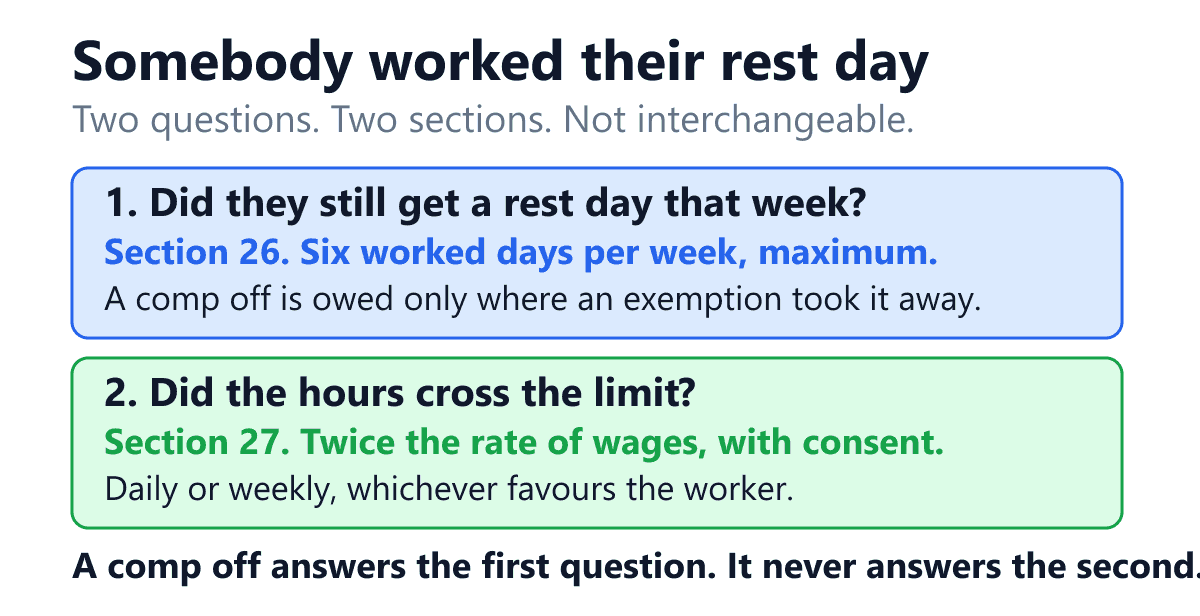
Section 27 says wages shall be paid at the rate of twice the rate of wages in respect of overtime work, where a worker works for more than such hours in a day or in a week as the appropriate Government prescribes. Three parts of that sentence do work most people skip.
- The trigger is hours, not the day of the week. A worker who comes in on Sunday and takes Wednesday off instead has worked six days and, if the prescribed limit was not crossed, has not worked a minute of overtime. There is no premium owed for the Sunday as such under the Code.
- Daily or weekly, whichever is more favourable to the worker. The section says the period of overtime shall be calculated on a daily basis or a weekly basis, whichever is more favourable to the worker. You do not get to pick the cheaper computation, and a payroll that only ever checks the weekly total is picking one.
- Consent. The first proviso requires that a worker be required to work overtime subject to the consent of that worker. A roster published on Saturday evening is not consent, and nothing in the section turns silence into agreement.
Which is why the two questions have to be asked separately. Did the worker still get a rest day inside that statutory week? Section 26. Did the hours cross the prescribed limit? Section 27, and it is owed in cash. A day off in lieu answers the first question and leaves the second exactly where it was. Our overtime calculation guide has the formulas and the ordinary-rate definition that go with them.
If your shift crosses midnight, your rest day is not a date
Section 28 deals with night shifts. It runs to two clauses, and both change how a roster has to be built:
Where a worker in an establishment works on a shift which extends beyond midnight, then, for the purposes of section 26, a weekly holiday for a whole day shall mean in his case a period of twenty-four consecutive hours beginning when his shift ends. The following day for him shall be deemed to be the period of twenty-four hours beginning when that shift ends, and the hours he has worked after midnight shall be counted in the previous day.
Take a security guard on 8pm to 8am, Saturday night into Sunday morning. His weekly holiday does not begin at midnight and it does not mean the Sunday square on a calendar. It is the twenty-four hours from 8am Sunday to 8am Monday. Roster him for 8pm Sunday and you have given him twelve hours, not a weekly holiday, however the attendance sheet reads.
Clause (b) fixes a second thing quietly. The post-midnight hours belong to the previous day, so a night worker's daily hours, and therefore the daily overtime computation under section 27, are counted against the day the shift began. A payroll that splits a night shift across two calendar dates is producing two short days instead of one long one, and the daily overtime disappears in the arithmetic. That failure is common enough that we wrote it up separately alongside the night shift consent requirement.
Who this binds, and what applies below the threshold
The OSH Code defines an establishment as a place where an industry, trade, business, manufacturing or occupation is carried on in which ten or more workers are employed. A factory comes in at ten workers for the purposes of Chapter II, and a mine, a port or a place where dock work is carried out comes in with no threshold at all. A proviso removes the ten-worker threshold entirely for establishments carrying on a hazardous or life threatening activity notified by the Central Government. Everywhere else, below ten workers, section 26 is not what governs you.
What governs you then is your State Shops and Commercial Establishments Act, which has its own weekly-off provision and, in several States, its own substitution machinery with its own window. Those Acts are State legislation and were not repealed by the Codes. States are also notifying their own rules under the Codes at different speeds, so a business operating across State lines can genuinely sit under section 26 in one location and under a 1960s Shops Act in the next.
The practical rule: count the workers at each location, then find the statute for that location. A single national comp-off policy written from the OSH Code will be wrong in every branch with nine people in it, and one written from a single State's Shops Act will be wrong in every branch with fifty.
What this looks like in the roster
Everything above reduces to four facts that either exist in the record on the day or get reconstructed badly at the end of the month:
- Where the statutory week starts. Sunday to Saturday unless a written approval says otherwise. A roster drawn Monday to Sunday is counting against the wrong seven days and will pass a check it should fail.
- How many consecutive days this person has worked, across the week boundary and not inside it. This is the number section 26 does not track and the one that ends in a resignation.
- Which rest day was moved, and to when. Not that a comp off sits somewhere in a leave balance, but the date it landed on, in the roster, so it can be shown.
- Daily hours, with a night shift counted against the day it began, so the daily overtime computation under section 27 is available alongside the weekly one.
None of that is exotic, and none of it is visible in a WhatsApp group or a monthly attendance sheet. It needs a roster and an attendance record that are the same record. Shiftelio rosters the rest day as a rostered thing rather than an absence, so a moved weekly off carries a date and a run of consecutive worked days is countable across the week boundary rather than inside it, and check-in and check-out times reach payroll as hours against a shift, so a night shift is one long day and not two short ones. If you are laying out the year rather than fixing one week, the free shift roster template is the quickest place to put the rest days down, and the labour law guide covers the registers the Codes expect to be computed from the same record.
What to check this week
- Find your longest run. Take last quarter's roster and count consecutive worked days per person across week boundaries. Anything over ten is the pattern this article is about, whether or not it is lawful in your sector.
- Check which seven days you are counting. If your roster or payroll week starts on Monday, your six-day check is not the check section 26 asks for.
- Read your own handbook back. A comp off validity of 30 or 90 days is your rule, not the Code's, and it is enforceable against you. Decide whether you meant it.
- Separate the two questions in payroll. A day off in lieu must not close an overtime line. Check that a worked rest day still runs through the section 27 computation on both a daily and a weekly basis.
- Fix the night shift boundary. If a shift crosses midnight, the hours after midnight belong to the previous day and the rest day is twenty-four hours from when the shift ended.
- Count heads per location. Ten or more workers puts that location under the OSH Code. Below that it is your State Shops Act, and the answer will differ.
- If you hold an exemption under 26(2), the compensatory holidays are due inside that month or the two months after, in equal number. That is a calendar obligation with an expiry, not a leave balance.
Frequently asked questions
Is comp off mandatory in India?
Not as a general rule under the OSH Code. Section 26(3) requires compensatory holidays only where a worker was deprived of weekly holidays because an order passed or a rule made under the Code exempted the establishment, and then equal holidays are due within that month or the two months immediately following. Outside that trigger, section 26(1) simply prohibits work beyond six days in a week. Many State Shops Acts and most company policies do create a broader comp-off entitlement, and those bind you on their own terms.
How many days can an employee work continuously in India?
Section 26(1) of the OSH Code caps worked days at six in any one week, and the week is a fixed Sunday-to-Saturday block. It sets no limit on consecutive days across a week boundary, so two compliant weeks can produce twelve consecutive worked days. The ten-day cap people quote comes from section 52 of the repealed Factories Act and now applies only to motor transport undertakings. Your State Shops Act may say something different for establishments below ten workers.
What is the weekly off rule under the new labour codes?
No worker may be allowed to work more than six days in any one week, under section 26(1) of the OSH Code. "Week" is defined in section 2(zzk) as seven days beginning at midnight on Saturday night, unless another night has been approved in writing for the area by the Chief Inspector-cum-Facilitator.
Do I have to pay double wages for working on a weekly off?
Not because it is a weekly off. Section 27 pays twice the rate of wages for overtime, and overtime is triggered by crossing the prescribed daily or weekly hours, computed on whichever basis is more favourable to the worker. A rest day worked in exchange for another day off in the same week may cross no limit at all. A rest day worked on top of a full week almost certainly does, and then twice the rate is owed in cash regardless of any comp off given.
Can a comp off replace overtime pay?
No. Section 26 is about rest days and section 27 is about hours, and they are separate obligations. A day off in lieu answers the rest question and leaves the overtime computation untouched. Where the hours crossed the prescribed limit, twice the rate is payable.
Does comp off expire after 90 days?
Not under the OSH Code, which contains no validity period for a comp off given outside the section 26(3) exemption case. The 30, 60 and 90 day expiries in circulation are company policy. Where 26(3) does apply, the window is the month in which the holidays were due plus the two months immediately following.
What is the weekly off for a night shift that crosses midnight?
Section 28(a) of the OSH Code says that for the purposes of section 26, a weekly holiday for a whole day means twenty-four consecutive hours beginning when the shift ends. For a worker finishing at 8am, the weekly holiday runs to 8am the next day, and under clause (b) the hours worked after midnight count against the previous day.
Does section 26 apply to a shop with six employees?
Usually not. The OSH Code's definition of establishment requires ten or more workers for a place of industry, trade, business, manufacturing or occupation, and a proviso removes that threshold for hazardous or life threatening activity notified by the Central Government. A mine, a port and dock work carry no threshold at all. Below ten workers and outside those cases, the applicable law is the State Shops and Commercial Establishments Act, which was not repealed by the Codes and has its own weekly-off and substitution provisions.
Can an employee refuse to work on their weekly off?
Where the work would be overtime, yes. The first proviso to section 27 makes overtime subject to the consent of the worker. Where it would not be overtime because the rest day is being moved rather than removed, this becomes a question of the contract, of the notice given, and in an establishment with certified standing orders, of what those standing orders say about roster changes.
Did the labour codes change comp off rules?
Yes, in the direction almost nobody reports. Section 26(3) reproduces the compensatory holiday provision of the Factories Act including its exemption trigger, while section 52 of that Act, which carried the three-day substitution window, the notice to the Inspector and the ten-day consecutive-days cap, was repealed. Only the ten-day cap survives, and only for motor transport.
The short version
- Section 26(1) prohibits more than six worked days in any one week. It is a prohibition, not a premium you can pay.
- "Week" is defined in section 2(zzk) as seven days beginning at midnight on Saturday night. The count is per fixed block, not rolling.
- Two compliant weeks can therefore produce twelve consecutive worked days. Section 52 of the Factories Act barred that at ten; the cap now applies only to motor transport undertakings.
- Section 26(3) owes compensatory holidays only where an exemption made under the Code deprived the worker of weekly holidays, and then within that month or the two following.
- The three-day substitution window and the 30 to 90 day comp-off validity are not in the Code. One is repealed Factories Act, the other is company policy.
- Section 27 is a separate obligation: twice the rate for overtime, with the worker's consent, computed daily or weekly, whichever is more favourable to the worker. A comp off discharges none of it.
- For a shift crossing midnight, the weekly holiday is twenty-four hours from when the shift ends, and post-midnight hours count against the previous day.
- Section 26 binds establishments with ten or more workers, with no threshold for mines, ports, dock work or notified hazardous activity. Below that, your State Shops Act governs and will say something different.
Position as at 8 September 2026. Sections 2(zzk), 26, 27 and 28 and the definition of establishment are taken from the Occupational Safety, Health and Working Conditions Code, 2020 as published by the Directorate General of Mines Safety under the Ministry of Labour and Employment. Sections 52 and 53 of the Factories Act, 1948 are cited as the repealed provisions they replace. No rule number is given for the weekly-rest provision of the OSH (Central) Rules, 2026: published summaries describe one and do not agree on where it sits, and nothing in this article rests on it. States are notifying their own rules under the Codes at different times, and State Shops and Commercial Establishments Acts continue to apply below the OSH Code threshold. This is general information about central legislation and not advice on any particular establishment.
Sources
- The Occupational Safety, Health and Working Conditions Code, 2020, as published by the Directorate General of Mines Safety, Ministry of Labour and Employment - sections 2(v), 2(zzk), 25, 26, 27 and 28 and the repeal schedule, from which every quoted sub-section in this article is taken.
- Occupational Safety, Health and Working Conditions Code, 2020, Ministry of Labour and Employment- the Ministry's own page for the Code and the rules made under it.
- The Factories Act, 1948, Ministry of Labour and Employment - sections 52 and 53, the three-day substituted holiday, the notice to the Inspector and the ten-day consecutive-days proviso, all repealed by the OSH Code.
- The four labour codes, Ministry of Labour and Employment - the Codes, the enactments they repeal and the status of the rules notified under them.
Keep reading
See how Shiftelio does this in practice with a roster and attendance record that are the same record.
Work your own numbers with the free shift roster template. No signup, no email.