Workplace Accident Compensation in India: What an Employer Owes When a Worker Is Injured or Killed
In short
Chapter VII of the Code on Social Security bites where ESI does not. One fatal accident, a worker aged thirty on Rs 22,000, and the bill is Rs 22,87,780.
A fabrication workshop in Rajkot employs nine men. Nine is one short of the number that would pull it into ESI, and the owner knows that number well, because it is the reason his monthly compliance is simpler than his neighbour's. One morning a fitter aged thirty, on Rs 22,000 a month, is knocked off his motorcycle at a junction four hundred metres from the gate, twenty minutes before his shift starts. He dies in hospital that evening.
The owner's two instincts are that this is a road accident and not a workplace one, and that with nine employees he is below every threshold that matters. Both instincts are wrong, and the second one is wrong in the specific way that costs the most. Being too small for ESI is not an exemption from workplace injury liability. It is what leaves the liability sitting on him personally.
The bill, worked out below from the sections themselves, is Rs 22,87,780, plus funeral expenses, plus the actual hospital bills, and it grows if he takes more than a month to pay it.
The chapter that only applies to employers who thought they were too small
Chapter VII of the Code on Social Security, 2020 is titled Employees Compensation. It is the successor to the Employees Compensation Act, 1923, and it came into force with the rest of the Codes on 21 November 2025.
The thing to understand about it is its scope, because the scope is counter-intuitive and it is what every summary gets backwards. Chapter VII applies to the employers and employees to whom Chapter IV, the Employees State Insurance chapter, does not apply. The two do not stack. Where ESI reaches, ESIC carries the cost of an employment injury out of contributions already collected. Where ESI does not reach, the employer carries it out of the current account.
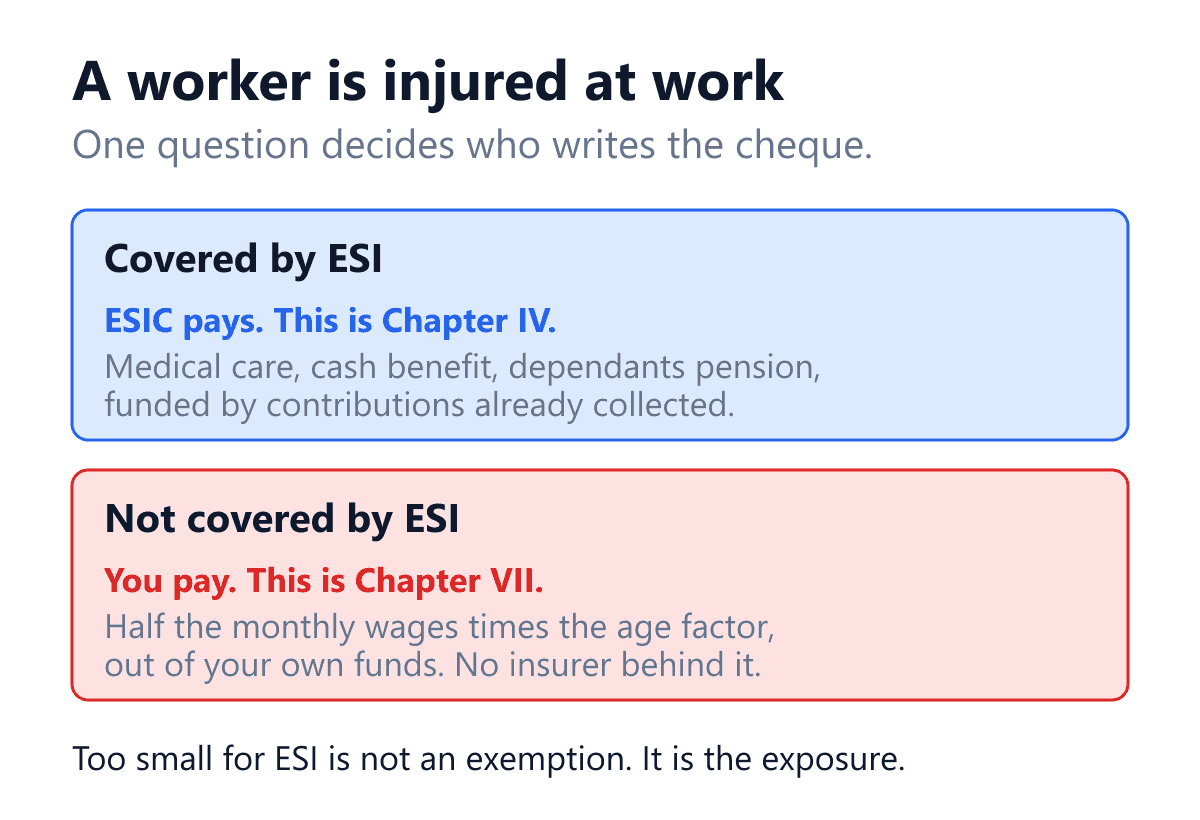
So the population most exposed to Chapter VII is exactly the population that assumes it has nothing to worry about:
- Establishments below the ESI headcount. Under ten employees in most States, and the small workshop, the single restaurant, the two-van logistics outfit all sit here.
- Establishments in areas where the ESI scheme is not implemented. Coverage is district by district, not nationwide, and a plant on a highway outside a notified area is uncovered even at fifty workers.
- Workers above the ESI wage ceiling. Your site supervisor on a salary above the ceiling is not an insured person. Our guide to the ESI contribution period and wage ceiling covers where that line currently sits and why it is a coverage test rather than a cap.
- Establishments that should be registered for ESI and are not. Non-registration does not create a Chapter IV establishment. It leaves you in Chapter VII with an ESI default sitting alongside it.
Read this the right way round. Paying ESI is not only a cost. It is the mechanism that moves a workplace-injury claim off your balance sheet and onto an insurer. An employer who has avoided ESI has not avoided the liability; they have avoided the funding for it.
One boundary does narrow Chapter VII, and it is worth checking rather than assuming. Section 2(26) carries three provisos, and the third says that for the purposes of Chapter VII the word employee means only the persons specified in the Second Schedule, plus anyone the Central or State Government adds to it by notification. The Second Schedule is a list of employments, and it is a wide one, running through factories, mines, plantations, construction, mechanically propelled vehicles, loading and unloading, and a great deal else. It is not, however, universal. Find your own work in it before you conclude either way, and remember that section 74(5) lets either government add to it on three months notice.
What arising out of and in the course of employment now covers
Section 74(1) states the liability in one sentence. If personal injury is caused to an employee by accident, or by an occupational disease listed in the Third Schedule, arising out of and in the course of employment, the employer is liable to pay compensation.
There is no negligence test anywhere in that sentence. This is no-fault liability. The question is never whether you were careless; it is only whether the injury arose out of and in the course of the employment. Three sub-sections then widen that phrase considerably further than most employers expect.
The commute is in
Section 74(4): an accident occurring to an employee while commuting from residence to the place of employment for duty, or from the place of employment to the residence after performing duty, is deemed to have arisen out of and in the course of employment if nexus between the circumstances, time and place in which the accident occurred and his employment is established.
The Ministry of Labour and Employment states the same rule in its own compliance handbook for employers, without the qualifying clause, as a flat proposition. The qualifying clause is where the argument actually happens, and we come back to it below, because circumstances, time and place is a description of an attendance record.
Breaking the rules does not break the claim
Section 74(2) is the sub-section that surprises people most. An accident is deemed to arise out of and in the course of employment notwithstandingthat the employee was at the time acting in contravention of any law applicable to him, or of any orders given by or on behalf of his employer, or acting without instructions from his employer at all. Two conditions attach: the accident would have been covered had the act not been in contravention, and the act was done for the purpose of, and in connection with, the employer's trade or business.
He was not authorised to operate that machine. He climbed the scaffold without being told to. He was doing a job that was not his. None of those is a defence. If he was doing it for your business, section 74(2) puts the accident inside the employment.
The three defences, and where they stop
Section 74(1) has a proviso with two limbs. The first is a threshold: no liability for an injury that does not disable the employee, totally or partially, for more than three days. A cut finger that keeps somebody off for two days is not a compensation event.
The second limb is the one that gets quoted as though it were a general defence. There is no liability for an injury directly attributable to the employee being under the influence of drink or drugs, or to wilful disobedience of an order expressly given or a rule expressly framed for safety, or to wilful removal or disregard of a safety guard he knew had been provided.
Now read the words that open that limb: in respect of such injury, not resulting in death or permanent total disablement. The three defences are expressly unavailable where the worker dies or is permanently and totally disabled. They apply to the cases worth thousands and vanish in the cases worth lakhs.
That single qualifier changes what safety documentation is for. A signed safety rule and a toolbox-talk register are worth having, and they will defeat a claim for a partial disablement. They will not defeat a death claim. Nothing will, short of showing that the accident did not arise out of the employment at all.
The arithmetic, worked to the rupee
Compensation under section 76 is not a discretionary figure and it is not negotiated. It is a formula with three inputs.
Input one, the monthly wages. Section 78 fixes the method. Where the employee has been in continuous service for twelve months or more, monthly wages are one-twelfth of the total wages that fell due for payment in the last twelve months. Where continuous service was less than a month, it is the average monthly amount earned by employees doing similar work for the same employer over the preceding twelve months. Otherwise it is thirty times the total wages earned in the last continuous period of service, divided by the days in that period. Service counts as continuous unless broken by an absence of more than fourteen days.
Input two, the percentage. Fifty per cent where death results. Sixty per cent where permanent total disablement results.
Input three, the relevant factor. A number read from column 3 of the Sixth Scheduleagainst the employee's completed age on the last birthday before the compensation fell due. It runs from 228.54 for an employee of sixteen or under down to 99.37 at sixty-five and over.
| Completed age | Relevant factor | Completed age | Relevant factor |
|---|---|---|---|
| 16 or under | 228.54 | 45 | 169.44 |
| 20 | 224.00 | 50 | 153.09 |
| 25 | 216.91 | 55 | 135.56 |
| 30 | 207.98 | 60 | 117.41 |
| 35 | 197.06 | 63 | 106.52 |
| 40 | 184.17 | 65 or over | 99.37 |
Notice the shape of that table before you use it. The factor falls as age rises, so a young worker is the expensive one. A twenty-five year old on the same wage costs roughly twice what a sixty-year old does. In an industry that hires young men to do the physically hardest work, the cheapest labour on the payroll carries the most expensive liability on it.
Back to the Rajkot workshop. Fitter aged thirty, monthly wages Rs 22,000, death.
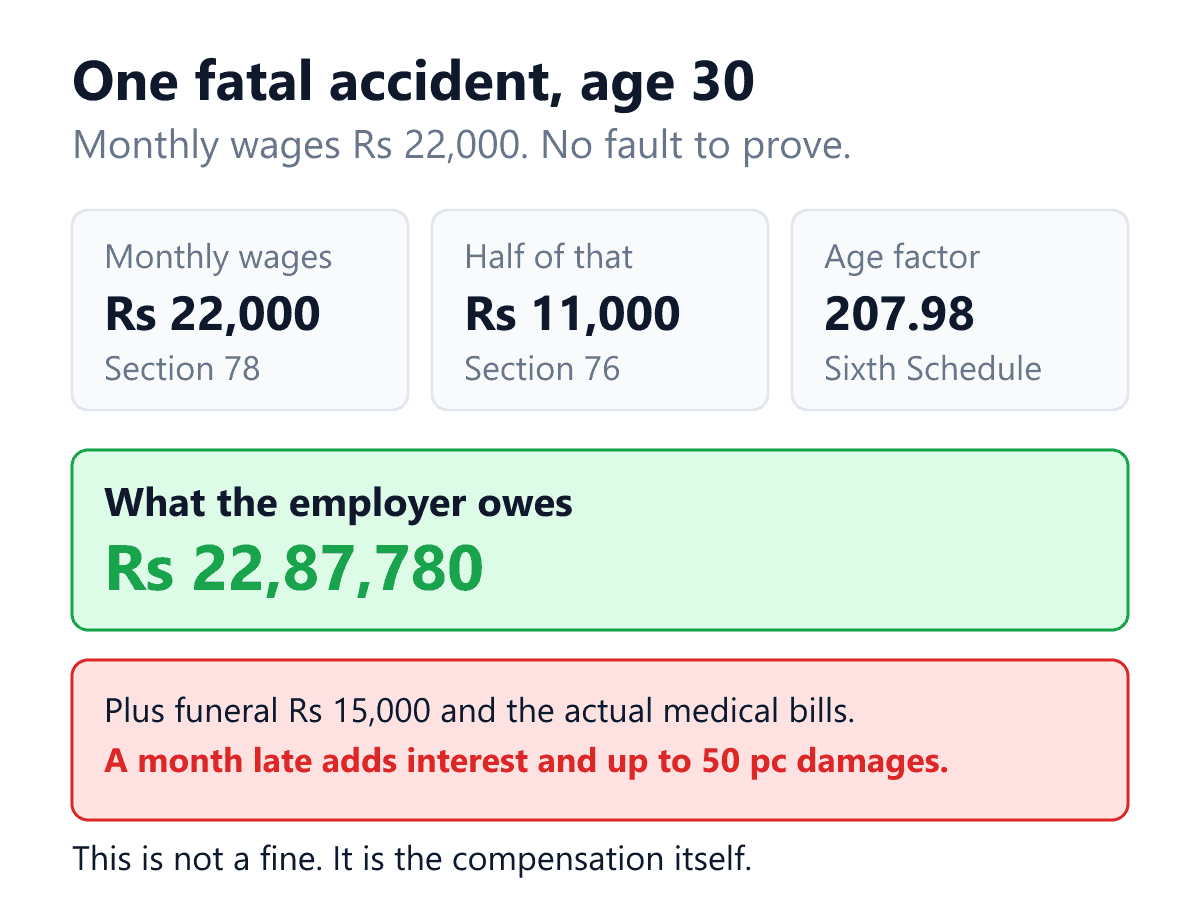
Fifty per cent of Rs 22,000 is Rs 11,000. The factor at thirty is 207.98. Eleven thousand multiplied by 207.98 is Rs 22,87,780.
Permanent total disablement is worse, because sixty per cent replaces fifty and the worker is usually younger than the average of your payroll. A machine operator aged twenty-five on Rs 18,000 who loses the use of both hands: sixty per cent is Rs 10,800, the factor at twenty-five is 216.91, and the compensation is Rs 23,42,628.
Permanent partial disablement is computed as a percentage of the permanent-total figure. Where the injury is listed in Part II of the Fourth Schedule, the Schedule states the percentage of loss of earning capacity. Where it is not listed, a medical practitioner assesses the loss of earning capacity and the same proportion is applied. Multiple injuries from one accident aggregate, but never above the permanent-total amount.
One number is genuinely unsettled and it moves the answer by about seven lakh rupees. Section 76(3) lets the Central Government notify, for the purposes of section 76(1), such monthly wages as it considers necessary. Under the repealed Employees Compensation Act 1923 the equivalent power was section 4(1B), and Rs 15,000 was notified under it by S.O. 71(E) dated 3 January 2020. If that ceiling is treated as carried into section 76(3), the Rajkot calculation runs on Rs 15,000 rather than Rs 22,000 and produces Rs 15,59,850 instead of Rs 22,87,780. Whether it carries over is a question for your adviser and for the notifications current in your State. Budget on the uncapped figure and be pleased if the capped one applies.
Four more bills that nobody adds up
The lump sum is the headline and it is not the whole invoice. Four further liabilities sit in the same chapter.
| What | Where | How much |
|---|---|---|
| Medical expenses | Section 76(5) | The actual expenditure incurred on treating injuries caused in the course of employment, reimbursed. No cap, no schedule of rates, no reference to the lump sum. |
| Funeral expenses | Section 76(7) | Not less than Rs 15,000, deposited with the competent authority for the eldest surviving dependant, or for whoever actually paid. In addition to the compensation, not out of it. |
| Temporary disablement | Sections 76(1)(d) and 76(4) | A half-monthly payment of twenty-five per cent of monthly wages, starting on the sixteenth day where the disablement lasts twenty-eight days or more, or after a three-day waiting period where it is shorter. Continues through the disablement or for five years, whichever is shorter. |
| Interest and damages | Section 77(3) | Default beyond one month from the date it fell due: interest on the arrears at the prescribed rate, and if the competent authority sees no justification for the delay, a further sum of up to fifty per cent of the arrears as damages. |
Section 77(3) deserves a second look, because two features of it are unusual and both work against a slow payer.
The first is section 77(4): the interest and the damages are paid to the employee or his dependant. This is not a fine that goes to the government. Delay does not attract a penalty alongside the claim; it enlarges the claim.
The second is section 77(1) and (2) read together. Compensation is to be paid as soon as it falls due, and where the employer does not accept liability to the extent claimed, he is bound to make a provisional payment on the part he does accept, without prejudice to any further claim. Disputing the quantum is not a reason to pay nothing. An employer who holds the whole amount back while arguing about half of it is in default on the half he never disputed, and the clock on that half started running on the date it fell due.
A worked consequence for the Rajkot case: on arrears of Rs 22,87,780, damages at the fifty per cent ceiling are a further Rs 11,43,890, before interest.
The seven-day report, and the paperwork that decides the claim
Two reporting duties bite immediately after a serious accident, and they sit in different Codes.
Section 73 of the Code on Social Security. Where any law requires notice of an accident on your premises resulting in death or serious bodily injury to be given to an authority, a report on the circumstances must go to the competent authority within seven days of the death or the serious bodily injury. Serious bodily injury is defined in the section and the definition is broader than it sounds: permanent loss of the use of or permanent injury to any limb, permanent loss of or injury to sight or hearing, the fracture of any limb, or enforced absence from work for more than twenty days. A broken wrist qualifies. Section 73(3) disapplies the whole section to establishments covered by Chapter IV, which is the ESI position again, from the other direction.
Section 10 of the OSH Code. Separately, the employer must notify the prescribed authorities of any accident in the establishment causing death, or an injury preventing work for forty-eight hours or more, or of a prescribed nature. Dangerous occurrences are notifiable under section 11 whether or not anybody was hurt, and Third Schedule diseases under section 12.
Then the claim itself. Section 82 sets a limitation period of two years from the accident, or from the date of death, and notice of the accident must have been given as soon as practicable. Do not read the two years as a shelter. Section 82(2) removes the notice requirement altogether where the death happened on your premises, and separately where the employer, or any person responsible to him for managing that branch of the business, had knowledge of the accident from any other source at or about the time it occurred. Your supervisor knowing is knowledge. And the proviso lets the competent authority entertain a late claim for sufficient cause anyway.
Section 82(4) also empowers the appropriate Government to require prescribed classes of employers to keep a notice-book on the premises, readily accessible at all reasonable times to any injured employee and to anyone acting on his behalf. Check whether your class is prescribed in your State.
If you use contract labour, section 85 puts the compensation on you as the principal employer where the work is ordinarily part of your trade or business, calculated on the wages the contractor pays. You are entitled to be indemnified by the contractor under section 85(2), and the competent authority settles indemnity disputes, but the worker can come to you first. The same structural point applies to statutory dues generally, which our guide to principal employer liability for a contractor PF default works through. Note the carve-out in section 85(4): the section does not apply where the accident happened somewhere other than on or about the premises you undertake to execute the work on, or which are otherwise under your control.
Why the answer is in your attendance record
Everything above turns on facts, and in almost every disputed claim the facts are ones only the employer's own records can settle. That is the practical reason this article sits on an attendance and payroll site rather than only on a law firm's.
Go back to the commuting clause. Section 74(4) makes the ride to work an employment injury if nexus between the circumstances, time and place in which the accident occurred and his employment is established. Three questions decide it, and each one is a record:
- Was he rostered that day? A roster published in advance shows a shift starting at 9 a.m. A roster reconstructed after the event from memory shows nothing at all.
- Was the time consistent with travelling to that shift? An accident at 8.40 a.m. before a 9 a.m. shift is one story. The same accident at 3 p.m. on a day he was not working is another.
- Was the place on the route? A junction four hundred metres from the gate is on the way. A junction thirty kilometres in the opposite direction is a personal errand.
Now the quantum. Section 78 computes monthly wages from the total wages which have fallen due for payment in the last twelve months. That is twelve months of wage records, including overtime and every allowance that counts as wages. An employer who pays partly in cash and keeps a summary register has no evidence of what fell due, and the dispute will be resolved on the claimant's figure and on whatever the wage slips say. The employer who under-records wages to reduce PF ends up arguing that his own records understate what he actually paid, which is not an argument anyone wins twice.
Then section 82. It is only ever the employer who benefits from being able to prove the date the accident happened, the date notice arrived, and what was said at the time.
What this needs is unglamorous and it is the same record three times over: who was rostered, when they actually started and stopped, where the check-in happened, and what fell due to them each month, kept continuously and not written up afterwards. A WhatsApp group cannot produce it, and a register that lives in a drawer produces it only for the days somebody remembered to fill in.
This is exactly what a labour-law-ready attendance and payroll record in Shiftelio is for. A shift is rostered before the day, the check-in carries a timestamp and a location, the twelve-month wage history is derived from the same data payroll runs on, and none of it can be back-dated to suit an argument. The same records answer the roster question, the time question, the place question and the section 78 question, because they are one record and not four. Businesses running site labour tend to meet this first, which is why our note on attendance for construction workers covers the site-boundary side of it in more detail.
None of this is a reason to buy software. It is a reason to hold a record that survives being questioned two years later, whatever you hold it in.
What to do this week
- Establish which side of the ESI line you are on, for the establishment and for each employee. Headcount, whether the district is implemented, and who sits above the wage ceiling. Anybody outside Chapter IV is a Chapter VII exposure. Our PF and ESI compliance checklist is the fastest way to work that out.
- Price your own worst case. Take your youngest worker in the most physical role, read the factor off the table above, and multiply. Do it once. It is a five-minute calculation and most owners have never done it.
- Check the Second Schedule for your employments, and the Third Schedule for occupational diseases relevant to your process.
- Decide how the seven days would actually work. Who writes the section 73 report, who signs it, and to which competent authority it goes. This is not a decision to make in the week somebody has died.
- Look at what an employer liability policy costs against the numbers above, if you are outside ESI. The liability is statutory and no-fault; only the funding of it is optional.
- Fix the record before you need it. Rosters published in advance, check-ins with a time and a place, and a wage history that matches what was actually paid.
Questions employers actually ask
We have fewer than ten employees. Does this apply to us?
Yes, and more so than to a larger employer. Chapter VII has no headcount threshold. It applies where Chapter IV does not, so a headcount below the ESI threshold puts you inside Chapter VII rather than outside everything. The compensation is identical for a nine-person workshop and a nine-hundred-person one; only the funding differs.
We pay ESI for everybody. Are we covered?
For everybody who is genuinely an insured person, the employment injury is dealt with under Chapter IV and the Chapter VII lump sum is not the route. Two gaps are worth checking. Employees above the wage ceiling are not insured persons. And an establishment in a district where the scheme is not implemented is not a Chapter IV establishment however willing you are to contribute.
He was riding rashly and had no helmet. Does that reduce what we owe?
Not in a death or permanent total disablement case. The intoxication and wilful-disobedience defences in section 74(1) are expressly limited to injuries not resulting in death or permanent total disablement. And section 74(2) keeps an accident inside the employment even where the employee was acting in contravention of a law, provided the act was for the purpose of the employer's trade. Contributory negligence is not a discount here; the liability is no-fault in both directions.
Can we just settle privately with the family?
Be careful with this. Where the employee has died, or where dependants are minors, the compensation is to be deposited with the competent authority rather than paid across directly, and the authority distributes it. Section 74(7) also has a switching rule worth knowing: an employee who has filed a civil suit for damages over the accident loses the right to compensation, and equally, no civil suit lies once a claim has been made to the competent authority or an agreement for compensation under the Chapter has been reached. A private settlement outside the Chapter buys less finality than it appears to.
The accident happened three days after he resigned. Are we liable?
Not for the accident, because it did not arise in the course of your employment. Occupational disease is different. Section 82 provides that where a worker employed for the continuous period specified in section 74(3) ceases to be so employed and develops symptoms of a disease peculiar to that employment within two years of leaving, the accident is deemed to have occurred on the day the symptoms were first detected. The claim can arrive long after the last working day.
How long does a family have to bring a claim?
Two years from the accident, or from the date of death. But section 82 lets the competent authority entertain a claim outside that window where the failure was for sufficient cause, so treat the two years as a strong expectation and not a wall.
Is any of this different for contract workers on our premises?
Section 85 makes you liable as principal employer for compensation to a contractor's employee executing work that is ordinarily part of your trade or business, calculated on the wages the contractor pays. You may recover it from the contractor by way of indemnity, and the worker may go to the contractor instead if he prefers. Section 85(4) limits the section to accidents on or about premises you undertake to execute the work on or which are under your control.
The short version
- Chapter VII of the Code on Social Security applies where the ESI chapter does not. Being below the ESI threshold moves the liability onto you personally; it does not remove it.
- Liability is no-fault. The only question is whether the injury arose out of and in the course of employment, and sections 74(2) and 74(4) read that phrase widely.
- The commute is inside the employment where nexus of circumstances, time and place is established. Roster, timestamp and location are what establish it.
- Acting against orders, against a law, or without instructions does not defeat a claim if the act was for your trade or business.
- The intoxication and wilful-disobedience defences do not apply where death or permanent total disablement results. They are unavailable in exactly the expensive cases.
- Death: fifty per cent of monthly wages times the Sixth Schedule factor. Permanent total disablement: sixty per cent. A thirty-year-old on Rs 22,000 is Rs 22,87,780.
- Younger workers cost more, because the factor falls with age. 228.54 at sixteen, 99.37 at sixty-five.
- Add actual medical expenditure with no cap, funeral expenses of not less than Rs 15,000, and half-monthly payments at twenty-five per cent of wages for a temporary disablement.
- Pay within one month or the arrears attract interest plus up to fifty per cent damages, and both are paid to the employee, not to the government. Disputing quantum obliges a provisional payment on the part you accept.
- Report a death or serious bodily injury to the competent authority within seven days under section 73, and to the prescribed authority under section 10 of the OSH Code. A fracture counts.
- Claims run for two years, extendable for sufficient cause, and defective notice is no bar where the employer already knew.
Position as at 7 September 2026. Sections 2(26), 73, 74, 76, 77, 78, 82 and 85 and the Sixth Schedule are quoted from the Code on Social Security, 2020 as enacted. The Rs 15,000 monthly wage figure discussed above was notified under section 4(1B) of the now-repealed Employees Compensation Act, 1923 and this article deliberately does not assert whether it carries into section 76(3); both computations are shown. ESI implementation is district by district and the Second and Third Schedules can be added to by notification, so verify both against the position in your own State. This is general information about central legislation and not advice on any particular accident or claim.
Sources
- The Code on Social Security, 2020, India Code, Ministry of Law and Justice - sections 2(26), 73, 74, 76, 77, 78, 79, 80, 82 and 85 and the Second, Third, Fourth and Sixth Schedules, from which the scope of Chapter VII, the no-fault liability, the commuting rule, the compensation formula, the relevant factors, the medical and funeral heads, the interest and damages provision, the seven-day report and the two-year limitation in this article are taken.
- Compliance Handbook for Employers Under the Four Labour Codes, Ministry of Labour and Employment, Government of India- paragraph 6.5 on employees compensation, which states the commuting rule in the government's own words, and paragraph 5.7 on notice of accidents and dangerous occurrences under sections 10 to 12 of the OSH Code.
- Ministry of Labour and Employment, Government of India - the four labour codes, their commencement on 21 November 2025, and the central Acts they repeal, including the Employees Compensation Act, 1923.
- Employees State Insurance Corporation, benefits under the ESI scheme - what an insured person receives for an employment injury under Chapter IV, which is the alternative to everything described in this article.
Keep reading
See how Shiftelio does this in practice with an attendance and wage record that survives a claim.
Work your own numbers with the free PF and ESI calculator. No signup, no email.