Fixed Pay Per Shift: How to Pay Banquet, Catering and Security Staff for Short Nights and Long Ones
In short
Pay a fixed amount for every shift attended, decide once whether hours past the shift are paid, and let attendance work out the month. Here is how.
- Per-shift pay means one fixed amount for each shift attended. A short night pays the same amount as a full one.
- Hours past the shift length are a separate decision: paid at an extra-hours rate, or recorded and not paid.
- Set both once, on the shift, and let the check-ins count the shifts. Nobody should count them from a register.
To pay staff a fixed amount per shift, set one amount for the shift, pay it for every shift the person attended however long or short the night was, and decide separately whether hours worked past the shift length are paid. That is the whole method, and it is how most banquet halls, caterers, event companies and security agencies in India already think about pay: a steward gets ₹900 for a wedding shift, a guard gets a flat amount for a duty.
Where it goes wrong is the month. The flat amount is easy on the night and hard on the 30th, when somebody has to count the shifts, remember which weddings ran two hours late, and decide whether those two hours were paid. This article works through one banquet steward's month, the two choices that decide what a shift pays, and how Shiftelio's shift rosters pay a shift the way you set it.
Who gets paid per shift, and why owners like it
Per-shift pay is common wherever the work comes in shifts of uneven demand rather than a steady month:
- Banquet halls and caterers. Stewards, service boys and helpers are paid per function. A wedding season month can be 18 shifts; a quiet month can be six.
- Event staff. Ushers, registration desks and floor staff are booked for an event and paid for each shift they work at it.
- Security agencies. Relief guards and guards on short postings are often paid per duty rather than a monthly salary.
- Restaurants. Extra hands for weekend dinners and party orders are paid for the shift, not the month.
Owners like it because the cost follows the bookings. Staff like it because the amount is clear before they walk in. Both sides lose the clarity the moment the night does not go to plan: the function ends early, or the baraat arrives two hours late and nobody can leave.
The two decisions that make a shift's pay
A flat shift amount answers one question, "what is a normal shift worth". Two other questions decide what the person is actually paid, and each one needs an answer before the month starts, not after.
1. Does a short shift still pay the full amount?
If the function ends at 10 pm instead of midnight, is the steward paid the full ₹900, or less? There are two honest answers:
- Fixed amount. The full amount for every shift attended, even a short one. This is what most banquet and event staff expect: they kept the evening free for you.
- Split by hours worked. The amount is divided by the shift length to give an hourly rate, and a shorter day pays less. This suits staff who are effectively hourly workers with a shift-sized booking.
2. Are the hours past the shift paid?
If the shift is 6 pm to midnight and the wedding runs to 2 am, the two extra hours are either:
- Paid, at an extra-hours rate worked out from the shift: the shift amount divided by the shift length, multiplied by your extra-hours rate (for example 2x).
- Recorded but not paid, because the flat amount was agreed to cover whatever the night needed.
Neither answer is wrong. What goes wrong is not deciding, so that every late night becomes an argument on payday.
| Fixed amount, extra hours not paid | Fixed amount, extra hours paid | Split by hours worked | |
|---|---|---|---|
| Short night (4 hours) | Full amount | Full amount | Less than the full amount |
| Normal night (6 hours) | Full amount | Full amount | Full amount |
| Long night (8 hours) | Full amount | Full amount plus extra hours | Full amount, extra hours as you set |
| Right for | Flat duty pay agreed to cover the night | Banquet and event staff on long functions | Staff you really pay by the hour |
One steward's October, worked shift by shift
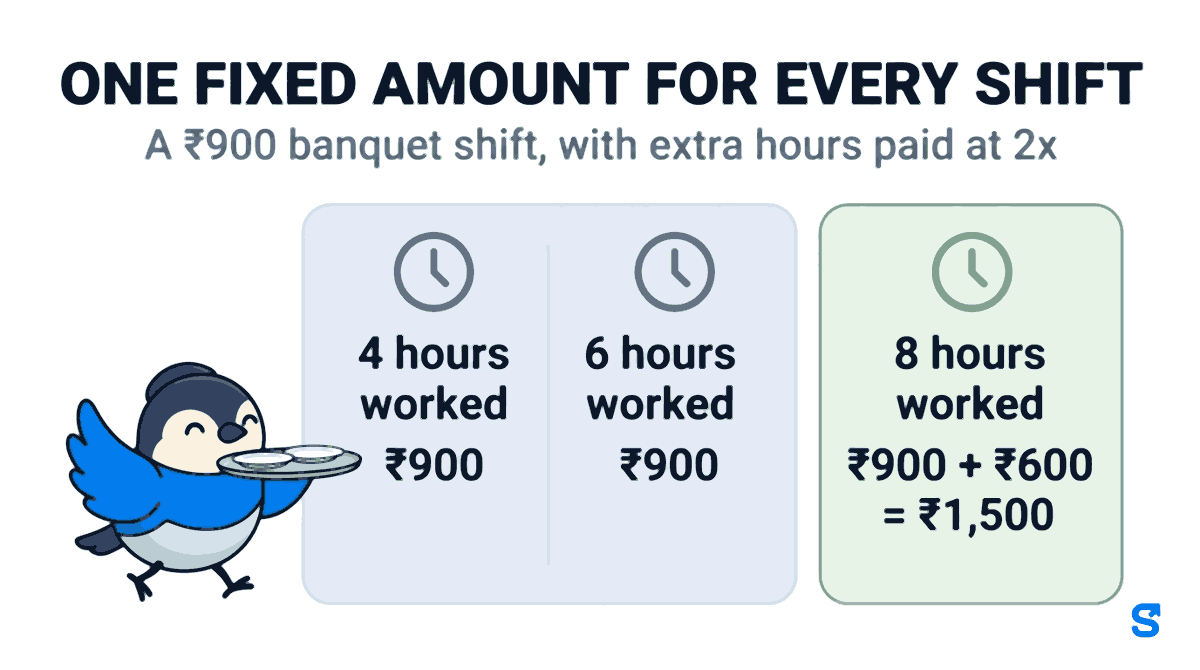
Ravi is a steward at a banquet hall in Lucknow. His shift is 6 pm to midnight, six hours, and he is paid ₹900 per shift as a fixed amount. The hall pays hours past the shift at 2x. His hourly figure is ₹900 ÷ 6 = ₹150, so an extra hour is worth ₹150 × 2 = ₹300. In one line: a ₹900 banquet shift, with extra hours paid at 2x.
Three nights from his month show how the two decisions play out:
- A short night. The birthday party ends at 10 pm. 4 hours worked: ₹900. A fixed amount does not shrink.
- A normal night. 6 hours worked: ₹900.
- A long wedding. The baraat is late and Ravi stays until 2 am. 8 hours worked: ₹900 + ₹600 = ₹1,500. The two extra hours at ₹300 each are paid on top.
Over October he works 18 shifts, and 5 of them are long weddings with 2 extra hours each:
- 18 shifts attended
- ₹16,200 for the shifts, 18 × ₹900
- ₹3,000 for extra hours, 5 × ₹600
- ₹19,200 pay for the month
If the hall had switched extra hours off for this shift, the month would be ₹16,200 and the ten late hours would still be on record, just not paid. If it had chosen split by hours worked, the short 4-hour night would have paid 4 × ₹150 = ₹600 instead of ₹900.
None of that is hard arithmetic. What is hard is getting the 18 and the 5 right from a notebook in the busiest month of the year, when the person who stayed late is not the person who writes the register.
How Shiftelio pays a fixed amount per shift
In Shiftelio the pay sits on the shift itself. On the Shifts screen, or under Manage Shift Patterns on the employee's page, the shift form has one pay block, the same on both screens:
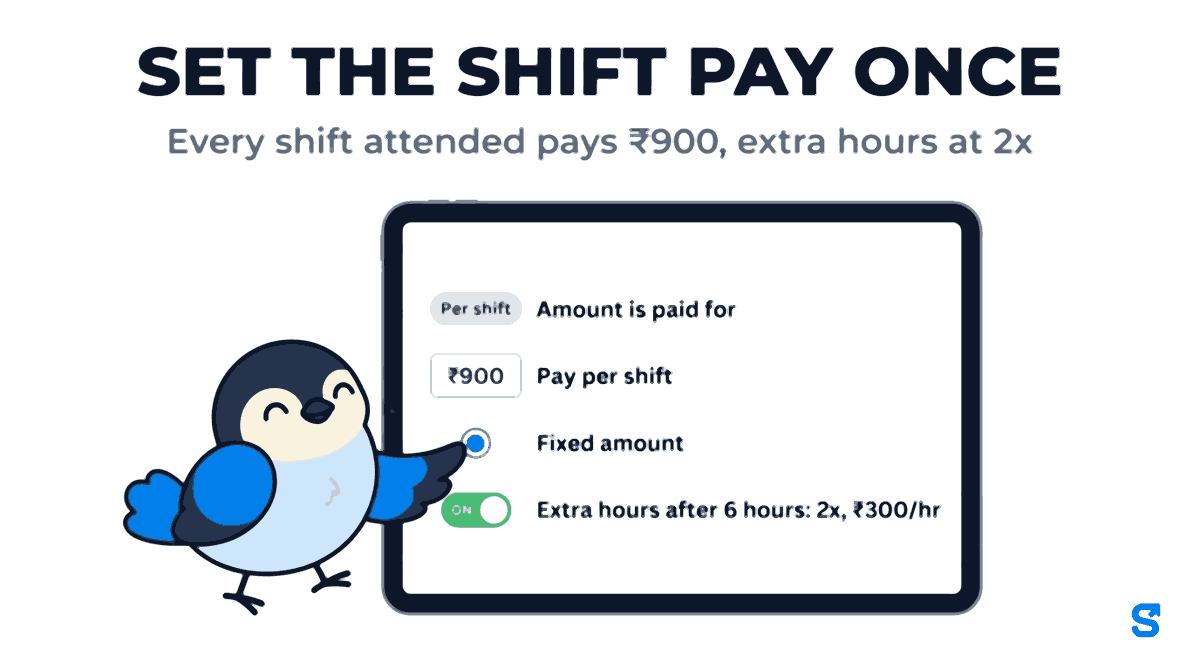
Under Amount is paid for, pick Per shift. The other choices are Per hour and Monthly. Changing this clears the amount you had typed, on purpose: ₹18,000 a month left in the box as "₹18,000 for every shift" would pay roughly 26 times too much.
Enter ₹900 as the pay per shift. Under How is a day paid?, choose Fixed amount (the full amount for every shift attended, even a short one) or Split by hours worked (a shorter day pays less). The form shows a worked example with your own numbers before you save.
The Extra hours switch sits under the pay. On, it shows what an hour past the shift is worth, worked out from the shift amount and your business's extra-hours rate: for Ravi, paid at 2x, ₹300 an hour. For Ravi that comes to extra hours after 6 hours: 2x, ₹300/hr. Set the shift pay once: every shift attended pays ₹900, extra hours at 2x. Off, it says hours past the shift are recorded but not paid. Each shift has its own switch, so a guard's duty and a steward's function can follow different rules.
From there the staff member's check-ins decide the month. Each shift attended earns the shift amount, and the payroll card shows the shift amount alongside the shifts attended, so the owner can see where ₹19,200 came from without opening a register. A short shift is still a full shift under Fixed amount. Extra hours appear only when the switch is on.
Two related set-ups are covered in their own guides. If one person works two shifts a day at different rates, see double duty and split shifts. If you pay a monthly salary and want to know what one day is worth, see how to calculate per day salary.
The rules a flat shift amount still has to meet
A fixed amount per shift is a pay arrangement, not an exemption from wage law.
The minimum wage applies to the hours worked. Minimum wages in India are notified by the Centre and by each state, by type of work and skill, and many states revise them every April and October. A shift amount that looks generous on a 6-hour night can fall below the minimum once a function runs long and the extra hours are not paid. Check your state's current rates on its labour department site (Delhi publishes its current minimum wage rates as an example) and our note on the October 2026 minimum wage revision.
Hours past the legal working day are overtime. The Occupational Safety, Health and Working Conditions Code, 2020 sets the normal working day at eight hours in Section 25 for the establishments it covers, and the Code on Wages, 2019 says in Section 14 that overtime is paid at no less than twice the normal rate of wages. Ravi's long wedding is 8 hours, so his paid extra hours sit inside the legal day and the 2x is the hall's choice. A guard on a flat 8-hour duty who stays two hours for a late relief is past the legal day, and those two hours are overtime whatever the duty is called. For that shift, extra hours should be switched on.
Shiftelio pays what you set. It does not check whether a shift amount clears your state's minimum wage or whether a pattern breaks your state's Shops and Establishments Act. That stays with you and your labour consultant.
When a notebook is enough
If you hire three people for a few functions a month and every function ends on time, a notebook with the date, the names and the amount does the job. A notebook stops being enough when the season is busy, when some nights run late and some end early, or when the supervisor who saw who stayed is not the person who pays. Then the count has to come from check-ins, and the rule for short and long nights has to be written down before the night, not argued about after it.
Which app pays staff a fixed amount per shift?
Frequently asked questions
How is salary calculated for staff paid per shift?
Multiply the shifts attended by the shift amount, then add any paid extra hours. Ravi worked 18 shifts at ₹900 and 5 long nights with 2 extra hours at ₹300 an hour: ₹16,200 plus ₹3,000, or ₹19,200.
Does a short shift pay the full per-shift amount?
It does if the shift is paid as a fixed amount. Under Fixed amount a 4-hour night pays the same ₹900 as a 6-hour one; under Split by hours worked it would pay 4 × ₹150 = ₹600.
How are extra hours paid on a per-shift salary?
Divide the shift amount by the shift length to get an hourly figure, then multiply by your extra-hours rate. For ₹900 over 6 hours at 2x, each extra hour is ₹300.
Can extra hours be left unpaid on a fixed shift amount?
Yes, if that was agreed, and if the hours stay inside the legal working day and the pay still clears the minimum wage. Hours past the legal working day are overtime and are paid at no less than twice the normal rate.
Can different shifts follow different rules?
Yes. In Shiftelio each shift has its own pay and its own extra-hours switch, so a steward's function shift and a guard's duty can be paid differently in the same business.
This is general information, not legal advice: check with your state labour department or an employment lawyer for your case.
Keep reading
Free to use, no signup: Payroll calculators.