How to Calculate Per Day Salary in India: 26, 30 or the Days in the Month?
In short
How to calculate per day salary from a monthly salary: why a fixed 26 or 30 is wrong most months, worked absence examples, and the Excel formula.
- Per day salary = monthly salary ÷ divisor; the divisor is the whole argument.
- A fixed 26 pays ₹18,692 in a 27-day month and ₹16,615 in a 24-day month for the same perfect attendance.
- Dividing by the month's own working days lands exactly on the section 20(2) ceiling for absence deductions.
To calculate per day salary, divide the monthly salary by the number of days that salary is meant to cover in that month, then multiply by the days the person is paid for. The formula is simple. The argument is always about the divisor: 26, 30, the working days in the month, or every calendar day. Pick the wrong one and a full month of perfect attendance stops adding up to the salary you agreed.
This guide works one example all the way through: Ravi, ₹18,000 a month, works Monday to Saturday, Sunday off. Every number below comes from that one salary.
The per day salary formula
Per day salary = Monthly salary ÷ Divisor
Salary for the month = Per day salary × Paid days
Paid days are the days worked, plus paid leave and paid holidays, plus the weekly offs if your divisor counts them.
Everything else in this article is about choosing the divisor honestly. There are four in common use in India, and they give four different answers for the same person in the same month.
Four divisors, four answers for the same month
October 2026 has 31 days. It starts on a Thursday, so it has four Sundays and 27 working days for somebody on a Monday to Saturday week.
| Fixed 26 | Fixed 30 | Working days in the month | Calendar days in the month | |
|---|---|---|---|---|
| Divisor in October 2026 | 26 | 30 | 27 | 31 |
| Ravi's per day salary | ₹692.31 | ₹600.00 | ₹666.67 | ₹580.65 |
| Sundays paid separately? | No | No | No, the salary is spread over working days | Yes, each Sunday is paid at the daily rate |
| Full month, no absence | Depends how you apply it | Depends how you apply it | ₹18,000 | ₹18,000 |
The last row is the one that catches people out. Both the working days method and the calendar days method pay exactly ₹18,000 for a full month, every month, because the divisor moves with the month. A fixed number does not.
Why a fixed 26 breaks in most months
The number 26 is not a payroll rule. It comes from gratuity: the Payment of Gratuity Act, 1972 (section 4(2)) works out fifteen days' wages by dividing the monthly rate by 26, and the Code on Social Security, 2020 kept that method. It found its way into salary sheets because it is a round guess at the working days in a month with Sundays off.
But a Monday to Saturday month has 24, 25, 26 or 27 working days depending on where the Sundays fall. If you pay per day salary × days present with 26 as the divisor, a person with perfect attendance gets:
- October 2026, 27 working days: 27 × ₹692.31 = ₹18,692.31, which is ₹692 more than the agreed salary.
- November 2026, 25 working days: 25 × ₹692.31 = ₹17,307.69, which is ₹692 short.
- February 2027, 24 working days: 24 × ₹692.31 = ₹16,615.38, which is ₹1,385 short.
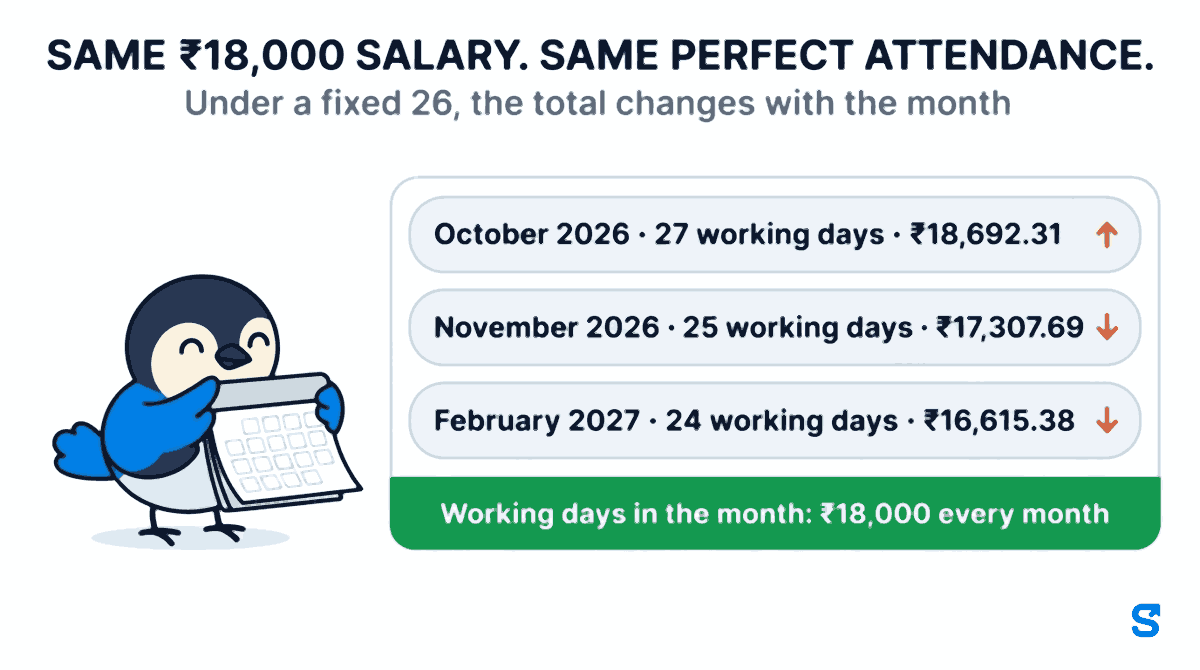
Nobody did anything different in February. The calendar did. A worker who notices that a full month paid less than the salary in the offer letter does not care that the spreadsheet has a reason.
A fixed 30 has the opposite habit: ₹600 a day looks cheap per day, and it only pays the full salary if you also pay every Sunday, which makes it the calendar days method with the wrong number of days in it (31-day months over-count, February under-counts).
How to calculate salary deduction for absent days
Say Ravi is absent for two days in October 2026 without leave. Here is what each divisor takes off:
| Divisor | Per day salary | Deduction for 2 days | Salary paid |
|---|---|---|---|
| Fixed 26 | ₹692.31 | ₹1,384.62 | ₹16,615.38 |
| Fixed 30 | ₹600.00 | ₹1,200.00 | ₹16,800.00 |
| Working days (27) | ₹666.67 | ₹1,333.33 | ₹16,666.67 |
| Calendar days (31) | ₹580.65 | ₹1,161.29 | ₹16,838.71 |
The law sets a ceiling on this. Section 20(2) of the Code on Wages, 2019 says a deduction for absence can never take a larger share of the wages than the share of the required working period the person was absent for. Ravi was required to work 27 days and missed 2, so the most that can come off is 2 ÷ 27 of ₹18,000, which is ₹1,333.33.
The working days method lands on that ceiling exactly. The calendar days method stays under it. A fixed 26 goes over it by ₹51.29 in October, and that excess is a deduction the Code does not authorise. It is a small number on one payslip and a pattern across every 27-day month for every person on the sheet. Our article on salary deduction rules in India covers the rest of section 18 to 20, including why a half-day penalty for a late arrival fails the same test.
Half days follow the same arithmetic. Half of Ravi's working days rate is ₹333.33. If your policy deducts a half day, that is the figure, and it should only be used when half a day was actually missed.
Working days or calendar days: which should you choose?
Both are defensible. They differ in what a single day is worth, and that matters beyond absence.
Working days. Salary ÷ the days the person is scheduled to work that month. Sundays are not paid separately; the whole salary is spread across the working days. Per day salary is higher, so an absence costs the employee more and an extra day worked is worth more. This is the closest match to the section 20(2) ratio and the easiest to explain to staff: "you are paid for the days you are meant to work".
Calendar days. Salary ÷ every day of the month, and each weekly off is also paid at that daily rate so the month still totals the salary. Per day salary is lower, so an absence costs less. Many businesses already think this way ("₹18,000 is ₹600 a day"), and it suits staff whose weekly off moves around.
The per day rate is also where an hourly rate, and so an overtime rate, starts. Section 14 of the Code on Wages sets overtime at twice the normal rate of wages, so a lower daily rate gives a lower overtime rate as well. Our overtime calculation guide works through that part.
Whichever you choose, write it in the appointment letter and do not switch it in the middle of a pay period. A change applied to a half-finished month re-values days that were already worked under the old rule.
Per day salary for different weekly offs
The divisor is the person's working days, not the business's. In the same October 2026:
- Monday to Saturday, Sunday off: 27 working days, so ₹18,000 is ₹666.67 a day.
- Monday to Friday, two days off: 22 working days, so ₹18,000 is ₹818.18 a day.
Two people on the same salary in the same shop can have different per day rates, and both are correct. A single "÷ 26" column in a spreadsheet cannot show that.
Salary calculation formula in Excel
If you keep the salary sheet in Excel, let Excel count the working days for you rather than typing 26.
With the monthly salary in B2, the first day of the month in C2 and the paid days in D2:
- Working days in the month, Sunday off:
=NETWORKDAYS.INTL(C2, EOMONTH(C2,0), 11)(the 11 means "only Sunday is a weekend"). - Per day salary:
=B2 / NETWORKDAYS.INTL(C2, EOMONTH(C2,0), 11) - Salary for the month:
=ROUND(B2 / NETWORKDAYS.INTL(C2, EOMONTH(C2,0), 11) * D2, 2) - Calendar days instead: replace the divisor with
DAY(EOMONTH(C2,0)).
That fixes the divisor. It does not fix D2. Paid days still come from a register somebody filled in, and a disputed day is still one person's word against another's. That is the half of the job a formula cannot do. If you want the sheet built from check-ins rather than typed, see the attendance and salary sheet in Excel.
How Shiftelio calculates per day salary
In Shiftelio the choice is one setting: Settings, Salary Calculation. It has two options, worded on the screen as:
- Working days: salary ÷ scheduled working days. Weekly-off days (e.g. Sundays) are not paid separately; the full salary is spread across working days.
- Calendar days: salary ÷ every day of the month. Weekly-off days are also paid, so the daily and overtime rate are lower.
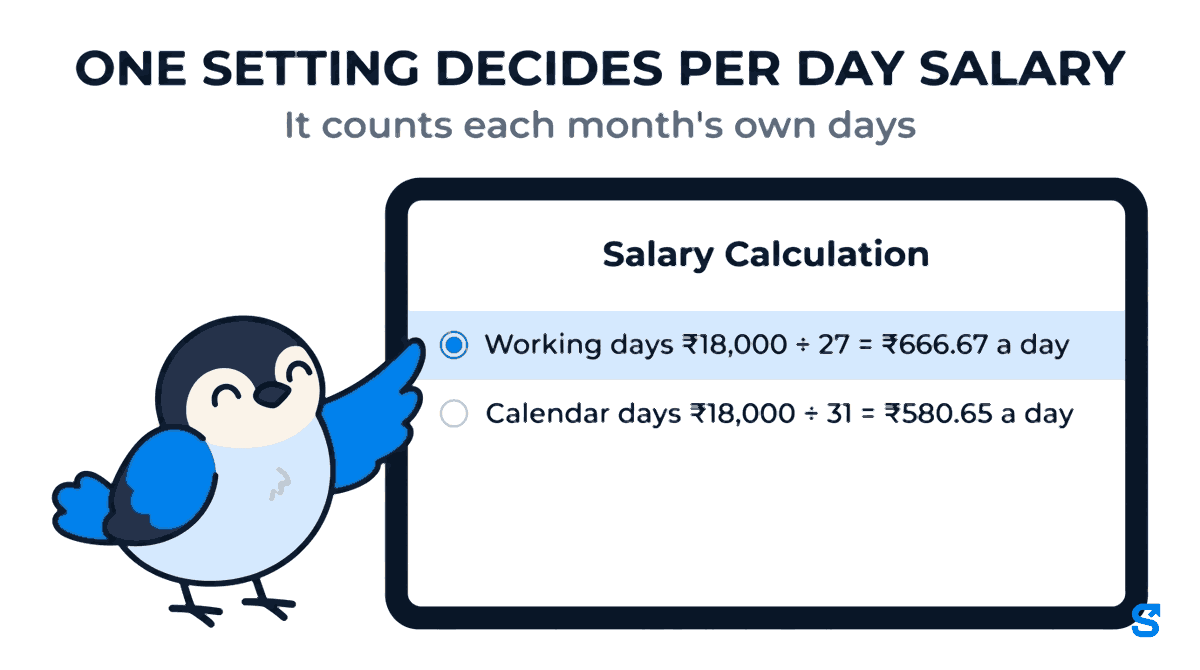
What that setting does that a fixed number cannot:
- It counts each person's own days. The divisor comes from that person's scheduled week in that month, so a Monday to Saturday person gets 27 in October 2026 and a Monday to Friday person gets 22.
- It never re-values a paid month. Switching to Calendar days asks for an Apply from date. Pay periods starting on or after that date use calendar days; already-paid payslips are never changed.
- It only touches salaried staff. Hourly and fixed per-shift pay are unchanged, whichever basis you pick.
- Paid days come from attendance. The days worked, absences, half days, paid and unpaid leave are counted from check-ins, so D2 is no longer somebody's typing.
- A single weekly off can be unpaid. On the calendar days basis you can switch off the pay for one weekly off, for example a Sunday between two days the person was not working.
If you are comparing payroll tools for a small team, our payroll software for small business guide sets the options side by side, and the features page shows what the rest of the platform does.
Which payroll app works out per day salary from attendance?
Frequently asked questions
How do I calculate per day salary from a monthly salary?
Divide the monthly salary by the days it is meant to cover in that month. On the working days basis that is the person's scheduled working days (27 in October 2026 for a Monday to Saturday week, so ₹18,000 ÷ 27 = ₹666.67). On the calendar days basis it is every day of the month (₹18,000 ÷ 31 = ₹580.65), with weekly offs paid.
Is per day salary calculated on 26 days or 30 days?
Neither is required by law for monthly salary. 26 comes from the gratuity calculation and 30 is a round month. Both are wrong in most months: a fixed 26 overpays a 27-day month and underpays a 24-day month when you pay per day salary × days present. Use the month's own working days or calendar days instead.
How much salary is deducted for one day's absence?
One day's per day salary on the basis you use, and never more than the share of the required working days the person missed (section 20(2), Code on Wages). For ₹18,000 on a 27-day month that is ₹666.67 on working days, or ₹580.65 on calendar days.
Are Sundays paid in a monthly salary?
On the working days basis, the salary already covers Sundays because it is spread across the working days, so Sundays are not paid separately. On the calendar days basis, each Sunday is paid at the daily rate. Either way, a full month of attendance adds up to the full monthly salary.
Does the per day salary change every month?
On both honest bases, yes, slightly, because months have different lengths. That is what keeps the monthly total fixed. A per day salary that never changes is a sign the divisor is fixed, and a fixed divisor is what makes the monthly total move instead.
Sources
- The Code on Wages, 2019 (Act 29 of 2019), Gazette of India, sections 14, 18 and 20.
- India Code, Government of India, the Payment of Gratuity Act, 1972, section 4(2), and the Code on Social Security, 2020.
- Ministry of Labour and Employment, Labour Codes.
Keep reading
Free to use, no signup: Payroll calculators.