Form 16 Is Now Form 130: The Four Payroll Numbers That Changed on 1 April 2026
In short
Form 16 is Form 130, Form 24Q is Form 138, Section 192 is Section 392. What the Income-tax Act, 2025 renamed, and why Form 143 is not your salary return.
On 1 April 2026 the Income-tax Act, 2025 replaced the Income-tax Act, 1961, and the Income-tax Rules, 2026 replaced the 1962 rules underneath it. For most of the country this was a renumbering exercise with no change in what anybody owes. For the person who runs payroll at a small Indian company it was something more irritating: four separate numbers changed, on two different clocks, and the internet got one of them wrong.
The wrong one is the quarterly salary return, which is the form with a live deadline sitting seven weeks away. So this is worth twenty minutes.
Nothing here changes your tax liability. Rates and thresholds came across broadly intact. What changed is every label on every box, and in a compliance system where you file by form number, a label is not cosmetic.
The four numbers that changed
Salary TDS used to live in section 192 of the 1961 Act. It now lives in section 392 of the 2025 Act. The old section 194 family, covering rent, commission, professional fees and the rest, is consolidated into section 393. Everything downstream of those two sections was renumbered to match.
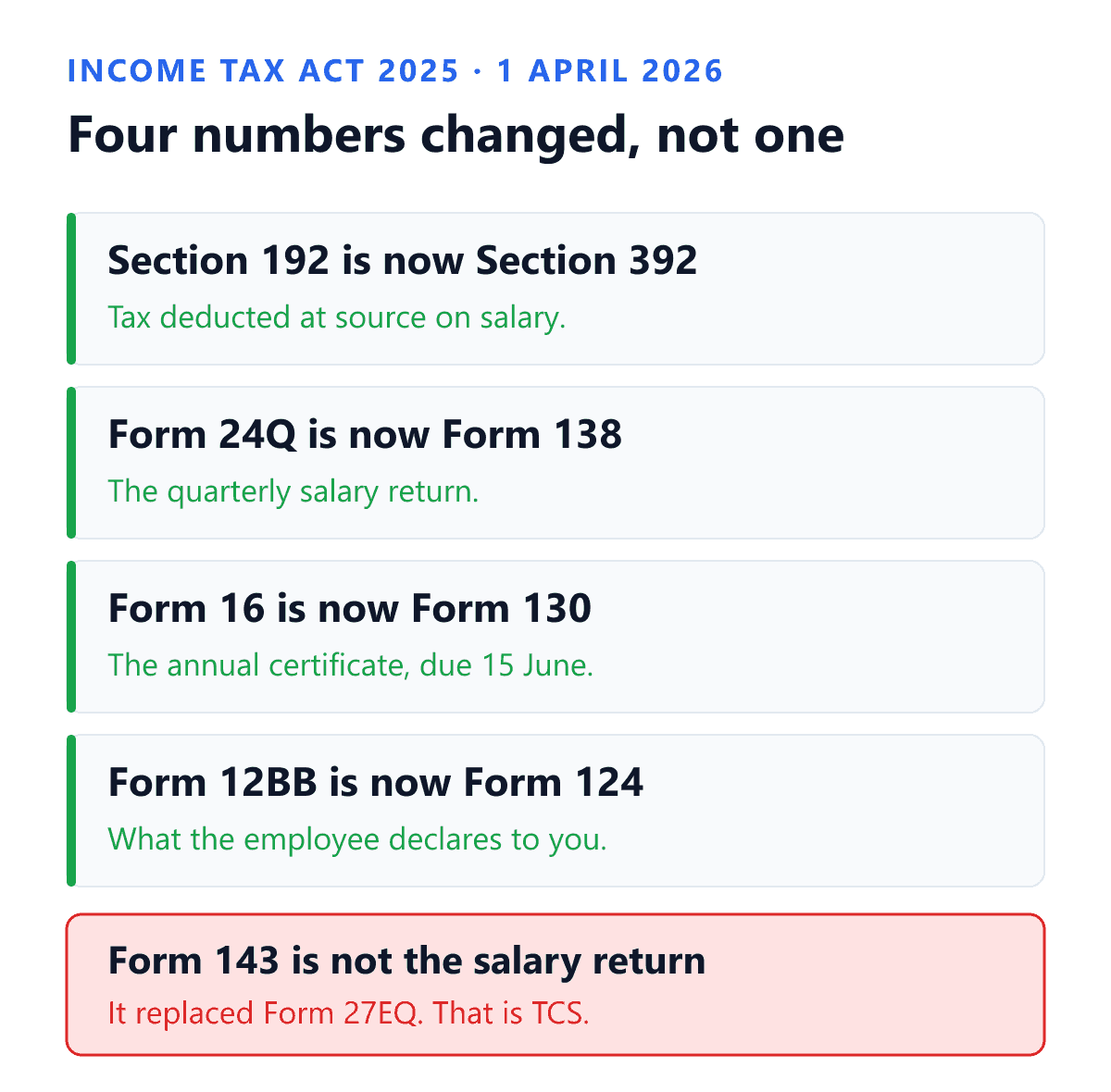
Set out as a mapping, with the governing provision for each:
| Until 31 March 2026 | From 1 April 2026 | What it is |
|---|---|---|
| Section 192 | Section 392 | The duty to deduct tax from salary |
| Form 24Q | Form 138 | Quarterly salary TDS statement, under section 397(3)(b) read with rule 219 |
| Form 16 | Form 130 | Annual salary TDS certificate, under section 395(4)(b) |
| Form 12BB | Form 124 | Employee declaration of rent, home loan interest and deductions, under section 392(5)(b) read with rule 205 |
| Form 26Q | Form 140 | Quarterly non-salary TDS, resident payees |
| Form 27Q | Form 144 | Quarterly non-salary TDS, non-resident payees |
| Form 27EQ | Form 143 | Quarterly statement of tax collected at source |
The Income Tax Department’s own user manual for Form 138opens by describing it as the form “earlier known as Form 24Q”, filed by employers and specified banks for tax deducted on salary, pension or interest income. If you read only one link in this article, read that one, because it settles the question the next section is about.
Form 143 is not your salary return
At least one widely syndicated employer compliance guide states, in a heading, that Form 24Q has become Form 143. It has not. Form 143 replaced Form 27EQ and is the quarterly statement for tax collected at source. Collection at source is a different mechanism from deduction at source, filed by a different class of person, for a different reason.
This matters more than a typo normally would, because the filing system is keyed on form type. A salary deduction reported inside a collection statement is not a late return or a defective return. It is a return that does not report the thing you deducted, in a slot where the department is not looking for it, while the statement you actually owed sits unfiled and accruing a daily fee.
The quick self-check. Salary and pension go on Form 138. If your consultant, your software or your bookmarked article says anything else for salary, check it against the department’s own page before the end of October. Two of the four new numbers in this area begin with 14, which is most of why this is being got wrong.
Which form applies is decided by the quarter, not by the date you file
This is the second thing that catches people, and it caught them in May 2026 rather than April.
The governing law attaches to the period the statement relates to, not to the date the statement is furnished. The fourth quarter of FY 2025-26 covers January to March 2026. Its due date is 31 May, which fell two months after the 2025 Act commenced. That quarter was still governed by the 1961 Act, so it was still furnished on Form 24Q, on a form belonging to a statute that had already been replaced.
A payroll team that switched form numbers on 1 April, because that is the date everybody wrote down, filed the new form for an old period.
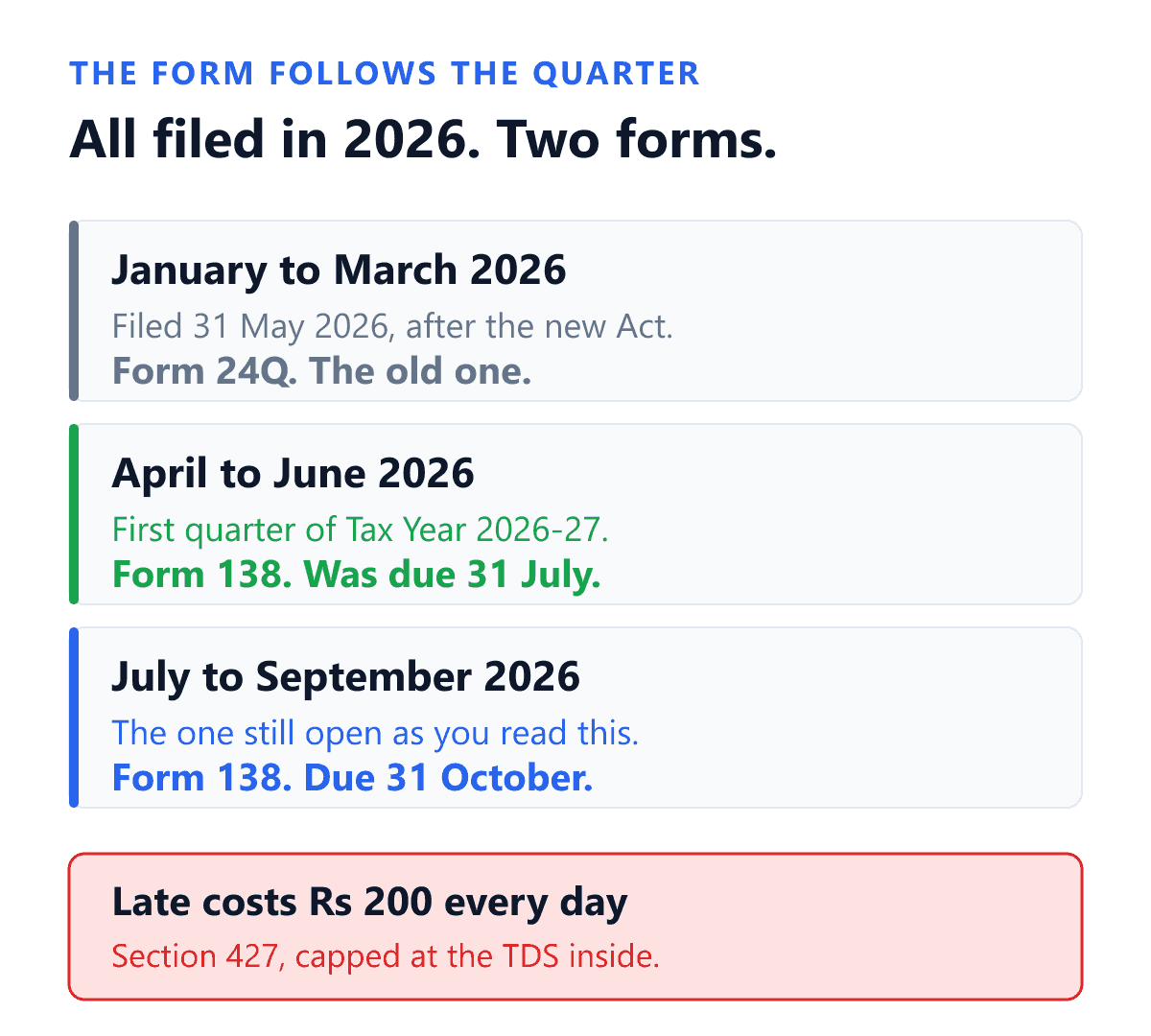
The quarterly due dates themselves did not move for TDS. They are 31 July, 31 October, 31 January and 31 May, in that order, for the four quarters of a tax year. One date did move: the TCS statement used to be due on 15 July for the first quarter and is now aligned with the rest at 31 July.
A vocabulary note that will save you an argument. The 2025 Act drops “previous year” and “assessment year” and uses a single tax year. The period from 1 April 2026 to 31 March 2027 is Tax Year 2026-27. When a form, a portal screen or an accountant says “TY 2026-27”, that is the year you are currently in, not a year ahead.
Form 130 does not exist yet, and that is the trap
Form 130 is the annual salary TDS certificate. It carries the same job Form 16 did: it certifies what you deducted from one employee across the year and what you deposited against it. Its structure is three parts, a details part, a deduction and deposit summary, and a detailed computation with annexures.
It is due by 15 June following the end of the tax year. For Tax Year 2026-27 that means 15 June 2027. Nobody has issued one yet, and nobody can.
Here is why that is a trap rather than a relief. The certificate is generated and downloaded from the TRACES portal, after the quarterly statements have been processed. It is not typed up in your payroll software and printed. Which means the certificate is a consequence of your four Form 138 filings and contains nothing you did not put in them.
The consequence, stated plainly. An error in the quarter you are in right now, filed on 31 October 2026, does not announce itself in October. It announces itself in June 2027, when an employee cannot download a certificate that matches their payslips, at exactly the moment they need it to file a return. By then the correction is a revised statement for a quarter three filings ago.
The old habit of treating the quarterly return as a formality and the certificate as the real document does not survive this. The quarterly return is the document. The certificate is a report printed off it.
Form 124, the one you collect rather than file
Form 12BB is now Form 124, under section 392(5)(b) read with rule 205. This is the declaration an employee gives you so that house rent allowance, leave travel allowance, home loan interest and Chapter VI-A deductions can be taken into account when you compute their monthly TDS. The Income Tax Department publishes it as Form No. 124 (Earlier Form No. 12BB), which is about as unambiguous as official naming gets.
Two things changed beyond the number. The terminology moved from assessment year to tax year, and the HRA section now asks for a declaration of the employee’s relationship with the landlord. If you are collecting rent receipts from an employee whose landlord is a parent or a spouse, that relationship is now a disclosed field rather than something nobody asked about.
Submitting it is optional for the employee. Acting on it is not optional for you. If an employee gives you no Form 124, you deduct without those reliefs and they claim them back when they file. If an employee gives you one, the figures in it feed your monthly computation and then your quarterly Form 138. Half the payroll disputes in an Indian small business in February are a Form 12BB, now 124, that somebody accepted in November and never keyed in.
If your declaration template still says Form 12BB and still says assessment year, it is a 2025 template. Replace it before the January investment-proof round, not during it.
What a late return actually costs
Three separate charges sit behind salary TDS, and small employers routinely conflate them.
Late deposit. Tax you deduct has to reach the government by the 7th of the following month, with March deductions allowed until 30 April for a non-government deductor. That timing did not change. Deposit late and interest runs at 1.5 per cent per month, and the meter starts on the date of deduction, not on the 7th. Two days late by the calendar is frequently two months of interest by the arithmetic, because a part of a month counts as a month at both ends.
Late statement. The quarterly return carries a fee of Rs 200 for every day of delay under section 427 of the 2025 Act, which is the successor to the section 234E that people still quote. It is capped at the total tax deducted in that statement.
That cap is worth understanding rather than skimming, because for a small employer it cuts both ways.
| TDS in the quarter | Fee at 30 days late | Fee at 90 days late |
|---|---|---|
| Rs 4,000 | Rs 4,000 (capped) | Rs 4,000 (capped) |
| Rs 40,000 | Rs 6,000 | Rs 18,000 |
| Rs 2,00,000 | Rs 6,000 | Rs 18,000 |
Read the first row carefully. A very small employer with four thousand rupees of deduction in the quarter hits the ceiling in twenty days and then stops accruing. That sounds like good news and is the reason a certain kind of employer stops filing altogether. It is not good news, because the fee is only the first of the three charges and the cheapest of them.
The certificate. A late salary TDS certificate has long attracted a penalty of Rs 100 a day per certificate, which scales with headcount rather than with tax. Twenty employees is Rs 2,000 a day. This article does not pin a renumbered section to that charge, because the sources consulted did not agree on one, and an article about people quoting wrong numbers should not add to the pile.
The real cost is none of the above. An unfiled or defective Form 138 means your employees cannot get a Form 130 that matches their payslips. They will still have had the tax deducted from their salary. What they lose is the ability to prove it, in June 2027, against a deadline of their own. That is not a compliance cost, it is a staff-relations event, and it lands on the person who signed the payslip.
What to actually do before 31 October 2026
The quarter running July to September 2026 closes at the end of this month, and its Form 138 is due on 31 October 2026. A short list, in the order that saves the most time:
- Confirm the form number with your filing agent in writing. One sentence: “confirm we are filing Form 138 for salary, not Form 143”. If they hesitate, that is worth knowing in September rather than on 31 October.
- Reconcile deposits against deductions, month by month. July, August and September each have a challan. The return will not accept a total that does not break down.
- Check every joiner and leaver in the quarter. Mid-quarter starts and exits are where per-employee salary figures diverge from the payroll total, and the annexure is per employee.
- Check the PAN of every person you deducted for. A missing or invalid PAN carries a higher deduction rate and produces a certificate that cannot be issued.
- Re-issue your investment declaration template as Form 124, with the landlord relationship field, ahead of the January proof round.
- Diarise 31 January 2027 and 31 May 2027 now, and 15 June 2027 for the first Form 130 anybody in India will issue.
If your full and final settlements are also running behind, the two problems compound: an exit paid after the quarter closes but earned inside it has to appear in the right quarter. Our piece on full and final settlement rules covers the timing, and the salary payment deadline covers the wage-side clock that runs alongside the tax one.
The return is only as good as the monthly record behind it
Everything above assumes you can answer, for each of three months and each employee, what was paid and what was withheld. That assumption is where most small employers actually lose the time.
Form 138 is not a summary. Its annexure is per employee, per quarter, and it has to agree with the challans you deposited and, eventually, with the certificate the department generates. If attendance arrives in a WhatsApp group, gets typed into a spreadsheet, and the spreadsheet is overwritten each month, then every quarter-end is a reconstruction exercise. That is not a tax problem. It is a records problem that only becomes visible at tax time.
This is the honest version of where a tool helps. Shiftelio computes payroll from the attendance that produced it, so the per-employee monthly gross, the deductions and the payslip are already a record rather than a memory, and the quarter is three months of stored figures instead of three months of recall. Our walkthrough of how to calculate payroll in India shows what that record contains, and the free PF and ESI calculator covers the two deductions that sit next to TDS on the same payslip.
Being straight about the boundary. Shiftelio produces the payroll record, the statutory deductions and the payslips. It does not file your Form 138 and it will not issue your Form 130. Those go through TRACES via your filing agent or a full statutory suite. What we can remove is the part where the figures have to be rebuilt from scratch before anybody can file anything.
Questions people are actually asking
Do I still call it Form 16 in conversation
For anything up to and including FY 2025-26, yes, and legitimately so, because that is the form that was issued. From Tax Year 2026-27 onward the document is Form 130. Expect both names in circulation for two or three years, the way Aadhaar-based verification and eKYC still get used interchangeably.
My employee is asking for Form 16 for this year. What do I tell them
That the certificate for Tax Year 2026-27 is Form 130, that it is due by 15 June 2027, and that it will come from the department’s portal once the fourth quarterly statement is processed after 31 May 2027. If they need proof of deduction before then, their Form 26AS equivalent on the portal and their payslips are what they have.
Did the tax rates or the slabs change with the new Act
Not as part of this renumbering. The 2025 Act restructured and reorganised; the rates and thresholds for deduction came across substantially as they were. If your computation logic was right in March 2026 it is very likely still right. It is the labels on the filings that moved.
We are a fifteen-person company and deduct almost no TDS. Do we still file
If you deducted tax from anybody’s salary in the quarter, you file for that quarter. If you deducted from nobody, there is no statement to furnish, but the safer position is to confirm that with your agent rather than to assume it, because a nil position and a forgotten position look identical from the outside and only one of them accrues Rs 200 a day.
Does any of this interact with the labour codes
Only indirectly, and the indirect route matters. The labour codes changed how wages are defined and therefore what basic pay has to be, which changes taxable salary and the allowances sitting around it. Our piece on the new salary structure under the labour codes covers that side. The tax renumbering did not cause it and does not depend on it, but a company that restructured salaries in 2026 will see the effect land in these returns.
The one-line version
Section 392, Form 138 quarterly, Form 130 annually, Form 124 from your employees, and Form 143 is somebody else’s form. The next date that belongs to you is 31 October 2026.
Keep reading
See how Shiftelio does this in practice with the monthly payroll record a quarterly return is built from.
Work your own numbers with the free PF and ESI calculator. No signup, no email.