Salary Payment Deadline in India: Section 17 Says the 7th, and the 10th-of-the-Month Rule Is Gone
In short
The Code on Wages sets one deadline for everyone. Monthly wages by the 7th, daily wages at the end of the shift, and two working days on exit.
A textile unit in Tiruppur has paid salaries on the 10th for nineteen years. Nobody has ever complained. The accountant closes attendance around the 5th once the supervisors have handed in their registers, the payroll file goes to the bank on the 9th, and the money lands on the 10th. It is not sloppiness. It was, for most of those nineteen years, the law.
It stopped being the law on 21 November 2025, and almost nobody in that building knows.
The rule everyone remembers is the one with two numbers in it: pay by the 7th if you employ fewer than a thousand people, by the 10th if you employ a thousand or more. That rule was real. It was section 5(1) of the Payment of Wages Act, 1936. That Act no longer exists. The Code on Wages, 2019 repealed it along with the Minimum Wages Act, the Payment of Bonus Act and the Equal Remuneration Act, and the section that replaced it has no headcount test in it anywhere.
The one deadline, and the rule it replaced
Section 17(1)(iv) of the Code on Wages says that for employees engaged on a monthly basis, the employer shall pay wages "before the expiry of the seventh day of the succeeding month". That is the whole test. There is no proviso about size, no schedule of establishments, no wage ceiling and no second tier.
Set it against what it replaced and the change is easy to see:
| Payment of Wages Act, 1936 (repealed) | Code on Wages, 2019 (in force) | |
|---|---|---|
| Monthly deadline | 7th if under 1,000 employed, 10th at 1,000 or more (s.5(1)) | 7th, for every employer (s.17(1)(iv)) |
| Who is covered | Only wages up to Rs 24,000 a month (s.1(6)) | Every employee, no ceiling |
| Which establishments | Railways, factories and a listed set of industrial establishments | All establishments |
| On exit | Before the expiry of the second working day | Within two working days (s.17(2)) |
Two of those rows matter far more than the headline. The wage ceiling row is the one that catches large employers by surprise: under the 1936 Act, a person earning above Rs 24,000 a month simply was not covered by the payment deadline at all, so a company could be scrupulous about its shop floor and casual about its managers without breaking anything. The Code removed the ceiling. The Ministry of Labour and Employment put it plainly in its November 2025 explainer on the Code: the timely payment provisions now apply to all employees irrespective of wage ceiling and sector.
The establishments row is the second one. An IT services company, a design studio, a clinic, a school, a co-working operator, a D2C brand with a warehouse: many of these were outside the 1936 Act entirely, which is why so many of them run payroll on the 10th or the 15th out of habit and have never once been told otherwise. They are inside the Code.
Four wage periods, four different deadlines
The argument about the 7th versus the 10th absorbs so much attention that it hides something more useful: the 7th is only one of four answers, and it is the answer for one wage period out of four.
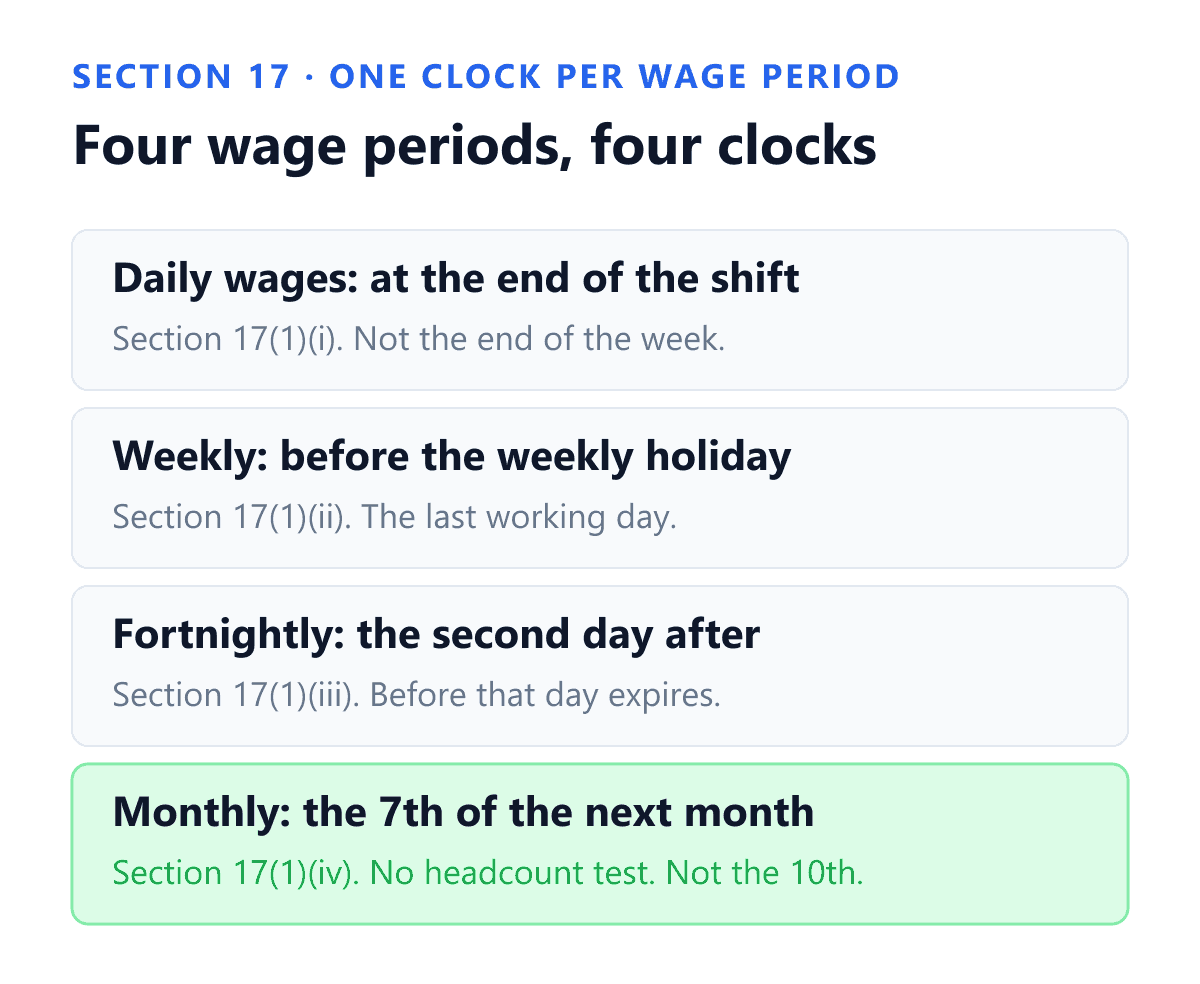
Here is section 17(1) in full, because it is short and because the wording of the middle two limbs is doing work that paraphrases lose:
"The employer shall pay or cause to be paid wages to the employees, engaged on (i) daily basis, at the end of the shift; (ii) weekly basis, on the last working day of the week, that is to say, before the weekly holiday; (iii) fortnightly basis, before the end of the second day after the end of the fortnight; (iv) monthly basis, before the expiry of the seventh day of the succeeding month."
Read limb (i) again. At the end of the shift.Not at the end of the week, not on Sunday, not when the site engineer next comes with cash. If you have engaged somebody on a daily basis, the wage for that day falls due when that day’s shift ends. A firm running fifty daily-wage helpers and settling them every Saturday is not marginally late by six days; it is on the wrong limb entirely, and no amount of arguing about the 7th helps, because the 7th is not its deadline.
Limb (ii) is similarly precise. Weekly wages are due before the weekly holiday, which for most establishments means Saturday evening rather than Monday morning. The Code on Wages (Central) Rules, 2026 define a week as seven days beginning at midnight on Saturday night and require one weekly rest day, ordinarily Sunday. Pay lands before the rest day, not after it.
Limb (iii) reads oddly until you count on your fingers. A fortnight ending on the 15th means the second day after it ends is the 17th, and the wage must be paid before the end of that day.
Section 16: the wage period nobody fixes on paper
None of the four limbs mean anything until you know which one you are on, and that is the job of section 16. It requires the employer to fix the wage period as daily, weekly, fortnightly or monthly, and it caps it: no wage period may exceed one month. Different establishments of the same employer may be on different wage periods, which is how a company running a head office on monthly salaries and a site on daily wages stays compliant on both.
Two consequences follow, and both are common in practice.
The first is the 45-day cycle. Plenty of businesses, particularly those paying agency or contract staff downstream of a client’s own payment terms, run a settlement cycle of six weeks or two months. That is not late payment under section 17. It is an unlawful wage period under section 16, which is a different and earlier problem: there is no such thing as a lawful 45-day wage period, so the arrangement fails before you get to the deadline.
The second is that most small employers have never fixed a wage period in writing at all. They think they have, because they pay monthly. But the place a wage period is recorded is the appointment letter, and appointment letters became a statutory obligation for every employee under the labour codes. Where it shows up afterwards is the wage slip, which is Form V under the Central Rules. If an inspector asks what your wage period is and the answer is not on either document, the honest answer is that you do not have one.
What "before the expiry of the seventh day" actually means
Take a wage period of 1 to 30 September. The succeeding month is October. The seventh day of October expires at midnight on 7 October. So 7 October is the last lawful day, not the 8th, and the reader who has been treating "by the 7th" as "in the first week or so" has been running one day of exposure every month for years.
Three follow-on questions come up constantly and all three have unsatisfying answers.
What if the 7th is a Sunday? Section 17 contains no extension for a Sunday, a bank holiday or a national festival holiday. There is no next-working-day saving anywhere in the section. The only relief is section 17(3), which lets the appropriate government provide a different time limit where it considers it reasonable, and that requires an actual notification. Absent one, the 7th is the 7th. In October 2026 the 7th falls on a Wednesday, so the question is academic this quarter and will not be next February, when it lands on a Sunday.
Does "pay" mean initiated or received?Section 15 sets out the lawful modes: current coin or currency notes, cheque, crediting the wages to the employee’s bank account, or electronic mode. It says nothing about when a transfer is deemed complete. The conservative reading, and the only one that survives an employee saying "I did not have my money on the 7th", is that the employee must be able to draw on it by the 7th. A NEFT batch pushed at 6pm on the 7th that settles on the 8th is a bad position to defend for the sake of one day.
Must we pay electronically? Not under the Code as such. Section 15 lists cash alongside cheque and bank credit as equally lawful. What section 15 also does is give the appropriate government power to notify, by industrial or other establishment, that wages must be paid onlyby electronic mode or bank credit. Whether such a notification covers you is a State-level question and it was not possible to verify centrally while writing this, so check your own State’s notification rather than assuming either way.
The penalty is not the interesting number
Section 54 grades the offences, and the grading is worth understanding because the two limbs land very differently.
Paying an employee less than the amount due is section 54(1)(a): a fine up to Rs 50,000 for a first offence, and on a second similar conviction within five years, imprisonment up to three months or a fine up to Rs 1,00,000, or both. Contravening any other provision of the Code is section 54(1)(b): a fine up to Rs 20,000, rising on a repeat within five years to imprisonment up to one month or a fine up to Rs 40,000, or both. Failure to maintain or correctly maintain records carries its own fine up to Rs 10,000.
Late payment of the right amount sits in the second bucket, not the first. That sounds like good news and it is, up to a point, because there is a further softener: before prosecuting for a records offence or an "other provision" contravention, the Inspector-cum-Facilitator must give the employer written notice and an opportunity to comply. That opportunity disappears if the same contravention recurs within five years. So the structure of the law is: the first time you are late and it is noticed, you get a letter. The second time, the letter is gone.
The number that actually hurts is not in section 54. It is in section 45, which lets an employee bring a claim before the appointed authority, and lets that authority order compensation in addition to the amount determined, extending to ten times the claim. If the employer does not pay, the authority issues a certificate of recovery and the Collector recovers it as arrears of land revenue. The authority is to endeavour to decide within three months.
Ten times is the reason to take the 7th seriously even though the criminal fine looks small. A month’s delayed salary for one supervisor is an amount worth arguing about only when it can be multiplied by eleven and recovered like a tax.
Where the 7th actually breaks, and it is not payroll
Here is the part that most compliance write-ups skip, because it is an operations problem rather than a legal one.
Almost no business misses the 7th because the bank was slow or because the finance team could not do the arithmetic. They miss it because on the 5th they still did not know how many days a particular person worked.
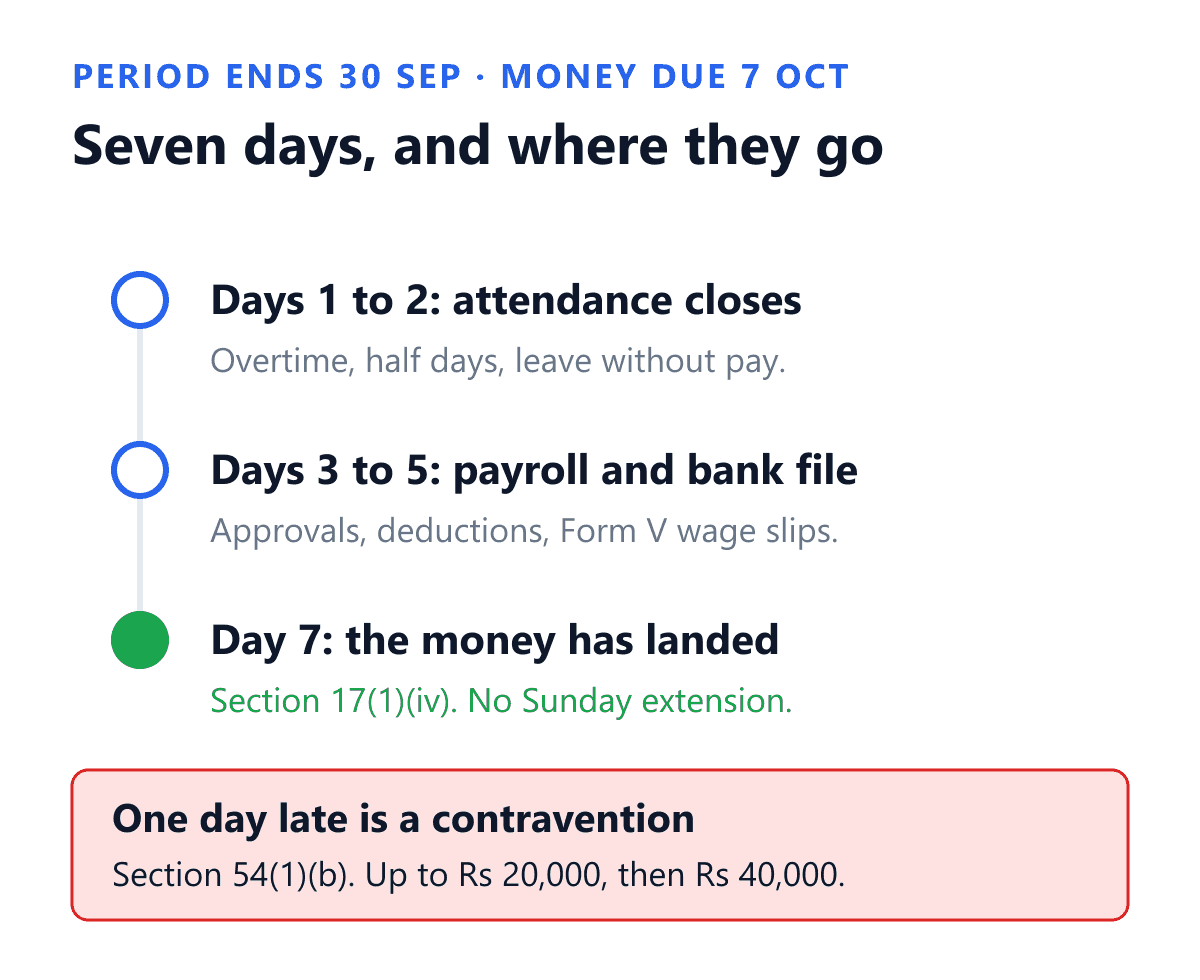
Work the Tiruppur unit’s calendar honestly. Forty-two people across three units. Attendance is a paper register at each unit plus a WhatsApp group where supervisors send the day’s headcount. The wage period closes on 30 September. On 1 October the registers are still at the units. Two arrive on the 3rd, the third arrives on the 5th because that supervisor was on leave. Then somebody has to reconcile the WhatsApp messages against the register for the four days where they disagree, decide whether two late marks are a half day, and confirm whose overtime was authorised. Payroll cannot begin until that is settled, and it settles on the 6th. The bank file goes out on the 8th or 9th.
Notice that nothing in that story is a payroll failure. Every one of those days is an attendance day. The seven days section 17 grants are, in practice, two days of closing attendance and five of running payroll, and if attendance takes five you have already lost.
This is where Shiftelio is genuinely relevant, and it is worth being specific rather than gestural about why. Attendance is captured at the punch, with the location and the time attached, so the wage period is closed on the morning of the 1st rather than assembled during the first week of the month. Overtime, half days and leave without pay are computed against the roster as the month runs, not reconstructed from a register afterwards. The wage slip generates from the same record that produced the attendance, which means the number on the slip and the number in the register cannot disagree. The effect on the deadline is not that payroll runs faster. It is that the five days you were spending on attendance were never needed, so the 7th stops being tight.
If you want to see where the days go in your own business before changing anything, our guides to calculating payroll in India and to overtime pay calculation walk through the same month from the arithmetic side.
The exit clock is a different clock, and it is shorter
Section 17(2) is the one provision on this subject that does get quoted, usually with a note of alarm. Where an employee has been removed, dismissed, retrenched, has resigned, or has become unemployed because the establishment closed, the wages payable are to be paid within two working days.
Two things about it are worth stating here even though it has its own guide on this site. First, it displaces the 7th completely for that person: a resignation effective 30 September does not get until 7 October, it gets until roughly 2 October. Second, it is not the 30 or 45 days that most Indian companies write into their exit policy, and writing a longer period into the policy does not extend the statutory limit. What the contract can do is bind you to something shorter. It cannot buy you longer.
The exit clock also runs alongside, not instead of, the other exit deadlines: the experience or service certificate has its own timing and paying the money on time does nothing for it.
A practical compliance position
If you want to take a defensible position on this before the next payroll run rather than after the next inspection, five things are worth doing and none of them are expensive.
- Write down the wage period. For each class of employee, in the appointment letter, in the words section 16 uses: daily, weekly, fortnightly or monthly. If any of them is longer than a month, that is the first thing to fix.
- Move the payroll calendar to the 5th, not the 7th. A deadline you hit on the last lawful day has no room for a bank holiday, a failed transfer or a wrong account number. Two days of buffer costs nothing and removes the whole category of near miss.
- Check the day labour separately. If anybody is engaged on a daily basis, limb (i) applies to them and it is not the 7th. Either pay at the end of the shift or move them to a lawful weekly or monthly wage period, deliberately and in writing.
- Close attendance before the 2nd. Whatever it takes. This is the actual constraint and every other step is downstream of it.
- Keep the proof. The wage register and the Form V wage slip are what evidence the date, and a records failure is its own offence under section 54 with its own fine.
Questions employers ask
Is salary really due by the 7th of every month in India?
For a monthly wage period, yes. Section 17(1)(iv) of the Code on Wages, 2019 requires payment before the expiry of the seventh day of the succeeding month, and the Code has been in force since 21 November 2025. If your wage period is daily, weekly or fortnightly, a different limb of the same sub-section applies and the 7th is not your deadline at all.
Does the 1,000-employee rule still apply, 7th versus 10th?
No. That split came from section 5(1) of the Payment of Wages Act, 1936, which the Code on Wages repealed. Section 17 has no headcount threshold. Any 2026 guidance still presenting the 7th-or-10th choice is describing law that no longer exists, and an establishment relying on it to pay on the 10th is three days late every month.
What if the 7th falls on a Sunday or a bank holiday?
Section 17 provides no extension. There is no next-working-day rule in the section, and none in the Central Rules. The only mechanism for a different limit is section 17(3), under which the appropriate government may prescribe another time limit where it considers it reasonable, which requires a notification that applies to you. The practical answer is to pay before the weekend rather than to argue afterwards.
Can we pay on the 10th if the employment contract says so?
No. A contractual term cannot extend a statutory deadline. Section 17(4) preserves any other law that sets a time limit for payment of wages, not any other agreement. A contract can commit you to paying earlier than the 7th, and that promise binds you. It cannot buy you until the 10th.
What is the penalty for paying salary late in India?
Late payment of the correct amount is a contravention of a provision other than the underpayment limb, so section 54(1)(b) applies: a fine up to Rs 20,000, and on a similar offence within five years, imprisonment up to one month or a fine up to Rs 40,000, or both. Paying lessthan what is due is the heavier limb, section 54(1)(a), at up to Rs 50,000 and up to Rs 1,00,000 on repetition. The larger exposure is section 45, where the authority hearing an employee’s claim may award compensation of up to ten times the amount determined, recoverable as arrears of land revenue.
Does the deadline apply to senior employees on high salaries?
Yes, and this is the change most large employers have not absorbed. The Payment of Wages Act, 1936 applied only where wages for the wage period did not exceed Rs 24,000 a month, so highly paid staff were outside the deadline. The Code on Wages has no wage ceiling and applies to all employees in all establishments. The 7th binds for everybody on the payroll.
Can we run a 45-day payment cycle for contract staff?
No, and the reason is section 16 rather than section 17. Section 16 requires a wage period to be fixed as daily, weekly, fortnightly or monthly and provides that no wage period shall exceed one month. A 45-day cycle is not a late monthly cycle; it is not a lawful wage period at all. If a client’s payment terms are driving it, that is a commercial problem to solve upstream, because it does not travel down to the worker as a defence. Related duties on the principal employer are covered in our guide to principal employer PF liability for contract workers.
When must we pay somebody who has resigned?
Within two working days of the resignation, under section 17(2), which also covers removal, dismissal, retrenchment and unemployment caused by closure. It replaces the 7th for that person, and it is not the 30 or 45 days that most exit policies assume.
The short version
- Monthly wages are due before the expiry of the 7th of the following month, under section 17(1)(iv) of the Code on Wages, 2019.
- The 7th-versus-10th split at 1,000 employees is dead. It was section 5(1) of the Payment of Wages Act, 1936, which the Code repealed. Section 17 has no headcount test.
- The old Rs 24,000 wage ceiling is gone too. The deadline now binds for every employee at every salary, in every establishment.
- Three of the four limbs are not the 7th: daily wages at the end of the shift, weekly before the weekly holiday, fortnightly before the end of the second day after the fortnight.
- Section 16 caps a wage period at one month. A 45-day cycle is unlawful as a wage period, before you even reach the deadline.
- There is no Sunday or holiday extension in section 17. Section 17(3) is the only escape and it needs a government notification.
- Section 15 permits cash, cheque, bank credit and electronic mode alike. Electronic-only is a State notification question, not a Code-wide duty.
- Late payment is section 54(1)(b): up to Rs 20,000, then Rs 40,000 or a month inside on a repeat within five years. Underpayment is the heavier limb at Rs 50,000 then Rs 1,00,000.
- The real exposure is section 45: compensation up to ten times the claim, recovered as arrears of land revenue.
- On exit the clock is two working days, not the 7th and not 45 days.
- Businesses miss the 7th because attendance is not closed, not because payroll is slow. Fix the first and the second stops mattering.
Position as at 7 September 2026. Sections 15, 16, 17, 45 and 54 are quoted from the Code on Wages, 2019 (Act 29 of 2019) as in force from 21 November 2025. Section 5(1) and section 1(6) are from the Payment of Wages Act, 1936, repealed by the Code. The week definition and the 48-hour limit are from the Code on Wages (Central) Rules, 2026, notified 8 May 2026. The Central Rules apply where the Central Government is the appropriate government; for most private employers the appropriate government is the State, and State rules under the Code may prescribe differently on matters left to the rules. Section 17(3) permits the appropriate government to notify a different time limit, and no such notification is asserted here for any State. Whether your establishment is required to pay wages only by electronic mode under the proviso to section 15 could not be verified centrally and should be checked against your own State notification. This is general information and not legal advice for a particular establishment.
Sources
- India Code, The Code on Wages, 2019 (Act 29 of 2019), as on 21 November 2025 - the official consolidated text, including section 15 on mode of payment, section 16 on fixation of the wage period, section 17 on the time limit, section 45 on claims and section 54 on penalties.
- Press Information Bureau, Code on Wages, 2019: Safeguards Workers, Induces Growth, Empowers Women- the Government’s own November 2025 explainer, which states that timely payment now applies to all employees irrespective of wage ceiling and sector.
- India Code, The Payment of Wages Act, 1936 - the repealed Act, whose section 5(1) is the source of the 7th-versus-10th split and whose section 1(6) carried the Rs 24,000 wage ceiling.
- PRS Legislative Research, Code on Wages (Central) Rules, 2026 - the Central Rules notified on 8 May 2026, including the daily wage conversion, the definition of a week and the weekly rest day.
- Ministry of Labour and Employment, Labour Codes - the four codes in force from 21 November 2025 and the Central Rules notified on 8 May 2026.
Keep reading
See how Shiftelio does this in practice with attendance that closes itself, so the wage period is final on the 1st.
Work your own numbers with the free attendance register generator. No signup, no email.