Housekeeping Supervisors: One Cleaner, One Crew, One Client Site
In short
Housekeeping site supervisors borrow cleaners from each other by phone. Give each supervisor a crew list and make every move a request somebody approves.
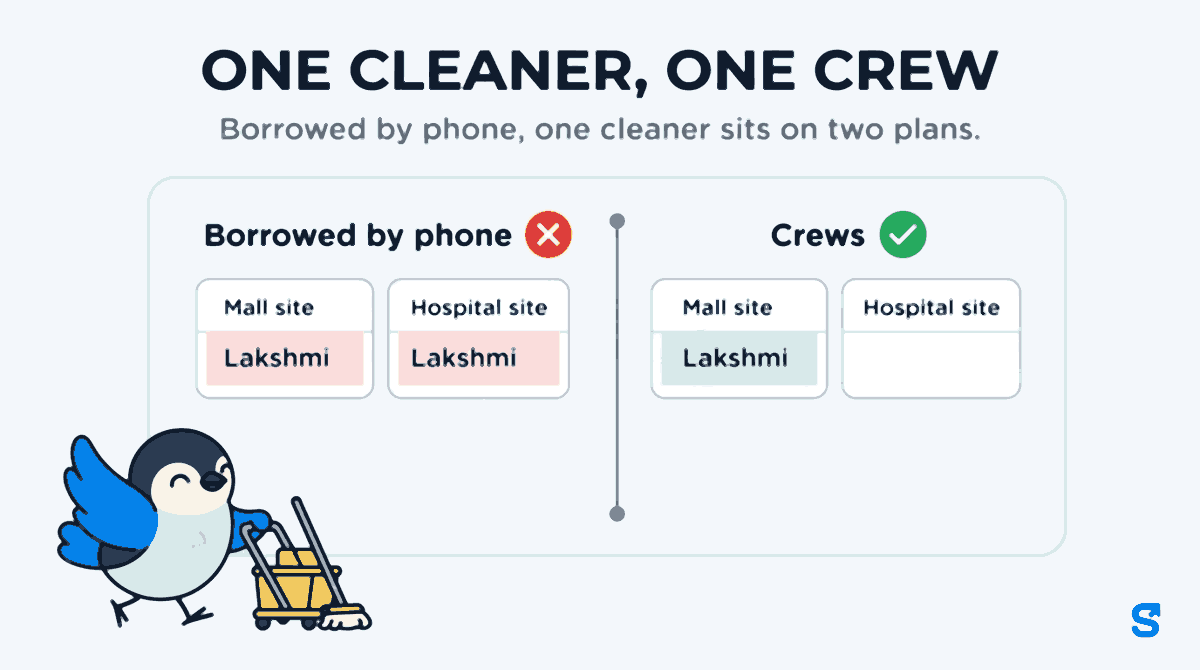
- Borrowing cleaners by phone puts one person on two supervisors' plans and leaves the client bill guessing.
- On a crew list a cleaner is on exactly one crew, and approval moves her; it never copies her.
- A request waits for somebody who approves crew changes and lapses after 7 days.
The mall site is two cleaners short before seven in the morning. Its supervisor does what every housekeeping supervisor does: rings the supervisor at the hospital site and asks for Lakshmi, just for today. Lakshmi goes. Nobody writes it down.
By the afternoon, the hospital's facility manager is asking why the third floor was not done. The hospital supervisor still has Lakshmi on her plan. The mall supervisor has her on his. On the attendance sheet she is on both, or on neither, depending on who filled it in. And at the end of the month somebody in the office has to work out which client she was actually working for, because each client pays for its own man-days.
This is the everyday problem of a housekeeping agency with more than one site supervisor. It is not a discipline problem. It is a missing rule: one cleaner belongs to one supervisor at a time, and moving her is a decision somebody makes, not a favour on the phone.
Why borrowing cleaners breaks the client bill
A housekeeping or facility-management agency sells cleaners by the site. The hospital pays for eleven people on its floors, the mall for eight, the office tower for six. Each site has a supervisor who knows their crew by name and plans the day around them.
Borrowing between sites is normal and often right. A cleaner who is idle at one site and needed at another should move. What goes wrong is not the move, it is that the move is invisible:
- The client who lost a cleaner is not told. Their supervisor finds out when the work is not done.
- The cleaner sits on two plans. Both supervisors believe she is theirs, so both count her.
- The office cannot tell which site to bill. The man-day belongs to the site she actually worked at, and nothing records which one that was. Our guide to man-day billing for facility management covers how a client invoice is built from attendance; it only works if each cleaner's day is counted once, at one site.
The usual fix is a WhatsApp group where supervisors announce moves. It works until the first busy morning, and it leaves no record anybody can check a month later.
One supervisor, one list of cleaners
In Shiftelio, Crews lets a supervisor keep their own list of workers, and ask you when they need somebody who is on another supervisor's list. For a housekeeping agency that maps directly onto the way you already work: each site supervisor has a crew, and the crew is the list of cleaners they are responsible for today.
Three rules make it trustworthy:
A cleaner is on exactly one crew. The app stores one crew row per worker, so the same cleaner on two supervisors' lists cannot even be recorded. That single rule ends the "she is on both plans" argument.
Each supervisor reaches only their own crew. Open Roles, edit the role your site supervisors share, and switch on Each person with this role manages their own crew. From then on each supervisor sees only the cleaners on their own list. If the role can mark attendance for others or approve leave, those reach the supervisor's own cleaners and nobody else. A crew changes who a supervisor reaches, never what they are allowed to do.
An empty crew sees nobody. A new supervisor with nothing on their list sees an empty screen, not the whole agency. That is the opposite of a site or department limit, where an empty list means no limit, and it is deliberate.
A cleaner moves only when somebody says yes
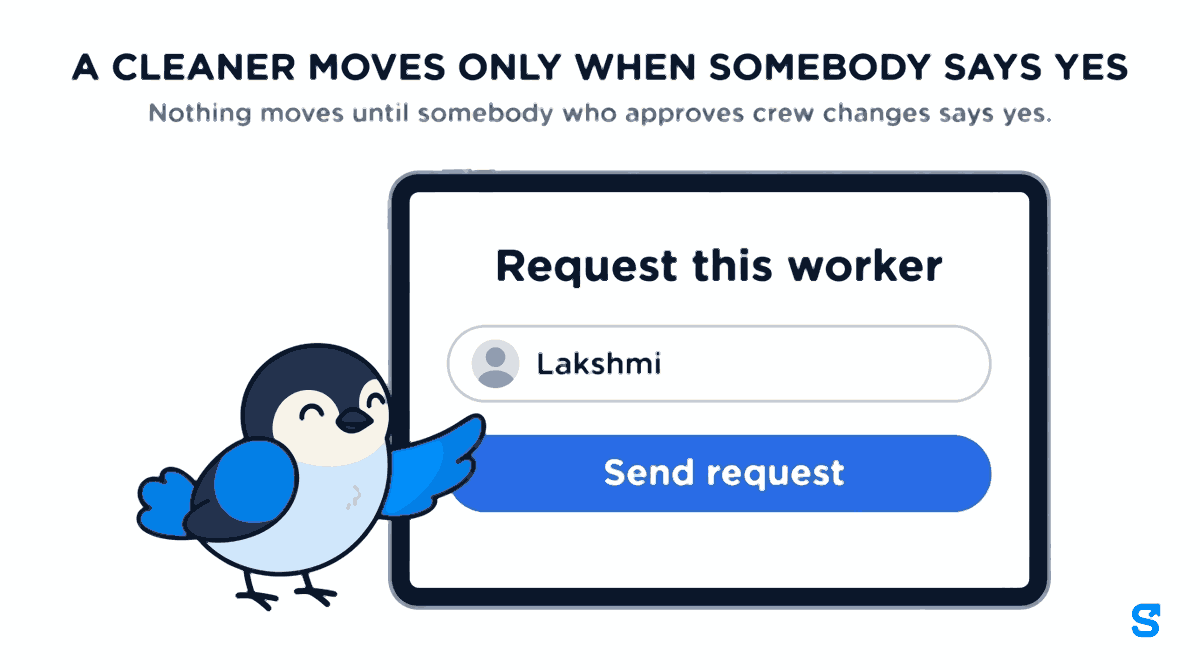
When the mall supervisor needs Lakshmi, he does not ring her. He opens Crews, finds her on the hospital supervisor's crew, and taps Request. The box that opens is titled Request this worker, and it says plainly: Nothing moves until somebody who approves crew changes says yes. There is room for a reason, which is optional but gets answered faster, and a Send request button.
Then the request goes to whoever approves crew changes: you, any co-owner, and any manager whose role has the Approve requests tick. In a housekeeping agency that is usually the operations manager who knows which client can spare a cleaner today.
She comes off the hospital supervisor's crew and onto the mall supervisor's in one step. There is no moment when she is on both lists, or on neither.
The supervisor who asked is told she is staying where she is, with your reason if you give one. A reason saves them asking again tomorrow.
A request nobody answers lapses after 7 days, and the supervisor who asked can take it back at any time before it is answered.
When a client contract ends: hand back, and see your bench
Housekeeping crews shrink as well as grow. A client cuts a floor, a short contract ends, a supervisor has one cleaner more than the site needs. The supervisor can hand a worker back at any time, with no form and no approval: giving somebody up takes nothing from anyone.
A cleaner who is handed back lands under On nobody's crew, marked Unassigned, on the owner's Crews screen. For an agency that list is useful in its own right. It is your bench: the cleaners who are paid and available and not yet placed. Instead of a supervisor ringing around for a spare pair of hands, the operations manager looks at one list and places somebody.
From there, anyone whose role holds Move without asking can put a cleaner straight onto a crew. You can tick several at once and move the whole group, which is what you do on the day a new client site opens and six cleaners start there together. Keep that tick for very few people: anybody holding it can take a worker off any supervisor without warning.
Pending leave goes with the cleaner
A cleaner who changes crew often has a leave request waiting, and it was the old supervisor's to decide. When she moves, her new supervisor gets a notification titled Leave waiting on your decision, saying the request is theirs to answer now. Without it, each supervisor assumes the other one has it and the request sits for a fortnight.
Setting it up for a housekeeping agency
- Make one role for your site supervisors, or edit the one they already share.
- On that role, switch on Each person with this role manages their own crew.
- Tick Crews → View and Request a worker for that role. If supervisors should decide leave for their own cleaners, tick Decide leave for their own crew too.
- Give Approve requests to the operations manager, and keep Move without asking for yourself.
- Open Crews and put each cleaner on the crew of the supervisor whose site they work at.
- Tell supervisors that from tomorrow, the way to get a cleaner from another site is Request, not a phone call.
New crew ticks start off for every existing role, so nobody gains anything until you tick it.
What crew lists do not do
Be clear about the edges before you rely on this.
- A crew belongs to a supervisor, not to a client site. If one supervisor runs two small sites, their crew covers both. Where the client bill needs the site, take it from each cleaner's check-in location, not from the crew.
- It is a transfer, not a loan. There is no "lent until Friday" state. If a cleaner helps another site for one day, the honest record is to move her and hand her back.
- It does not decide pay. Wages and deductions come from attendance and the cleaner's own salary settings, not from which crew she is on.
- It is not your statutory contractor record. The four labour codes took effect on 21 November 2025, and the contract-labour rules that used to sit in the Contract Labour Act, 1970 now sit in the Occupational Safety, Health and Working Conditions Code, 2020. The Ministry of Labour and Employment's labour codes page has the codes and their rules. A crew list is an operating roster for your supervisors; keep the records the codes require as your compliance advisor tells you.
The idea of crews is the same in every trade; our guide to supervisor crew lists on construction sites walks through it for site engineers and welders. For geofenced, selfie-verified check-in at every client site, see the labour attendance app for India, and if you are still deciding how much each supervisor should be allowed to do, start with manager permissions and custom roles.
Which app gives each housekeeping supervisor their own crew?
Can a cleaner be on two supervisors' crews at once?
No. The app keeps one crew row per worker, so it cannot record a cleaner on two crews. Approving a request moves her; it never copies her.
Can a supervisor take a cleaner from another site without asking?
Only if their role holds Move without asking. Everyone else can only request, and nothing moves until somebody with Approve requests says yes.
What happens to a cleaner a supervisor no longer needs?
The supervisor hands her back. She shows under On nobody's crew as Unassigned until somebody places her on another crew.
Does a new supervisor with no crew see every cleaner?
No, they see nobody until cleaners are added to their list.
Keep reading
Free to use, no signup: Shift roster template.