Man-Day Billing in India: A Client’s Deduction Has Exactly One Place to Land
In short
The mall’s admin counted heads at 11am and cut six man-days. Your supervisor swears all nine were there. Section 20 decides who absorbs it, and it is you.
A housekeeping contractor in Pune deploys thirty eight people across five client sites. Two corporate offices, a hospital, a mall and a small manufacturing unit. The contract with each client is written in man-days: so many people, so many days, at a rate that covers the wage, the provident fund, the employee state insurance, the bonus and leave loading, and a fee on top.
On the eighth of the month the invoice for the mall goes out. On the nineteenth, the mall’s admin executive sends a debit note. She walked the site on the fourteenth at around eleven in the morning, counted seven housekeepers where the deployment sheet says nine, and has deducted six man-days for the month on that basis. Two short, and she has assumed it ran for three days.
The contractor calls his site supervisor, who is certain. All nine were on duty on the fourteenth. Two were doing the second floor washrooms, which is where they are at eleven, because that is the schedule. The supervisor is almost certainly right. And the contractor is going to pay the six man-days anyway, because he cannot prove it, and because the alternative is a conversation about the renewal.
What happens next is the part worth writing about. In a large number of firms in this trade, the six man-days get passed down. The supervisor is told to adjust it across the team, and six days of wages quietly disappear from workers who were present. That move is not a grey area. It is the thing the Code on Wages was written to stop, and it is the subject of this article.
Why neither record can settle it
Put the two pieces of evidence on the table and look at what each one actually is.
The client has a headcount. One person, one walk, one moment. It is a sample, and it is a sample of the worst possible kind, because it was taken at a time chosen for the counter’s convenience rather than for the work. A housekeeper is by definition not where you last saw her. The count missed the second floor, and it would have missed a basement, a terrace, a service corridor or a tea break just as reliably.
The contractor has a muster roll. It is filled at the site office, or more often at the head office, from what the supervisor reported on WhatsApp. It is complete, it is neat, and it was written after the fact by somebody with an obvious interest in the outcome. It is not evidence of anything that happened at eleven on the fourteenth. It is evidence of what the supervisor said in the evening.
Neither document can place a named person at a named site at a named time. So the dispute is not decided on evidence at all. It is decided on who needs the relationship more, and in this trade that is never the client.

The thing to notice. Both parties are behaving reasonably. The admin executive is doing the only verification available to her. The supervisor is reporting honestly. The deficiency is structural: nobody in the chain is producing a record at the moment and the place the work happens, so there is nothing for the argument to land on.
What one disputed man-day actually costs
Contractors in this trade underprice deduction risk, and the reason is that it is charged to the wrong mental account. A deducted man-day feels like a small revenue item. It is not. It is a margin item, and margin is a fraction of revenue.
Run it. Take a month in which you deployed and worked a hundred man-days at a client, and take a margin of ten per cent as the example. Your own number may be seven, or twelve, or fifteen: the shape of the answer does not change, only its size.
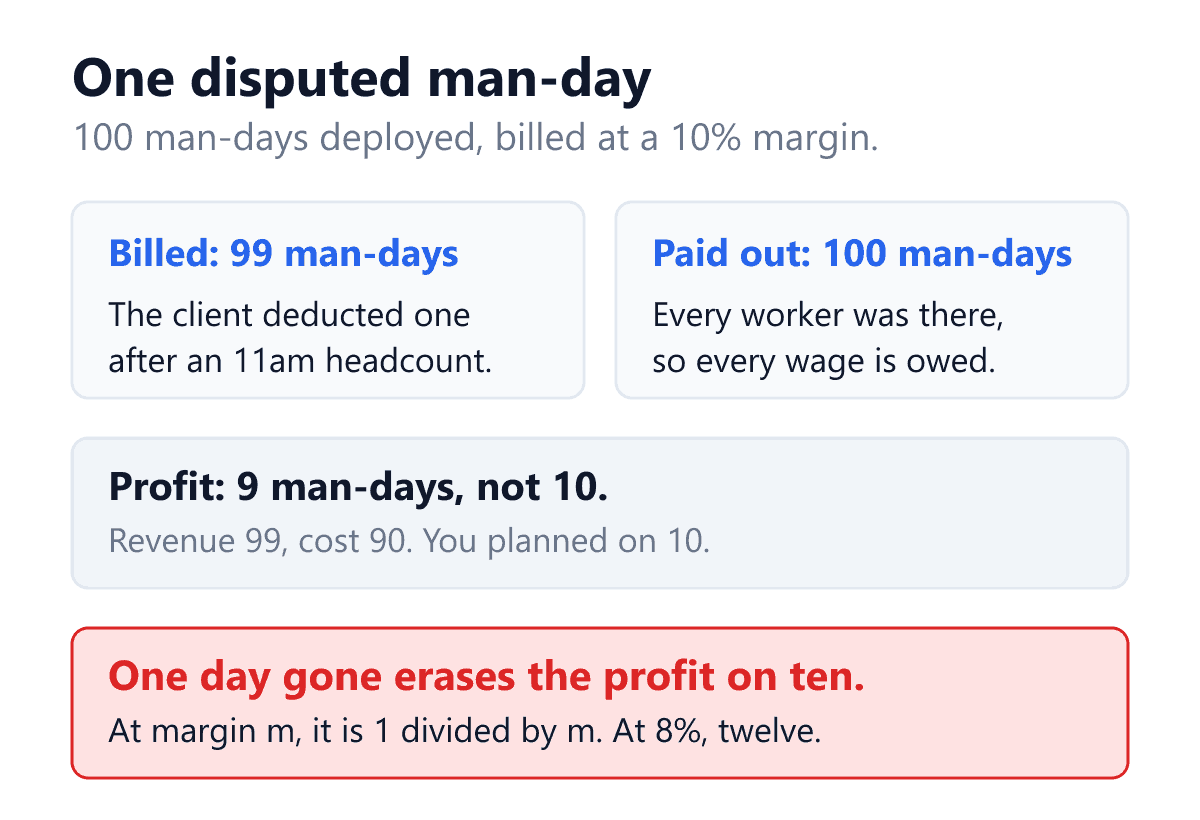
At a ten per cent margin, each man-day you bill earns you a tenth of a man-day in profit. Losing a whole one therefore erases the profit on ten. The general form is one divided by your margin, which is worth committing to memory because it scales the wrong way: the thinner your margin, the more days a single dispute destroys. At eight per cent it is twelve and a half. At five, twenty.
Now apply it to the Pune contractor. Six man-days at the mall, at a ten per cent margin, is the profit on sixty. If the mall deployment is nine people over about twenty six days, that is roughly two hundred and thirty man-days a month, so one debit note from one junior executive took a quarter of the year’s profit on that site. The contractor experienced it as a routine adjustment.
Where a client’s deduction can lawfully land
Here is the step most of this trade gets wrong, and it is worth being exact about it, because the instinct is so strong and the law is so narrow.
A deduction on your invoice is a commercial event between two businesses. It reduces what your customer pays you. It does not, by itself, reduce what you owe your employee, and it never can, because your employee is not a party to it. Whether any of it reaches a wage is a completely separate question governed by Chapter V of the Code on Wages, 2019, and Chapter V is a closed list.
Section 18(2) sets out every deduction that may lawfully be made from wages: fines, absence from duty, damage to or loss of goods expressly entrusted for custody, house accommodation, amenities supplied, recovery of advances and loans, income tax and statutory levies, social security subscriptions, co-operative society payments, trade union dues with written authorisation, and a short list of railway specific items. Section 18(3) caps the total at fifty per cent of wages in a wage period. “Because my customer deducted it” is not on the list, and there is no residual clause it could shelter under.
Two of those entries look, at first glance, as though they might carry the pass-through. Neither does, and the reasons are different.
Absence from duty, section 18(2)(b). This one is genuinely available, but read what section 20 does to it:
Every noun in that sentence is singular and specific. An employee. A place. A period. It permits you to dock Sunita for the day Sunita was not at the mall, in the proportion that day bears to the month. It does not permit you to recover an aggregate of six man-days from whoever is convenient, and it certainly does not permit you to recover it from workers who were present, which is what “adjust it across the team” means in practice.
Fines, section 18(2)(a). This is the route people reach for when absence will not stretch, and it is the more firmly closed of the two. Section 19 requires that no fine be imposed except for acts and omissions the employer has specified with the previous approval of the appropriate Government or the prescribed authority, that the employee be given an opportunity to show cause before it is imposed, and that total fines in a month not exceed three per cent of the wages payable. An adjustment made in the back office against a client’s debit note clears none of those three.
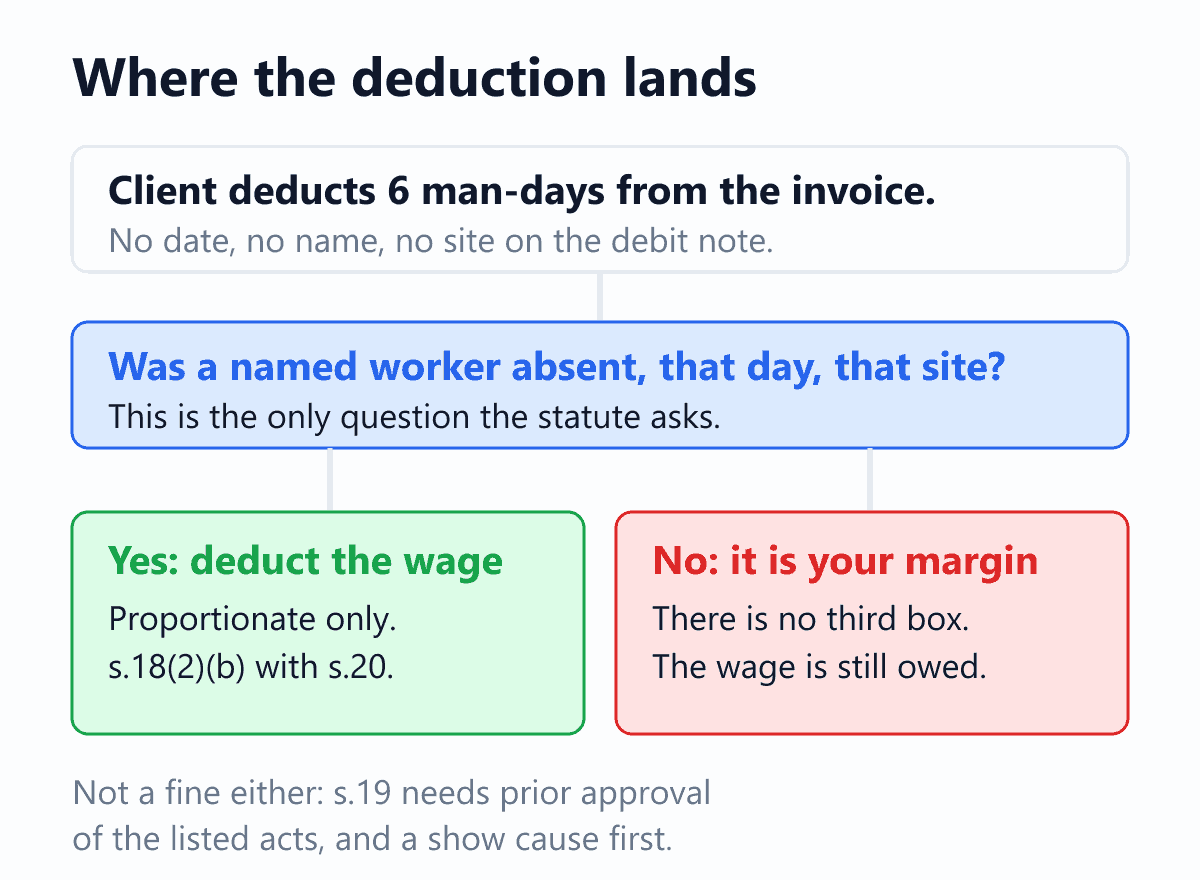
So the conclusion is uncomfortable and it is also clean. A man-day deduction you cannot trace to a named absence lands on your margin, and nowhere else. Not because the client was right, but because the only other place it could go is closed by statute. The wider list of what you may and may not take off a pay slip is in the salary deductions article; what matters here is the narrow point that a commercial dispute is not a permitted ground.
And the exposure does not stop with you. Under section 43 of the Occupational Safety, Health and Working Conditions Code, 2020, if a contractor fails to pay wages, the principal employer pays them and recovers from the contractor. A worker who complains about a short payment therefore produces a problem at your client, in your client’s name, about your client’s site. The pass-through that felt like protecting the relationship is the single most efficient way to end it. We took the principal employer’s side of that apart in the principal employer article.
The record you already have to keep is the record that wins
Now the useful part, because everything above is a description of a loss and none of it is a fix.
You are already required to keep the document that settles this. The Code on Wages (Central) Rules, 2026 prescribe Form IX, the Attendance Register-cum-Muster Roll, which records the daily attendance of every employee with in-time and out-time. Not a headcount. Not a monthly total. A per-person, per-day record of when they started and when they stopped. Under the labour codes, which came into force on 21 November 2025, that register may be maintained electronically. Our registers article goes through it column by column.
Read that against the mall’s debit note and the asymmetry is total. The client has one person’s recollection of one moment. The statute already obliges you to hold a timestamped entry for every one of the nine people on that site on that day. If your Form IX is real, the debit note does not survive the first meeting. If your Form IX was typed up on the thirtieth from a WhatsApp thread, you have complied with the form and kept none of its value.
The sentence to take away.The muster roll, the payroll input and the invoice annexure are not three documents. They are one document with three readers: the labour inspector, your accounts team, and your client’s admin. The trade keeps them as three, which is exactly why the third reader always wins.
What a site-pinned punch has to prove
A record that is going to survive a client meeting has to answer four questions, and a paper register answers one of them. This is the specification, whatever you end up buying.

| The question | What has to be true | What a paper muster roll does |
|---|---|---|
| Who | The entry identifies one named person, not a count. A selfie at the punch makes the identity checkable months later. | Names them, and cannot show the signature was theirs. |
| Where | The punch is matched to a site by position, with a radius set per site. A mall and a plant do not want the same tolerance. | Says nothing about location at all. |
| When | In-time and out-time recorded as they happen, not reconstructed. This is the Form IX requirement and it is the one the debit note argues about. | Records a date and, at best, a shift label. |
| Still true later | The entry cannot be edited without the edit itself being recorded. An attendance sheet your own office can rewrite proves nothing to a client who knows it. | Can be rewritten with a pen. |
The fourth row is the one contractors skip and clients care about most. If the record can be altered by the party producing it, it is not better than the supervisor’s word, it is the supervisor’s word in a nicer font. An audit trail on corrections is what converts your register from an assertion into evidence.
One practical warning before you buy anything. Housekeeping happens in basements, plant rooms, service corridors and hospital sub-levels, which is to say in the places mobile signal does not reach. A system that only records a punch when the phone is online will fail exactly where your disputes come from. The punch has to be captured on the device with its time and position and sent when the phone next sees a network. We wrote up what offline actually has to mean for precisely this reason.
The software that does this, and what it costs
A thirty day fix for a contractor losing man-days
In order. The later steps do nothing without the earlier ones, and the first one is the one that changes the conversation internally.
- Add up last year’s deductions, per client, in man-days. Not in rupees, because rupees make it look like a rounding item. In man-days, divided by your margin. Most contractors have never seen this number and it is usually a multiple of what they assumed.
- Stop the pass-through today, in writing, to every supervisor. Before any software, before any contract change. It is the exposure that can turn into a claim at your client’s premises in your client’s name, and it is free to stop.
- Pick the one client who deducts most and instrument that site first. One site, one month. Do not roll out to five at once; you will spend the month arguing about radius settings instead of collecting evidence.
- Set the radius per site, then read the failures for two weeks. A mall atrium and a factory gate need different tolerances, and the punches that fail tell you which one is wrong far faster than the punches that succeed.
- Send the per-day, per-person sheet with the invoice, unasked. This is the whole intervention. A debit note raised against an annexure that already names nine people and their in and out times is a debit note somebody has to justify, and most are never raised at all.
- Put the evidence standard into the next contract renewal. One clause: deductions are to be raised against a named worker, a named date and a named site, within a stated number of days of the month end. Clients accept this far more readily than contractors expect, because it is a fairness clause and because their own auditors like it.
Questions manpower contractors ask
The client deducted, and the worker really was absent. Can I deduct the wage?
Yes, and this is the case the statute expressly provides for. Section 18(2)(b) permits a deduction for absence from duty, and section 20 tells you how to size it: the deduction must bear no larger proportion to the wage period than the absence bears to the total period. One day missing from a twenty six day month is one day’s wages, not two, and not a round figure that happens to match what the client took. Record which worker, which site and which date against the deduction, because that record is what makes it lawful rather than merely customary.
Can I recover it from the supervisor who should have noticed?
Almost certainly not, and this is a popular mistake. A recovery from a supervisor for a shortfall he did not cause is either a fine or a damage deduction. As a fine it needs the acts and omissions specified with prior government approval, a show cause, and a three per cent monthly cap. As a damage deduction under section 18(2)(c) it is limited to damage to or loss of goods expressly entrusted to him for custody, or money he was accountable for, and a client’s billing dispute is neither. If you want supervisors to carry deployment accuracy, carry it in an incentive you pay, not a deduction you take.
My client wants biometric attendance at their gate. Does that solve it?
It helps and it is not sufficient, and the reason is worth understanding before you agree to it. A gate reader answers “who came in” well. It does not answer “who was on duty at eleven”, which is the question the debit note is really about, and in most sites it is the client who owns the device and the data. You are then defending yourself with evidence held by the party you are arguing with, and you cannot produce it for your own payroll or your own Form IX without asking them for it each month. Where a client insists, agree to it and keep your own record alongside. The two agreeing is a stronger position than either alone.
What if the client refuses to accept app-based attendance as proof?
Ask what they would accept, in writing, and you will usually find the refusal is about the absence of a standard rather than about the technology. The productive move is to offer the annexure for one month without asking them to commit to anything, and let their own finance team notice that it reconciles. A client who has had a clean, per-person, per-day sheet for three months rarely goes back to a headcount, because the headcount was never comfortable for them either. They were relying on it because nothing better arrived.
Does any of this change if I have fewer than fifty workers at a site?
Not the deduction rules, which apply to every employer under the Code on Wages regardless of headcount, and not Form IX. What changes is the contract labour licensing machinery: under Chapter XI of the OSH Code the licence bites at fifty contract workers rather than the old twenty, and below that threshold there is no licence and no security deposit. That sounds like relief and is partly the opposite, for reasons we set out in the contract labour article. Your billing exposure is entirely unaffected by it.
I run security guards, not housekeeping. Is it the same problem?
The billing half is identical and the rostering half is harder, because a guarding contract is usually written as a post that must be manned continuously rather than as a number of people who must attend. A relief who arrives twenty minutes late leaves a gap in the post, and a gap in the post is a deduction with a much better argument behind it than a corridor headcount. The 24 hour post, and what it does to weekly hours, is its own article.
Where do the statements in this article come from?
The deduction rules are sections 18, 19 and 20 of the Code on Wages, 2019 as published by the Ministry of Labour and Employment, with the register forms prescribed by the Code on Wages (Central) Rules, 2026. The contract labour chapter and the principal employer’s wage liability are in the Occupational Safety, Health and Working Conditions Code, 2020, with the Central Rules notified as G.S.R. 345(E) on 8 May 2026; the Ministry’s own explainer of 22 November 2025 is the readable summary. Contractor licences and returns move through the Shram Suvidha Portal. The margin arithmetic is arithmetic: the ten per cent used in the figure is a stated example, not a claim about what this trade earns, and the general form is printed beside it so you can run your own.
Keep reading
See how Shiftelio does this in practice with deployed labour, muster rolls, and wages paid against days actually verified.
Still deciding what to buy? Compare what nine attendance apps cost for 25 staff deployed across client sites.
Work your own numbers with the free loss of pay calculator, for a deduction sized the way s.20 requires. No signup, no email.