Restaurant Uniforms, Knives and Order Tablets: Getting Them Back When Staff Leave
In short
High turnover and a two-day final settlement leave no time to argue about a missing chef jacket. How a restaurant tracks what every cook and waiter holds.
- A restaurant hands out three different kinds of company property: uniforms counted by size, knife sets that belong to one cook, and order tablets that change hands every shift. One notebook cannot track all three.
- Since 21 November 2025 the Code on Wages gives you two working days to settle a leaver. The question "did they give back the jacket" has to be answered on the day they go, not argued over for a month.
- You can only recover the cost of something that was expressly entrusted to that person, and only after asking them about it. Both need a record made at the counter, at the moment of the handover.
The jacket that left on a Sunday
A commis cook joins you in October for the wedding season. On his first day he is given two chef jackets, two aprons, a cap and a knife roll with four knives in it. In January he stops coming. His friend collects his last salary.
Where are the jackets? Somebody thinks he gave one back. The knife roll turns up in the dry store with two knives in it. Nobody remembers whether the paring knife was already missing when he got it.
Multiply that by the turnover of an ordinary Indian restaurant, where a kitchen can replace half its staff in a year, and uniforms and small tools become a steady monthly loss that never shows up as one big number. It shows up as a supplier bill for twenty more jackets.
The law has also stopped giving you time to sort it out later. Under Section 17(2) of the Code on Wages, 2019, in force since 21 November 2025, a person who leaves must be paid within two working days. The old habit of holding the settlement for a month "until the uniform comes back" is not available any more. You need to know what they are holding before the settlement is calculated, which means you need to have written it down when you handed it over.
Three kinds of thing, three ways to lose them
A workshop issues a drill. A restaurant issues something harder to count, and each kind goes missing in its own way.
| Item | How it is issued | How it goes missing |
|---|---|---|
| Chef jackets, aprons, waiter shirts | Several at a time, by size, to many people | Nobody knows how many a person was given, so nobody knows how many are missing |
| Knife sets | One set to one cook, usually for months | A knife is swapped, chipped or lost and the set comes back short |
| Order tablets and card machines | Shared, passed from lunch captain to dinner captain | It was "with the other shift" and every shift says the same |
The first kind is a count, not an object. "Chef jacket, size L" is one line with a quantity, and what matters is how many are in the store and how many each person has. The second and third are single, named objects: a knife set with a tag on it, a tablet with a serial number. Mixing them in one spreadsheet is why the spreadsheet stops being filled in by the second week.
What you may recover, and what you must do first
If a cook loses a knife set through their own carelessness, you may be able to recover its cost. Section 18(2)(c) of the Code allows a deduction for damage to or loss of goods expressly entrusted to the employee, where the loss is directly attributable to their neglect or default. Section 21 then says the deduction cannot be more than the actual loss, and that it cannot be made until the employee has had an opportunity to show cause. Section 18(3) caps all deductions in a wage period at fifty per cent of wages.
In a kitchen, that turns into three questions you must be able to answer with something better than memory:
- Was this item given to this person, by name, and on what date?
- What condition was it in when it went out, and what condition is it in now?
- What did it cost, so the recovery is never more than the loss?
Whether you then deduct anything is a separate decision, and it is yours. Plenty of owners decide a torn apron is a cost of doing business and a missing tablet is not. What the record gives you is the ability to have that conversation with facts instead of a shouting match at the pass. Our longer guide to the company asset register and lawful deductions covers the legal side in more depth; this article is about how it works in a restaurant. This is general information and not legal advice.
Setting it up for a restaurant
In Shiftelio this is Company items, described in the app as a log book of company property: who has the laptop, the drill, the uniform, and since when. For a restaurant, set it up in three groups.
Uniforms as counted items. Add "Chef jacket, size M", "Chef jacket, size L", "Waiter shirt, size M" and so on, each with the quantity you bought. Give each a low-stock number. When fewer than that are left in the store, the item shows as running low on the screen and in the owner's morning summary, so you reorder before the festive rush instead of during it.
Knife sets as single items. One entry per set, with a tag such as K-04. You can print QR labels for them from the same screen and stick one on each roll.
Tablets and card machines as single items, with the serial number and the purchase price. The price is what lets the register tell you what a loss actually cost.
If you already keep a list in a spreadsheet, you can paste the rows straight in rather than typing them again.
Issuing on the first day, with a photo
When a new joiner arrives before the season, issue their whole kit, jackets, aprons, cap and knife roll, in one go rather than item by item. Each handover records the person, the quantity, the date and, if you want one, the date the item is due back. For seasonal staff, the due date can be the last day of the season. The person holding the item gets a reminder as that date comes close, and anything past its return date shows up in the owner's morning summary.
Take a photo when a knife set goes out. It costs five seconds at the counter. A photo taken when something comes back can only prove what it looks like now. It cannot say whether the chip was there on day one, which is the only thing anybody ever argues about. Two photos, one at each end, settle it.
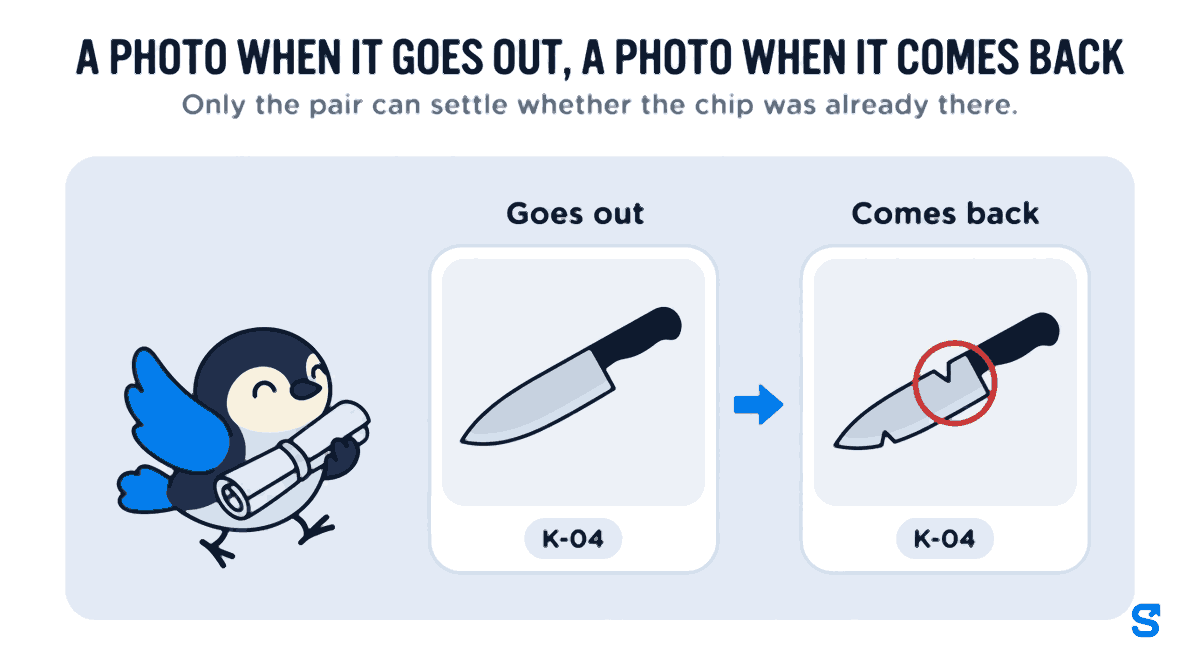
Every cook and waiter sees their own list under My Items in the Shiftelio app: company things currently signed out to them. There is nothing for them to accept. Issuing is final, because an item that waits for a tap on a phone with a flat battery is an item the register cannot account for.
The handover between lunch and dinner
The order tablet is where restaurants lose track most often, because it genuinely does move between people. Shiftelio handles this without a manager standing at the pass.
The lunch captain opens My Items, taps Hand to a colleague and picks the dinner captain by name. Nothing moves yet. The dinner captain's phone asks whether they have it, and they answer I have it or I do not have it. Until they confirm, the tablet stays signed out to the lunch captain, who is still responsible for it. An offer nobody answers is closed automatically rather than left hanging.
So when the tablet is missing on Monday morning, the register does not say "the evening shift". It says a name, and the time that person confirmed they had it.
When something comes back broken, or does not come back
A cook who chips a knife or tears a jacket can say so from their own phone with Report damage, a short note and a photo. The office sees it straight away, which is far better than finding out at the next count.
When the item comes back, whoever is on the counter records the return, with a condition photo if they like. A cook cannot mark their own item as returned. A return is a handover to somebody, and a register in which the person holding the item decides when they stopped holding it is not a register.
If a tablet is marked lost, Shiftelio shows you, on that screen, who was holding it when it went missing and what it cost, with a link to that person's profile. It deliberately stops there. Whether it becomes a deduction, a write-off or a conversation is your decision, and if it is a deduction, the Code wants the person heard first.
The day somebody leaves
This is the moment all of the above exists for. When you mark a cook or waiter as having left, Shiftelio shows you what they are still holding before you save, with the total value if you are allowed to see prices. Two jackets, one knife set, nothing else.
Then one button, Take everything back, records the return of all of it at once. It is one button rather than a list to tick because at the moment somebody leaves the question is not "which of these" but "all of it", and a list that has to be ticked correctly is a list somebody misses a row of. If they share a counted item with others, only their share comes back and everybody else keeps theirs.
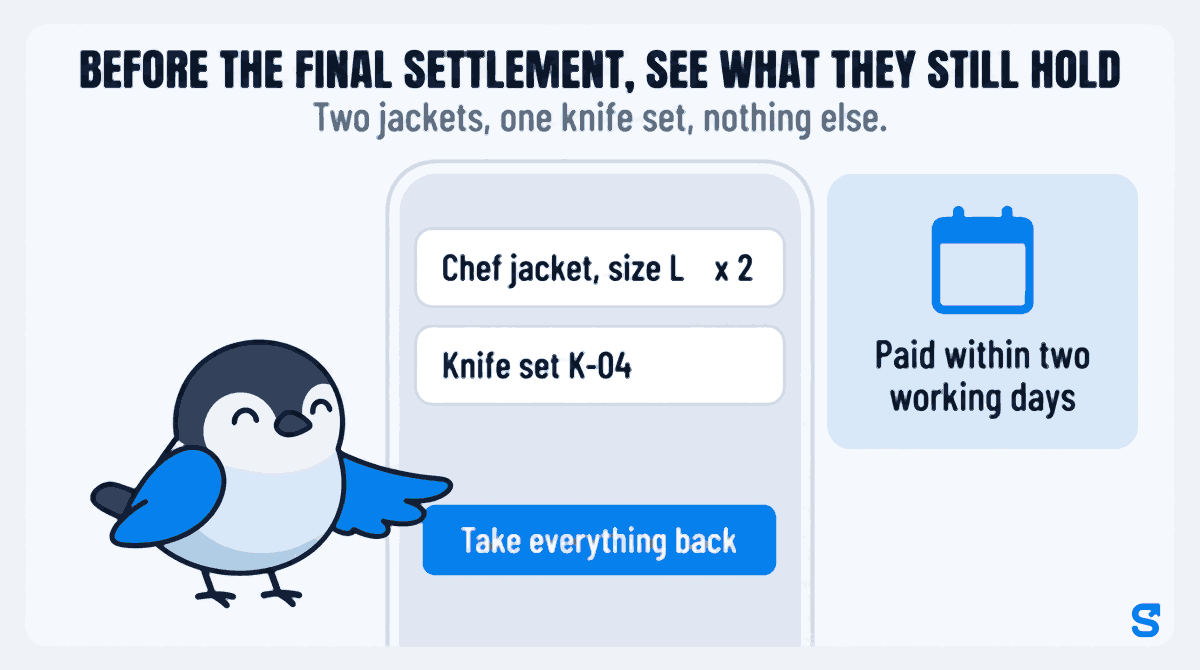
You now have what you need for the settlement inside the two working days: what came back, what did not, what it cost, and a dated record that it was given to that person. The rest of the settlement, notice pay, leave and dues, is covered in our guide to full and final settlement rules.
The register also keeps a count of people who have already left and are still holding something, so a waiter who walked out without a word does not quietly disappear from the list.
Counting the store once a month
Records drift. Once a month, or before the season starts, count what is actually on the shelf. Open the count on a phone and scan the QR labels on the knife rolls and tablets, or type the tag if a label has worn off. The count keeps working in a basement store with no signal and sends the scans when the phone is back in range. At the end it tells you what was expected and not found, which is your list of questions for the next morning.
Who at the outlet can do what
The person handing out jackets at the start of a shift does not need to know what the jackets cost or be able to delete the list. In Shiftelio these are separate ticks on a manager's role:
- Issue & return: the day-to-day counter job. It does not let them add items or change prices.
- Add & edit items: adding new stock and retiring old stock.
- See what things cost: without it the register still works, the money columns are simply not there.
If you run more than one outlet, a manager limited to certain sites only sees the items kept at those sites. The head chef at one branch manages that branch's knife sets and nobody else's. Our article on staff across several restaurant outlets covers how the same people are rostered and paid across branches.
A register only works if handovers are recorded at the counter, when they happen. A list filled in on Sunday night from memory is a spreadsheet with extra steps, and it will not survive the first argument.
Which app tracks restaurant uniforms and equipment on the staff's own phone?
Common questions
Can I deduct the cost of an unreturned uniform from a waiter's final settlement?
Only if the uniform was expressly entrusted to that waiter and the loss is down to their neglect or default, under Section 18(2)(c) of the Code on Wages, 2019. The deduction cannot exceed the actual loss, and under Section 21 the waiter must first be given an opportunity to show cause. A dated record of what you issued to that person is what makes the first condition provable. This is general information, not legal advice.
How long do I have to pay a restaurant worker who leaves?
Under Section 17(2) of the Code on Wages, 2019, in force since 21 November 2025, wages due to a person who leaves must be paid within two working days of their last working day. That is why the list of what they hold needs to be ready on the day they go.
Do staff have to accept an item when it is issued?
No. Issuing is final in Shiftelio. The only step that needs a confirmation is one member of staff handing an item to another, because nobody neutral is watching that handover.
Can I track uniforms by size?
Yes. Add each size as its own counted item with a quantity and a low-stock number. The register shows how many are in the store, how many are with people, and who holds how many.
Does it work if the store room has no signal?
The monthly count does. Scans are kept on the phone and sent when it is back in range.
Keep reading
Free to use, no signup: HR letter formats.