Employing Anyone Under 18 in India: The Adolescent Rules the Labour Codes Did Not Touch
In short
A 17 year old cannot work past 7 pm, cannot do overtime, and cannot work three hours without a break. The rules the labour codes deliberately left standing.
A seventeen year old walks into your restaurant looking for work. He has an Aadhaar card, he is willing, his parents are fine with it, and you need someone on the evening shift. Everything about that transaction feels ordinary, and almost every part of it is regulated by a statute most employers assume the labour codes swept away.
They did not. The Child and Adolescent Labour (Prohibition and Regulation) Act, 1986 is not one of the thirteen enactments repealed by section 143(1) of the Occupational Safety, Health and Working Conditions Code, 2020. It is still a live, standalone Act. And the OSH Code does something stranger than leaving it alone: in section 25(4) it explicitly hands the working hours of anyone under eighteen straight back to it.
So the eight hour day you have read about all year is not the rule for a seventeen year old. The rule is five hours, inside a six hour window, ending at 7 pm, with no overtime at all. Here is the whole of it.
The two ages the law cares about, and neither one of them is eighteen
Indian law does not have a single working age. It has a child, an adolescent and an adult, and the boundaries fall in different places from the ones most people carry in their heads.
A child is a person who has not completed his fourteenth year of age, or such age as may be specified in the Right of Children to Free and Compulsory Education Act, 2009, whichever is more. An adolescent is a person who has completed his fourteenth year but has not completed his eighteenth. An adult, under section 2(1)(b) of the OSH Code, is a person who has completed his eighteenth year. The OSH Code does not define adolescent for itself at all: section 2(1)(a) simply imports the meaning from clause (i) of section 2 of the 1986 Act, which is the first sign that the Code intends the older statute to keep running.
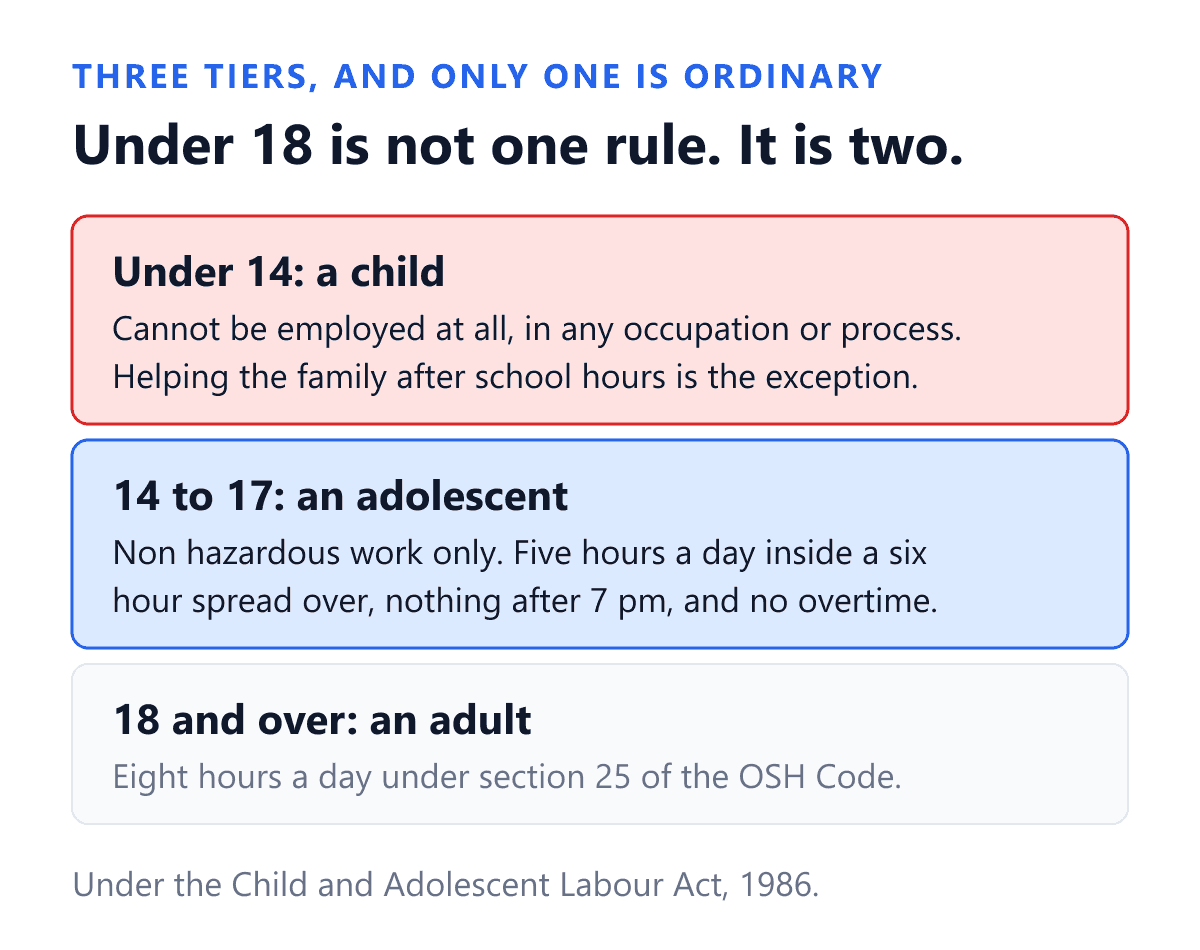
Section 3 of the 1986 Act is absolute for the first tier: no child shall be employed or permitted to work in any occupation or process. The two exceptions are narrow and are not employment as a business understands it. A child may help his own family or family enterprise, which must itself be non-hazardous, after school hours or during vacations. And a child may work as an artist in audio visual entertainment, including advertisements, films and television serials, but expressly not the circus, subject to prescribed conditions and provided the work does not affect his school education. Neither exception describes a person on your payroll.
Section 3A governs the second tier and is where employers actually operate: no adolescent shall be employed or permitted to work in any of the hazardous occupations or processes set forth in the Schedule. Outside the Schedule, an adolescent may be employed, and Part III of the Act then tells you how.
What the labour codes repealed, and what they left standing
This is worth spelling out because the mistake is so easy to make. Until the codes came into force, an employer looking for the rules on young workers in a factory looked at the Factories Act, 1948, which carried its own chapter: certificates of fitness, the token a young person had to carry, a four and a half hour ceiling, a register of child workers.
Section 143(1) of the OSH Code repealed the Factories Act, 1948 outright, along with the Mines Act, the Plantations Labour Act, the Contract Labour Act, the Inter-State Migrant Workmen Act, the Building and Other Construction Workers Act and eight more. That chapter is gone.
The 1986 Act is not on the list. What actually happened, then, is a narrowing rather than a replacement: the factory-specific machinery for young persons was repealed, and the general Act that applies to every establishment survived to carry the whole load.
Section 25(4) of the OSH Code, in full: “Notwithstanding anything contained in this section, the working hours of an adolescent worker shall be regulated in accordance with the provisions of the Child and Adolescent Labour (Prohibition and Regulation) Act, 1986.” A notwithstandingclause is not a cross reference. It is the Code standing its own eight hour day down in favour of somebody else’s rule.
There is a second consequence, and for this site’s readers it is the bigger one. The 1986 Act has no size threshold. The OSH Code reaches establishments with ten or more workers. The 1986 Act defines an establishment to include a shop, a commercial establishment, a workshop, a farm, a residential hotel, a restaurant, an eating house, a theatre or other place of public amusement. A four-person tea shop is outside the OSH Code entirely and squarely inside sections 3A, 7, 8 and 11 of the 1986 Act. The businesses most likely to employ a seventeen year old are the businesses least likely to have been told any of this.
The five hour day, worked out from section 7
Section 7 has six sub-sections and they are usually quoted two at a time, which is how the actual ceiling gets lost. Read together:
- No adolescent shall be required or permitted to work in excess of such number of hours as may be prescribed for that establishment or class of establishments.
- No period of work shall exceed three hours, and no adolescent shall work more than three hours before he has had an interval for rest of at least one hour.
- The period of work shall be so arranged that, inclusive of that rest interval, it shall not be spread over more than six hours, including the time spent waiting for work on any day.
- No adolescent shall be permitted or required to work between 7 p.m. and 8 a.m.
- No adolescent shall be required or permitted to work overtime.
- No adolescent shall work in any establishment on any day on which he has already been working in another establishment.
Now do the arithmetic that the summaries skip. Sub-section (3) caps the total spread over at six hours. Sub-section (2) makes one of those hours a compulsory rest, because you cannot reach the six hour limit without having worked more than three. Six hours of clock, minus one hour of rest, leaves five hours of actual work, and the longest single stretch inside it is three. That is the real ceiling, and it is not the number anybody prints.
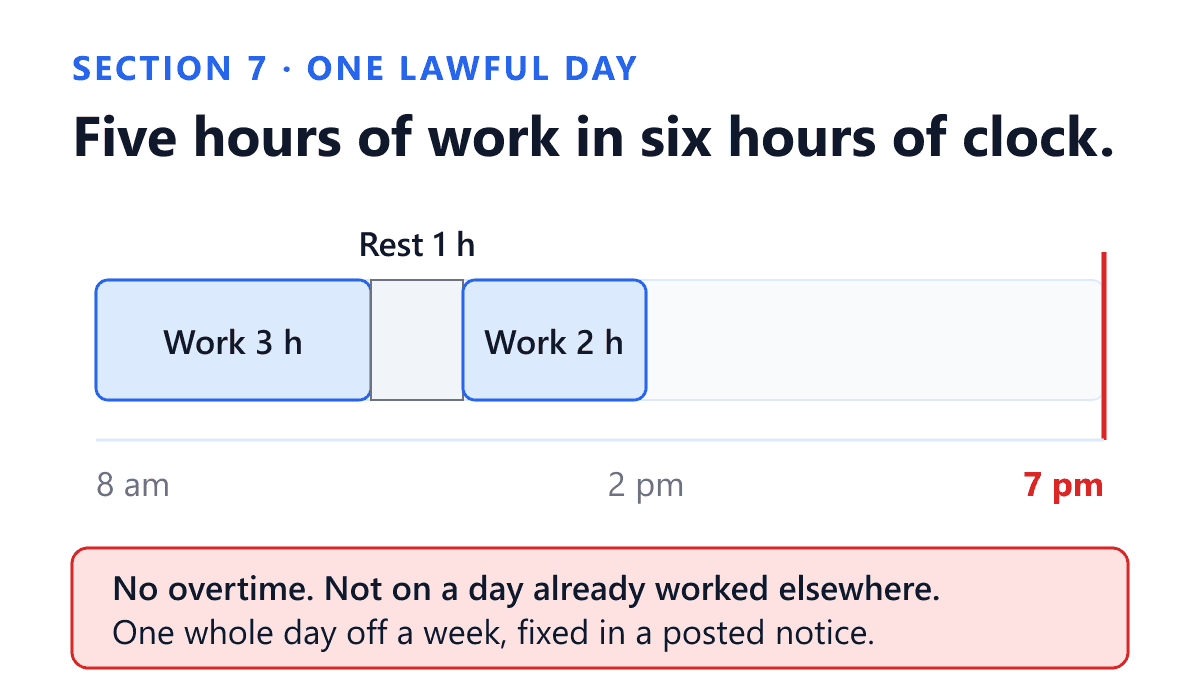
Two details in sub-section (3) deserve attention because they are where an honest roster still fails. The spread over includes time spent waiting for work, so a person told to come in at 8 a.m. and stand around until 9 a.m. has already spent an hour of the six. And the six hours are a spread, which means a split shift is almost impossible: a morning block and an evening block that are five hours apart blow the limit before either block is counted.
The 7 p.m. wall is the one that catches restaurants
Sub-section (4) is the provision most often breached and most easily proved. An adolescent may not work between 7 p.m. and 8 a.m. Not with consent, not with parental permission, not at time and a half, and not because the evening rush is the reason you hired him. In hospitality, retail and food delivery, the shift a young person is most likely to be offered is exactly the shift the statute forbids.
And sub-section (5) removes the usual pressure valve entirely. Overtime is not merely discouraged for an adolescent, it is prohibited, which means the whole apparatus of double-rate overtime pay under the OSH Code is simply unavailable here. If you are relying on it, our guide to how overtime is calculated in India explains the adult rule that does not apply to this worker.
Sub-section (6) is worth a second read too. An adolescent may not work in your establishment on a day he has already worked in another one. Nobody can police that perfectly, but it is a real duty, and the practical response is to ask the question at hiring and record the answer, rather than to discover it during an inspection.
The weekly holiday, and the notice nobody posts
Section 8 gives every adolescent employed in an establishment a holiday of one whole day in each week. Two conditions attach to it that ordinary weekly-off practice does not satisfy. The day must be specified by the occupier in a notice permanently exhibited in a conspicuous place in the establishment. And the day so specified shall not be altered more than once in three months.
A rota that moves a young person’s day off around each week to suit the roster is therefore not compliant, however fair it feels. This is stricter than the adult position under the OSH Code, which our article on weekly offs and compensatory offs works through, and the difference is exactly the fixed, posted, quarterly-stable day.
Section 9 adds a filing. Every occupier who employs or permits an adolescent to work must, within thirty days of that employment, send the local Inspector a written notice giving the name and situation of the establishment, the name of the person in actual management, the address for communications, and the nature of the occupation or process carried on. It is one letter, it is due once per establishment rather than per hire, and virtually nobody sends it.
Two exclusions worth knowing. Section 9(3) puts sections 7, 8 and 9 aside for an establishment where the process is carried on by the occupier with the aid of his own family, and for a school established by or receiving assistance or recognition from government. Section 6 confines the whole of Part III to establishments in which none of the section 3A hazardous processes is carried on, for the obvious reason that where such a process is carried on, an adolescent may not be there at all.
The register that has to carry times, not ticks
Section 11 requires every occupier to maintain, in respect of every adolescent employed or permitted to work, a register available for inspection by an Inspector at all times during working hours, showing four things:
- the name and date of birth of every adolescent so employed;
- the hours and periods of work of any such adolescent, and the intervals of rest to which he is entitled;
- the nature of the work of any such adolescent; and
- such other particulars as may be prescribed.
Read the second bullet against a normal Indian muster roll and the problem is immediate. A muster roll records a day as present or absent. This register has to record periods and intervals, which are clock times: in at 8:02, break from 11:00 to 12:00, out at 14:00. There is no way to satisfy section 11 from a register that only knows P and A, and an inspector who asks whether the rest interval was a full hour on 14 August is asking a question a tick cannot answer.
Separately, section 33(a) of the OSH Code requires every employer to maintain a register of prescribed particulars of workers which expressly includes, at clause (vi), employment of adolescent alongside hours of work, the weekly day of rest, wages, leave, overtime and attendance. So for an establishment of ten or more there are two duties pointing at the same record, from two different statutes, with two different penalty scales behind them. Our guide to the statutory registers and wage slips the labour codes now require covers the wider set that this one sits inside.
Proving the age, before you need to
Section 10 handles the dispute directly: if a question arises between an Inspector and an occupier as to the age of a person employed, then in the absence of a certificate as to age granted by the prescribed medical authority, the Inspector refers the question to that authority for decision. Note where the burden falls. Without a document, the answer is decided by somebody else, on a body, months later.
The Child Labour (Prohibition and Regulation) Amendment Rules, 2017, notified on 2 June 2017, set the order in which age is established, and it is a strict hierarchy rather than a menu:
| Order | Document | Used when |
|---|---|---|
| First | Aadhaar card of the adolescent | Always, if it exists |
| Second | Date of birth certificate from the school, or the matriculation or equivalent certificate from the examination Board | In the absence of Aadhaar |
| Third | Birth certificate issued by a corporation, municipal authority or panchayat | In the absence of both of the above |
| Last | Ossification test or other latest medical age determination test | Only where none of the above exists |
The operational reading is short. Take a copy of the Aadhaar at hiring, put the date of birth on the employee record rather than in a drawer, and the question never reaches section 10 at all. A separate obligation runs alongside it: the OSH Code, at section 43(2)(c), makes the examination and certification of an adolescent, to ascertain his fitness for employment in any work likely to cause injury to his health, one of the statutory duties of the medical officer.
Do not skip the display duty either. Section 12 requires every occupier to display, in a conspicuous and accessible place at the place of work, a notice in the local language and in English containing an abstract of sections 3A and 14. It is a printed sheet on a wall, and it is the cheapest item on this entire list.
What it costs when it goes wrong
The penalties split into two very different tiers, and the gap between them is the single most useful thing to understand about this Act.
| What went wrong | Provision | Consequence |
|---|---|---|
| Employing an adolescent in a hazardous occupation or process in the Schedule | Section 14(1A) | Imprisonment of not less than six months, up to two years, or fine of Rs 20,000 to Rs 50,000, or both |
| Employing a child under 14 in any occupation | Section 14(1) | Same range: six months to two years, or Rs 20,000 to Rs 50,000, or both |
| A second offence under section 3 or section 3A | Section 14(2) | Imprisonment of six months to two years. The fine option disappears. |
| Breaching the hours, the weekly holiday, the notice or the register | Section 14(3)(d) | Simple imprisonment up to one month, or fine up to Rs 10,000, or both |
| The same register, viewed as an OSH Code contravention (10+ workers) | OSH Code section 94 | Rs 2,00,000 to Rs 3,00,000, plus up to Rs 2,000 a day if it continues |
Two things fall out of that table. First, the money on the 1986 Act is small and the criminal exposure is not: a repeat offence under section 3A carries a mandatory minimum of six months’ imprisonment with no fine alternative, which is an outcome no fine schedule prepares an owner for. Section 14B routes the fine into a Child and Adolescent Labour Rehabilitation Fund, to which the appropriate Government adds Rs 15,000 per child or adolescent.
Second, look at the last row. The record-keeping breach that costs Rs 10,000 under the 1986 Act costs a minimum of Rs 2 lakh under the OSH Code once you have ten workers, because section 94 is a residual penalty that catches any contravention of the Code not otherwise provided for. The register is the cheap duty with the expensive failure mode. Our piece on what actually happens in a labour inspection covers how that gets found.
The eighteenth birthday is a switch, and it is a date
Everything above stops on one day. On the morning a person completes his eighteenth year he becomes an adult under section 2(1)(b) of the OSH Code, and the five hour ceiling, the 7 p.m. wall, the overtime ban, the fixed posted weekly holiday and the separate register all fall away at once. His leave accrual changes too: section 32(1)(ii) of the OSH Code gives an adolescent one day of leave for every fifteen days worked, against one for every twenty for an adult, so the entitlement that was more generous becomes less generous on the same date. The leave rules under the labour codes set out the adult position that takes over.
That is an unusually sharp compliance edge. Roster a seventeen year old for an evening shift the day before and you have a criminal contravention. Keep restricting him a month after the birthday and you are paying for restrictions the law stopped requiring. Both errors have the same cause: nobody knew the date.
This is a records problem before it is a compliance problem
Step back and look at what section 7 and section 11 are actually asking for. Not a policy, not an undertaking, not a signed form. Clock times. Did any single period of work exceed three hours. Was there a full hour of rest after three. Did the spread over, including waiting time, exceed six hours. Did any minute of work fall after 7 p.m. or before 8 a.m. Was the weekly holiday the same posted day it was last month.
Every one of those is a question about a timestamp, asked months later by someone holding your register. A business that records attendance as a tick in a column, a WhatsApp message, or a supervisor’s memory has no way of answering any of them, and the answer it gives under pressure will be a reconstruction. Our article on why a WhatsApp attendance group cannot survive an audit is about exactly this failure in the adult case, and the adolescent case is the same failure with a criminal provision behind it.
What a system buys you here is narrow and specific. In Shiftelio a check-in and a check-out are timestamps rather than marks, the break sits between them as its own interval, and the employee record carries a date of birth, which means the person who is still seventeen next Tuesday is a filter rather than a memory. That turns section 11 from a register somebody has to remember to write into a report drawn from what already happened, and it turns the eighteenth birthday from a thing you hope somebody notices into a date in the same record as the roster. Our free attendance register template carries the same in, break and out columns if you would rather do it on paper first.
A worked example: a seventeen year old in a coffee shop
A twelve-person coffee shop wants to hire a seventeen year old. The work is not a hazardous process, so section 3A does not bar him, and Part III applies. Twelve workers also puts the shop inside the OSH Code.
| The plan | Verdict | Why |
|---|---|---|
| 4 p.m. to 10 p.m., six days a week | Unlawful | Three hours of it fall after 7 p.m., section 7(4). Nothing rescues it. |
| 9 a.m. to 3 p.m. with a 30 minute lunch | Unlawful | The break must be a full hour after three hours, section 7(2), and the spread over is six with only 30 minutes of rest inside it. |
| 8 a.m. to 11 a.m., one hour off, 12 noon to 2 p.m. | Lawful | Five hours of work, no stretch over three, a full hour of rest, six hour spread over, all before 7 p.m. |
| The same day, plus two hours at a busy weekend | Unlawful | Overtime is prohibited outright by section 7(5), at any rate of pay. |
So the offer letter says five hours, mornings, a fixed weekly day off named in a notice on the wall, and no evenings. The Aadhaar copy goes on file at hiring. One letter goes to the Inspector within thirty days. The attendance record keeps times rather than ticks. That is the entire compliance burden, and it costs an afternoon once.
The document that has to carry the terms is now mandatory for every worker anyway, which our piece on the appointment letter the labour codes made compulsory covers in full.
One more place the line is drawn differently
Mines are their own answer and the answer is stricter. Section 70(1) of the OSH Code says no person below eighteen years of age shall be allowed to work in any mine or part of one. Sub-section (2) opens a single narrow door: apprentices and other trainees not below sixteen may be allowed to work under proper supervision, and for trainees other than apprentices the prior approval of the Chief Inspector-cum-Facilitator or an Inspector-cum-Facilitator must be obtained first. That is the only route, and it is a training route, not an employment one.
What to do this week
- List everyone on your books under eighteen. If the date of birth is not on the employee record, that is the first gap, not a detail.
- Check the Schedule. If the work is a hazardous occupation or process, section 3A ends the discussion and the person has to be moved.
- Re-cut the shift. Five hours of work, no block over three, a full hour of rest, everything between 8 a.m. and 7 p.m., and no overtime at any price.
- Fix the weekly holiday to a named day, put it on a notice on the wall, and do not move it more than once a quarter.
- Send the section 9 notice to your local Inspector if you have not, and keep the acknowledgement.
- Start the section 11 register with dates of birth, clock times and rest intervals, not ticks. If your attendance system already has the timestamps, this is a report and not a new book.
- Diarise every eighteenth birthday, because that is the date the restrictions end.
For the wider picture, our labour code compliance checklist for 2026 runs through the obligations in the order they bite, and the rules on women working night shifts covers the other place where a shift after dark carries conditions rather than a simple yes.
Sources
The Occupational Safety, Health and Working Conditions Code, 2020 was read from the bare Act as published: section 2(1)(a) and 2(1)(b), section 25(1) and 25(4), section 32(1)(ii), section 33(a), section 43(2)(c), section 70, section 94 and the section 143(1) repeal list. The arrangement of the Code and the statutes it subsumes is set out by PRS Legislative Research.
The Child and Adolescent Labour (Prohibition and Regulation) Act, 1986 is published by the Office of the Chief Labour Commissioner (Central), Ministry of Labour and Employment. The Child Labour (Prohibition and Regulation) Amendment Rules, 2017, which set the order of age proof, were notified by the Ministry of Labour and Employment on 2 June 2017. Complaints and enforcement run through the government’s PENCIL portal.
Where a reproduction of the 1986 Act conflicted with another, the section was checked against a second independent copy before being used. One widely republished text prints section 7(4) as “between 7 p.m. and 8 p.m.”; the correct reading, confirmed against a second source, is 8 a.m.
This is general information about Indian labour law as it stands in September 2026, not legal advice. Part III of the 1986 Act commences by notification and may differ by State and by class of establishment, several States have their own rules on top, and the Schedule of hazardous occupations is amendable by notification. Check the current position for your State and your establishment, or take advice, before rostering anybody under eighteen.
Keep reading
See how Shiftelio does this in practice with the timestamped attendance record a rest interval is proved from.
Work your own numbers with the free attendance register template. No signup, no email.