Apprenticeship Is Mandatory at 30 Workers in India, and Your Industry Was Probably Just Added
In short
IT, retail, hospitality and healthcare came inside the Apprentices Act in September 2025. At 30 workers the 2.5 percent quota binds. Here is the full rule.
A forty person software company in Pune has spent 2026 doing what every other employer has been doing: reading about the four labour codes, restructuring salaries so that basic pay clears half of CTC, issuing appointment letters, and working out which of its people are workers and which are not. Twenty nine laws became four codes. The compliance map felt, at last, finished.
It is not finished, and the gap is not a detail. The Apprentices Act, 1961 is not one of the enactments the four codes subsumed. It is a live, standalone statute with its own Adviser, its own portal, its own inspection power and its own penalty section. And in September 2025 the Government did something to it that almost no employer in India noticed: it rewrote the list of industries the Act applies to, and put that software company inside it.
The Act the labour codes left standing
Everything you have read this year about consolidation is true and none of it touches this. The Code on Wages subsumed four Acts, the Industrial Relations Code three, the Social Security Code nine, the Occupational Safety, Health and Working Conditions Code thirteen. The Apprentices Act appears on none of those repeal lists, and neither does the Sexual Harassment of Women at Workplace Act, 2013 that our POSH committee article covers for the same reason.
So an employer working from a labour code checklist alone has a blind spot exactly the shape of this statute. Our own labour code compliance checklist has it too, because a checklist built from the codes can only contain what the codes contain.
Why your industry is new to this, and section 1(4)(a) is why
The Apprentices Act does not apply to everybody by default, and this is the provision that decides it. Section 1(4)(a):
“The provisions of this Act shall not apply to any area or to any industry in any area unless the Central Government by notification in the Official Gazette specifies that area or industry as an area or industry to which the said provisions shall apply with effect from such date as may be mentioned in the notification.”
Read that twice, because it inverts the usual reading. The Act is opt in by notification. The schedule of specified industries is not a footnote to the applicability question; it is the applicability question. And that schedule had not been rewritten since 1999, which is why apprenticeship has spent a generation being understood as a manufacturing obligation. For most of the service economy that understanding was correct.
On 3 September 2025 the Ministry of Skill Development and Entrepreneurship replaced the 1999 schedule with one aligned to the National Industrial Classification, 2008, by notification S.O. 4072(E). The reported effect is that agriculture, mining, information technology and software services, telecommunications, retail, hospitality, healthcare, financial services and more are now specified industries. On the same date the Ministry notified the Apprenticeship (Amendment) Rules, 2025 by G.S.R. 610(E), published 11 September 2025. Both flow from the 38th meeting of the Central Apprenticeship Council.
That pairing matters. The Government did not merely raise stipends in September 2025; it raised stipends and simultaneously widened the set of employers who have to pay them. If your business is a hotel, a hospital, a retail chain, a software firm, a bank, an NBFC or a logistics operation, the honest position is that this Act reached you a year ago and nothing arrived in the post to tell you.
Thirty workers, counted from a year you have already closed
Here is the first place the popular summaries go wrong. Section 8(1), as substituted by Act 29 of 2014, says only this: “The Central Government shall prescribe the number of apprentices to be engaged by the employer for designated trade and optional trade.” The Act itself contains no threshold and no percentage at all. Every number you are about to read lives in rule 7B of the Apprenticeship Rules, 1992, and rules move faster than Acts do.
Rule 7B(1), as substituted: “The employers having four or more workers shall only be eligible to engage apprentices and engagement of apprentices by establishment having thirty or more number of workers shall be obligatory.” That gives three tiers, and the bottom one surprises people: an establishment with three workers or fewer cannot engage an apprentice even if it wants to.
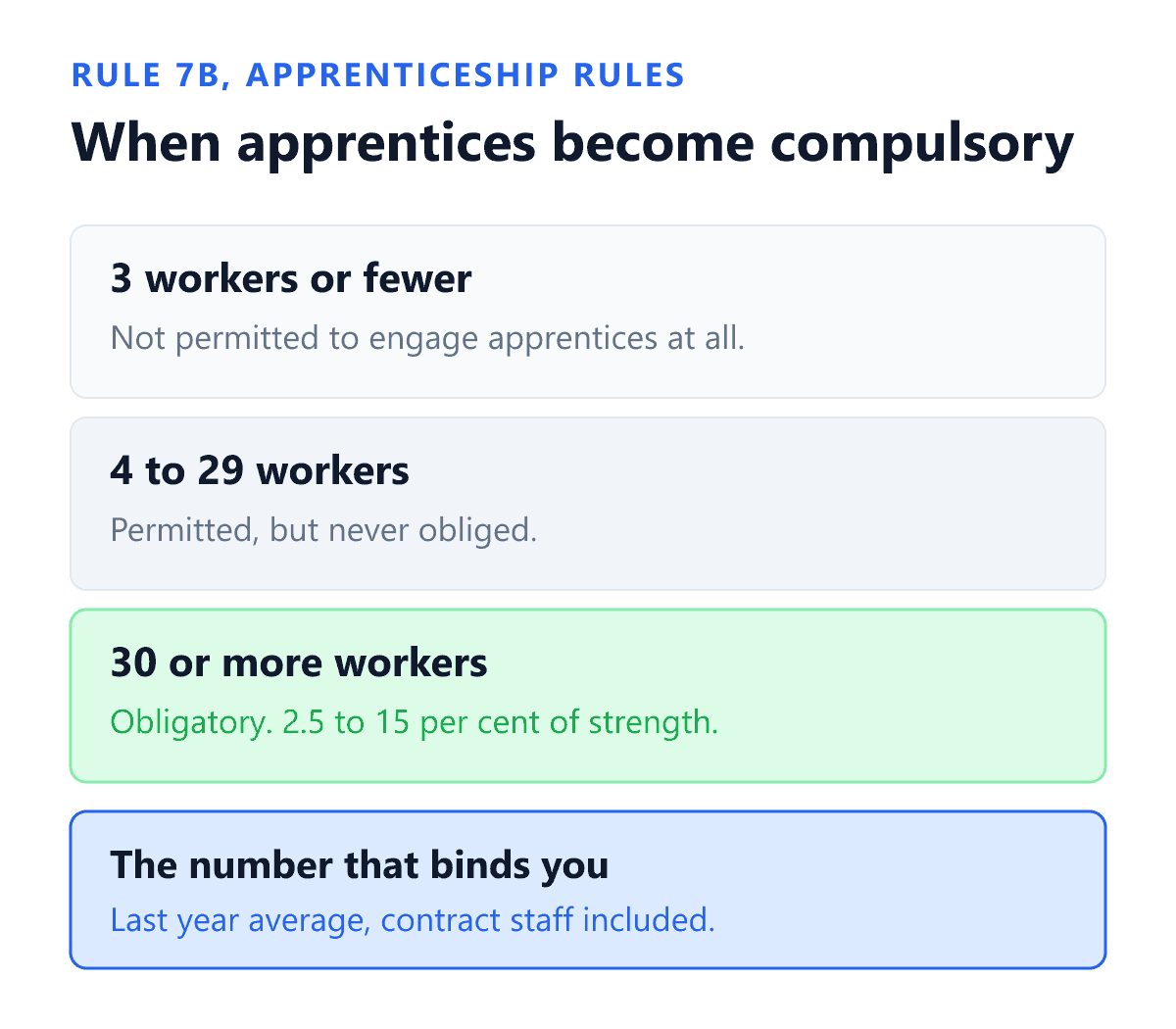
Now the sentence that almost nobody quotes. Rule 7B(2): “The strength of workers shall be calculated on the basis of average strength in the preceding financial year.”
So the number that decides whether you are obliged this year is an average across twelve months that are already closed. Not your headcount today, not your headcount on 1 April, and not the number on your PF return last month. A business that ran at thirty four people through most of FY 2025-26 and has since dropped to twenty six is obliged for FY 2026-27 anyway. A business that grew from twenty to forty in January is probably not obliged this year and will be next.
Contract staff count, and apprentices do not
Rule 7B(3) fixes the band at “2.5 per cent. to 15 per cent. of the total strength of the establishment including contractual staff”. The official Apprenticeship FAQ puts the same point the other way round: the mandate applies to establishments with a workforce of thirty or more comprising regular and contract employees, and the clarification it carries is that contractual employees must be on the roll of the company engaging apprentices.
This is the counting trap. An establishment with twenty four people on its own payroll and ten on a contractor bill is at thirty four, not twenty four, and it is obliged. If you are not sure who is on whose roll, our piece on contract labour rules for 2026 and the one on the principal employer liability for contract worker PF both turn on the same question, and getting it wrong there is more expensive than getting it wrong here.
Apprentices themselves are excluded from the count, which follows from section 18 and saves you from the circularity of apprentices creating the obligation to engage apprentices.
The quota is 2.5 to 15 per cent, and it is measured in apprentice months
Rule 7B(3) sets the annual band and reserves part of it: within a financial year each establishment engages apprentices in a band of 2.5 to 15 per cent of total strength, “subject to a minimum of 5 per cent. of the total to be reserved for fresher apprentices and skill certificate holder apprentices”. So the floor is not simply a number of bodies; a share of it has to be people with no prior training, which is the entire policy point of the scheme.
Rule 7B(4) then does something the summaries almost universally drop:
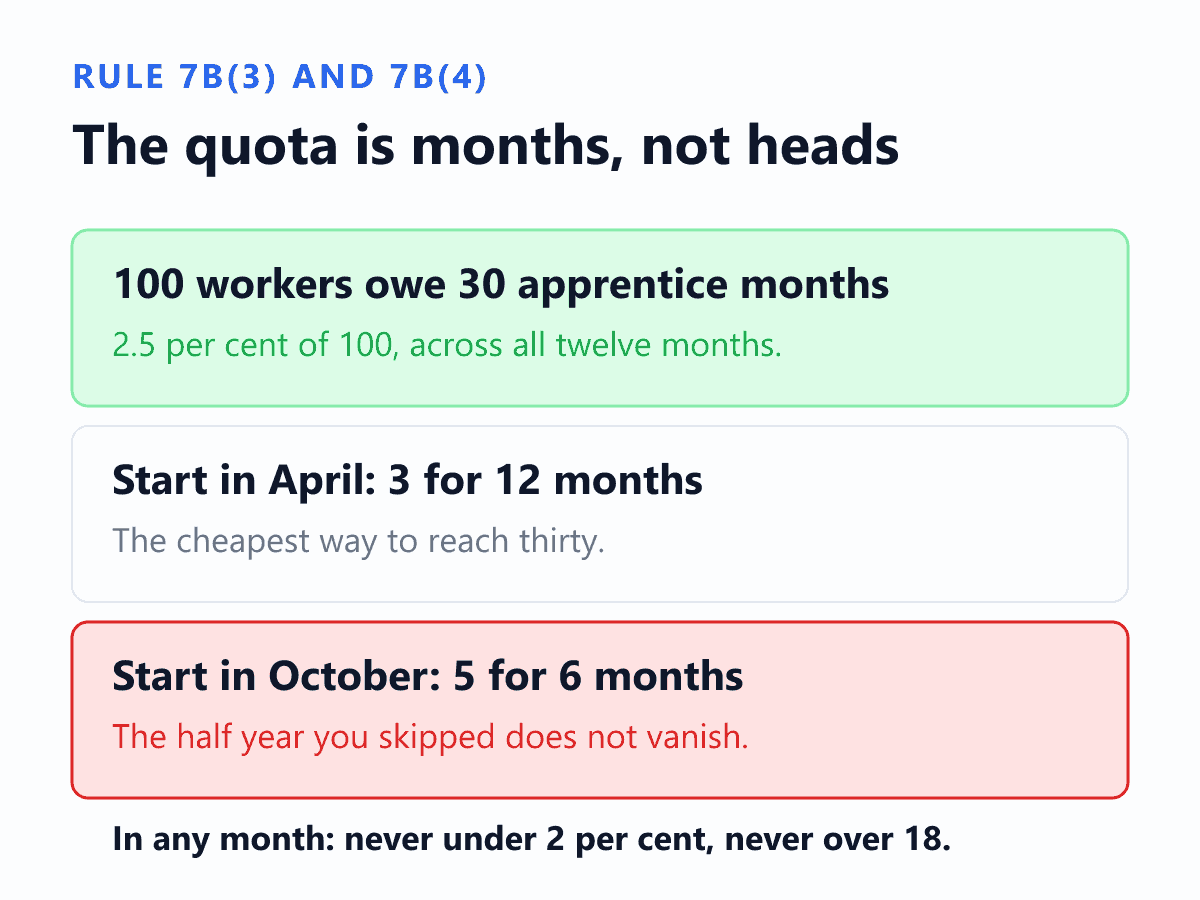
“In no month, number of apprentices should be less than 2 per cent. of the total strength of the establishment and more than 18 per cent. of the total strength of the establishment subject to the condition that he shall fulfill apprentice months corresponding to minimum 2.5 per cent. obligation in a financial year.”
The obligation is a quantity of apprentice months, not a headcount you can satisfy by having the right number of people on 31 March. Work it through for an establishment of one hundred. Two and a half per cent of one hundred is two and a half apprentices; across twelve months that is thirty apprentice months. An employer who started on 1 April meets it with three apprentices held all year. An employer who has let half the year go and starts on 1 October has six months left, and thirty apprentice months divided by six is five.
We are writing this in the second week of September 2026. For every establishment reading it, five months and a bit of FY 2026-27 are gone. That is the practical reason this is a September problem rather than a March one: the longer the delay, the more people you need at once, and the 18 per cent monthly ceiling eventually stops you catching up at all.
Rule 7B(5) adds a rhythm on top. Every employer must disclose their intention to engage apprentices, in designated and optional trades, on the portal each quarter: 1 April to 30 June, 1 July to 30 September, 1 October to 31 December, and 1 January to 31 March. The current quarter closes on 30 September.
What an apprentice costs in 2026
The stipend is not negotiable downward. Section 13(1) requires payment of a stipend at a rate not less than the prescribed minimum, and rule 11 of the Apprenticeship Rules sets that minimum by educational qualification rather than by minimum wage schedule. Those rates were raised by the September 2025 amendment and the new figures have been in force since 11 September 2025.
| Category of apprentice | Old rate | Rate from 11 Sep 2025 |
|---|---|---|
| School pass-outs, class 5th to class 9th | Rs 5,000 | Rs 6,800 |
| School pass-outs, class 10th | Rs 6,000 | Rs 8,200 |
| School pass-outs, class 12th | Rs 7,000 | Rs 9,600 |
| National or State Certificate holder | Rs 7,000 | Rs 9,600 |
| Technician (vocational) apprentice, vocational certificate holder, or sandwich course from a diploma institution | Rs 7,000 | Rs 9,600 |
| Technician apprentice, diploma holder in any stream, or sandwich course from a degree institution | Rs 8,000 | Rs 10,900 |
| Graduate apprentice, degree apprentice, or degree in any stream | Rs 9,000 | Rs 12,300 |
Three adjustments sit on top of that table and each one moves real money.
- Year two is plus 10 per cent, year three a further 15 per cent. The increase is on the prescribed minimum, so it compounds off the new figures rather than the old ones.
- A fresher in basic training is paid half. For a period of up to three months of basic training, the establishment pays 50 per cent of the prescribed stipend. If basic training runs simultaneously with on the job training, the full amount is due.
- Apprentices already on training on 11 September 2025 moved to the new rate. The Ministry clarified this in October 2025: a contract that straddles the date carries two rates, and the portal generates an addendum automatically. If you were engaging apprentices before that date and never applied it, you have arrears.
What the Government pays back
Under the National Apprenticeship Promotion Scheme the Government reimburses 25 per cent of the prescribed stipend, capped at Rs 1,500 per apprentice per month, claimed quarterly. Note the interaction with the new rates: at Rs 9,600 a month, 25 per cent is Rs 2,400, so the cap binds and you recover Rs 1,500. The stipend rise of September 2025 was not matched by a rise in the cap, so the employer share went up in real terms.
Basic training cost is reimbursed separately to the basic training provider, up to Rs 7,500 per apprentice for a maximum of 500 hours. Under the National Apprenticeship Training Scheme, which covers graduate, technician and technician (vocational) apprentices through the Boards of Apprenticeship Training, the same prescribed minimums apply and the cost is split half and half with the Government, disbursed directly to the apprentice by DBT.
An apprentice is not a worker, and that cuts both ways
Section 18 is short and it is the reason this whole arrangement is affordable:
“Save as otherwise provided in this Act, (a) every apprentice undergoing apprenticeship training in a designated trade in an establishment shall be trainee and not a worker; and (b) the provisions of any law with respect to labour shall not apply to or in relation to such apprentice.”
An apprentice under the Act is outside the definition of employee in the EPF legislation and outside the definition of employee in the ESI legislation. No provident fund, no ESI, no gratuity, no statutory bonus. Compare that with a junior hire on the same monthly figure, where the employer side adds roughly 16 per cent before you get to bonus and gratuity accrual: twelve per cent EPF, half a per cent EDLI, half a per cent administration, and 3.25 per cent ESI. Our PF and ESI compliance checklist and the free PF and ESI calculator will give you the exact figure for your wage level.
That is the honest case for doing this, and it is a much better case than the penalty. But section 18 opens with save as otherwise provided in this Act, and what the Act otherwise provides is a set of restrictions that do not apply to an employee at all.
Three ways employers break this without noticing
- Piece rate and incentives are prohibited outright. Section 13(2): an apprentice shall not be paid on the basis of piece work, nor be required to take part in any output bonus or other incentive scheme. Section 30(2)(e) and (f) make each of those a fine of one thousand rupees for every occurrence. A per-order delivery incentive or a sales commission paid to an apprentice is an offence, and in retail and food delivery it is the default way of paying people.
- Overtime needs the Apprenticeship Adviser, not the apprentice. Section 15(2): no apprentice shall be required or allowed to work overtime except with the approval of the Adviser, who may only approve it if satisfied it is in the interest of the training or in the public interest. Consent from the apprentice buys nothing. Section 30(2)(c) fines it per occurrence.
- The apprentice must be doing the training. Section 30(2)(d) fines an employer who employs an apprentice on any work not connected with the training. An apprentice used as general cover on a short-staffed shift is the ordinary way this goes wrong.
Two further duties survive section 18 and are worth knowing. Section 16 makes the employer liable to pay compensation for personal injury to an apprentice arising out of and in the course of training, so the injury exposure our article on workplace accident compensation describes does not disappear. And section 22(2) is a trap in the contract: if the apprenticeship contract contains a condition that the apprentice will serve the employer after successful completion, the employer is bound to offer suitable employment on completion. Section 22(1) otherwise leaves you free, requiring only that you formulate your own recruitment policy for completing apprentices.
One curiosity, for completeness. Section 14 still applies Chapters III, IV and V of the Factories Act, 1948 to the health, safety and welfare of apprentices in a factory, and section 16 still points at the Workmen’s Compensation Act, 1923. Both of those statutes were repealed into the codes. The cross references have not been updated, which is what happens when an Act is left outside a consolidation exercise.
The tenth of the month, not the seventh
This one is small and it will catch a payroll team that assumes one deadline covers everybody. Rule 11(3) of the Apprenticeship Rules requires that the stipend for a particular month shall be paid by the tenth day of the following month, and that it shall be paid through the bank account of the apprentice.
The Code on Wages sets a different clock for wages, which our article on the salary payment deadline works through. So a business running one payroll cycle now has two statutory deadlines sitting on the same list of people, and the stipend one has a mandatory payment channel attached. Cash is not an option, and the Ministry reiterates the bank account requirement in the same memorandum that carries the new rates.
What actually happens if you engage nobody
Most articles on this subject reach for the penalty and stop. It is worth reading the actual section, because it does not work the way it is usually described.
Section 30(1), inserted by Act 29 of 2014: an employer who contravenes the provisions relating to the number of apprentices he is required to engage “shall be given a month’s previous notice in writing, by an officer duly authorised in this behalf by the appropriate Government, for explaining the reasons for such contravention”. Section 30(1A) only then applies, if the employer fails to reply within the specified period or the authorised officer, after giving an opportunity of being heard, is not satisfied with the reasons: “he shall be punishable with fine of five hundred rupees per shortfall of apprenticeship month for first three months and thereafter one thousand rupees per month till such number of seats are filled up”.
So the fine is not automatic, it is preceded by a notice and a hearing, and on any reading it is small. An establishment of one hundred short by three seats for a full year is looking at something in the region of twenty five to thirty thousand rupees, against a stipend bill several times that. If the only argument for compliance were the fine, the arithmetic would point the other way and it would be dishonest to pretend otherwise.
Three things the fine calculation leaves out. It runs until the seats are filled, so it does not extinguish the obligation, it accrues beside it. Section 32 makes the person in charge of the business personally liable alongside the company. And an establishment in default is not a candidate for the government skilling schemes, tenders and incentive programmes that ask for apprenticeship compliance as a precondition.
A worked example: an eighty person restaurant group
Eight outlets, seventy two people on payroll and eight on a housekeeping contractor bill. Average strength across FY 2025-26, contract staff included, was eighty. Restaurants and hospitality are inside the specified industries after the September 2025 notification, so the Act applies and eighty is well over thirty.
| Step | Figure | Where it comes from |
|---|---|---|
| Annual obligation, minimum | 2 apprentices | 2.5 per cent of 80, rule 7B(3) |
| Expressed as apprentice months | 24 apprentice months | 2 across 12 months, rule 7B(4) |
| Starting 1 October instead | 4 apprentices | 24 apprentice months over 6 months left |
| Monthly ceiling, so this is allowed | 14 apprentices | 18 per cent of 80, rule 7B(4) |
| Stipend, 4 class 12 pass-outs | Rs 38,400 a month | Rs 9,600 each, rule 11 as amended |
| Less NAPS reimbursement | Rs 6,000 a month | Rs 1,500 cap each, not 25 per cent |
| Net monthly cost | Rs 32,400 | No PF, no ESI, no gratuity, no bonus |
Now price the alternative. Four junior hires at the same Rs 9,600 cost Rs 38,400 in wages plus about Rs 6,240 of employer side PF and ESI, and they accrue statutory bonus and gratuity on top. Call it a little under Rs 50,000 a month against Rs 32,400. The four apprentices are roughly a third cheaper than the four hires the group was going to make anyway, and the group stops being in default of a statute it did not know applied to it.
That is the whole argument. Not the fine.
This is a headcount records problem before it is a skilling problem
Look again at what rule 7B actually asks you for. The average strength of your establishment across the preceding financial year, including contract staff on your rolls. The number of apprentices in every single month, tested against a 2 per cent floor and an 18 per cent ceiling. The total apprentice months accumulated so far this year against the 2.5 per cent target. A quarterly declaration of intent.
Every one of those is a question about headcount over time, and headcount over time is the number almost no small business can produce. Most owners can tell you who is on the payroll this morning. Very few can tell you the average of the last twelve closed months, and fewer still can separate the contract staff who count from the ones on somebody else’s roll who do not. The compliance failure here is rarely a refusal; it is that the number that triggers the duty is invisible.
What a system buys you here is narrow and specific. In Shiftelio every employee record carries a join date and an exit date, contract staff are a category rather than a note, and the headcount for any past month is a query rather than a reconstruction from bank statements. That turns “what was our average strength last financial year” from an afternoon of archaeology into a number, which is the number this rule is built on. Apprentices themselves need to sit in the record as their own category too, because they are on your roster and in your attendance every day and must never appear on your PF or ESI filing. If they are typed as employees, those two records will contradict each other, and our article on the statutory registers explains why contradiction between records is the thing inspections find.
What to do before this quarter closes
- Work out your average strength for FY 2025-26, counting contract staff on your rolls and excluding any apprentices. That single number decides whether anything below applies to you.
- Check whether your industry is now specified. After the September 2025 notification the answer is yes far more often than employers expect, particularly in IT, retail, hospitality, healthcare and financial services.
- Do the apprentice month arithmetic, not the headcount arithmetic. Multiply 2.5 per cent of strength by twelve, then divide by the months left in this financial year.
- Register on the national apprenticeship portal and file the quarterly declaration of intent. This quarter ends on 30 September.
- Reserve part of the obligation for freshers and skill certificate holders, which rule 7B(3) requires and which also unlocks the basic training reimbursement.
- Fix the stipend at the current prescribed minimum, and if you were engaging apprentices before 11 September 2025, check whether you owe arrears at the revised rate.
- Set the stipend run for the tenth, paid to bank accounts, and take apprentices out of any piece rate or incentive scheme they are currently in.
- Read your contract template before signing it. A clause requiring the apprentice to serve you after training binds you to offer employment under section 22(2).
If you are also working through the other thresholds that arrive as a business grows, our guides to the grievance redressal committee at twenty workers and the canteen duty at one hundred sit either side of this one on the same ladder.
Sources
The Apprentices Act, 1961 was read from the bare Act as published by the Board of Apprenticeship Training (Western Region), a body of the Ministry of Education. Sections quoted or relied on: 1(4)(a), 8(1) and 8(2) as substituted by Act 29 of 2014, 9(4), 13(1) and 13(2), 14, 15(1) and 15(2), 16, 18, 19, 22(1) and 22(2), 30(1), 30(1A), 30(2) and 32.
The revised stipend table, the G.S.R. 610(E) reference, the 11 September 2025 effective date, the treatment of apprentices already on training, the rule 11(3) tenth-of-the-month deadline and the bank account requirement are from Government of India Office Memorandum File No. DGT-36/1/2021-AP dated 15 September 2025 and its clarification dated 15 October 2025, both issued by the Apprenticeship Training Division of the Ministry of Skill Development and Entrepreneurship and published on the national apprenticeship portal. Rule 7B(1) to 7B(5), the fresher reservation, the monthly 2 and 18 per cent limits, the apprentice month sentence, the preceding financial year averaging rule, the stipend increments for years two and three, the 50 per cent basic training rate and the NAPS reimbursement terms are from the official Apprenticeship FAQ published on the same portal. Registration and returns run through apprenticeshipindia.gov.in.
One item is reported rather than quoted. The text of S.O. 4072(E) of 3 September 2025 was not obtained from the gazette for this article. Its number, date and effect are reported by S.S. Rana & Co.and are consistent with the Ministry’s own memorandum, which records that the Council notified amendments to the Apprenticeship Rules and the applicability of the Act to specified groups of industries together. No sector by sector schedule is printed here for that reason.
This is general information about Indian law as it stands in September 2026, not legal advice. The appropriate Government under section 2(d) differs by establishment, State Apprenticeship Advisers administer the Act differently, and both the schedule of specified industries and the Apprenticeship Rules are amendable by notification at any time. Check the current position for your establishment with your State Apprenticeship Adviser, or take advice, before deciding you are outside this Act.
Keep reading
See how Shiftelio does this in practice with the headcount rule that decides which labour law applies to you.
Work your own numbers with the free PF and ESI calculator. No signup, no email.