Multi-Outlet Retail Attendance in India: Four Shops Do Not Give One Person Four 48-Hour Weeks
In short
A salesperson who covers at your other branch worked one week, not two. Both sheets say eight hours. Section 14 reads the person, not the premises.
A saree retailer in Chennai runs four shops. Anna Nagar, Velachery, T. Nagar and a small one in Porur that opened last year. Twenty six staff across the four, most of them attached to one shop, a handful who float. Each shop keeps its own attendance sheet in a register behind the counter, and the owner collects photographs of the four sheets on WhatsApp at the end of the month.
On a Saturday night in October the Velachery supervisor calls: two of the four Sunday staff are down with fever, and the Sunday before Deepavali is the biggest day of the quarter. The owner does the obvious thing. She messages a salesperson from Anna Nagar, who is off on Sunday, and asks her to come to Velachery for the day. The salesperson says yes. The Velachery sheet records her eight hours. The Anna Nagar sheet records her as off.
Nobody in that sequence has done anything unusual, and nobody has been dishonest. Both sheets are accurate, and both are inside the daily cap. But the two sheets together describe a person who worked fifty six hours in one week with no rest day in it, and there is no line anywhere in the owner’s records that says so. That is the multi-outlet problem, and it is not a paperwork problem. It is a bill.
Four shops do not give you four weeks
Start with the assumption almost every multi-outlet owner is running on, usually without having noticed they hold it: that each shop has its own hours cap, because each shop is its own establishment with its own registration and its own register.
The assumption has a real basis. Registration under the state Shops and Establishments Act genuinely is per premises, and the labour codes did not change that. The four codes came into force on 21 November 2025, and the Occupational Safety, Health and Working Conditions Code, 2020 allows a single electronic registration covering an employer’s establishments. It did not repeal the state Shops Acts, which are state legislation and continue to run alongside it. So a four shop chain really does hold four state registrations and really does keep four sets of records.
Now read what the hours provision actually says. Section 12 of the Maharashtra Shops and Establishments (Regulation of Employment and Conditions of Service) Act, 2017 is representative, and it is one sentence:
The word doing the work is any. It is not “in the establishment in which he is employed”, and it is not “in each establishment”. Every version of this provision, in the state Acts and in the OSH Code, is built the same way: the subject of the sentence is the worker, and the duty falls on whoever requires or allows the work.
Suppose you read it the other way, distributively, so that each shop gets its own forty eight hours. Then run the arithmetic on the Chennai owner’s four shops.
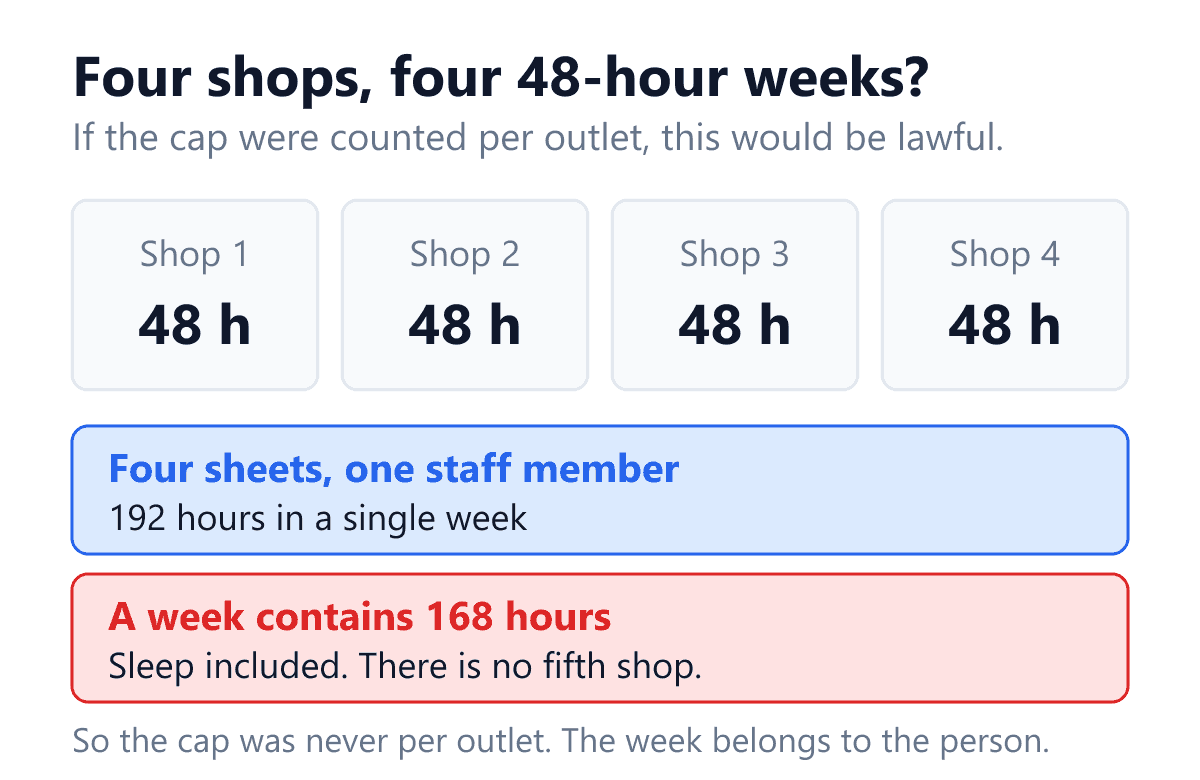
One hundred and ninety two hours, for one person, in a week that contains one hundred and sixty eight. A reading that permits more hours of work than the week physically holds is not a reading a court is going to adopt, and it is not one any labour officer has ever applied. The cap counts the person. It has to.
The caveat this deserves, stated plainly. No Indian court has been asked to decide the aggregation question squarely for two premises of the same employer, because nobody litigates the point: the employer who is caught concedes it. What follows therefore rests on the plain words of the provisions and on the impossibility of the alternative, not on a citation. Two things make that safe enough to plan around. The first is that the alternative reading fails on arithmetic rather than on argument. The second is the weekly holiday, which does not depend on the reading at all, and which we get to in a moment.
This is the mirror image of a question we took apart from the other side. When the second employer is a different business, aggregation genuinely does not happen, and the only statutory bar is section 30 of the OSH Code, which reaches factories and mines and nothing else. We went through that in the dual employment article, and the two situations are worth keeping apart in your head. A shop assistant who works somewhere else on her day off is your contract’s problem, not your wage bill’s. A shop assistant who works at your other shopon her day off is entirely your wage bill’s problem.
What one Sunday cover shift actually costs
Take the Chennai Sunday and price it in wage hours rather than rupees. Retail minimum wages are notified state by state, and vary by zone and by category inside a state, so a national figure would be wrong everywhere. The ratio does not vary, because the ratio is what the statute fixes.
Section 14 of the Code on Wages, 2019 is the provision that does the pricing, and the thing to notice about it is what it is silent on:
Where an employee whose minimum rate of wages has been fixed under this Code works on any day in excess of the number of hours constituting a normal working day, the employer shall pay for every hour, or part of an hour, so worked in excess, at the overtime rate, which shall not be less than twice the normal rate of wages.
No premises appear in that sentence. It attaches to the employee, to the day, and to the employer who must pay. Whatever one concludes about how the hours cap is counted, the wage liability was never written per shop. The full formula, the wage base it applies to and the quarterly ceilings are in the overtime article. Here we only need the multiplier.
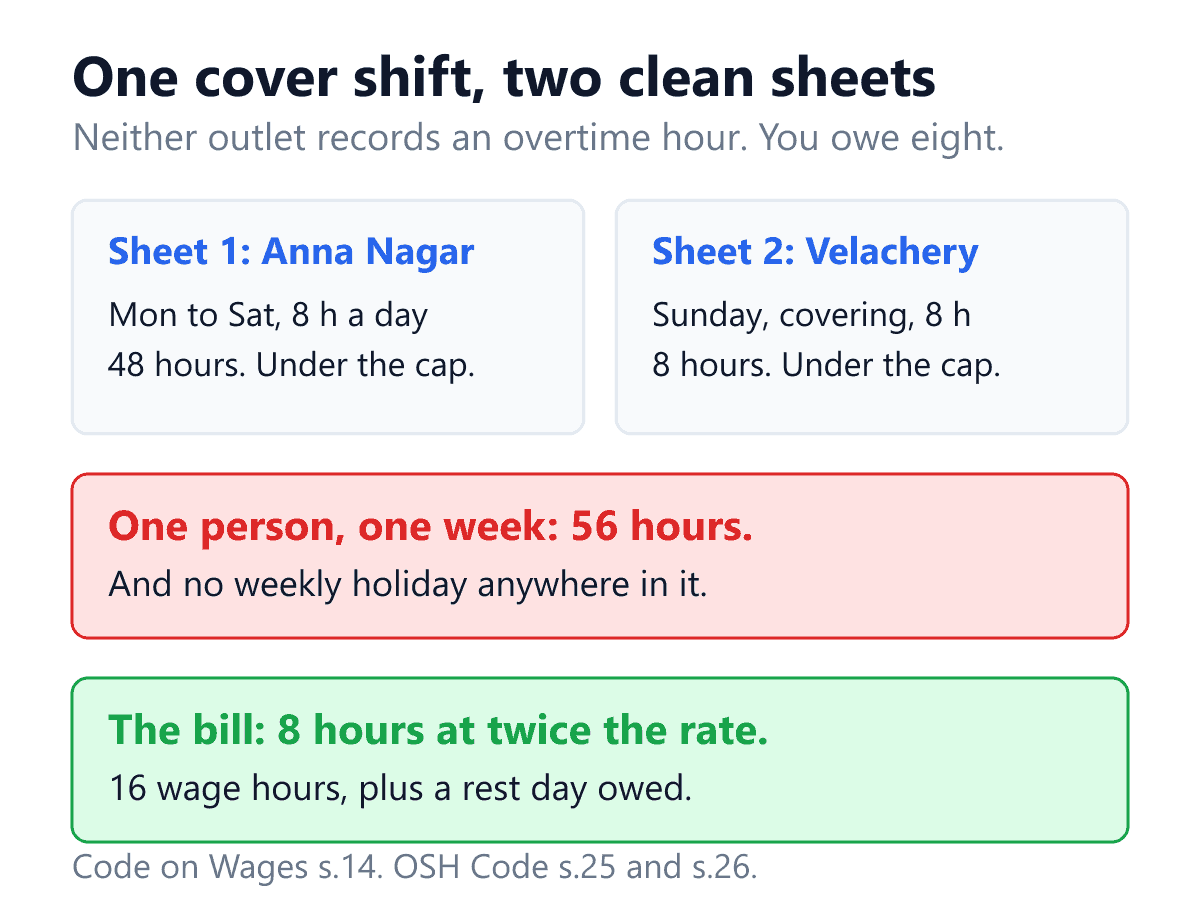
Eight hours at twice the ordinary rate is sixteen wage hours, for a day the owner priced at eight when she agreed to it. The cover shift cost double what she thought, and she will not find that out from either sheet, because neither sheet is wrong.
Now scale it the way retail actually scales. Four shops, open seven days, festive season, one floating salesperson covering somewhere else roughly twice a month is a conservative estimate for a chain this size.
| Cover pattern in one month | Hours the sheets show | Wage hours actually owed | Hidden by |
|---|---|---|---|
| Full day at another shop, on a day off | 8 | 16 (all 8 fall beyond the week) | Two sheets, neither of them over its own cap |
| Half day at another shop after a full shift | 8 + 4 | 16 (4 hours at 2x) | The second entry sits on a different sheet, on the same date |
| Two full cover days in a month | 16 | 32 | Nothing in the business sums the person across shops |
Sixteen extra wage hours a month per floating staff member. Six floaters is close to a hundred wage hours a month that the four sheets do not contain, and all of it is payable. Whether it is ever actually paid is a different question, and the answer to that question is usually no, until somebody leaves unhappy.
The honest objection, and the answer to it. Plenty of owners settle the cover shift in cash on the day, at a rate everybody is happy with, and no salesperson in Chennai is filing a claim over a Sunday she volunteered for. That is true, and it is how most of this trade runs. What it is not is a record. The cash is invisible, the hours are invisible, and the moment the relationship sours the only surviving documents are two attendance sheets written by the employer that together prove a fifty six hour week. You do not get to introduce the cash later. You get to explain the sheets.
The weekly holiday does not depend on a reading
Everything above turns on how the hours cap is counted, and we were honest that there is a reading in it. This part has no reading in it at all.
Section 26 of the OSH Code gives the worker a day of rest in the week, and section 28(a) fixes what a whole day means. A rest entitlement has never been understood as attaching to a building. It attaches to the person, for the obvious reason that the purpose of rest is not served by the worker being absent from one shop while present in another. Nobody has ever argued otherwise, and no state Shops Act is drafted in a way that would let them.
So the Chennai salesperson worked six days at Anna Nagar and the seventh at Velachery. She took no weekly holiday. That is true whatever you conclude about the forty eight hours, and it is the leg of the argument that does not move. What you owe her for it, and whether a compensatory day inside the same week or the following one discharges it, is set out in the weekly off and comp off article, including the twelve consecutive working days that are lawful and the pattern that looks identical and is not.
The operational consequence, which is small and annoying. A cover shift arranged on a Saturday night cannot be tested against any of this by a supervisor at the counter, because the supervisor at Velachery does not know what the Anna Nagar rota did this week. The only place that question can be answered is above both shops. If you take one thing from this article, take that: the check has to live at the chain, not at the shop, and right now the owner sending a WhatsApp message at ten at night is the check.
Your registers are per shop, and the cover hour is in neither
The wage exposure is the expensive half. The record is the half that decides how the expensive half goes.
Statutory records under the codes are kept by the establishment. The register of employees, the muster roll, the wage register and the overtime entry all belong to a shop, they name the workers on that shop’s roll, and they are preserved for the statutory period. We went through them form by form in the registers article. Apply that structure to a cover shift and something uncomfortable happens.
- The home shop’s register shows her absent, or shows a weekly holiday, on a day she worked eight hours for the same employer.
- The covering shop’s register shows eight hours against a person who is not on its roll, or, far more commonly, shows nothing at all, because the supervisor did not want to add a stranger to his register for one day.
- The wage register at either shop shows no overtime hour, because neither shop saw one.
Read together, those three documents are the employer’s own written account of a week that did not happen. The usual instinct is to fix it by writing the cover day onto the home shop’s sheet, since that is where she is paid from. Resist it. That records her as present at Anna Nagar on a day she was demonstrably at Velachery, which turns a gap in the record into a false entry in it, and a false entry is a materially worse thing to be holding.
The record you actually need has a shape that neither sheet has: one row per person per day, carrying which site each stretch of minutes belongs to. Not one sheet per shop that somebody reconciles later. The reconciliation is the thing that never happens, and it never happens because it is monthly, manual, and nobody is measured on it.
Outlets in two states are two rule books
One more layer, and it catches every chain that crosses a state line, which in practice means every chain that gets past about six shops.
The Shops and Establishments Act is state legislation. It was not repealed by the labour codes, and the codes were never intended to subsume it. Registration thresholds differ and are moving: Maharashtra raised its threshold from ten workers to twenty in 2025, and other states are amending in their own directions and on their own timetables. Daily hours differ too. The OSH Code fixes the normal working day at eight, while several state Shops Acts still say nine, and where they differ the position more favourable to the worker is the safe one to run on.
What does not differ, in the OSH Code or in any state Shops Act we have read, is the forty eight hour week. That is the number the aggregation argument above is built on, deliberately, because it is the one number a multi-state owner can rely on being the same in every rule book that applies to them.
The practical upshot for a chain crossing a state line. One OSH registration does not merge your establishments for any purpose except the registration itself. You still hold a separate state registration per shop, you still keep records per shop, your daily cap may be eight in one state and nine in another, and your quarterly overtime ceiling may be a different number in each. The week is your fixed point. Build the roster check on the week, and treat the daily cap as a per-shop rule you look up once per state and then encode.
One further trap, and it is the one that catches owners who read an article like this and decide to fix the roster on Monday. Moving a shop from one set of shift timings to another is not a rota tweak. It is a change of service conditions with its own notice requirement, and we set out what that costs and how long it takes in the shift timings notice article. Changing who covers is free. Changing when the shop opens is not.
What a multi-outlet roster has to be able to do
Four capabilities, and the order matters, because each one is worthless without the one above it.
- One roll for the chain, not one roll per shop. A person exists once, and is attached to as many shops as she actually works at. The moment a chain keeps a separate list per outlet, a floating salesperson becomes two records, and two records cannot be summed.
- The punch knows which shop it happened at, without anybody choosing. If the person selects a branch from a dropdown, the cover shift gets logged against the home shop roughly half the time, because that is the entry they select on every other day of the month. Position decides, not a tap.
- A single day can hold minutes at more than one shop. Not a day that belongs to a shop. Eight hours at Anna Nagar and four at Velachery on the same date is one day with two segments, and any structure that forces the day to pick a shop is going to throw one of them away.
- The week is totalled on the person, before the roster is published, not after payroll.This is the one that prevents the problem rather than pricing it. The question “how many hours has she already got this week, everywhere” has to be answerable on a Saturday night by whoever is arranging the cover.
Notice that a biometric machine at each counter satisfies none of these. Four machines produce four databases, which is the same problem as four paper registers with better handwriting. The multi-outlet requirement is not a better capture device. It is one record above all the shops.
What software a multi-outlet Indian retailer uses for this, and what it costs
A thirty day fix if you are running four shops on WhatsApp
In order. The later steps do nothing without the earlier ones.
- Write down who has actually covered at another shop in the last three months. Not who is allowed to. Who did. Most owners are surprised by the list, and it is usually four or five people carrying most of it.
- For each of them, reconstruct one bad week by hand. Take the two or three sheets, sum the hours on the person, and find the week that crosses forty eight or contains no rest day. One week, done properly, is more convincing than this entire article.
- Merge the four staff lists into one. This is the painful afternoon, and it happens once. Duplicates come out, people who left months ago come out, and the floaters stop being four half-records.
- Move the punch to the phone, with a radius set per shop. A counter and a godown do not want the same tolerance. Then leave it alone for two weeks and read the failures rather than the successes, because the failures tell you which radius is wrong.
- Put a weekly running total in front of whoever arranges cover. Hours so far this week, across every shop, per person. This is the whole intervention. Everything above it is plumbing for this.
- Decide what a cover shift is worth before the next festive season, not during it. If the answer is double time for the hours past forty eight, say so in writing to the staff who float, and pay it through payroll rather than from the till.
Questions multi-outlet owners ask
Can I just keep separate attendance sheets per shop?
You must keep separate records per shop, because the statutory registers belong to the establishment. What you cannot do is stop there. The per-shop registers are the filing requirement. The per-person weekly total is the compliance requirement, and it is not derivable from four sheets that nobody adds up. Keep both, and build the second from the same data the first comes from, rather than from a monthly reconciliation that will not survive December.
Is overtime counted per shop or per person?
Per person. Section 14 of the Code on Wages attaches the obligation to the employee’s day and to the employer’s duty to pay, and mentions no premises at all. The hours cap provisions are worded “in any establishment”, and the distributive reading of that phrase gives a four shop owner a one hundred and ninety two hour lawful week, which is longer than a week. Both routes arrive at the person.
What if my shops are separate legal entities?
Then you have a genuinely different question, and one this article does not answer. Separate companies are separate employers, aggregation does not follow automatically, and the analysis moves to whether the arrangement is real or whether the entities are a device. That is a question for a lawyer who can see your shareholding, not for an attendance app. What is worth saying is that most Indian multi-outlet retailers are one proprietorship, or one company with several registered premises, and for them the answer above is the answer.
Does a biometric machine at each shop solve this?
No, and it is worth being precise about why, because the machines are good at the thing they do. A fingerprint reader answers “was this the right person”. The multi-outlet problem is not identity, it is aggregation: four machines hold four databases, and the fifty six hour week is still written nowhere. If you already own the machines, the fix is a layer above them rather than a replacement for them.
What about staff who work at two shops every week by design?
That is the easier case, because it is a roster rather than an emergency, and a roster can be checked before it is published. Split the week deliberately so the total lands under forty eight with a rest day in it, record the split as a split, and pay any planned hours past forty eight at the overtime rate rather than pretending they are two ordinary jobs. The trouble in this trade is almost never the planned split. It is the Saturday night phone call.
Do the labour codes replace my state Shops and Establishments Act?
No. The four codes came into force on 21 November 2025 and consolidated twenty nine central enactments. The Shops and Establishments Acts are state legislation and continue to apply, which is why a multi-state chain now navigates both: a single electronic registration under the OSH Code, plus a separate registration and a separate set of substantive rules under each state’s Act. Where the two differ on a number, the standard more favourable to the worker is the one to run your roster on.
Keep reading
See how Shiftelio does this in practice with every store on one dashboard, with scoped manager roles and one payroll.
Still deciding what to buy? Compare what nine attendance apps cost for 25 employees across several sites.
Work your own numbers with the free overtime calculator. No signup, no email.